Can You Withdraw From a High-Yield Savings Account?

Yes, you can withdraw from a high-yield savings account. Your savings are not normally locked away. However, accessing them may not be as quick as using a checking account.
The provider decides which withdrawal methods are available. It may also set daily transfer limits, charge certain fees, or place a temporary hold on recently deposited money. These terms can differ from one account to another.
Before you open an account, it is worth knowing how you will get your money out when you need it. In this article, we explain the main withdrawal methods, how long transfers can take, which account limits to check, and how withdrawals from PureFi work differently.
How do high-yield savings account withdrawals work?
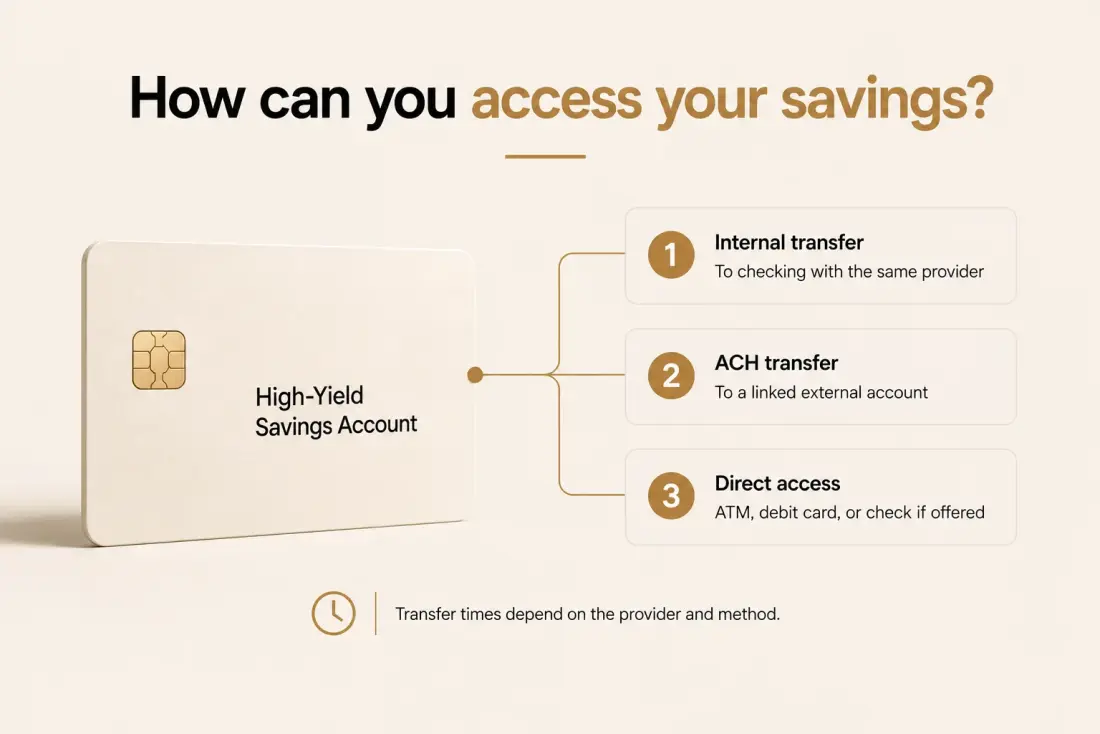
Most high-yield savings accounts let you send money to another account in your name. If the provider operates online, this is often the main way to make a withdrawal.
You usually start by linking a checking account. The provider may ask you to confirm ownership before you can transfer money. Once the accounts are connected, you enter the amount you want to withdraw and review the expected arrival date.
Some providers offer more ways to access your savings. These can include:
- transferring money to a checking account with the same provider
- sending an ACH transfer to an account at another provider
- withdrawing cash from an ATM
- requesting a bank check
- using a debit card linked to the savings account
Not every account includes every option. Many online accounts do not come with an ATM card, debit card, or physical branch access. Check the available methods before depositing money you may need at short notice.
How long does a withdrawal take?
The answer depends on where the money is going and how the transfer is processed.
An internal transfer between accounts held with the same provider can be quick. The money may appear in the receiving account shortly after the transfer is approved.
An external ACH transfer can take longer. The Consumer Financial Protection Bureau explains that an ACH payment may clear quickly, including on the same business day in some cases, but that does not mean every transfer will be completed that day. Processing and security checks can cause a payment to take several days.
Timing can also be affected by:
- the time you submit the request
- weekends and bank holidays
- the receiving provider’s processing schedule
- verification checks
- a hold on a recent deposit
- an incorrect account or routing number
Do not assume that an online high-yield savings account provides instant access. If you keep emergency money in one, check how long a normal withdrawal takes before an emergency happens.
Are high-yield savings account withdrawals limited?
There is no longer a federal rule limiting convenient savings withdrawals to six per month. The Federal Reserve removed that limit from Regulation D in April 2020.
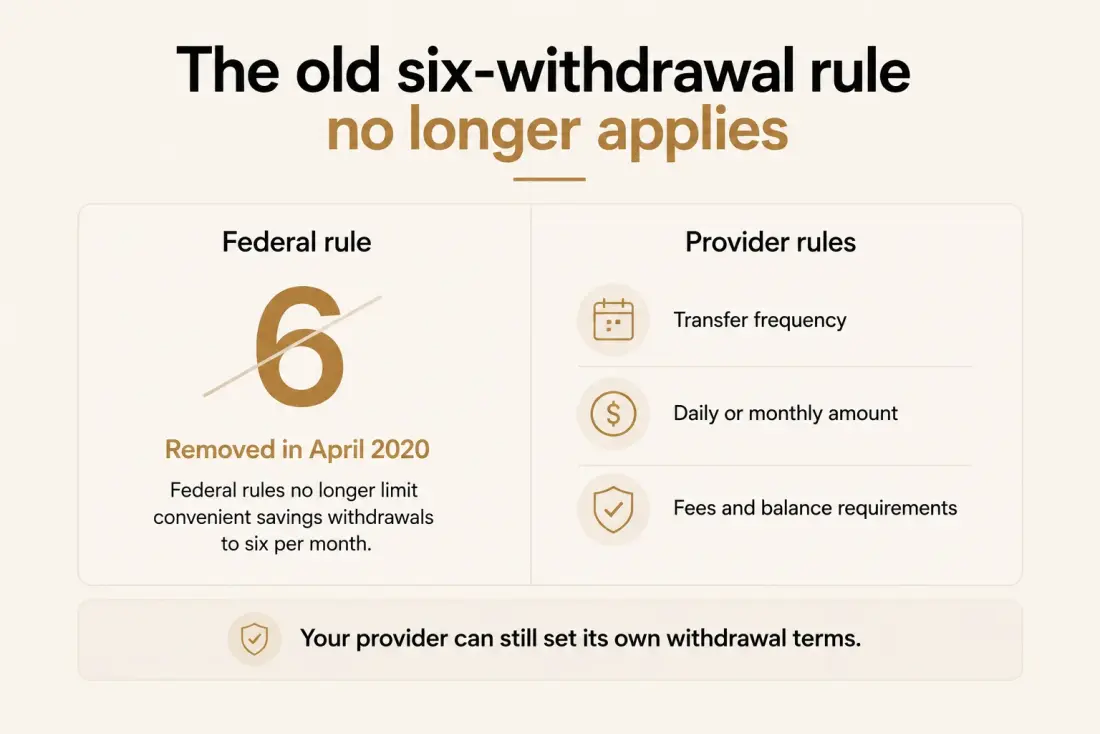
This change did not require every provider to offer unlimited withdrawals. A bank or credit union can still set its own account rules. It may limit:
- the number of transfers during a statement period
- the amount you can transfer each day or month
- ATM withdrawals
- transfers to a newly linked account
- large withdrawals that require extra review
The provider can also charge a fee if you make too many withdrawals, withdraw more than an allowed amount, or let your balance fall below a required minimum. The CFPB confirms that these provider-level charges are still possible.
This is why it is important to read the account disclosure. Providers must disclose limits on the number or dollar amount of withdrawals and deposits. Do not rely on an old rule of thumb or assume every online savings account works the same way.
Can you withdraw all your money at once?
You can usually close a high-yield savings account and withdraw the full available balance. Still, a provider may not let you send the entire amount in one online transfer.
A daily transfer cap could require you to split the withdrawal across several days. A recent deposit may still be on hold. The provider may also request identity verification before approving an unusually large transaction.
If you want to close the account, check whether you need to leave enough money to cover pending payments or fees. Ask how the remaining balance will be sent and whether account closure requires a phone call, secure message, or written request.
Can a provider delay a withdrawal?
Yes. A balance shown in your account is not always ready for immediate withdrawal. Providers can place temporary holds on some deposits while they confirm that the money has cleared. They may also pause a transfer when account details have changed or when activity looks unusual. These checks are intended to reduce fraud and incorrect transfers, but they can delay access.
If a withdrawal is pending, check the expected delivery date in the app or account portal. Make sure the linked account details are correct. Contact the provider if the date has passed or you do not recognize the transfer status.
The hold policy should explain when deposited money becomes available. Review it alongside the account’s withdrawal terms rather than looking only at the advertised yield.
Are there fees for taking money out?
Some high-yield savings accounts do not charge routine withdrawal fees. Others charge for certain methods or for exceeding an account limit. Possible charges include:
- excess-withdrawal fees
- outgoing wire fees
- charges for official checks
- ATM fees
- account-closure fees
- monthly fees triggered by a lower balance
A provider may also require a minimum balance to earn its advertised annual percentage yield. If a withdrawal takes your balance below that level, the account may earn at a lower rate.
When comparing accounts, look beyond the headline rate. The highest rate online savings account is not necessarily the most useful choice if access is slow or the withdrawal terms do not suit you.
Does withdrawing money reduce your earnings?
Withdrawing money does not normally remove earnings that have already been credited to the account. It does reduce the balance that can continue to earn.
Suppose you withdraw part of your savings halfway through the month. The provider will usually calculate future earnings using the balance that remains, according to its stated method. If the account uses balance tiers, the rate could also change when the balance falls into a different tier.
There may be separate rules for promotional offers. For example, a provider could require you to keep a minimum balance for a set period to receive an opening bonus. Read those terms before withdrawing.
What should you check before opening an account?
If you plan to open a high-yield savings account online, check how you will access the money as carefully as you check the rate.
Look for clear answers to these questions:
- Which withdrawal methods are available?
- How long do external transfers usually take?
- Is there a daily or monthly transfer limit?
- Does the provider charge withdrawal or transfer fees?
- Is there a minimum balance?
- Are ATM withdrawals available?
- How long can new deposits be held?
- What happens if you need to close the account?
A savings account with high yield should still fit the way you use your money. Fast access may matter more than a small difference in the advertised rate, especially for emergency savings.
How withdrawals work with PureFi
PureFi is not a bank and does not provide a high-yield savings account. It is a financial technology platform that gives users access to shares of real, income-producing homes.
Your PureFi balance is held in a self-custodial wallet that you control. PureFi supports USDC, USDT, and other U.S. dollar stablecoins. Money is not pooled into a bank deposit, and balances are not FDIC insured or covered by another government guarantee.
When tenants pay rent, your share of the earnings is added to your balance. You can reinvest those earnings or take them out.
If you want to exit a property holding, PureFi states that you can sell your shares at the current market price. The proceeds return to your balance, and there are no lock-ups. However, the current market price may be higher or lower than the amount you paid. A sale can result in a loss.
Frequently Asked Questions
Can I withdraw from a high-yield savings account at any time?
You can normally request a withdrawal when you want. The provider’s transfer limits, processing times, security checks, and deposit holds can affect when the money becomes available elsewhere.
How many withdrawals can I make each month?
Federal rules no longer impose the old six-per-month limit. However, your provider can still set its own limit or charge a fee for excessive withdrawals. Check the account disclosure for the current terms.
Can I withdraw cash at an ATM?
Only if the account includes ATM access. Many online savings accounts require you to transfer money to a checking account before withdrawing cash.
Why is my withdrawal still pending?
A withdrawal may be pending because of normal processing, a weekend or holiday, a hold on a recent deposit, incorrect account details, or an additional security check. Contact the provider if the stated delivery date has passed.
Do I lose my yield when I withdraw?
You do not normally lose earnings already credited. The amount left in the account will continue to earn according to the provider’s terms. A lower balance could affect the rate if the account uses balance tiers or minimum requirements.
Can I take my PureFi earnings out?
Yes. PureFi states that rental earnings can be reinvested or taken out. Property shares can also be sold at the current market price, with the proceeds returned to your balance.
Put Your Dollars Into Something Real
With PureFi, your projected earnings come from shares of real homes with tenants. Choose your properties from your phone, review the documents, and see every fee before you confirm.
Learn more about how PureFi can help you own real estate shares or download the app to get started today.