Can You Add to a Traditional Savings Account Regularly?

Yes, you can normally add money to a traditional savings account as often as the provider allows. Regular deposits increase the balance available to earn, although the rate may change over time. You can usually access the funds when needed, subject to transfer times and account rules. Eligible deposits may also receive federal protection when the account is held at an insured bank or credit union. Automatic transfers can make adding money easier.
Can You Add Money to a Traditional Savings Account Regularly?
Most traditional savings accounts allow additional deposits after the account has been opened. You do not usually need to follow a fixed deposit schedule or add the same amount every time.
You might deposit $25 one week, $100 the next month, and nothing during a month when your expenses are higher. The account remains open as long as you meet any balance or activity requirements set by the provider.
This flexibility makes a traditional savings account different from some certificates of deposit. A CD may not allow additional deposits after the account is funded. You may also have to pay a penalty if you withdraw money before the term ends.
A traditional savings account does not normally have a fixed term. You can continue adding money while keeping the balance available for emergencies, upcoming expenses, or general savings.
Our guide to the different types of savings accounts explains how traditional accounts compare with high-yield savings accounts, money market accounts, and CDs.
How Can You Add Money to Your Savings Balance?
The available deposit methods depend on the bank or credit union. Most accounts support at least one electronic option, while traditional institutions may also accept cash and checks.
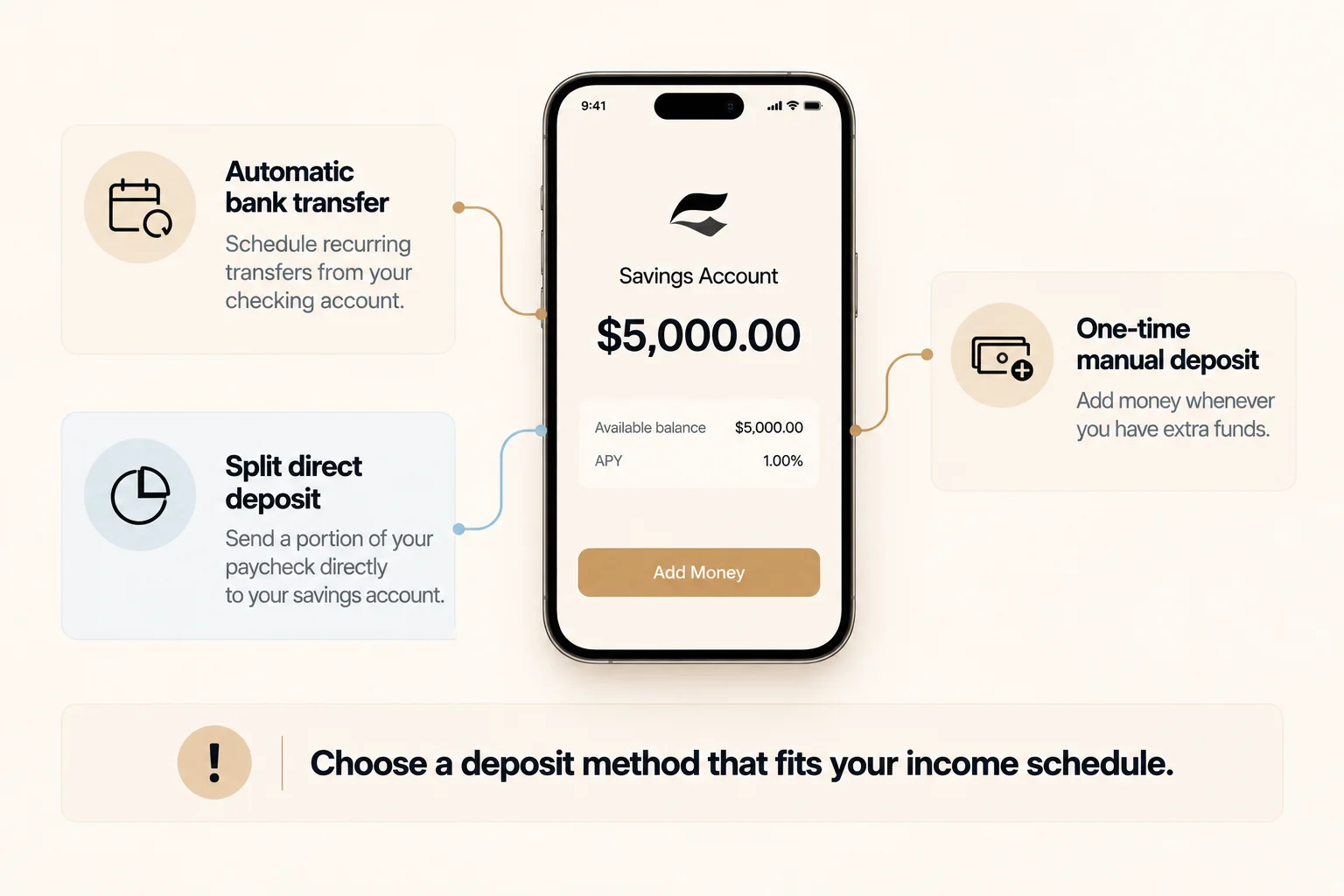
Automatic Transfers
An automatic transfer sends a set amount from one account to another on a schedule you choose. For example, you could transfer $50 from checking to savings every Friday or $200 after each monthly payday. The transfer continues until you pause, change, or cancel it.
The FDIC suggests using regular automated deposits as one way to build emergency savings. Automatic transfers work well because they make saving part of your normal routine. You do not have to remember to complete a manual transfer every month.
However, the checking account needs enough money to cover the transfer. Scheduling a transfer for the day before major bills are paid could leave too little available for your regular expenses.
Direct Deposit
Some employers allow you to divide your paycheck between multiple accounts. You could send most of your pay to checking and direct a smaller amount to savings.
For example, you might send $1,800 to checking and $200 directly to savings each payday. The savings contribution happens before you have an opportunity to spend it.
Check with your employer or payroll provider to see whether split direct deposit is available. You will usually need the savings account number, the bank’s routing number, and the amount or percentage you want deposited.
Manual Deposits
You can also add money when it becomes available instead of following a set schedule. Depending on the account, this may include:
- Transferring money from a linked checking account
- Depositing a check through a mobile banking app
- Making a cash or check deposit at a branch
- Using an eligible deposit-taking ATM
- Sending a transfer from an account at another institution
An online savings app may not accept cash directly. You may need to deposit the cash into a local checking account before transferring it to savings.
How Do Regular Deposits Increase Your Earnings?
A savings account generally calculates earnings using your balance and APY. A larger balance gives the account more money on which to calculate those earnings.
Regular deposits can therefore help in two ways. They increase the amount you have saved, and they may increase the dollar amount your account earns.
Suppose you open an account with $5,000 and the account has a hypothetical 1.00% APY. Assume the APY remains unchanged for a full year and there are no fees or withdrawals.
If You Make No Additional Deposits
Starting balance: $5,000 Additional deposits: $0 Estimated balance after one year: approximately $5,050 Estimated earnings: approximately $50
If You Add $200 Each Month
Starting balance: $5,000 Monthly deposit: $200 Total additional deposits: $2,400 Estimated balance after one year: approximately $7,461 Estimated earnings: approximately $61
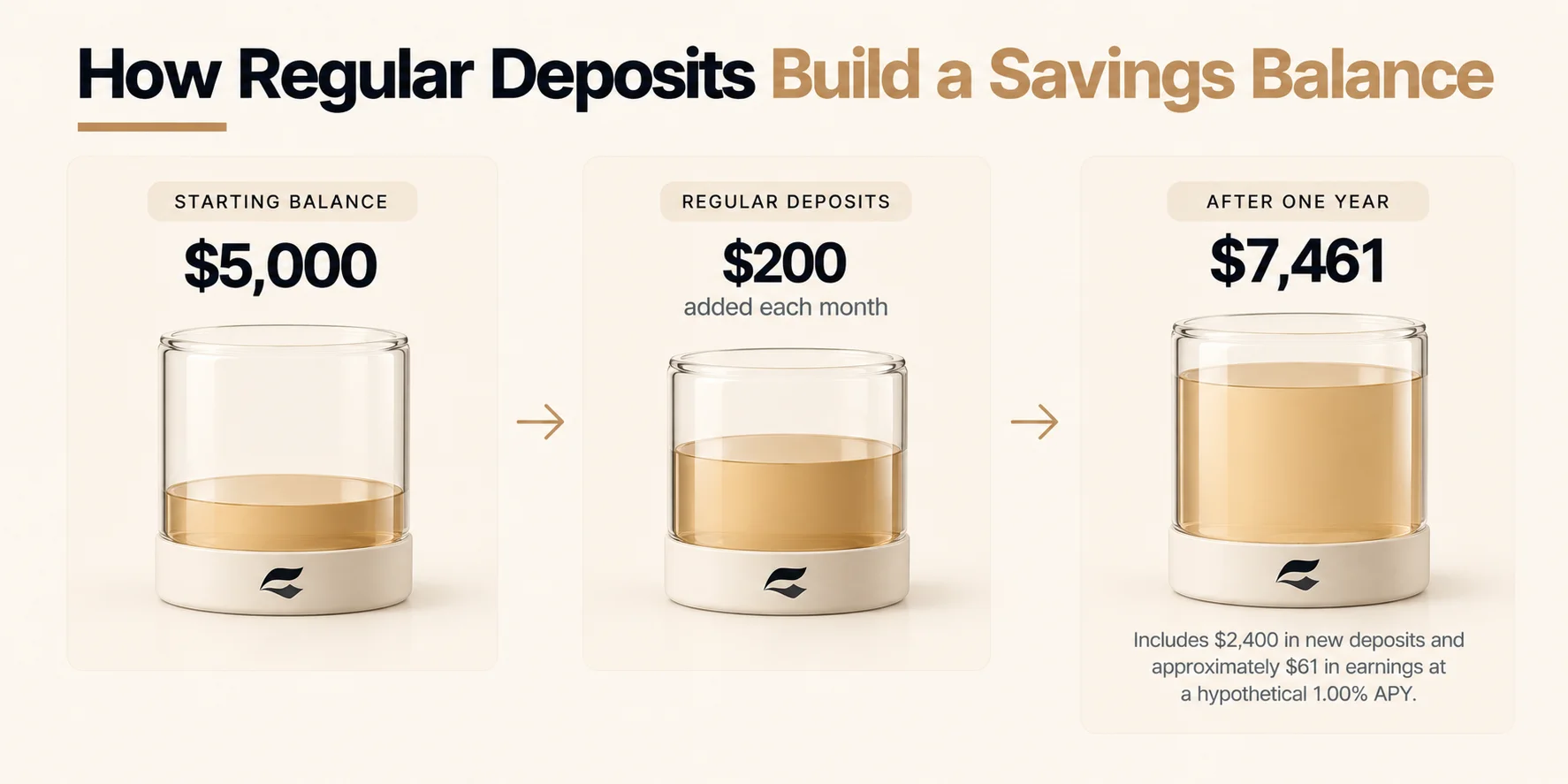
In the second example, most of the increase comes from the $2,400 you added. The higher average balance also produces about $11 more in estimated earnings.
The exact amount will depend on when each deposit reaches the account, how frequently earnings are calculated and credited, and whether the APY changes.
The earlier a deposit reaches the account, the more time it has to earn. A $200 deposit made in January generally has more time to contribute than one made in December.
For examples using different balances and APYs, read How Much Does a High-Yield Savings Account Earn?.
How Often Should You Add to Your Savings Account?
There is no single deposit schedule that works for everyone. A realistic schedule is more useful than setting an amount you frequently have to cancel.
Many people save after each payday. This can make the deposit feel like part of the normal pay cycle rather than a separate monthly expense.
Weekly deposits may work for someone who is paid weekly or has a variable income. Monthly deposits may be easier for someone who is paid once a month and follows a monthly budget.
You can also make one-time deposits when you receive extra money, including:
- A work bonus
- A tax refund
- A gift
- Freelance income
- Money left over from a monthly budget
The deposit does not have to be large to be useful. Adding $25 each week creates $1,300 in contributions over one year before any account earnings are included.
The best schedule is one that leaves enough money in checking for bills, daily spending, and unexpected costs.
How Do You Set Up Recurring Savings Deposits?
Most banks allow recurring transfers through online banking or a mobile app. The process usually takes a few minutes.
- Sign in to the account that will send the money.
- Link the savings account if it is held at another institution.
- Select the transfer amount.
- Choose a weekly, biweekly, or monthly schedule.
- Select the first transfer date.
- Review and confirm the instructions.
If your checking and savings accounts are held at the same bank, the transfer may happen quickly. Transfers between different institutions can take longer. It can help to schedule the transfer shortly after payday. This reduces the chance that the money will be spent before it reaches savings.
Review the arrangement every few months. You might increase the amount after receiving a raise or temporarily reduce it when your regular expenses rise.
A digital savings platform or high-yield savings app may let you pause or adjust the schedule from your phone. Check whether the transfer is processed by the platform itself or through a partner bank.
Are There Limits on How Much You Can Add?
Many traditional savings accounts do not impose a low maximum balance. However, banks may set limits on individual deposit methods or on the amount that can be transferred within a certain period.
For example, an institution might have:
- A daily limit for external transfers
- A mobile check deposit limit
- A waiting period for newly linked accounts
- Different APYs for different balance ranges
- A minimum balance for avoiding a monthly fee
- A maximum balance that qualifies for a promotional APY
A transfer limit does not necessarily mean the account cannot hold a larger amount. It may only control how much can be added through one method or during one day.
You should also distinguish between an account’s balance limit and the amount eligible for federal protection.
The standard FDIC insurance amount is $250,000 per depositor, per insured bank, for each account ownership category. Deposits held in the same ownership category at the same bank are combined when coverage is calculated.
An account may accept more than $250,000, but that does not mean the full balance receives protection. Read How Much Can I Keep in a Savings Account? for a fuller explanation.
Traditional Savings vs High-Yield Savings for Regular Deposits
Traditional and high-yield savings accounts usually allow account holders to make additional deposits. The main differences often involve the APY, fees, access methods, and account management.
| Feature | Traditional savings | High-yield savings |
|---|---|---|
| Regular deposits | Usually allowed | Usually allowed |
| APY | Often lower | Usually more competitive |
| Access | May include branches and ATMs | Often mainly online |
| Monthly fee | May apply | Often avoidable or absent |
| Minimum balance | Varies | Varies |
| Federal protection | Depends on the institution | Depends on the institution |
A high-yield digital savings account could suit someone who wants to make regular deposits while earning a more competitive APY. However, a higher advertised APY does not automatically make an account better.
Check whether the account charges monthly fees or requires a minimum balance. A fee can consume a large part of the earnings on a smaller balance.
You should also consider how quickly you can access your money. A traditional account with local branches may be more convenient for cash deposits. An online account may offer a higher APY but require electronic transfers.
Our guide to the benefits of a high-yield savings account covers these differences in more detail.
Put Your Dollars Into Something Real
With PureFi, your projected earnings come from shares of real homes with tenants. Choose your properties from your phone, review the documents, and see every fee before you confirm.
Learn more about how PureFi can help you own real estate shares or download the app to get started today.
Up to 6% APY is projected, variable, and not guaranteed. Property shares can lose value. PureFi is not a bank, and its balances and real estate shares are not covered by FDIC insurance or another government deposit scheme.