
How to Calculate High-Yield Savings Account Interest
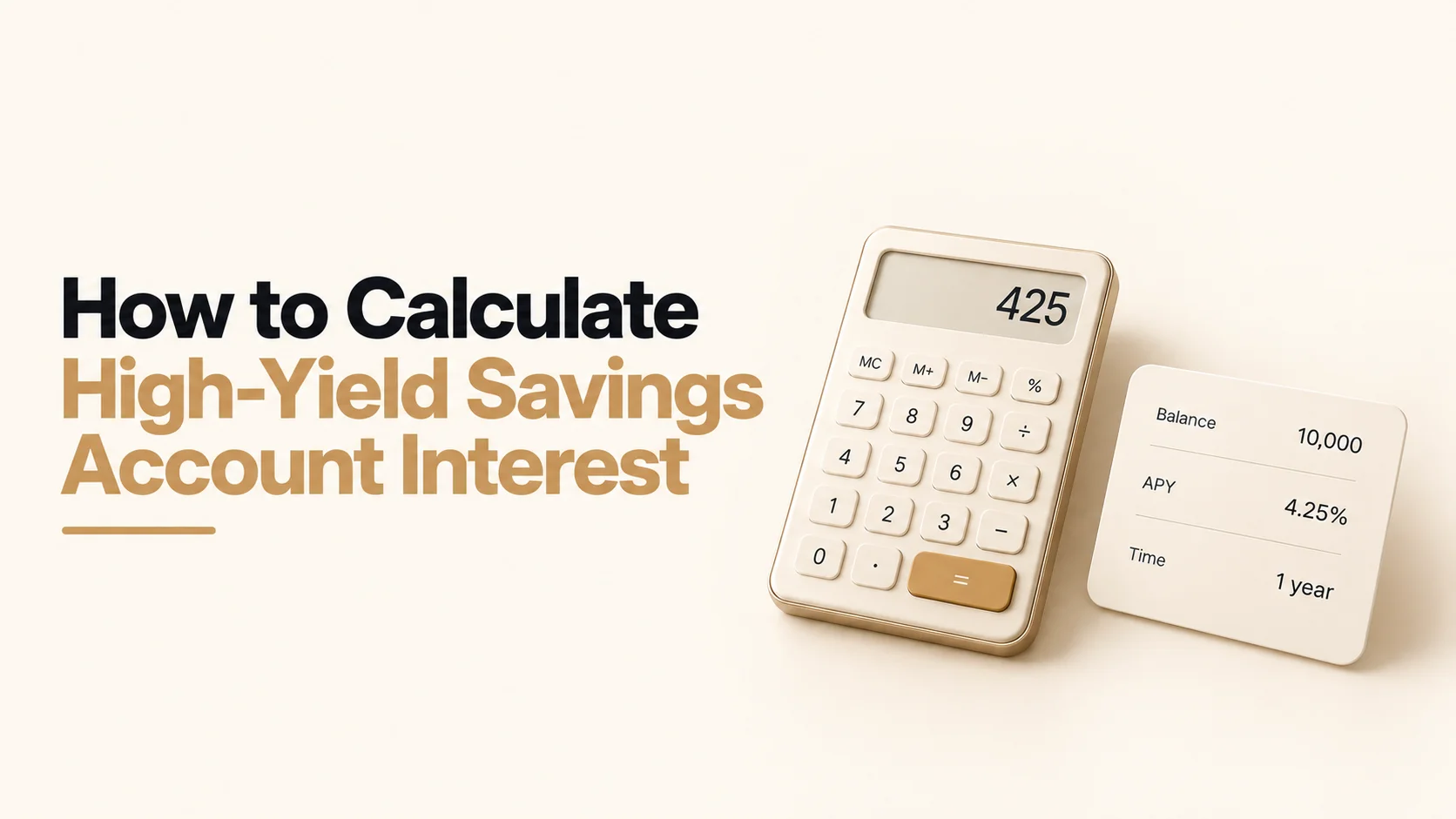
A high-yield savings account earns money based on your balance, APY, and time. The yield comes from the rate offered by the bank or provider, and that rate can change. Most savings accounts let you withdraw or transfer funds, though limits may apply. Eligible bank deposits may receive FDIC coverage, while a digital savings platform can use a different structure. To estimate growth, you can use a quick annual calculation or a more exact formula that accounts for time and compounding. This guide shows both methods with plain calculations you can copy into a document or calculator.
The Quick Way to Estimate Your Savings Earnings
If you plan to leave the same balance in an account for one full year, the easiest calculation is:
Estimated annual earnings = Balance × APY
First, convert the APY from a percentage to a decimal. Divide the percentage by 100. For example, 4.00% becomes 0.04, while 4.50% becomes 0.045.
Suppose a high-yield digital savings account has a 4.00% APY and you keep $10,000 in it for one year.
Estimated annual earnings = $10,000 × 0.04 Estimated annual earnings = $400 Estimated ending balance = $10,000 + $400 Estimated ending balance = $10,400
This calculation works because APY already includes the effect of compounding over one year. According to the Consumer Financial Protection Bureau, APY is an annualized measure that reflects the account’s rate and compounding frequency.
The answer assumes the balance and APY stay the same for the full year. It also assumes that you do not withdraw the earnings.
For more examples using different balances and rates, see how much a high-yield savings account can earn.
What Do You Need for the Calculation?
You need three pieces of information before estimating your earnings.
Starting Balance
The starting balance is the amount already in the account. If you have $5,000 saved, your starting balance is $5,000. This amount may also be called the principal.
If you add or withdraw funds during the calculation period, one starting balance will not give you an exact result. You would need to calculate each balance period separately or use the account’s average daily balance.
APY
APY stands for annual percentage yield. It estimates how much an account can earn over one year after compounding is included.
You can usually find the APY on the provider’s website, inside its high-yield savings app, or in the account disclosure. Make sure you use APY rather than a basic stated rate. Using the APY and then adding compounding again would count the same effect twice.
APYs on savings accounts are commonly variable. The percentage displayed today may not remain in place for the next 12 months.
Length of Time
Time is written as a portion of one year. Use 1 for a full year, 0.5 for six months, and 0.25 for three months.
For a more exact result, use the actual number of days divided by 365. For example, 90 days becomes 90 ÷ 365, or about 0.247 years.
How to Calculate Earnings Step by Step
For periods shorter or longer than one year, use this APY formula:
Ending balance = Starting balance × (1 + APY) ^ Time Earnings = Ending balance - Starting balance
The ^ symbol means “raised to the power of.” Most phone and online calculators provide this function.
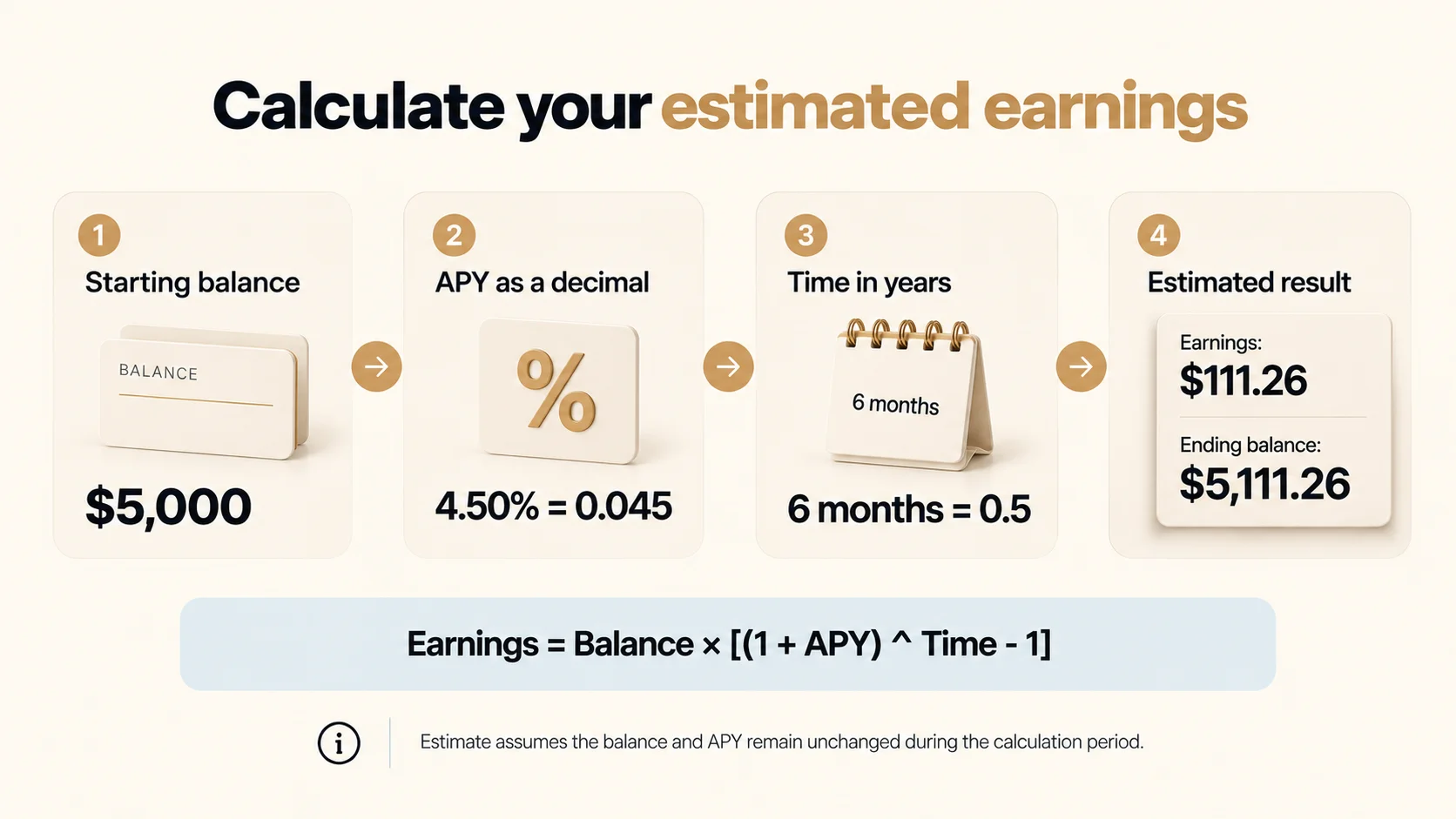
Assume you place $5,000 in an account with a 4.50% APY for six months.
Step 1: Convert the APY 4.50 ÷ 100 = 0.045
Step 2: Convert the Time Six months ÷ 12 months = 0.5 years
Step 3: Enter the Numbers Ending balance = $5,000 × (1 + 0.045) ^ 0.5 Ending balance = $5,111.26
Step 4: Find the Earnings Earnings = $5,111.26 - $5,000 Earnings = $111.26
The estimated earnings for six months are $111.26, giving you an estimated ending balance of $5,111.26.
A quicker calculation would be:
$5,000 × 0.045 × 0.5 = $112.50
That result is close, but it is only a simple estimate. The longer APY formula gives a better estimate for a period shorter than one year because it converts the annual yield to the selected length of time.
How Compounding Affects Your Earnings
Compounding means earnings are added to the balance, allowing later calculations to use a slightly larger amount. The effect becomes more noticeable when the balance is larger or the funds remain in the account for several years. Our guide to daily and monthly HYSA compounding explains how the common schedules work.
If the provider gives you an APY, you do not need to add the compounding frequency to the APY formula. It has already been considered. This is why APY is useful when comparing one online savings app with another.
If you only have a stated annual rate and the number of compounding periods, use this formula instead:
Ending balance = Principal × (1 + Annual rate ÷ Compounding periods per year) ^ (Compounding periods per year × Years)
For monthly compounding, use 12 periods per year. For daily compounding, use 365. Do not place an APY into this formula. It is intended for a stated annual rate that has not yet been adjusted for compounding.
Daily Compounding
With daily compounding, the provider calculates earnings using the eligible balance each day. The earnings may still appear in the account only once per month. Calculation frequency and payment frequency are not always the same.
The CFPB’s Regulation DD guidance recognizes that an account can compound daily while crediting the resulting amount monthly. It also explains that providers may use a daily balance or average daily balance when calculating the APY earned for a statement period.
Monthly Compounding
With monthly compounding, the calculation is applied 12 times per year. Each new month can begin with the previous month’s earnings included in the balance.
If two accounts advertise the same APY, both should produce the same estimated earnings over one year when the balance stays unchanged. One may compound daily and the other monthly, but the advertised APY already reflects that difference.
Compounding frequency becomes more useful when comparing accounts that show the same stated annual rate instead of the same APY. With the same stated rate, more frequent compounding produces a slightly higher effective annual yield.
How to Estimate Monthly Earnings From APY
Dividing the annual amount by 12 gives a quick monthly estimate:
Quick monthly estimate = Balance × APY ÷ 12
For a $10,000 balance and a 4.00% APY:
Quick monthly estimate = $10,000 × 0.04 ÷ 12 Quick monthly estimate = $33.33
For a more precise estimate based on APY, convert the annual yield into an equivalent monthly yield:
Monthly earnings = Balance × [(1 + APY) ^ (1 ÷ 12) - 1]
Using the same numbers:
Monthly earnings = $10,000 × [(1 + 0.04) ^ (1 ÷ 12) - 1] Monthly earnings = $32.74
The quick method gives $33.33, while the APY-based method gives $32.74 for the first month. The difference appears because APY represents the result across a full year, including compounding. Simply dividing it by 12 does not produce the exact monthly equivalent.
The amount shown by your bank may still be slightly different. Banks often calculate earnings using each day’s balance and the actual number of days in the statement period. The CFPB requires the APY earned on a periodic statement to reflect the actual amount paid and the account balance used for that period.
If you deposit the same amount every month, use a savings calculator that supports recurring contributions. A basic one-balance formula assumes all the money was present from the beginning, so it would overstate earnings on deposits added later.
Put Your Dollars Into Something Real
With PureFi, your projected earnings come from shares of real homes with tenants. Choose your properties from your phone, review the documents, and see every fee before you confirm.
Learn more about how PureFi can help you own real estate shares or download the app to get started today.
Up to 6% APY is projected, variable, and not guaranteed. Property shares can lose value. PureFi is not a bank, and its balances and real estate shares are not covered by FDIC insurance or another government deposit scheme.