Will Stablecoins Replace Credit Cards?
Stablecoins are already changing how money moves. They can cross borders at any hour, settle on public blockchains and fund a stablecoin debit card without forcing the merchant to accept crypto. That does not mean credit cards are about to disappear. A credit card is more than a payment rail: it combines borrowing, fraud controls, disputes, rewards and near-universal acceptance. The more likely outcome is less dramatic but more useful. Stablecoins could replace part of the plumbing underneath payments while cards remain the familiar way people pay.
Stablecoins and Credit Cards Solve Different Problems
A stablecoin is a digital token designed to track the value of another asset, usually the US dollar. It can move between compatible wallets without waiting for standard bank hours. A credit card is a line of credit and a payment credential. The issuer pays the merchant, then the cardholder repays the issuer later.
That distinction matters. Comparing a stablecoin with a credit card is not quite like comparing two cards. It is closer to comparing a new settlement asset with an established package of credit, acceptance and consumer protections.
A stablecoin-backed card joins the two models. The user funds spending with stablecoins, but the transaction still travels through a card network. The merchant receives the payment through its normal card setup.
Which Parts of a Credit Card Could Stablecoins Replace?
The answer changes depending on which part of the payment is under discussion.
| Payment function | Could stablecoins replace it? | What is more likely |
|---|---|---|
| Moving value between institutions | Yes, in some flows | Stablecoins become an additional settlement rail |
| Funding a card balance | Yes | A wallet balance funds an existing Visa or Mastercard credential |
| The physical or virtual card | Not soon | Cards remain a convenient checkout interface |
| Consumer borrowing | Not by themselves | A separate lender still has to provide credit |
| Disputes and chargebacks | Not automatically | Issuers, networks and program managers keep handling them |
| Merchant acceptance | Not directly | Stablecoin cards use existing card acceptance |
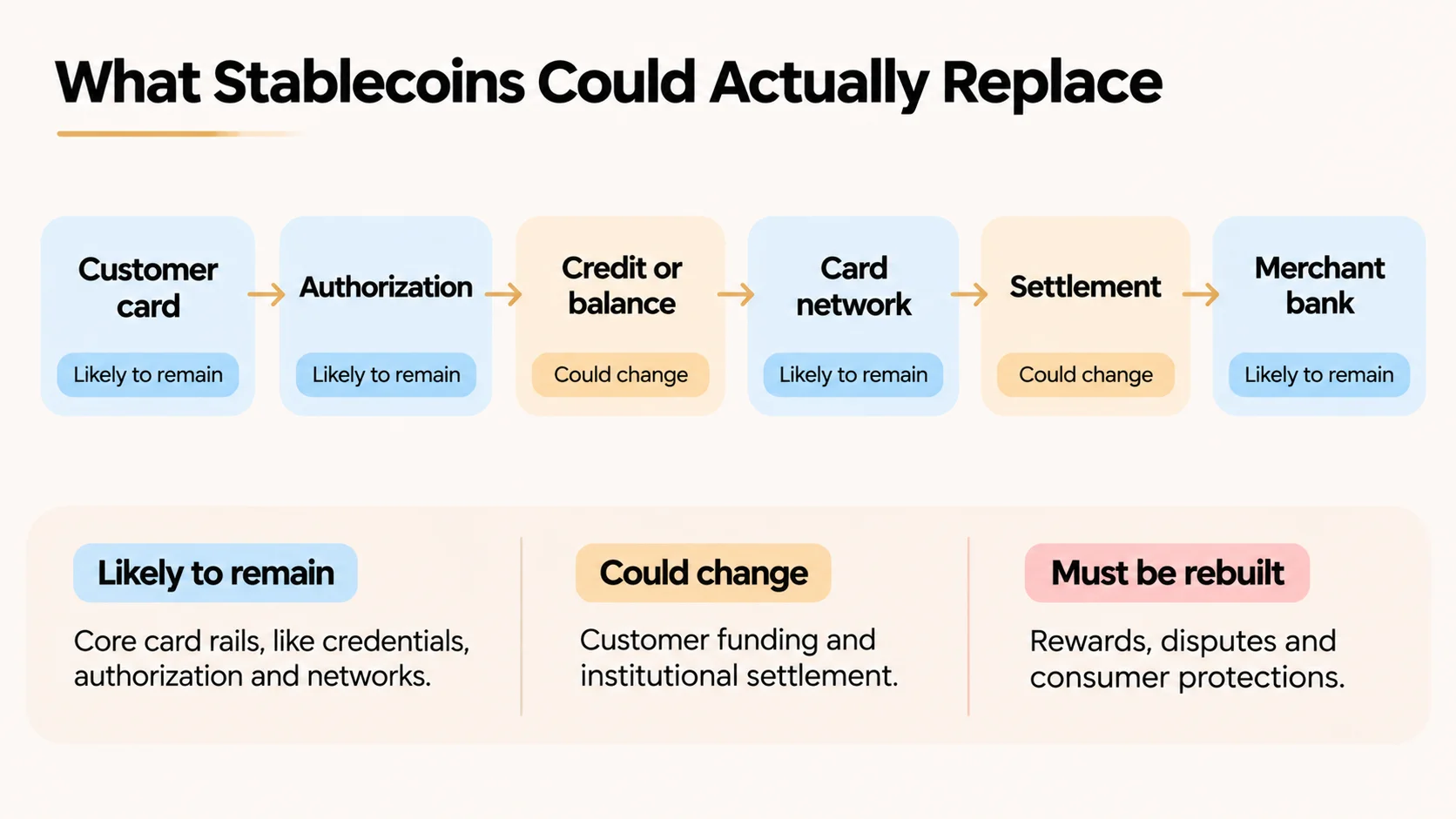
Visa describes this as a multi-rail future rather than a replacement of traditional payments. Its own explanation says the card authorization process and the roles of issuers, acquirers and networks can remain in place while the funding or settlement layer changes behind the scenes. That is a better guide to the market than the claim that shoppers will soon pay every merchant directly from a blockchain wallet.
Are Stablecoin Payments Faster?
Stablecoins can be transferred around the clock, including weekends and holidays. That is valuable for cross-border payouts, treasury transfers and card-program settlement. In April 2026, Visa reported that its stablecoin settlement pilot had reached a $7 billion annualized run rate and expanded to nine blockchains. Mastercard has also announced support for additional intraday, weekend and holiday settlement options, including regulated stablecoins.
But “blockchain settlement” and “the customer receives a refund immediately” are not the same thing. A card purchase still passes through authorization, clearing, fraud checks and the merchant’s systems. A stablecoin transfer may settle quickly onchain, yet converting money, screening a transaction or resolving an error can add time.
Stablecoins have the clearest speed advantage before and after checkout: funding programs, moving treasury money and sending value across borders.
Are Stablecoins Cheaper Than Credit Cards?
They can be, but a network fee is only one line in the total cost.
Consider a business sending $100 to a contractor overseas. A direct stablecoin transfer might have a small blockchain fee. The sender may still pay to buy the stablecoin. The recipient may pay to convert it, withdraw local currency or use a linked card. Foreign-exchange spread, wallet fees and card conversion charges can matter more than the onchain fee.
A useful comparison is:
Total stablecoin cost = funding fee + network fee + conversion spread + card or withdrawal fee
Credit-card costs are also distributed. The merchant normally pays for acceptance, while the cardholder may face annual fees, foreign-transaction charges or borrowing costs. Stablecoins do not make those commercial costs vanish when they are wrapped in a card. They may change who pays and where the cost appears.
This is why businesses should compare the amount delivered, not just the quoted transfer fee. Our guide to how stablecoins can reduce transaction costs examines the full route rather than one fee in isolation.
Security Is More Than Blockchain Finality
Blockchain transactions are normally difficult to reverse after confirmation. That can reduce certain settlement risks, but it can be unforgiving when someone uses the wrong address or authorizes a scam. Wallet security, private-key management, smart contracts and the stablecoin issuer all add separate risks.
Credit cards were built around reversible consumer commerce. In the United States, the Consumer Financial Protection Bureau explains that a cardholder should send a written billing-error notice within 60 calendar days after the charge appears on a statement to preserve federal dispute rights. The CFPB also notes that liability for unauthorized credit-card use is limited in many circumstances.
A stablecoin card can offer card-network dispute procedures for the purchase while the underlying wallet remains subject to different rules. A Visa logo does not make a stablecoin balance FDIC insured. Readers should verify the issuer, reserve model, custody arrangement and cardholder agreement. See Are Stablecoins Safe? for a closer look at those layers.
Merchant Acceptance Still Favors Cards
Direct stablecoin acceptance is growing, but shoppers cannot assume that a local store accepts a wallet transfer. Card networks already connect merchants, banks, processors and fraud systems across many markets.
Stablecoin cards take advantage of that reach. Visa reported in March 2026 that its Bridge-enabled stablecoin cards were live in 18 countries, with expansion planned to more than 100, and could be used across more than 175 million Visa merchant locations. The merchant does not need to manage a stablecoin wallet.
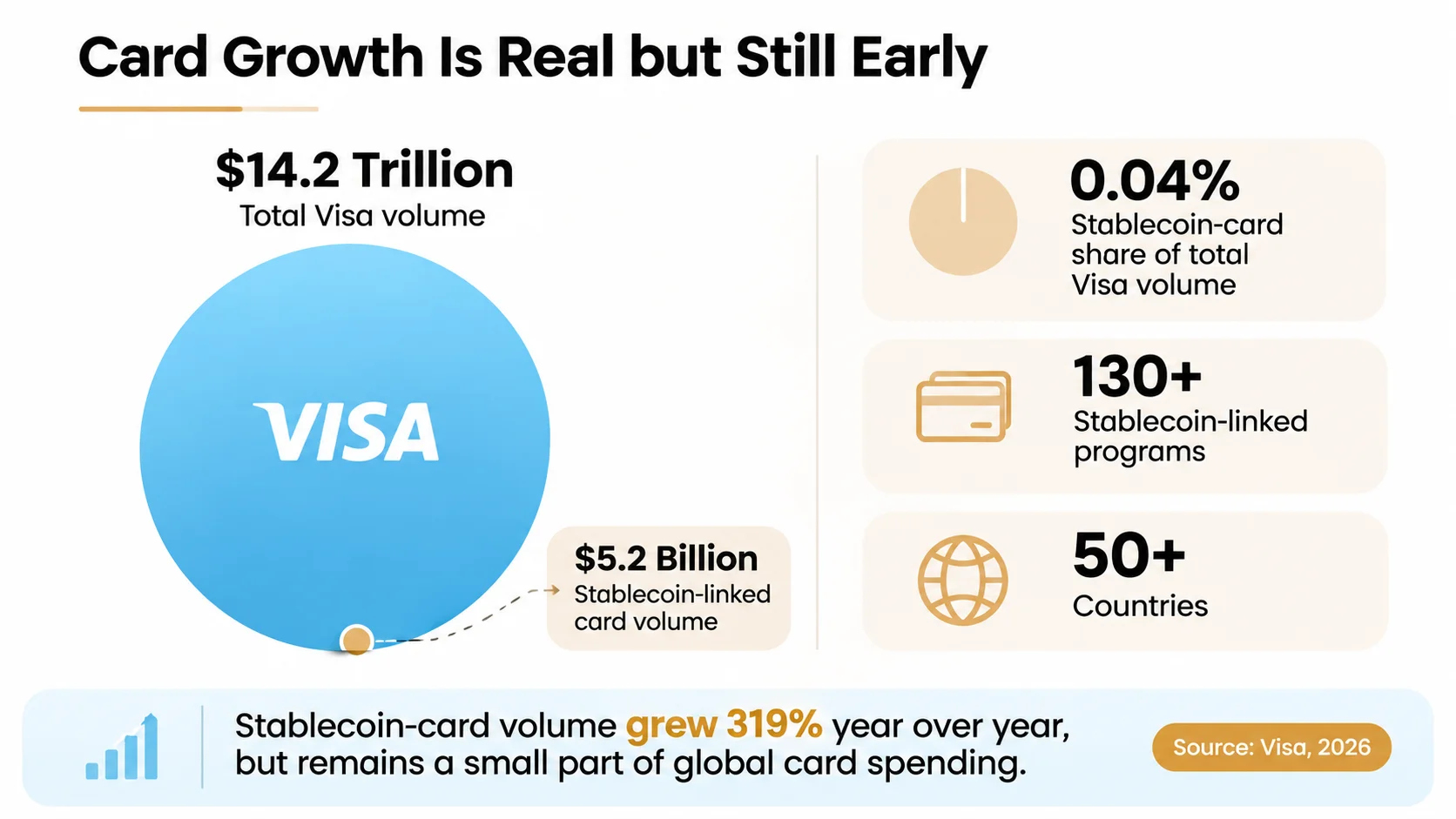
The scale is growing quickly, but it remains early. Visa put 2025 stablecoin-linked card volume at about $5.2 billion, up 319% year over year. That was only about 0.04% of Visa’s $14.2 trillion in total volume. In other words, growth is real and the base is still small.
What About Credit, Rewards and Consumer Benefits?
Stablecoins do not create a grace period or a loan on their own. A stablecoin debit card usually spends an available balance. A stablecoin-secured credit card may provide credit, but it still needs an issuer, underwriting model and repayment rules.
Rewards are possible. They may be funded by interchange, program economics or a separate incentive budget. They are not an automatic feature of blockchain payments. Credit cards also offer mature extras such as travel insurance, purchase protection and established chargeback processes. A new stablecoin card should be judged on the actual agreement, not on the word “crypto.”
The practical benefit of stablecoin cards is different: they can make an existing digital-dollar balance spendable without a separate withdrawal to a bank account. That can be especially useful for globally paid workers, remittance recipients and businesses managing funds across countries.
The Evidence Points to a Hybrid System
By September 2026, Visa reported more than 160 live stablecoin-linked card programs and nearly 200% year-over-year payment-volume growth across those programs. Yet Visa’s own view is that stablecoins will sit alongside fiat rails. That view matches what providers are building.
The card can remain the credential at checkout. Stablecoins can fund the balance, move money between institutions or settle obligations outside banking hours. Merchants can keep their current terminals. Users may not even see the blockchain involved.
So, will stablecoins replace credit cards? Not as a complete product. They are more likely to replace pieces of the funding and settlement process. Credit cards retain strong advantages in borrowing, acceptance, disputes and packaged benefits. Stablecoins add speed, programmability and cross-border reach. The winning system may use both.
For readers interested in that bridge, see how to get a stablecoin-backed debit card and compare PureFi with Coinbase Card.
Be first in line for a PureFi card
PureFi stablecoin Visa debit cards are coming soon. Download the PureFi app now and you will automatically be added to the list, with no separate form. When cards arrive, you will be able to order through the app and spend from your available PureFi balance wherever Visa debit is accepted.
The Prepaid Debit Visa Card is issued by Lead Bank under licence from Visa U.S.A. Inc. Bridge Ventures LLC is the program manager, and PureFi is the platform provider. Applicants must be 18 or older. Fees, eligibility and availability may vary. PureFi is not a bank, and PureFi balances are not FDIC insured or guaranteed by PureFi.