Top Stablecoin Card Issuance Providers in Asia
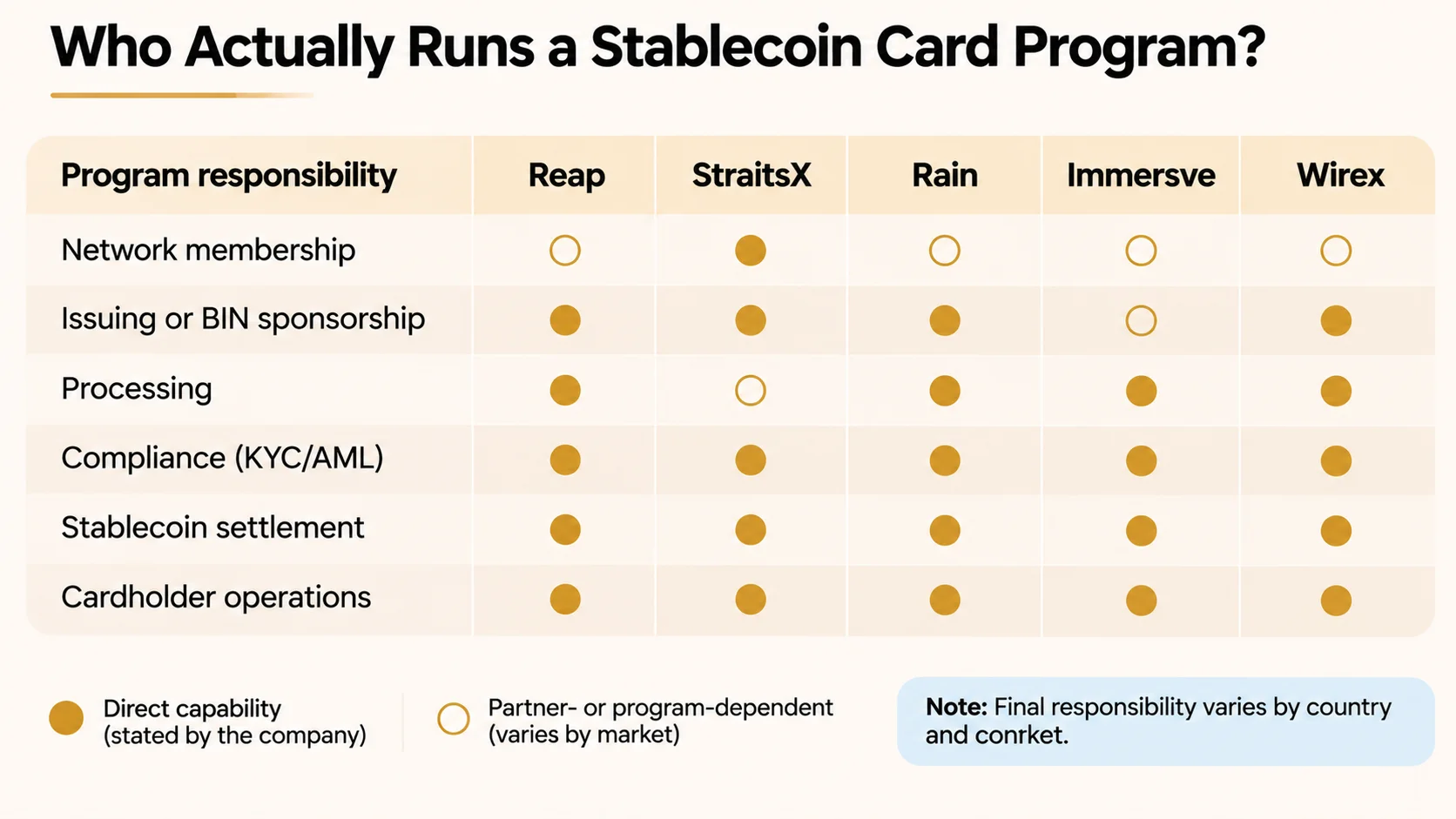
Launching a stablecoin card in Asia takes more than an API and a card design. A business needs network access, an issuer or BIN sponsor, customer checks, transaction monitoring, processing, settlement, disputes and approval in every target market. Providers package those jobs differently. Some hold principal network memberships. Others supply software while a licensed partner issues the card. This guide compares five providers with meaningful Asian coverage and explains the question most shortlists miss: who is legally and operationally responsible for the card program?
What Does a Stablecoin Card Issuance Provider Do?
A stablecoin card provider connects a stablecoin balance or wallet with Visa or Mastercard. Its role may include issuing, processing, compliance, wallet integration, settlement and card production. Those are separate functions. A virtual stablecoin card issuer may provide the credential while another company holds the network licence.
Before comparing vendors, businesses should map five roles:
- The licensed card issuer or BIN sponsor
- The network principal member
- The processor that authorizes transactions
- The program manager responsible for operations
- The provider handling wallets, stablecoins and settlement
Our guide to white-label stablecoin debit cards explains how these layers fit together.
Stablecoin Card Providers With Asian Coverage
| Provider | Network position | Publicly stated reach | Standout capability |
|---|---|---|---|
| Reap | Visa Principal Issuer | 100+ markets planned, subject to approvals | Stablecoin-secured credit and end-to-end issuing |
| StraitsX | Visa BIN sponsorship; MAS-regulated entity | Expansion to 100+ markets announced | Asia-based stablecoin settlement and issuing stack |
| Rain | Visa and Mastercard Principal Member | APAC expansion plus broad global acceptance | Consumer, corporate and secured-credit programs |
| Immersve | Mastercard issuing infrastructure | 140+ markets | Custodial and non-custodial funding models |
| Wirex | Visa and Mastercard principal membership | Market availability varies | Multi-currency cards, accounts and payments through one API |
Public reach is not a promise that a provider can issue every card type in every country. The final answer depends on the customer base, legal entity, product design, network approval and local law.
1. Reap
Best for: Businesses seeking a Visa stablecoin credit-card program with issuing and operations under one provider.
What Reap controls: Reap describes itself as a Visa Principal Issuer in Hong Kong and Mexico. Its service covers issuance, processing, compliance, fraud, disputes and card logistics. It also offers secured corporate cards funded by stablecoin collateral.
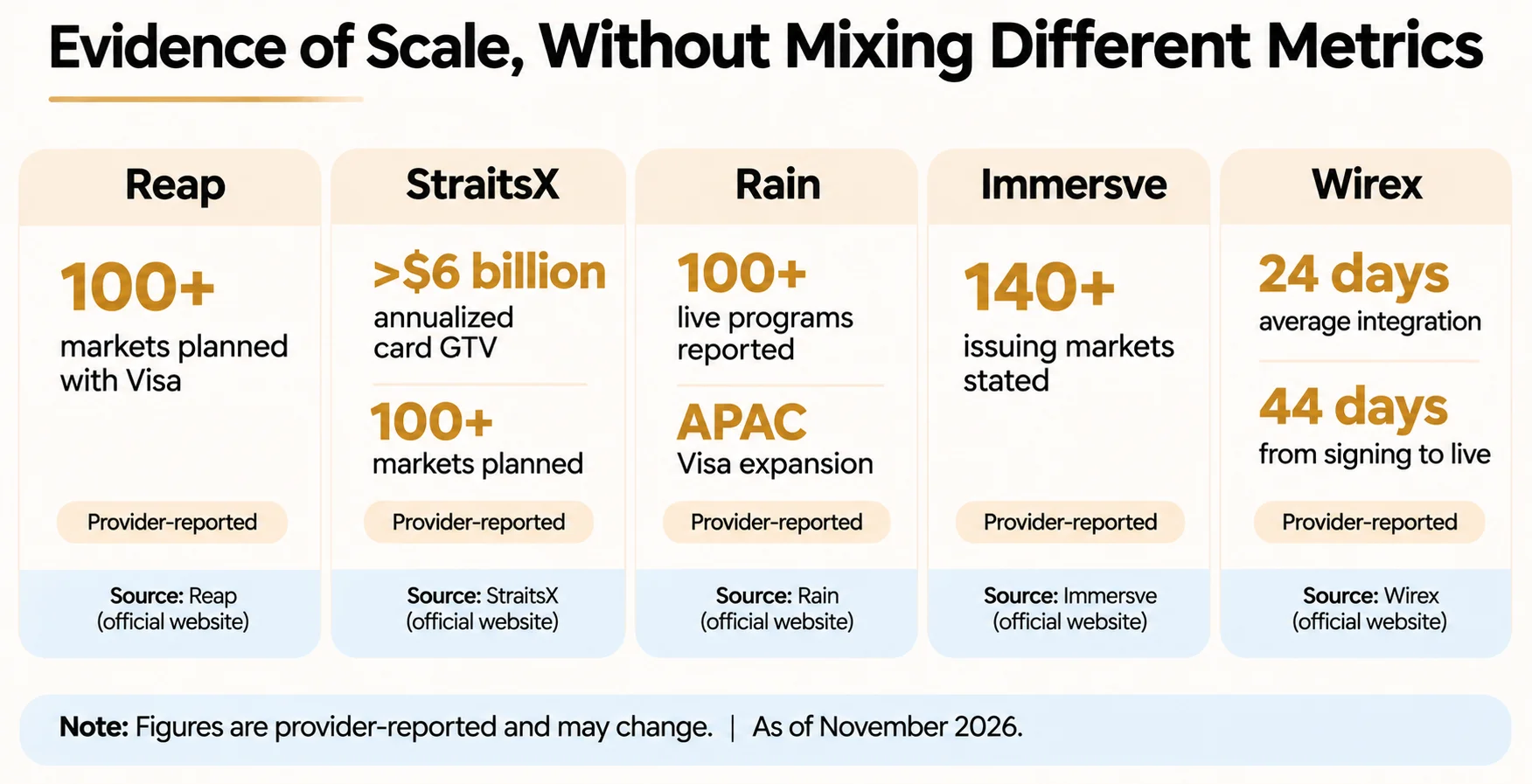
Stablecoins and settlement: Reap’s business accounts can be funded with USDC or USDT. Its secured cards use a 1:1 collateral model, according to the company’s help center. In September 2026, Reap announced a Visa collaboration intended to extend stablecoin-linked credit-card programs to more than 100 markets, subject to local requirements. Reap also participates in Visa stablecoin settlement in Asia Pacific.
Watch for: “100+ markets” describes planned reach, not automatic approval. Ask which Reap entity issues the card, its product type and any collateral requirement.
2. StraitsX
Best for: Asia-based wallets, exchanges and fintechs that want Visa BIN sponsorship and stablecoin-native settlement.
What StraitsX controls: StraitsX offers Visa BIN sponsorship, issuing, processing, virtual and physical cards, and supported digital-wallet provisioning.
Compliance and assets: The Monetary Authority of Singapore directory lists StraitsX Payment Services as a Major Payment Institution. StraitsX states that card-program settlement can use XUSD, XSGD and USDC where applicable.
Evidence of scale: In October 2026, StraitsX and Visa announced expansion toward more than 100 markets. StraitsX reported annualized gross transaction value above $6 billion across its stablecoin-backed card programs in Asia.
Watch for: Support remains program-specific. Confirm that the intended cardholder countries are live, not simply part of an expansion plan.
3. Rain
Best for: Enterprises that want global consumer, corporate or secured-credit programs from a principal member of both major networks.
What Rain controls: Rain supplies stablecoin wallets, issuing infrastructure, compliance layers, rewards, on/off-ramps and settlement. It is a Visa and Mastercard Principal Member. Its April 2026 processing partnership with Episode Six covered credit, debit and prepaid programs, initially focused on Asia Pacific.
Asian expansion: Rain announced an expansion of its Visa membership into APAC in March 2026, with initial launches expected during 2026. The company’s stated use cases include remittance-linked spending, corporate treasury and global payouts.
A real program example: Western Union launched Stablecard with Rain in August 2026. The product combines a USDPT wallet with a Visa secured credit card. This is useful evidence that Rain is not just selling an API demo; its stack supports a branded consumer program with a large payments company.
Watch for: Acceptance and issuance availability are different. Rain must still confirm that the target residents and legal entity are eligible. Compare the model in PureFi vs Rain.
4. Immersve
Best for: Wallets and exchanges that need Mastercard cards with either custodial or self-custodial funding.
What Immersve controls: Immersve combines issuing, KYC, compliance and funding through one API. It states that it has Mastercard principal membership and supports physical, virtual and mobile-wallet cards.
Assets and markets: Immersve publicly lists USDC and USDT across major EVM-compatible chains. Its supported-regions documentation includes Asian and Middle Eastern markets such as Japan, South Korea, Taiwan, Malaysia, Thailand, Pakistan, Saudi Arabia and the UAE. The company states that it can issue in more than 140 markets, though availability may vary by partner program.
Distinctive feature: Immersve supports two funding designs. A custodial program checks the platform’s ledger. A non-custodial program can settle from audited smart contracts, allowing users to retain control of their keys until spending occurs.
Watch for: Chain support does not settle questions about custody, conversion spreads or local permissions. Ask which entity issues in each country.
5. Wirex
Best for: Fintechs that want cards, accounts and stablecoin payments from one multi-currency API.
What Wirex controls: Wirex states that it issues through Visa and Mastercard principal membership. Its platform handles onboarding, screening, monitoring, 3-D Secure, disputes and settlement.
Cards and currencies: Wirex offers virtual and physical cards and lists USD, EUR, GBP and AUD among supported spending currencies. Apple Pay and Google Pay support is available for eligible programs. The platform can link a card to a user wallet, while final product configurations remain country-specific.
Operational evidence: Wirex advertises an average of 24 days for integration and 44 days from signing to launch. Treat those figures as provider-reported benchmarks, not a guaranteed implementation schedule. Regulatory review or custom product work can extend a launch.
Watch for: Wirex also operates a consumer brand. Examine geographic coverage, commercial terms and the issued product type. See PureFi vs Wirex for the consumer-side comparison.
How to Choose a Provider That Can Actually Launch
A polished sandbox does not prove launch readiness. Ask for a market-by-market responsibility matrix.
- Which named legal entity issues the card in each country?
- Does the provider supply its own BIN or use a sponsor?
- Who performs KYC, sanctions screening and transaction monitoring?
- Which stablecoins and chains are live in production?
- Is the stablecoin converted at authorization, clearing or settlement?
- Who funds chargebacks, refunds and daily network settlement?
- Are Apple Pay and Google Pay certified for the exact program?
- What prefunding, reserves or collateral must the business provide?
The last question is often overlooked. Stablecoin settlement can still require working capital for daily network obligations.
Businesses that need a broader infrastructure review can also compare enterprise stablecoin payment platforms. For the customer experience behind the stack, see What Are Stablecoin Payment Cards?.
Be first in line for a PureFi card
PureFi stablecoin Visa debit cards are coming soon. Download the PureFi app now and you will automatically be added to the list, with no separate form. When cards arrive, you will be able to order through the app and spend from your available PureFi balance wherever Visa debit is accepted.
The Prepaid Debit Visa Card is issued by Lead Bank under licence from Visa U.S.A. Inc. Bridge Ventures LLC is the program manager, and PureFi is the platform provider. Applicants must be 18 or older. Fees, eligibility and availability may vary. PureFi is not a bank, and PureFi balances are not FDIC insured or guaranteed by PureFi.