What Are Stablecoin Payment Cards?
Stablecoin payment cards let people spend a digital balance through an ordinary card network. A customer pays in a shop or online. The card provider checks the linked balance and handles any conversion or settlement behind the scenes. The merchant receives a standard card payment and does not usually need to accept stablecoins directly.
One card may spend USDC directly from a wallet. Another may convert the stablecoin before a purchase. Fees, supported networks and account protection also vary. Here is how these cards work and what to check before choosing one.
How Does a Stablecoin Payment Card Work?
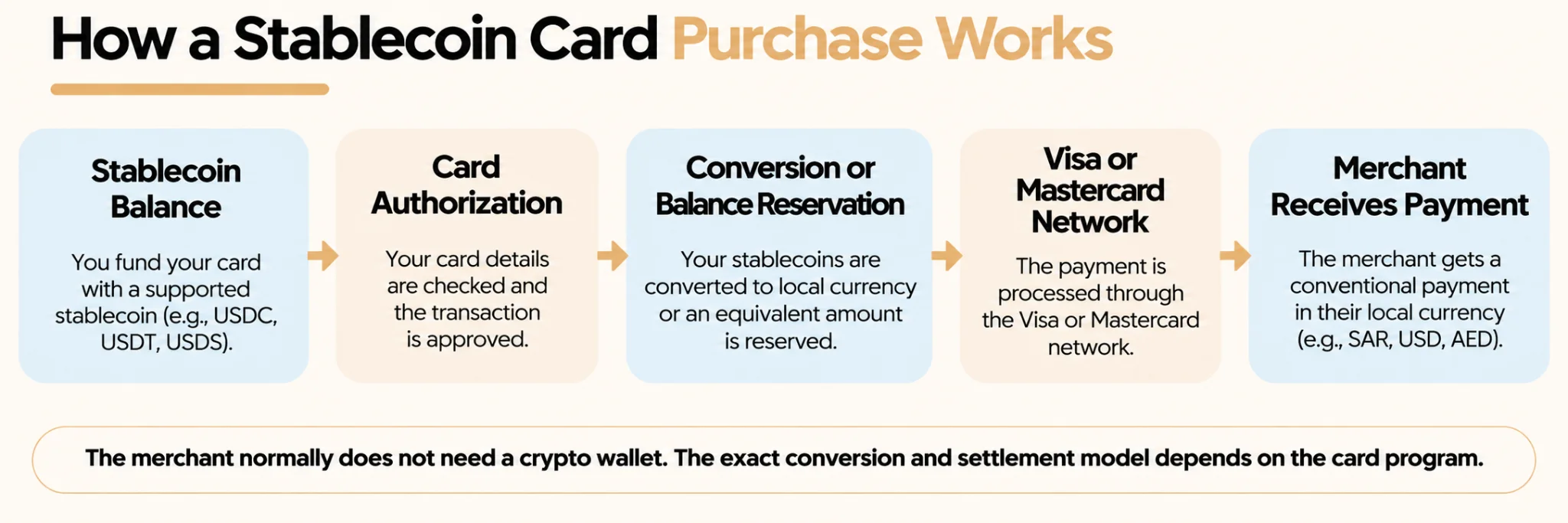
The card connects a digital balance with Visa, Mastercard or another payment network. The exact process depends on the provider, but most purchases follow four steps.
1. The customer selects a spending balance
The balance may contain USDC, USDT, another supported stablecoin or conventional currency. Some providers also let customers select assets such as Bitcoin or Ether.
2. The card checks the available funds
When the card is used, the program checks whether enough spendable value is available. It may reserve slightly more for purchases where the final amount is not yet known, such as hotel stays or petrol-station payments.
3. Conversion or settlement takes place
The provider may sell enough of the stablecoin to cover the payment. Another program may use a pre-converted balance or move stablecoins between approved partners. The cardholder does not normally manage this step manually.
4. The merchant receives a regular card payment
The merchant sees a standard card transaction. It does not need a blockchain wallet or a system that prices products in stablecoins.
The process for getting one is covered inHow to Get a Stablecoin-Backed Debit Card.
Are Stablecoin Cards Debit, Prepaid or Credit Cards?
“Stablecoin card” describes how the card connects to digital value. It does not identify the legal card type.
- Debit cards spend an available balance linked to the account.
- Prepaid cards spend value made available to a card program before or during the transaction.
- Credit cards use a credit line. Stablecoins may be used for repayment, settlement or rewards rather than funding each purchase.
The cardholder agreement should identify the actual structure, issuer and program manager. A Visa or Mastercard logo only identifies the payment network. It does not mean every balance connected to the card is a bank deposit.
Which Stablecoins Can You Spend?
USDC and USDT are common because both are designed to track the U.S. dollar. Other cards may support a regional stablecoin or a token issued by the provider.
Support must be checked at two levels:
- The asset: Is the specific stablecoin spendable?
- The network: Is that stablecoin supported on the blockchain being used?
USDC on Ethereum and USDC on another network may look like the same asset in an app, but the transfer routes are different. Sending funds through an unsupported network can delay access or make recovery difficult.
A wallet may also hold more assets than its card can spend. Do not assume every token displayed in the app is connected to the card.
For the wider risks behind dollar-linked assets, readAre Stablecoins Safe?.
Do Stablecoin Cards Convert Crypto at Checkout?
Many do, but there is more than one funding model.
Automatic conversion
The provider converts the required amount when the card is used. This is convenient, but a spread or conversion charge may be included.
Pre-converted balance
The customer converts the stablecoin into conventional currency before spending. The card then uses the converted balance.
Just-in-time funding
The card program checks a connected wallet during authorization. It reserves or moves the required value without asking the customer to preload a separate card balance.
None of these models is automatically cheaper. The final cost depends on the quoted exchange rate, program fee, blockchain network and purchase currency.
What Fees Can a Stablecoin Payment Card Charge?
A card advertised without a transaction fee can still cost money in other ways. Review the complete fee schedule, not only the headline charge.
Possible costs include:
- Card issuance or physical delivery
- Monthly or annual membership
- Stablecoin conversion spread
- Foreign-exchange markup
- ATM withdrawal fee
- Blockchain network fee when adding or removing funds
- Replacement-card fee
- Third-party ATM surcharge
Some providers include their cost inside the exchange quote. This makes the conversion look free even though the customer receives a less favorable rate.
Foreign-currency purchases need extra attention. A dollar-linked balance may still be converted when the merchant charges euros, pounds or another currency. Our guide toforeign transaction fees explains how these charges work.
Where Can Stablecoin Payment Cards Be Used?
Cards can generally be used wherever their payment network and card type are accepted. Depending on the program, this may include:
- Contactless payments in stores
- Online checkout
- Recurring subscriptions
- Mobile wallets
- ATM withdrawals
- Purchases while travelling
Acceptance is not unlimited. Providers may block gambling, money transfers, crypto purchases and other merchant categories. Some cards cannot be used in restricted countries. Hotels, car-rental companies and petrol stations may also place temporary holds above the final payment amount.
ATM access and Apple Pay or Google Pay support should be checked separately. A physical card does not automatically include either feature.
Are Stablecoin Payment Cards Safe?
Several systems are involved in every transaction. A problem can occur with the stablecoin issuer, wallet, card account, exchange or payment network. The main risks include:
- The stablecoin losing its link to the reference currency
- The issuer or custodian restricting redemptions
- A compromised wallet or account
- Conversion fees changing the final cost
- A transfer being sent over the wrong blockchain
- The card being frozen during a compliance review
- Limited recovery for an unsupported blockchain transfer
Deposit insurance is another issue. A card may be issued by an insured bank, but that does not automatically insure stablecoins held in a separate wallet. Card protections for unauthorized transactions are also different from deposit insurance.
The article onwhite-label stablecoin debit cards explains how the issuer, program manager, wallet provider and branded fintech divide responsibility.
How Will PureFi Stablecoin Cards Work?
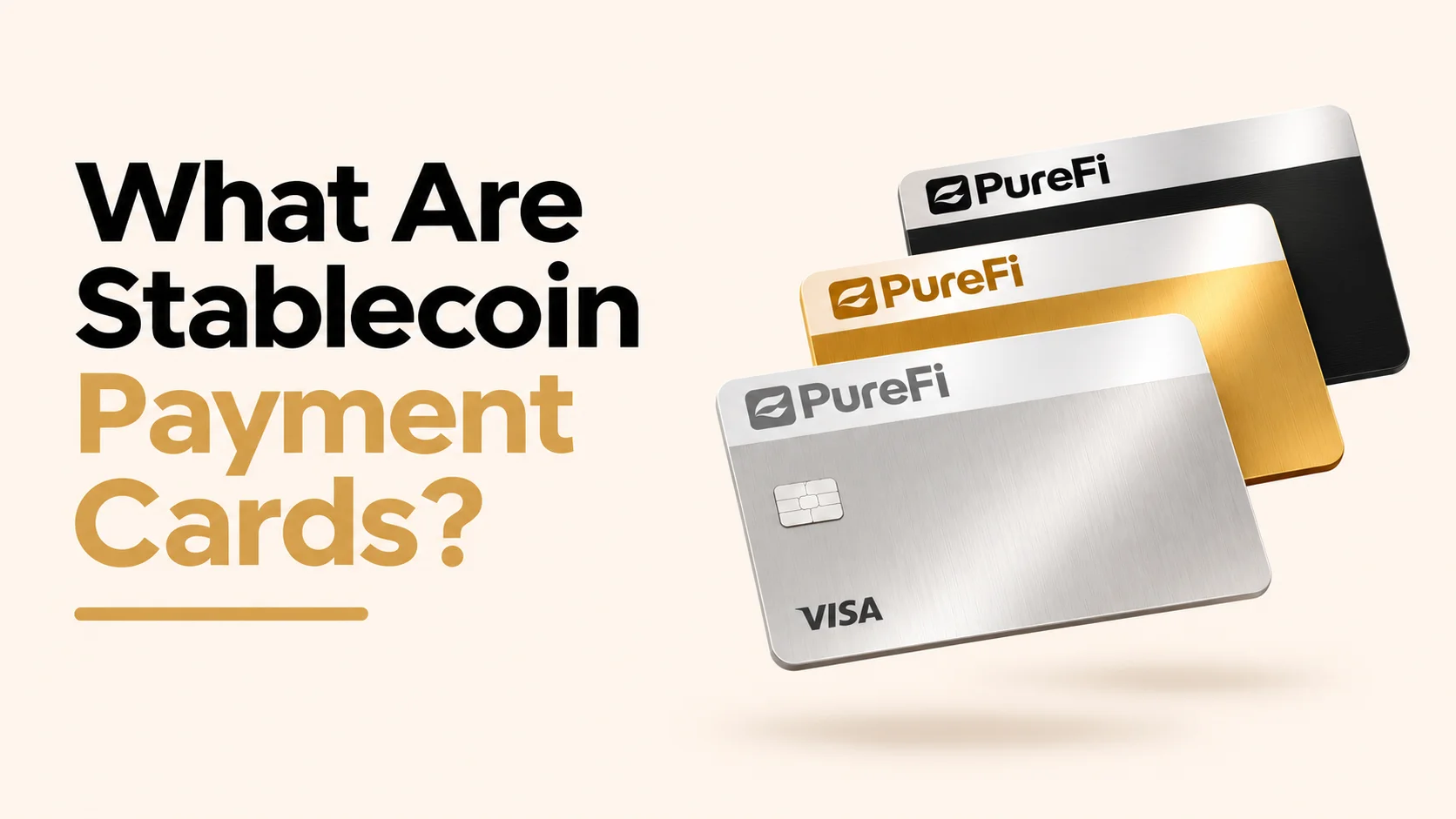
PureFi’s stablecoin cards are coming soon. The public card range currently includes Basic, Gold and Obsidian. All three are planned as Visa debit cards managed through the PureFi app.
The card will spend from the available PureFi balance. Customers will not need to move money into a separate card balance before each purchase. PureFi Earn remains separate. Property shares held through PureFi Earn cannot be spent directly at checkout or sold automatically to cover a card purchase.
Be first in line for a PureFi card
PureFi stablecoin Visa debit cards are coming soon. Download the PureFi appnow and you will automatically be added to the list, with no separate form. When cards arrive, you will be able to order through the app and spend from your available PureFi balance wherever Visa debit is accepted.
The Prepaid Debit Visa Card is issued by Lead Bank under licence from Visa U.S.A. Inc. Bridge Ventures LLC is the program manager, and PureFi is the platform provider. Applicants must be 18 or older. Fees, eligibility and availability may vary. PureFi is not a bank, and PureFi balances are not FDIC insured or guaranteed by PureFi.