Which Platforms Offer Enterprise Stablecoin Payments?
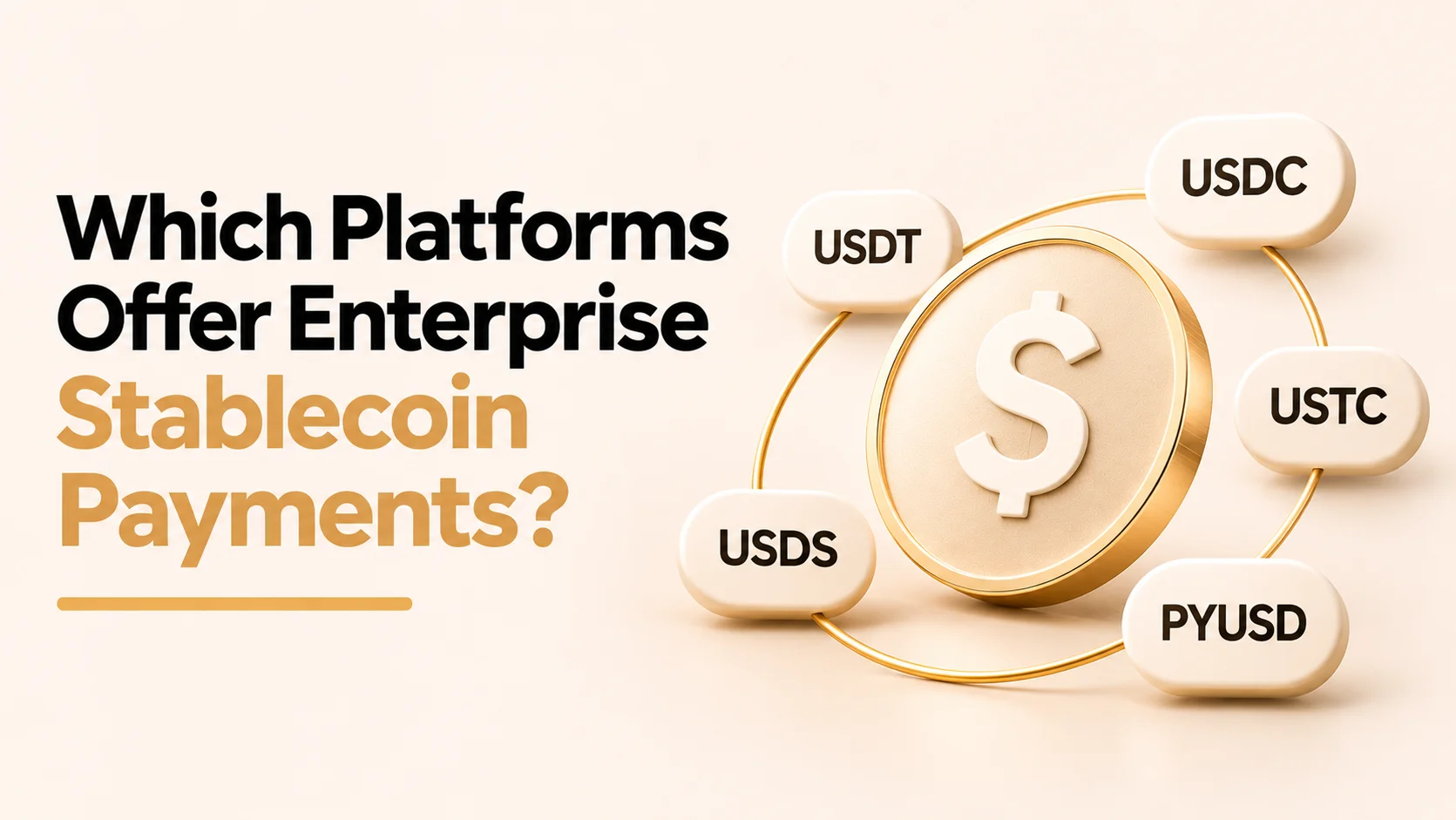
Enterprise stablecoin payments are no longer limited to crypto companies. Payment providers now help businesses accept stablecoins, pay overseas suppliers, settle between subsidiaries and send money to contractors around the world.
The platforms do not all solve the same problem. Some handle checkout or payouts. Others provide wallets, cards and institutional infrastructure.
Our guide compares six enterprise stablecoin payment platforms by their main use, integration options, reach and limitations.
What Should an Enterprise Stablecoin Platform Provide?
A usable system must connect blockchain transfers with accounting, compliance and local payment rails. Important features include:
- Stablecoin and blockchain support
- Fiat deposits and withdrawals
- APIs, webhooks and payment-status updates
- Wallet or virtual-account infrastructure
- Identity checks and transaction screening
- Reconciliation and reporting
- Controls for different team members
- Local payout coverage
- Card issuing where required
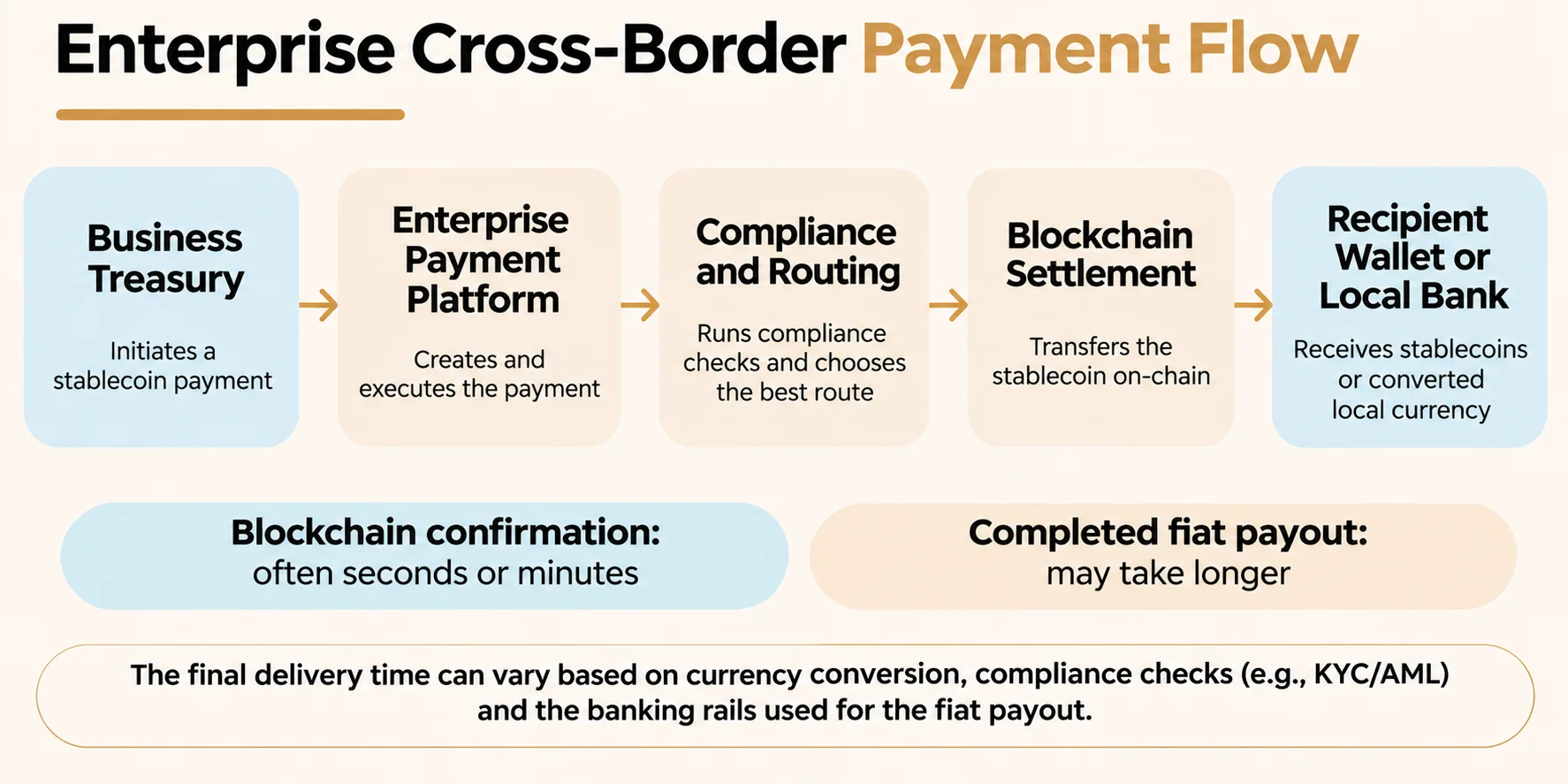
A blockchain transfer may confirm quickly. The complete payment can take longer when conversion, review or a local bank payout is required.
Our guide tohow stablecoins reduce transaction costs explains where the technology may remove payment friction and where costs can remain.
Enterprise Stablecoin Platforms
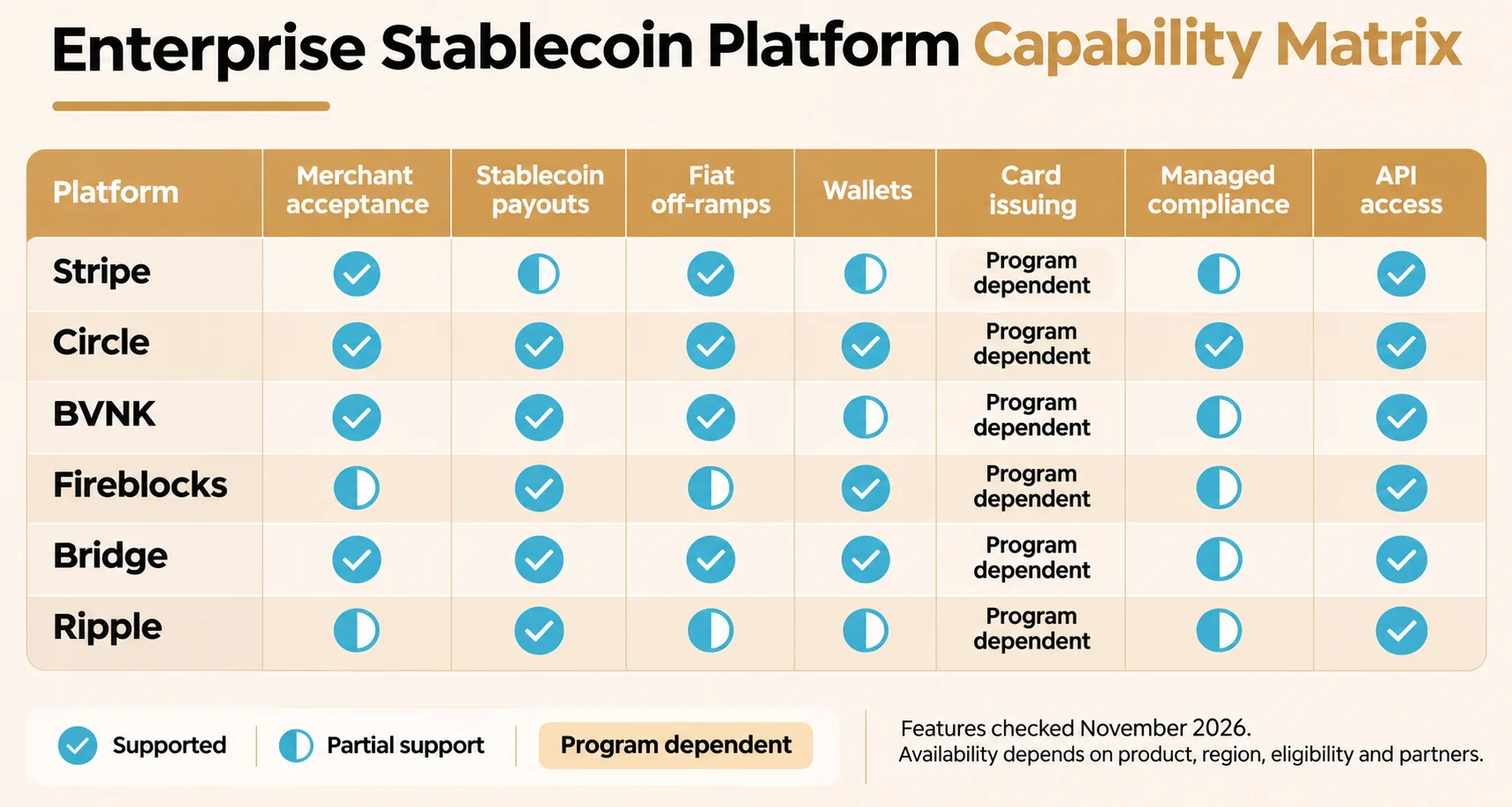
| Platform | Best for | Main capabilities | Integration | |---||---||---||---| | Stripe | Businesses already using Stripe | Acceptance, payouts, treasury and cards | APIs, hosted tools and dashboard | | Circle | USDC-based global payments | Pay-ins, payouts, settlement and treasury | APIs and managed service | | BVNK | High-volume companies | Send, receive, store, convert and spend | API and portal | | Fireblocks | Banks, fintechs and PSPs | Wallets, orchestration, custody and compliance | API and enterprise console | | Bridge | Embedded financial products | Orchestration, wallets, cards and virtual accounts | API | | Ripple Payments | Managed cross-border payments | Fiat and stablecoin settlement | API and web interface |
1. Stripe
Best for: Businesses that already use Stripe and want to add stablecoin acceptance or global payouts.
What it offers: Stripe lets eligible businesses accept stablecoin payments and settle the proceeds into their Stripe balance. It also provides global stablecoin payouts, Connect payout tools, treasury services and stablecoin card infrastructure.
Integration: Businesses can use Stripe APIs, hosted payment components and the Stripe Dashboard.
Settlement and reach: In October 2026, Stripe reported instant stablecoin payouts to recipients in more than 160 markets. It also expanded stablecoin card issuing to more than 65 countries.
What to check: Some payout, Connect and Treasury features remain in preview. Confirm eligibility before designing the workflow.
2. Circle Payments Network
Best for: Enterprises, banks, fintechs and payment companies that want to build around USDC and Circle’s payment infrastructure.
What it offers:Circle Payments Network supports stablecoin payments, local fiat payouts, B2B settlement, contractor payments and treasury movements. Businesses can send, receive and manage value without building each regional connection separately.
Integration: Circle offers stablecoin APIs and Managed Payments. The managed option is designed for companies that do not want to operate wallets, blockchain infrastructure and digital-asset compliance themselves.
Settlement and reach: Circle advertises stablecoin payouts in more than 180 countries and local fiat payouts across more than 60 countries.
What to check: Circle Payments Network is still labelled beta. Blockchain, stablecoin and corridor coverage varies.
3. BVNK
Best for: Established businesses with high stablecoin and fiat payment volumes.
What it offers:BVNK combines six functions: send, receive, store, convert, spend and earn. A business can receive stablecoins, convert them into fiat, make payouts and create virtual accounts through the same provider.
Integration: The direct model uses the BVNK Portal or API for the company’s own payments. The embedded model lets a platform integrate payment functions into its customer experience.
Settlement and reach: BVNK reports coverage across more than 130 markets and support for major tokens and chains through one API.
What to check: BVNK states that prospective customers should generally process at least $500,000 per month and have six months of operating history.
4. Fireblocks
Best for: Banks, payment service providers and fintechs that need secure infrastructure and control over complex payment flows.
What it offers:Fireblocks Payments provides wallets, key management, stablecoin accounts, payment orchestration, cross-chain routing and compliance tools. Businesses can screen wallets, set approval rules and produce an audit trail before funds move.
Integration: The platform is available through APIs and an enterprise console. The Fireblocks Network also connects customers with exchanges, custodians, liquidity providers and payment partners.
Scale: Fireblocks reports more than 2,500 network participants across over 100 countries. Its network supports major stablecoins such as USDC, USDT and PYUSD, alongside more than 60 fiat currencies through connected providers.
What to check: Fireblocks is infrastructure rather than a plug-and-play merchant checkout. A business may still need separate banking, liquidity and last-mile payout partners.
5. Bridge
Best for: Fintechs and platforms embedding stablecoin accounts, wallets, payouts or cards into their own products.
What it offers:Bridge provides orchestration, virtual accounts, wallets, card issuing and stablecoin issuance. It can move money between stablecoins and fiat currencies without forcing the business to build separate connections for every network.
Integration: One API supports major stablecoins across more than ten blockchains. Businesses can combine transfers with customer-named virtual accounts, wallets and cards.
Settlement: Bridge supports stablecoin payouts, cross-chain transfers and local off-ramps. Prefunded accounts can make the customer experience faster while conventional fiat rails finish settling.
What to check: Bridge is now part of Stripe, but its APIs remain a distinct infrastructure option. Coverage depends on the customer type, country, payment route and licensing requirements.
If the end product includes a branded card, readwhat white-label stablecoin debit cards are.
6. Ripple Payments
Best for: Companies and financial institutions that want a managed cross-border service instead of assembling their own provider network.
What it offers:Ripple Payments supports first- and third-party payments with settlement in fiat, RLUSD and other supported stablecoins. Ripple handles foreign exchange, payout connections and last-mile delivery for supported routes.
Integration: Payments Direct is available through a REST API and a web interface. Businesses can create reusable sender and recipient records, request a quote and track a payment.
Reach: Ripple advertises first- and third-party payouts across more than 60 destination markets.
What to check: Products may be supplied by different Ripple entities. Supported countries, stablecoins and payout methods depend on the customer agreement and corridor.
How to Choose an Enterprise Stablecoin Platform
Start with the payment the business actually needs to make.
- Merchant acceptance: Look at Stripe, Circle or another provider with checkout tools and fiat settlement.
- Global supplier or contractor payouts: Compare payout countries, local off-ramps and recipient requirements.
- Embedded financial products: Bridge or BVNK may provide more control over wallets, accounts and cards.
- Institutional infrastructure: Fireblocks provides detailed security, approval and orchestration tools.
- Managed cross-border service: Ripple can reduce the number of banking and payout relationships a business manages directly.
Ask who verifies customers, holds assets and handles failed transfers. A low blockchain fee does not guarantee a low total payment cost.
The article onstablecoin safety covers issuer, reserve and wallet risks. For conventional and blockchain-based international payments, seetypes of remittance in banking.
What Does Fast Settlement Really Mean?
“Instant” can describe only one part of the payment.
A stablecoin may reach the recipient’s wallet within seconds. If the recipient keeps that stablecoin, the transfer may be complete. If they need local currency in a bank account, more steps follow. The provider may run additional checks, convert the asset and send money through a local banking partner.
Businesses should measure the full time from payment instruction to usable recipient funds. They should also test what happens outside banking hours, during a compliance review or when a local payout fails.
Be first in line for a PureFi card
PureFi stablecoin Visa debit cards are coming soon. Download the PureFi appnow and you will automatically be added to the list, with no separate form. When cards arrive, you will be able to order through the app and spend from your available PureFi balance wherever Visa debit is accepted.
The Prepaid Debit Visa Card is issued by Lead Bank under licence from Visa U.S.A. Inc. Bridge Ventures LLC is the program manager, and PureFi is the platform provider. Applicants must be 18 or older. Fees, eligibility and availability may vary. PureFi is not a bank, and PureFi balances are not FDIC insured or guaranteed by PureFi.