What Types of Savings Accounts Should I Have?
What Types of Savings Accounts Should I Have?
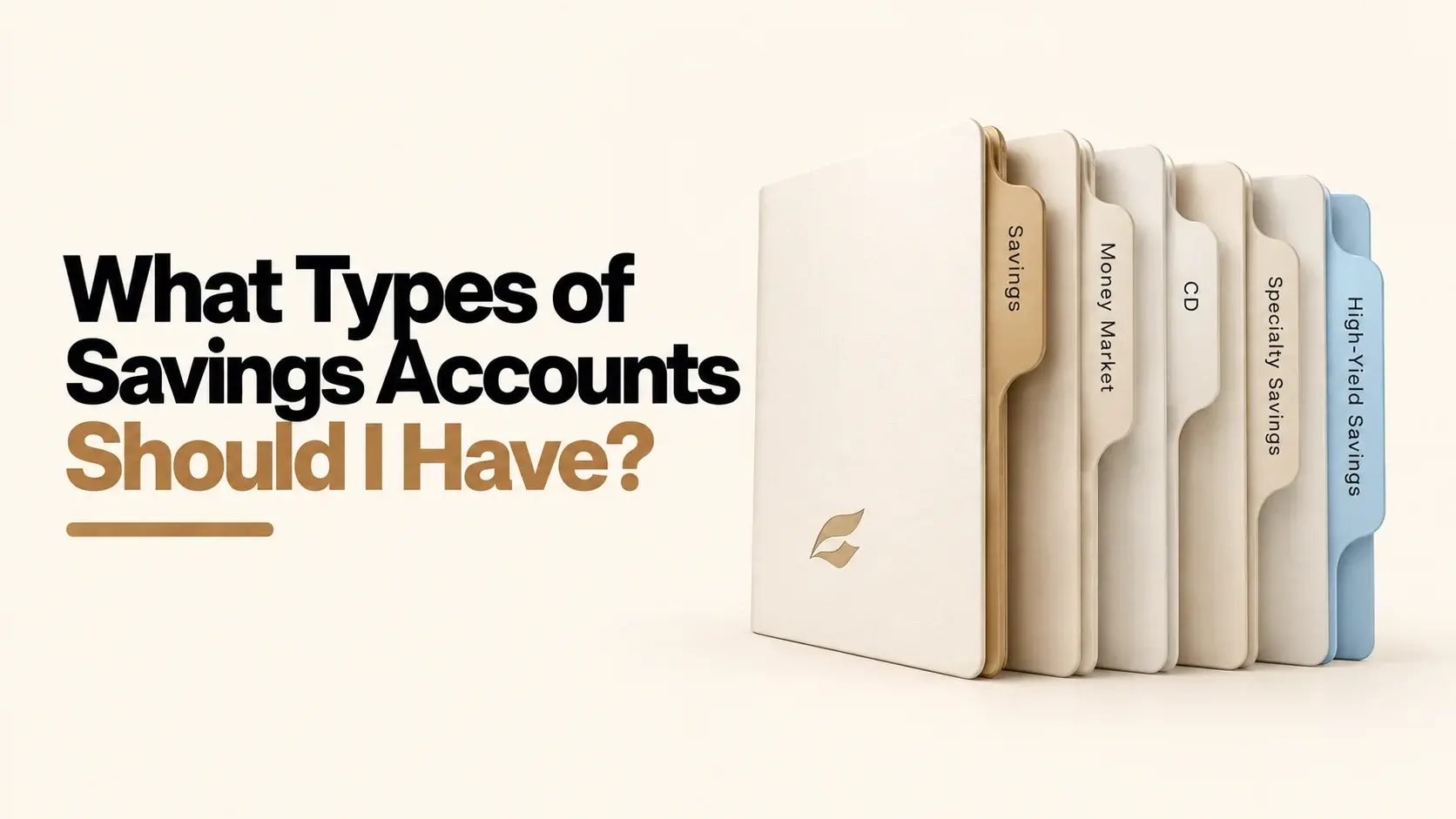
You do not need every type of savings account. The right mix depends on when you will need the funds and how you want to access them.
A high-yield savings account may work for an emergency fund. A money market account may help when you want checks or card access. A CD may suit funds you can leave untouched until a known date.
In this article, we’ll explain the main account types, how they earn, what access they provide, and what federal protection may apply.
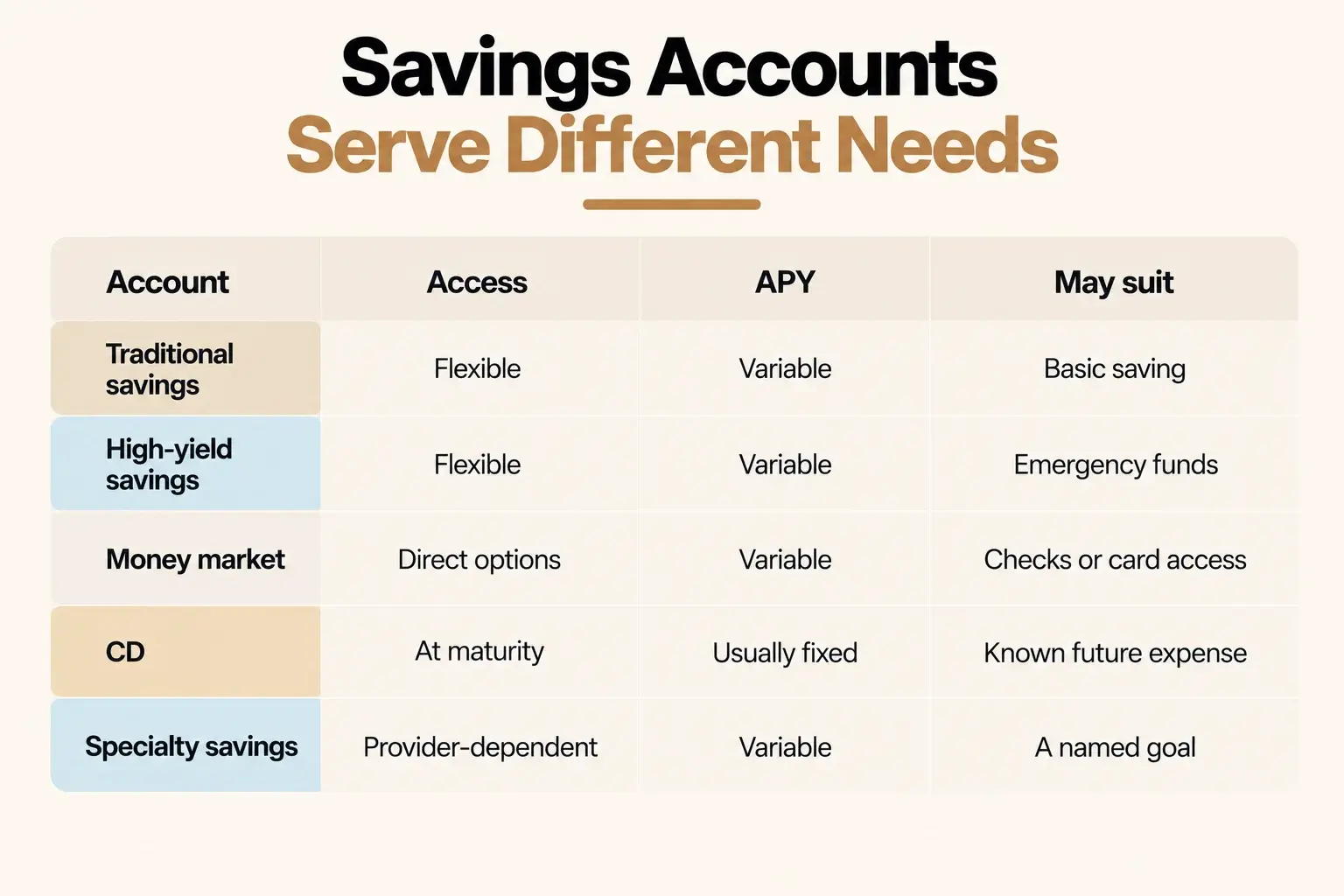
Types of Savings Accounts at a Glance
| Account type | Access | APY | Term | May suit |
|---|---|---|---|---|
| Traditional savings | Generally flexible | Usually variable | No fixed term | Basic saving and branch access |
| High-yield savings | Generally flexible | Usually variable | No fixed term | Emergency funds and short-term goals |
| Money market account | May include checks or a card | Usually variable | No fixed term | Savings that may need direct access |
| Certificate of deposit | Limited before maturity | Usually fixed | Set term | Expenses with a known date |
| Specialty savings | Depends on provider | Usually variable | Usually no fixed term | Children, students or named goals |
The account name does not tell you everything. APYs, fees, balance requirements and access methods can differ between providers.
1. Traditional Savings Account
A traditional savings account is a basic deposit account offered by banks and credit unions. You can usually add or withdraw funds when needed. The account may connect directly to a checking account at the same institution, making transfers simple.
Traditional savings accounts often provide branch and ATM access. This may help people who prefer in-person service or need to deposit cash. The APY is normally variable. The provider can change it after the account is opened.
A traditional savings account may also have:
- A minimum opening deposit
- A monthly maintenance fee
- A balance needed to avoid the fee
- Withdrawal or transfer limits
- ATM access
This type of account may work for someone who values convenience more than earning the highest available APY.
2. High-Yield Savings Account
A high-yield savings account is a savings account offering a more competitive APY than many traditional accounts. Many are offered by online banks or credit unions. Without a large branch network, some providers can offer stronger APYs or lower account fees. This does not mean every online account offers better terms.
A high yield digital savings account usually allows electronic deposits and withdrawals. You may connect it to a checking account and transfer funds when needed. Some accounts also offer direct deposit or ATM access. Others require you to transfer funds to another account before you can use them.
A high-yield savings account may work well for:
- Emergency funds
- A home deposit
- Planned travel
- A car purchase
- Education costs
- Other short-term goals
Its APY is generally variable. A competitive APY today may rise or fall later. Before choosing a high-yield savings app , check the fees, minimum balance, transfer times, and the institution holding the deposits.
3. Money Market Account
A money market account is a deposit account that combines savings features with limited checking-style access. Depending on the provider, the account may include:
- Paper checks
- A debit card
- An ATM card
- Electronic transfers
- Online account access
This can make a money market account useful when you want to earn on your savings but may need to make payments directly from the account.
Money market accounts may require a larger opening deposit or minimum balance. Some providers use balance tiers, so the APY may depend on how much you hold. Do not confuse a money market account with a money market mutual fund. The first is a deposit account. The second is an investment product with different risks and protections.
A money market account may suit funds that need to remain accessible without being used for everyday spending.
4. Certificate of Deposit
A certificate of deposit, or CD, is a deposit account with a set term and maturity date. You usually add one amount when opening the CD. You then agree to leave the funds in the account for a stated period.
Standard CDs normally offer a fixed APY for the term. This means the APY does not change before maturity. The main tradeoff is access. If you withdraw funds before the maturity date, the provider may charge an early withdrawal penalty.
CDs may work for planned expenses with known dates, such as:
- A purchase expected next year
- Education fees
- A home renovation
- A scheduled tax payment
- A large annual bill
Choose a maturity date that comes before you expect to need the funds.
Some CDs renew automatically after maturity. The renewed CD may have a different term and APY. Review the maturity notice and act during the grace period if you do not want the account to renew.
The Consumer Financial Protection Bureau recommends comparing the term, APY and early withdrawal penalty before opening a CD.
5. Specialty Savings Account
A specialty savings account is designed for a certain person or goal.
Examples may include:
- Student savings accounts
- Children’s savings accounts
- Holiday savings accounts
- Goal-based savings accounts
- Accounts linked with savings rewards
These accounts are often standard savings products with different names, features or eligibility rules.
A children’s account may require a parent or guardian to be an owner. A student account may remove certain fees until the account holder reaches a set age. A holiday account may limit withdrawals until a certain time of year.
Do not assume a specialty label means a better APY. Compare its terms with a regular or high-yield savings account.
Which Savings Account Fits Each Goal?
Different goals may need different levels of access.
Emergency fund
An emergency fund should normally be easy to reach. A high-yield savings account can keep it separate from daily spending while allowing the balance to earn. Check how long transfers take. A strong APY may not help during an emergency if you cannot access the funds quickly.
Regular saving
A traditional or online savings account may work for regular deposits. Choose an account that supports automatic transfers and does not charge a fee that reduces your earnings.
Savings that may need direct access
A money market account may help if you want checks, a debit card or ATM access.Not every money market account includes these features. Check before opening one.
A planned expense
A CD may work when you know the date of an expense and can leave the funds untouched until then. Match the CD maturity date with your expected payment date. Otherwise, you may need to withdraw early and pay a penalty.
A child or named goal
A specialty account may make the goal easier to track. A normal savings account with a custom nickname may do the same job with fewer restrictions. Compare both options before deciding.
How Many Savings Accounts Should You Have?
There is no correct number of savings accounts. One account may be enough if you have a single goal or prefer simple account management. Several accounts may help if you want to separate emergency savings from planned expenses.
For example, you could use:
- One high-yield savings account for emergencies
- One separate savings account for a planned purchase
- One CD for funds needed on a known date
Separate accounts can make progress easier to track. They can also create more passwords, statements, APYs and minimum balance rules to manage. You do not need a different account for every small goal. Some online savings apps let you create named savings sections inside one account.
Before opening several accounts, check:
- Monthly fees
- Minimum balances
- APYs
- Transfer times
- Withdrawal methods
- Account protection
- How easily you can manage everything
Opening several accounts at the same bank does not automatically increase your federal coverage.
Are These Savings Accounts Protected?
Traditional savings accounts, high-yield savings accounts, money market deposit accounts, and CDs may receive federal protection when held at an eligible bank or credit union.
The FDIC generally protects eligible deposits up to $250,000 per depositor, per insured bank and per ownership category. The NCUA provides similar protection for eligible deposits at federally insured credit unions.
Balances in different account types may be combined when they are held at the same institution and in the same ownership category.
For example, a savings account and CD owned by the same person at the same bank do not automatically receive separate $250,000 limits.
When using a digital savings platform, check the legal name of the institution holding the deposits. The company providing the app may not be the bank itself.
You can confirm a bank through the FDIC BankFind tool . Credit union members can review the NCUA coverage guide .
Put your dollars into something real
With PureFi, your projected earnings come from shares of real homes with tenants . Choose your properties from your phone, review the documents, and see every fee before you confirm.
Learn more about how PureFi can help you own real estate shares or download the app to get started today.
Up to 6% APY is projected, variable, and not guaranteed. Property shares can lose value. PureFi is not a bank, and its balances and real estate shares are not covered by FDIC insurance or another government deposit scheme.