What Is ETF Investment?
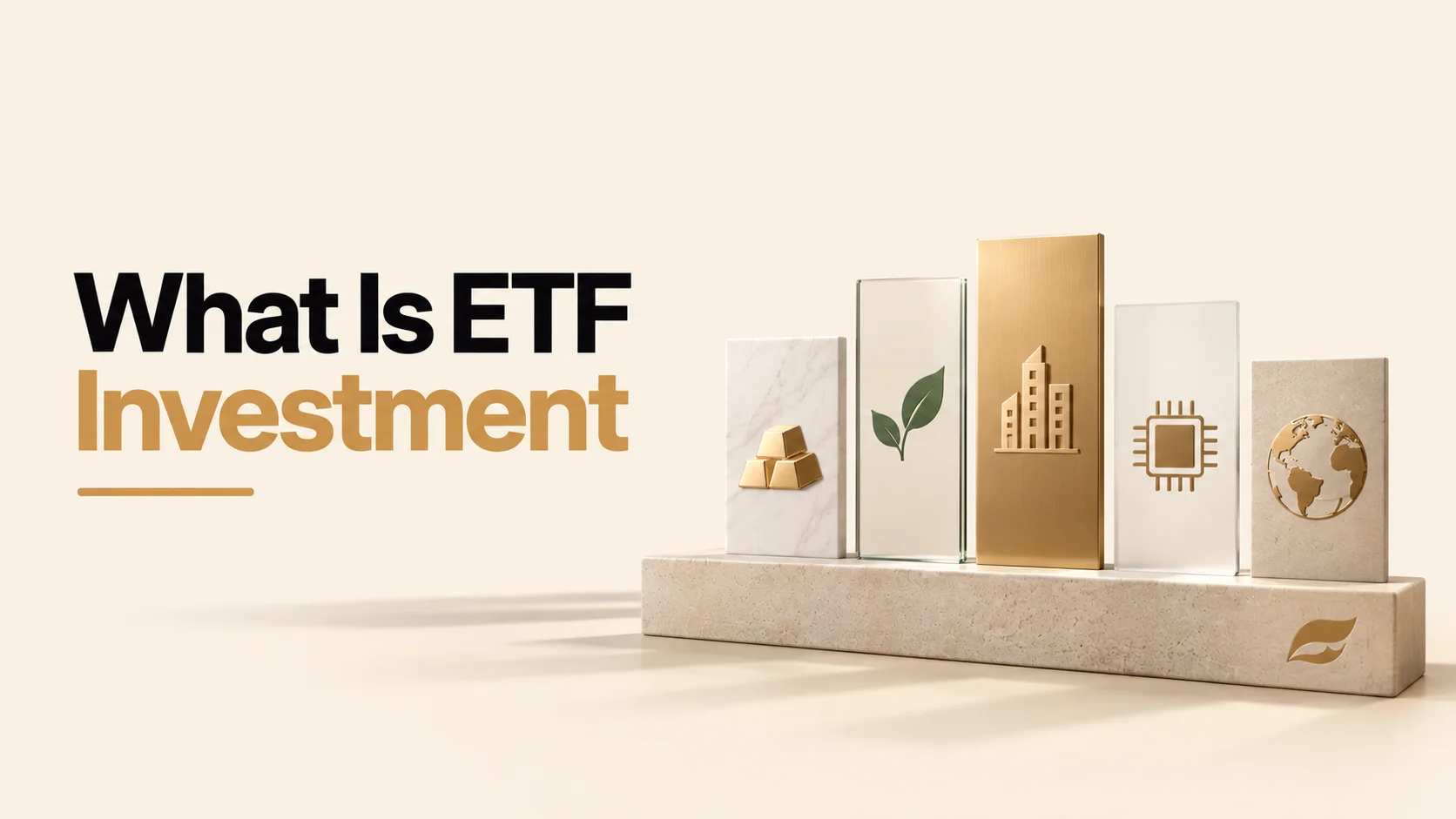
An ETF is a fund that holds a group of investments and trades on a stock exchange. ETF stands for exchange-traded fund. When you buy an ETF share, you own part of the fund. You do not directly own each stock, bond, or other asset inside it.
Some ETFs hold hundreds of investments. Others focus on one industry, country, commodity, or company. This means the name “ETF” tells you how the fund is structured and traded, but not whether it is simple, diversified, or low risk.
In this article, we explain how ETFs work, what they can hold, where returns come from, why the market price may differ from the assets inside the fund, and which risks and costs to check.
How does an ETF work?
An ETF pools funds from many investors. The fund then holds a portfolio based on a stated plan. That portfolio may contain company shares, bonds, or a mix of assets.
Many ETFs follow an index. An index is a list or measurement used to represent part of a market. An ETF may try to follow a broad stock market, a group of large companies, a particular industry, or another defined category.
Other ETFs are actively managed. A fund manager decides what the ETF should buy and sell based on the fund’s stated goal.
Retail investors normally buy and sell ETF shares through a brokerage account. The shares trade during exchange hours, and their market price can change throughout the day.
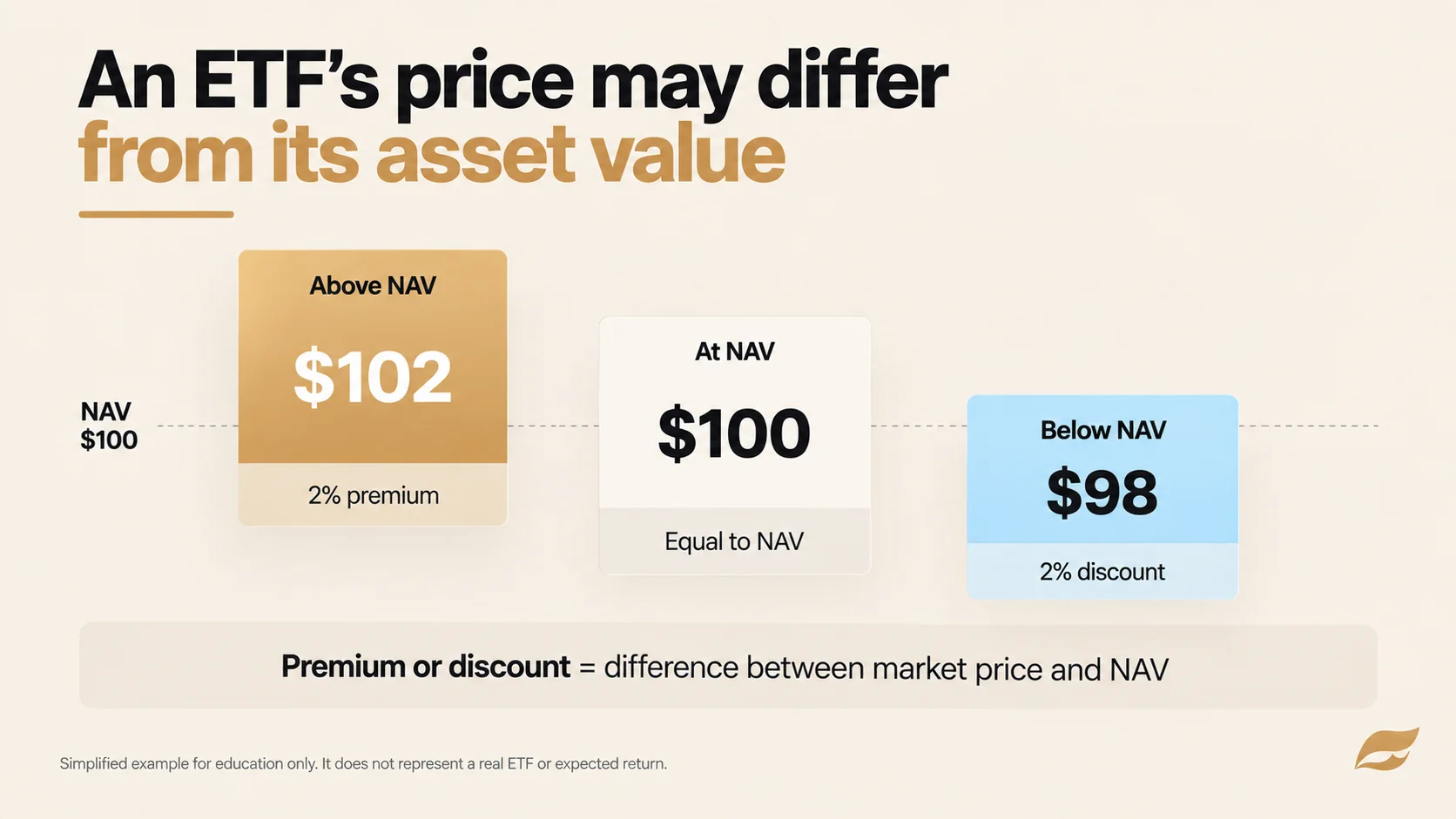
The fund also calculates its net asset value, known as NAV. NAV is the value of the fund’s assets after its liabilities are deducted, divided by the number of fund shares. It is normally calculated once each business day.
The ETF’s trading price and NAV are not always identical. When the market price is higher than NAV, the ETF is trading at a premium. When it is lower, the ETF is trading at a discount.
The US Securities and Exchange Commission confirms that retail investors buy and sell ETF shares at market prices that may be above or below the fund’s NAV. Read the SEC overview of ETFs.
What can an ETF hold?
The holdings depend on the fund. Read the fund’s summary prospectus and latest reports instead of relying only on its name.
Stock ETFs
Stock ETFs hold shares in companies. A broad stock ETF may cover many companies across different industries. A narrower ETF may focus on one sector, country, company size, or investing style.
The value of a stock ETF changes with the companies it holds. A broad fund may spread company-specific risk, but it can still fall when the wider market declines.
Bond ETFs
Bond ETFs hold debt issued by governments, companies, or other organizations. The bonds may have different repayment dates, payment terms, and levels of credit risk.
These ETFs can receive scheduled income from their holdings and may pass income to investors through distributions. Their share prices can still fall. Changes in market rates, issuer credit quality, and trading conditions can affect their value.
Real estate ETFs
A real estate ETF usually holds shares in real estate investment trusts or property-related companies. It does not normally give the investor a direct share of a particular home.
Its performance depends on the businesses and securities it holds. Property markets may affect the fund, but so can company debt, management decisions, operating costs, and stock market demand.
Sector and thematic ETFs
These ETFs focus on a particular industry or idea, such as technology, healthcare, clean energy, or robotics. The focus may sound clear, but the fund can still be complex. Two ETFs with similar names may hold different companies or follow different rules. A narrow theme can also create concentration risk.
International ETFs
International ETFs hold assets linked to countries outside the investor’s home market. Some focus on one country. Others cover a region or a group of developed or emerging markets.
These funds can carry currency, political, regulatory, and market risks. Buying the ETF in your home currency does not always remove the currency exposure inside the fund.
Commodity ETFs and related products
Some funds provide exposure to commodities such as gold or oil. They may hold the physical asset, contracts linked to its future price, or shares in related companies.
The legal structure matters. Not every exchange-traded product is a registered ETF. An exchange-traded note, for example, is a debt obligation rather than a fund holding a basket of assets. Check the product documents before buying.
Leveraged and inverse ETFs
Leveraged ETFs aim to produce a multiple of a benchmark’s daily result. Inverse ETFs aim to produce the opposite of a benchmark’s daily result.
These products normally reset each day. Their longer-term performance can differ greatly from a simple multiple or opposite of the benchmark’s return over the same period. They may create fast and substantial losses.
The SEC describes leveraged and inverse ETFs as complex products with risks that may not suit every investor.
How can an ETF make or lose money?
An ETF investor may receive a return in two main ways.
The first is a change in the share price. If you sell an ETF for more than you paid after costs, you make a gain. If you sell it for less, you make a loss.
The second is a distribution from the fund. Assets held by the ETF may produce company payments, bond income, rent-related income, or other earnings. The ETF may pass some of this income to its shareholders. The amount and timing depend on the fund.
The final result is affected by costs. ETFs charge operating expenses, usually shown as an expense ratio. The expense ratio is deducted from fund assets, so it reduces investor returns over time.
Other costs may include brokerage charges and the bid-ask spread. The bid is the highest price a buyer is offering. The ask is the lowest price a seller will accept. The gap between them is a trading cost.
An ETF may also fail to follow its target index exactly. The difference between the ETF’s result and the index result is often called tracking difference. Fund costs, trading, taxes, and the way the portfolio is managed can contribute to it.
The SEC notes that ETF costs can include expenses not shown in the main fee table, including some brokerage and transaction costs. Read the SEC guidance on ETF fees.

What are the risks of ETF investment?
An ETF is not automatically safe because it holds several assets. You need to check what is inside the fund and how it works.
Market risk
The ETF can fall when the assets it holds lose value. A stock ETF may fall during a stock market decline. A bond, property, or commodity ETF can also fall when conditions change in its market.
Concentration risk
Some ETFs hold many assets but remain concentrated in one industry, country, theme, or small group of companies. Several holdings may be exposed to the same problem. A single-stock ETF may follow only one company. It does not provide the broad diversification that many people associate with ETFs.
Premium and discount risk
You may pay more than the fund’s underlying assets are worth if the ETF trades at a premium. You may receive less than that underlying value if you sell at a discount. The difference can become larger when markets are volatile or when the underlying assets are difficult to trade.
Liquidity and spread risk
An ETF with little trading activity may have a wider bid-ask spread. This can increase the cost of entering or leaving the investment.
The liquidity of the assets inside the fund also matters. An ETF may trade on an exchange even when some of its underlying holdings are difficult to buy or sell.
Tracking risk
An index ETF may not match its benchmark exactly. Costs, portfolio changes, trading delays, and the fund’s method can create a difference.
Read the fund’s reports to see how closely it has followed its stated target. Past results do not guarantee the same outcome later.
Fee risk
A small annual percentage can make a noticeable difference when it is charged year after year. Some ETFs also invest in other funds, creating more than one layer of expenses.
Do not assume every ETF is low cost. Compare expense ratios, brokerage charges, spreads, and any account fees.
Currency and overseas market risk
An international ETF may lose value when exchange rates change, even if some of its overseas holdings perform well in their local currency. Different markets may also follow different rules, reporting standards, and trading hours.
Complex product risk
Leveraged, inverse, commodity-linked, and single-stock ETFs may behave very differently from a broad index fund. Their daily objectives and legal structures need closer review.
If the product is difficult to explain in plain words, do not assume the ETF label makes it simple.
Frequently asked questions
Is an ETF suitable for beginners?
Some broad ETFs are easier to understand than complex trading products, but the ETF label alone does not make a fund suitable for beginners. Check its holdings, objective, fees, risk level, and trading structure.
Leveraged, inverse, and single-stock ETFs are more complex. A new investor should not treat them like a basic broad-market fund.
Is an ETF the same as a stock?
No. A stock normally represents ownership in one company. An ETF share represents ownership in a fund that may hold many investments.
Both can trade on an exchange, and both can rise or fall during the trading day.
Can an ETF lose money?
Yes. An ETF can lose value when its holdings fall, its market price changes, or costs reduce the return. Some ETFs can lose a large part of their value in a short time.
Does every ETF provide diversification?
No. A broad ETF may hold hundreds of investments, while a narrow or single-stock ETF may provide very little diversification. Read the holdings rather than relying on the fund name.
What is the difference between an ETF and a mutual fund?
Both pool investor funds and hold a portfolio. ETF shares trade on exchanges throughout the day at market prices. Mutual fund purchases and redemptions normally use the NAV calculated at the end of the trading day.
Both may charge operating expenses, and other costs can apply. FINRA provides a current comparison of ETFs and mutual funds.
Is an ETF safer than a high-yield savings app?
They are different products. An ETF is an investment whose value can fall. A high-yield savings app may provide a cash account, but its protection depends on where the money is legally held and whether the deposit qualifies for government insurance.
Do not assume an app is protected simply because it uses the word “savings.”
How to protect savings from inflation with ETFs?
Some people use stock, property, or other asset ETFs to seek growth that may outpace rising prices over time. This is not guaranteed. An ETF can fall in value, and inflation may still be higher than its return.
Funds needed soon should not be exposed to market losses only because inflation is reducing buying power.
Should you build savings before buying ETFs?
It is generally sensible to keep accessible funds for bills and unexpected costs before investing money that may fall in value. Practical tips for saving money fast may help you build that reserve, but the amount should fit your own expenses and needs.
Is PureFi a real estate ETF?
No. A real estate ETF normally holds REITs or property-related companies. PureFi lets users buy shares of individual homes. Projected earnings come from rent and changes in those homes’ values.
Put Your Dollars Into Something Real
With PureFi, your projected earnings come from shares of real homes with tenants. Choose your properties from your phone, review the documents, and see every fee before you confirm.
Learn more about how PureFi can help you own real estate shares or download the app to get started today.