What Is APY on a Savings Account?

What Is APY on a Savings Account?
APY stands for annual percentage yield. It shows how much your savings could earn over one year when compounding is included.
You will usually see APY listed when comparing a traditional savings account, online savings app, or high-yield digital savings account. A higher APY can mean higher earnings. But the number alone does not tell you everything about an account.
In this article, we’ll explain what APY measures, how compounding changes your balance, why APY can change, and how fees, access, and account protection may affect your savings.
What does APY mean?
APY (Annual Percentage Yield) turns an account’s earning rate into one yearly percentage. This gives you a standard number that you can use to compare accounts.
For example, an account with a 5% APY could earn about $50 on a $1,000 balance over one year. This assumes:
- The APY stays at 5%.
- The full $1,000 remains in the account.
- You do not make any withdrawals.
- No fees reduce the balance.
The actual amount may be different if any of these things change. APY also includes compounding. This is important because compounding can increase the amount you earn over time.
How does APY work on a savings account?
A savings provider applies a yield rate to the eligible money held in your account. Your earnings may be calculated each day and added to the account monthly. Other providers may use a different schedule.
Once those earnings enter your balance, they may begin earning too. APY includes this effect and shows the estimated result across one year.
Under the official CFPB APY calculation rules , the yearly calculation for a standard savings account assumes that the original balance and its earnings remain in the account for 365 days. It also assumes there are no added deposits or withdrawals during that time. This makes APY useful for comparison. It does not mean your account will earn that exact amount.
How does compounding affect APY?
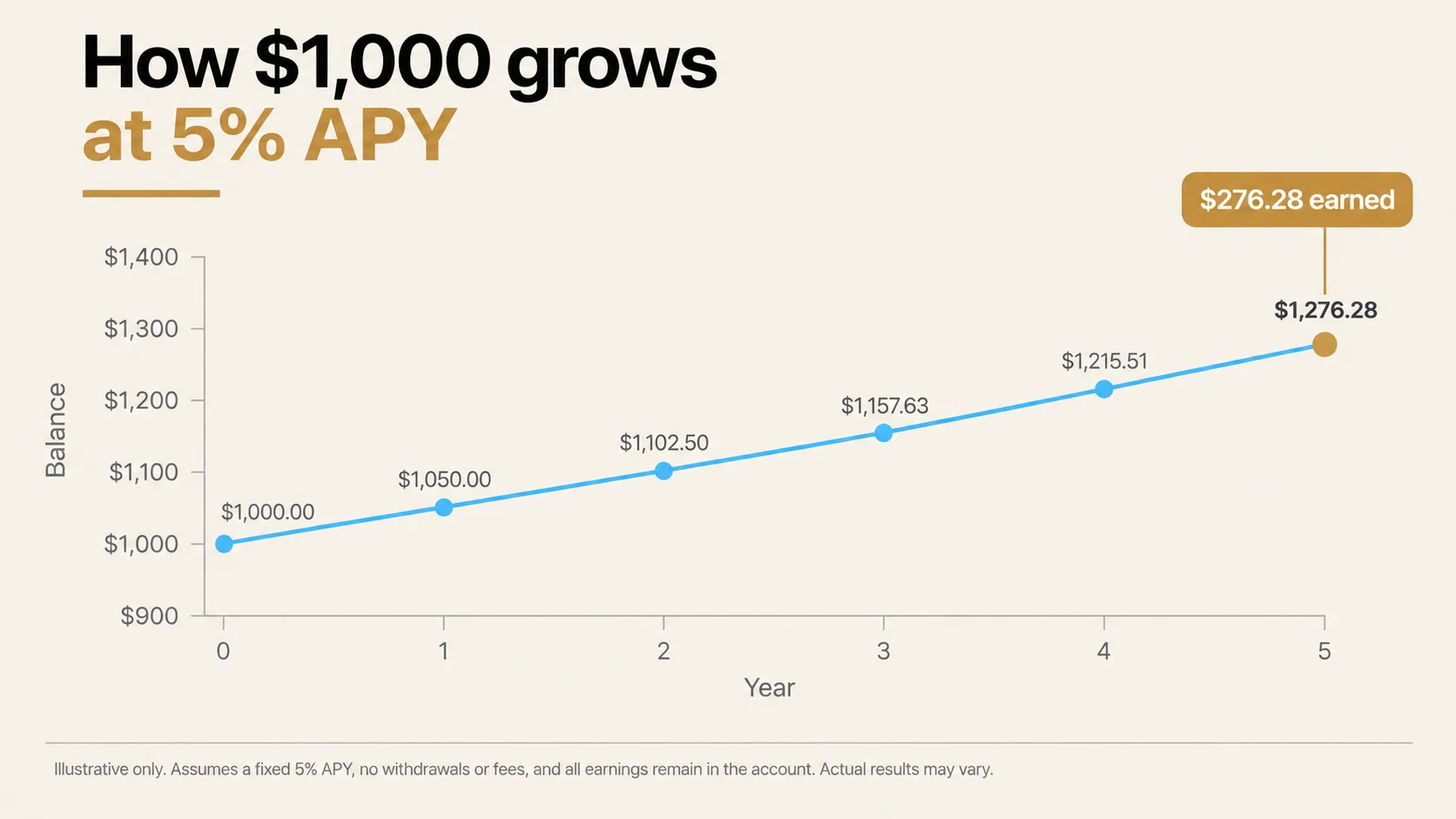
Compounding means earning on both your starting balance and the earnings already added to it. Suppose you place money in an account and receive earnings at the end of the first month. Those earnings become part of your new balance. During the next month, the provider may calculate earnings using that larger balance.
The process continues for as long as the funds remain in the account. Some accounts compound daily. Others compound monthly or on another schedule. More frequent compounding can increase your total earnings when the basic rate is the same.
You do not need to calculate each compounding period yourself when comparing accounts. The APY already includes it.
How can you estimate your APY earnings?
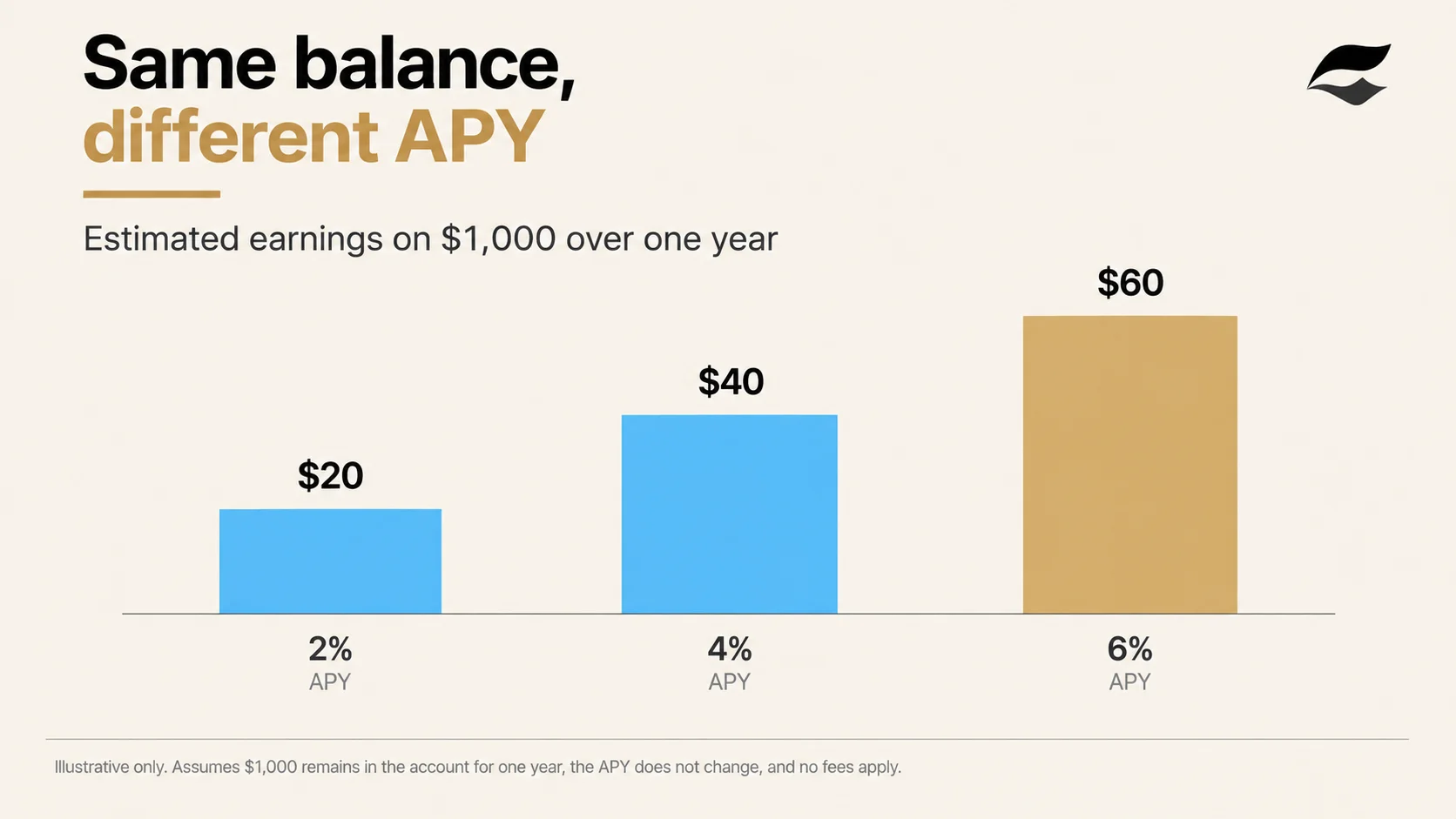
For a quick one-year estimate, multiply your balance by the APY written as a decimal.
Balance × APY = estimated earnings for one year
If an account offers a 4% APY and you keep $2,000 in it for a full year:
$2,000 × 0.04 = $80
The estimated closing balance would be $2,080.
This is a simple illustration. It assumes the APY and balance do not change. It also assumes that no account fees apply.
The calculation becomes less exact when you add or withdraw funds during the year. Money added later will not have a full year to earn. Money taken out will stop contributing to future earnings.
Why can APY change?
Many savings accounts have a variable APY. The provider can raise or lower it over time.
A change may apply to both new and existing customers. The APY you see when you open the account may therefore be different several months later.
Some accounts also offer a promotional APY. This may apply only during an opening period. Once that period ends, the account changes to its standard APY.
The balance can matter too. A provider may offer different APYs for different balance levels. It may also limit the highest advertised APY to a certain part of the balance.
Before opening an account, check:
- Whether the APY is variable.
- How long any promotional APY lasts.
- Whether a minimum balance is required.
- Whether the APY applies to the whole balance.
- Whether there is a maximum eligible balance.
The highest number in an advertisement may not apply to every customer or every dollar held in the account.
What affects how much you earn?
APY is only one part of the calculation. Your actual earnings also depend on how you use the account.
Your balance
A larger eligible balance will usually produce more earnings when the APY is the same.
Time in the account
Money must remain in the account to earn. Funds deposited halfway through the year will have less time to grow than funds held for the full year.
Deposits and withdrawals
Adding money can increase future earnings. Taking money out reduces the balance used for later calculations.
APY changes
A variable APY may rise or fall during the year. This changes the amount you earn from that point onward.
Account fees
Monthly fees and withdrawal charges can reduce your balance. A strong APY may offer little value if regular fees take away much of what you earn.
Account conditions
Some providers require a minimum balance, regular deposits or other activity before the highest APY applies. Read the account terms rather than relying only on the headline figure.
How should you compare APYs?
Compare APY with APY. Do not compare an APY from one provider with a basic rate shown by another.
Start by checking whether both figures apply for a full year. A temporary promotional APY may look better at first but fall once the offer ends.
You should also compare the conditions attached to each account. Look at minimum balances, balance caps, fees and withdrawal rules.
Access matters as well. An online savings app may take several working days to transfer funds to another account. A high yield savings app may also limit certain transfer methods or charge for faster access.
Protection is separate from APY. In the United States, eligible accounts at covered banks or credit unions may have federal protection. Coverage depends on the institution, account type and ownership category. For example, the NCUA protects eligible accounts at federally insured credit unions within its coverage rules.
A high APY does not prove that an account has this protection. Check the provider and the exact product before depositing money.
Savings APY and projected APY are not the same
APY can appear on both savings accounts and asset-based platforms. The same letters may be used, but the way earnings are produced can be different.
A bank savings APY applies to money held in a deposit account. An APY shown by a high yield investment platform may be a projection based on the performance of an asset.
This distinction matters. Asset-based earnings can change with rent, property values or market conditions. The value of the asset itself may also rise or fall.
PureFi is a digital savings platform, not a bank. It lets you buy shares of individual, income-producing homes. Each home is bought outright and professionally managed.
Your potential earnings come from your share of the rent and changes in the home’s value. Nothing is lent out. PureFi currently shows up to 6% projected APY , but this figure is variable and is not a promise of future earnings.
Your property shares are also not bank deposits. They do not have FDIC or NCUA protection and may lose value. You can review the available property, its documents and its projected figures before deciding whether to buy.
Put your dollars into something real
PureFi gives you a simple way to own shares of real homes from your phone. When rent comes in, you earn your share. You can reinvest those earnings or take them out.
There are no monthly fees. A one-time purchase fee is shown before you confirm an order. You can also sell your shares at the current market price without a fixed lock-up.
Learn more about how PureFi can help you own real estate shares or download the app to get started today.
Up to 6% APY is projected, variable and not guaranteed. Property shares can lose value. PureFi is not a bank, and its balances and real estate shares are not covered by FDIC insurance or another government deposit scheme.