What is a Good Savings Rate?
What is a Good Savings Rate?
A good savings rate is one that sits clearly above the national average without high fees or difficult account conditions.
The FDIC reported an average US savings rate of 0.38% APY as of August 17, 2026. By comparison, some leading high-yield accounts were advertising up to 4.50% APY in September 2026. The highest offers often came with balance limits or other requirements, so the headline number did not always apply to every dollar in the account.
These figures will change. A competitive rate today may become average within a few months. In this article, we’ll explain how APY works, where savings yield comes from, and why the rate can change.
What is considered a good savings rate?
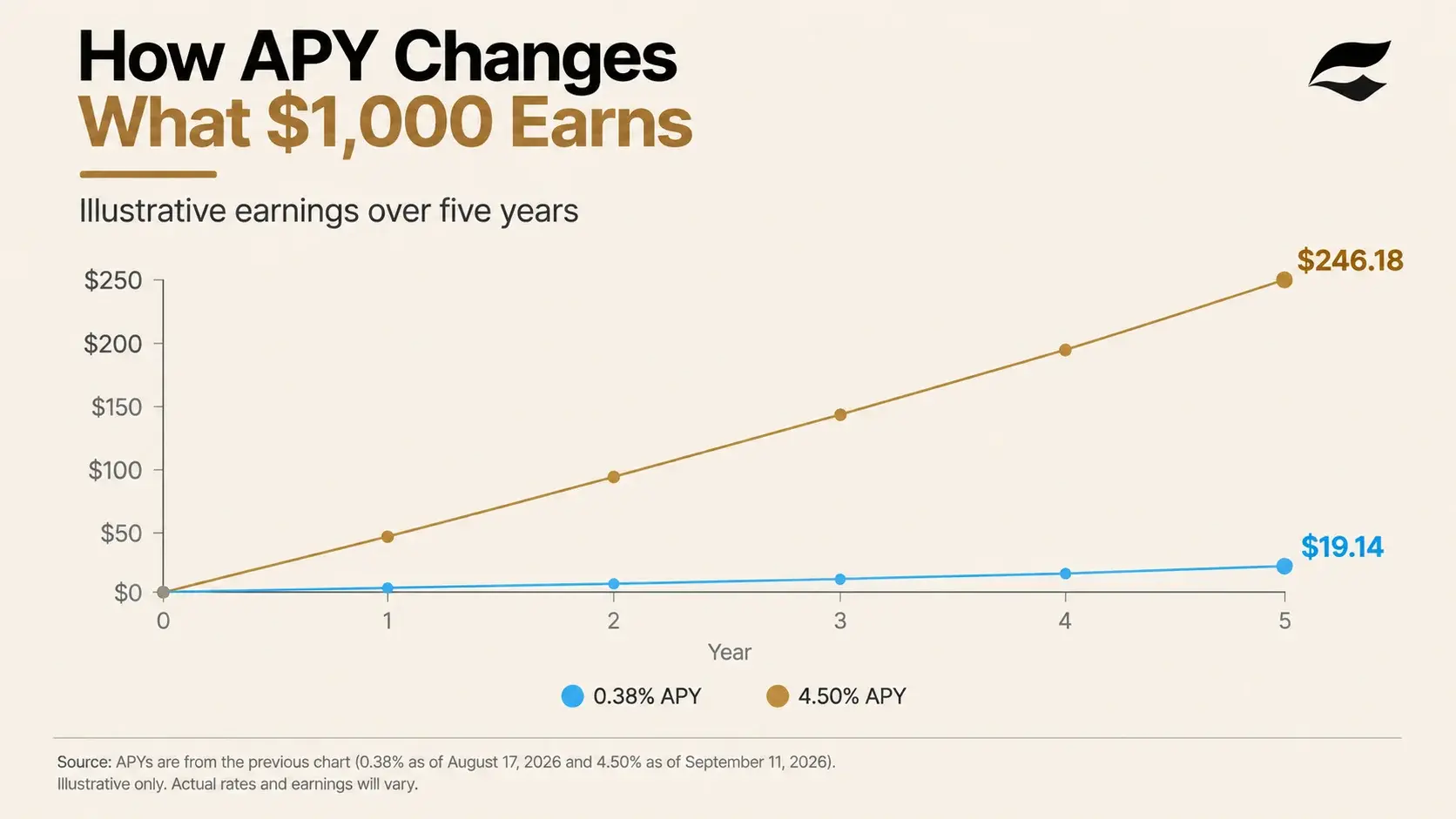
There is no single percentage that always counts as a good savings rate. Market conditions change, and providers adjust their rates in response. A practical way to judge an account is to compare its APY with the current national average. If the account pays several times more than that average, it may be competitive.
However, the rate must apply to your actual balance. An account advertising a high APY may only pay that amount on the first part of your savings. Money above that limit may earn much less.
For example, an advertised rate may only apply if you:
- Keep your balance below or above a set amount
- Add a minimum amount each month
- Receive regular payments into the account
- Open another product with the same provider
- Pay for a membership-
- Complete a set number of transactions
A lower rate with no conditions may sometimes earn more than a higher rate that only applies to part of your balance.
The national average is useful as a benchmark, but it is not a target. It includes accounts from many providers, including large banks that may pay very little. The FDIC updates its national savings data regularly.
What does APY tell you?
APY stands for annual percentage yield. It shows how much your money could earn over one year if the rate stays the same and the earnings are added back to the account. This makes APY useful when comparing savings accounts. It includes compounding, which happens when you begin earning on both your original balance and the amount already added to it.
A higher APY usually means faster growth when:
- The starting balances are the same
- The rate applies to the full balance
- Neither account charges fees
- The money remains in the account
- The rate stays unchanged
APY does not promise that you will receive the same rate for a full year. Most savings accounts have variable rates. The provider can raise or lower the APY after the account has been opened.
This is why an online savings app should clearly show both the current APY and any conditions attached to it. US savings providers are also required to disclose APY, minimum-balance rules, and fee schedules so consumers can compare accounts. The CFPB explains these disclosure requirements under Regulation DD.
What makes a savings rate competitive?
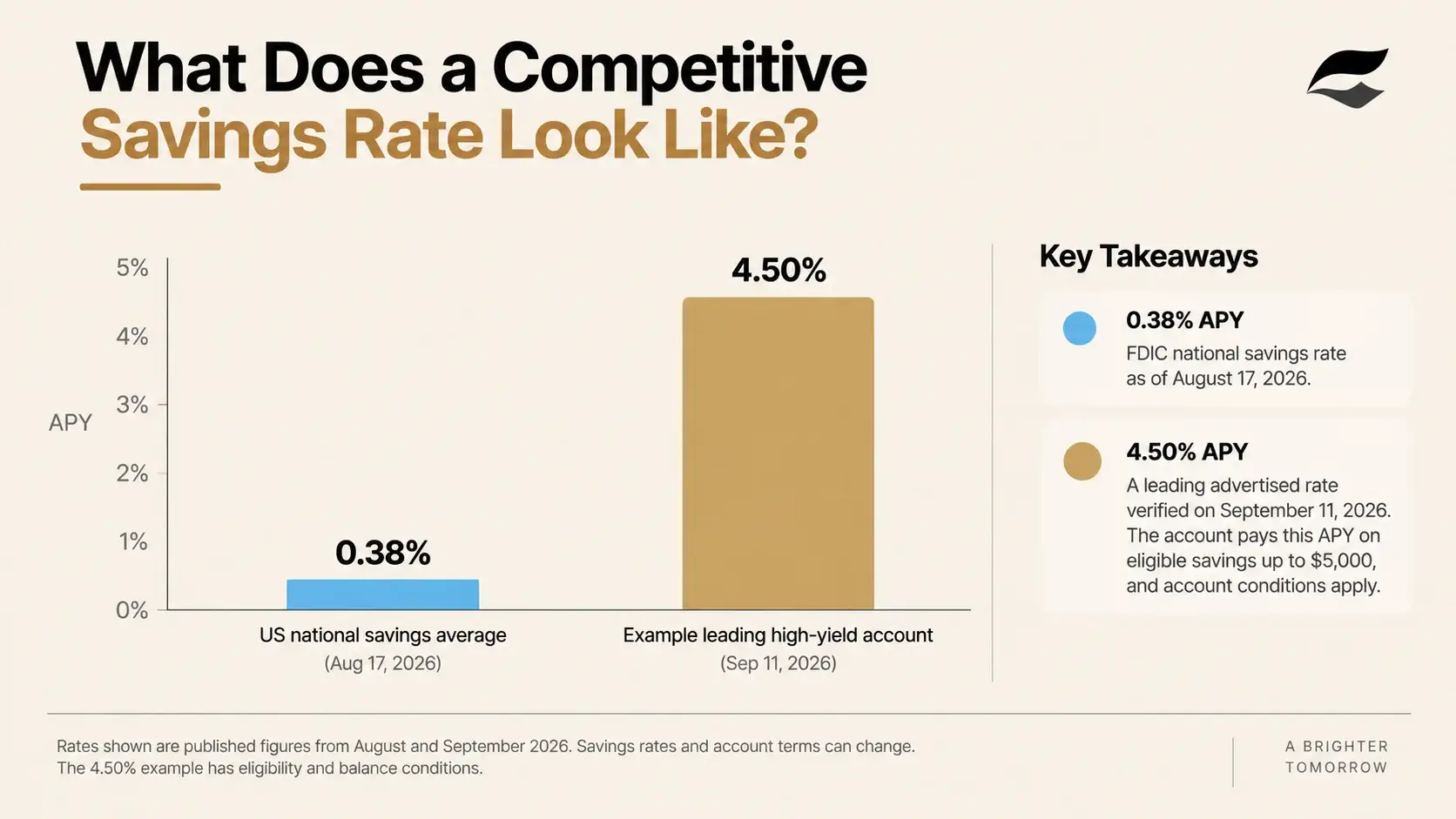
A competitive rate does more than look good in an advertisement. It needs to provide a meaningful return on the money you actually plan to keep in the account.
It is above the national average
Start with the latest national average for a basic savings account. This shows what banks and credit unions are paying across the market. A high-yield digital savings account should normally pay more than an ordinary savings account. If its APY is close to the national average, it may not provide much extra value.
Always check the date attached to a national average or account comparison. Savings rates can change quickly, so a figure from last year may no longer be useful.
It applies to your full balance
Some providers advertise their highest APY even though it only applies to a small part of the account.
Check the balance tiers before opening an account. A provider may pay one rate on the first $5,000 and a much lower rate on everything above it. Another may only pay its best rate once the balance reaches a set minimum.
Work out which rate applies to the amount you plan to save. Do not judge the account only by its largest advertised number.
It is not only a short promotion
A high-yield savings app may offer a promotional APY to new customers. The rate could fall after a few weeks or months. Promotional rates are not automatically bad. They can still provide value if the conditions are clear. The important point is knowing:
- When the promotion ends
- What the rate becomes afterwards
- Whether the offer applies to new deposits only
- Whether you must keep the account open for a minimum period
A competitive account should make these details easy to find.
It does not require costly conditions
Some providers only offer their highest rate when users meet several monthly requirements. You may need to pay for an account plan, maintain a large balance, or add a set amount every month. Missing one condition could cause the rate to fall.
Check whether the conditions fit how you already manage your money. Paying a monthly fee only to unlock a higher APY may not make sense for a smaller balance.
Fees do not cancel out the yield
A monthly account fee reduces the amount you earn. This matters most when the balance is small. Even a modest fee can remove most or all of the yield earned during the month.
A competitive digital savings platform should clearly display its:
- Monthly account fee
- Minimum-balance fee
- Transfer charges
- Withdrawal charges
- Membership cost
Compare what remains after these costs, not just the advertised APY.
Why do savings rates change?
Most savings accounts have variable rates. This means the provider can change the APY while the account remains open. Savings providers use customer deposits as part of their wider banking operations. The yield they offer depends on how much they want to attract deposits and what they can afford to pay.
Several factors can cause a rate to change.
Changes in the wider economy
Savings rates often respond to changes in benchmark rates and wider economic conditions. When market rates rise, banks may offer more to attract deposits. When they fall, savings APYs may also fall.
The change is not always immediate. Each provider decides when and how much to adjust.
Competition between providers
A newer online savings app may offer a higher APY to attract customers. Other providers may then increase their rates to remain competitive.
A provider that already has enough deposits may not need to offer as much. This is one reason large banks can pay less than smaller or online providers.
The provider’s business costs
Every provider has operating expenses. These include staff, technology, customer support, compliance, and physical branches.
A digital provider may have lower costs because it does not operate a large branch network. That can leave more room to offer a stronger APY, although it does not guarantee that every digital account will pay more.
Temporary promotions
A provider may raise its APY for a limited campaign and reduce it when the offer ends. The account may still be described as a high-yield product even after its rate falls.
Check the account regularly and read notices sent by the provider. Do not assume the opening rate will remain unchanged.
Savings rates and investment yields are not the same
A savings rate is the APY paid on money held in a savings account. The account balance does not normally rise or fall with property or market values. An eligible account at an FDIC-insured bank or federally insured credit union may also receive government-backed protection within the applicable limits.
An investment yield works differently. A high-yield investment platform puts money into assets that can gain or lose value. The amount earned depends on the performance of those assets.
PureFi falls into this second category. It is a financial technology company, not a bank or savings provider. Money invested through PureFi buys shares of real homes with tenants.
Potential earnings come from rent and changes in home values. PureFi currently shows up to 6% projected APY, but this figure is variable and not guaranteed. Property shares can lose value. PureFi users can sell their shares at the current market price without a fixed lock-up. However, the sale price may be higher or lower than the original purchase price.
A savings account may be more suitable for money that must remain stable and easy to access. Real estate shares may suit money that can be exposed to changes in property value. They should not be compared using APY alone.
Put your dollars into something real
With PureFi, your projected earnings come from shares of real homes with tenants . Choose your properties from your phone, review the documents, and see every fee before you confirm.
Learn more about how PureFi can help you own real estate shares or download the app to get started today.
Up to 6% APY is projected, variable and not guaranteed. Property shares can lose value. PureFi is not a bank, and its balances and real estate shares are not covered by FDIC insurance or another government deposit scheme.