What Is a Good APY for a CD?
What Is a Good APY for a CD?
As of September 2026, a good APY for a CD is around 4.25% to 5.00%, depending on the term and the rules attached to the account.
For standard terms such as six months, one year and two years, many competitive offers sit between 4.20% and 4.45% APY. The highest nationwide offer currently reaches 5.00% APY, but it is a short promotional CD with limits on how much you can deposit.
By comparison, the national average for a 12-month CD was 1.71% in August 2026. This means there can be a large gap between an average CD and a leading offer.
APYs change, so these figures will not stay current forever. In this article, we’ll explain what makes a CD APY competitive, how the term affects it, when you can access your money, and what account protection may apply.
Current CD APYs at a glance
Here is a snapshot of leading nationwide CD offers available on September 11, 2026:
| CD term | Leading APY |
|---|---|
| Short promotional term | Up to 5.00% |
| Around 6 months | Up to 4.31% |
| Around 1 year | Up to 4.45% |
| Around 2 years | Up to 4.45% |
| 3 to 5 years | Up to 4.50% |
The 5.00% offer applies to a four-month CD. It requires at least $1,000 and limits eligible deposits to $5,000. This is why the highest APY should always be read with its account rules.
The six-month, one-year, and two-year figures come from offers checked and available nationwide as of September 11, 2026. The overall market comparison included CDs from more than 200 banks and credit unions. View the September 2026 CD comparison.
Rates may change after publication. Confirm the latest APY directly with the provider before applying.
What is a CD?
A certificate of deposit, or CD, is an account offered by a bank or credit union. You deposit a set amount for an agreed period. This period is called the term. Common terms include three months, six months, one year, and five years.
The CD reaches maturity when the term ends. At that point, you can withdraw the original deposit and the amount earned.
You generally agree to leave the money in the CD until maturity. Taking it out early can lead to a penalty. The Consumer Financial Protection Bureau recommends choosing a maturity date based on when you expect to need the money.
What does APY tell you?
APY stands for annual percentage yield. It estimates how much an account can earn over one year when compounding is included. Compounding happens when earnings are added to the account balance. New earnings can then be calculated using the larger balance.
If you place $5,000 in a one-year CD with a 4.25% APY, it would earn about $212.50 over the year. The balance at maturity would be about $5,212.50. This example assumes the full deposit remains in the CD for one year and the APY does not change.
APY gives you a standard way to compare CDs. When two CDs have the same term, the one with the higher APY will earn more if the deposit amount and other conditions are the same.
How does the national average compare?
The FDIC publishes national deposit rates for common CD terms. These figures cover insured banks and credit unions and are weighted by their share of domestic deposits.
The national average for a 12-month CD was 1.71% in August 2026. The leading one-year APY available on September 11 was 4.45%.
On a $5,000 deposit held for one year:
- A 1.71% annual yield would produce about $85.50.
- A 4.45% APY would produce about $222.50.
- The difference would be about $137.
These calculations are simple illustrations. They assume the deposit remains unchanged for a full year. The national average is useful as a starting point. However, it does not show the strongest offer available. A good APY will usually be well above the average for the same term.
You can review the latest national figures through the FDIC rate data published by FRED .
Does a longer CD offer a better APY?
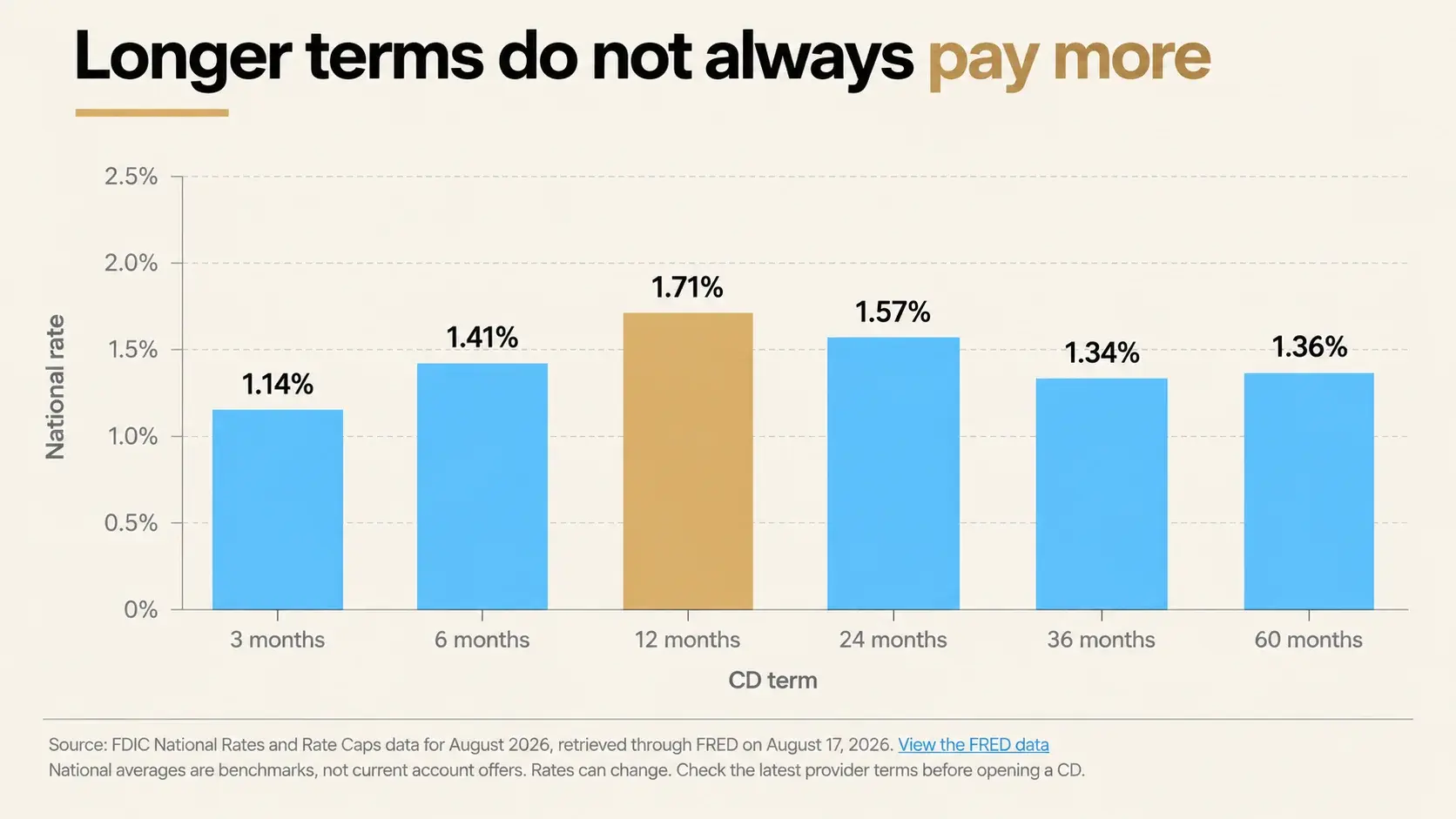
Not always. Banks and credit unions decide their CD APYs based on current market conditions and what they expect to happen during each term. A six-month CD can sometimes offer a higher APY than a five-year CD.
In September 2026, several shorter and medium-term CDs offered APYs similar to or higher than many longer products. This means you should compare matching terms:
- Compare six-month CDs with other six-month CDs.
- Compare one-year CDs with other one-year CDs.
- Compare five-year CDs with other five-year CDs.
Do not choose a longer term only because you expect it to offer more. Check the actual APY and decide whether you can leave your money there until maturity.
Is the highest APY always the best choice?
The highest APY is not always the best CD for you. A top offer may require a large opening deposit. It may only be available to members of a credit union or people living in certain areas. It may also have a low maximum deposit.
The 5.00% APY available in September 2026 is a good example. It leads the nationwide rankings, but it has a four-month term and only applies to deposits between $1,000 and $5,000.
Another CD offering 4.40% or 4.45% may allow a larger deposit or provide a term that better matches your plans. Before choosing, check:
- The minimum deposit
- The maximum eligible balance
- The maturity date
- The early withdrawal penalty
- Membership or location rules
- Whether the APY is fixed
- What happens after maturity
A competitive APY only helps when you can meet the account rules.
Check the early withdrawal penalty
A CD is meant for money you can leave alone until maturity. If you take it out early, the provider may reduce the amount you earned. Some penalties equal several months of earnings. Longer CDs may have larger penalties.
In some cases, the penalty could be more than the amount already earned. The remaining cost may then be taken from the original deposit. Read the account agreement and find out:
- How the penalty is calculated
- Whether partial withdrawals are allowed
- Whether the original deposit could be reduced
- Whether any exceptions apply
No-penalty CDs are also available. They provide more access, but their APYs may be lower than standard CDs.
Check the minimum deposit
Minimum deposits vary widely. Some CDs have no minimum. Others require $500, $1,000, $10,000 or more. A higher minimum does not always produce a higher APY.
For example, one leading one-year CD offered 4.45% APY with a $1,000 minimum in September 2026. Another provider offered 4.25% APY but required $10,000.
Do not place more money in a CD than you can afford to leave there. Keep enough accessible funds for regular expenses and unexpected costs.
Is the APY fixed for the whole term?
Most standard CDs have a fixed APY. The provider agrees to apply it until the maturity date. This gives you a clearer idea of how much the CD can earn. It also means you may miss better APYs if market rates rise while your money is locked in.
Some CDs have variable terms. Others allow one APY increase if the provider starts offering a better rate. These may be called bump-up or step-up CDs.
Check the agreement to see:
- Whether the APY is fixed
- When it can change
- Who can request a change
- How many changes are allowed
Do not assume every CD works in the same way.
What happens when the CD matures?
When the term ends, the provider usually gives you a short grace period. This is your chance to withdraw the money or place it in a new CD.
If you do nothing, the CD may renew automatically. The renewed CD may have the same term but a different APY. Check the maturity notice for the new terms. The APY available at renewal may be lower than the one you originally received.
Set your own reminder before the maturity date. This gives you time to compare new offers.
CD versus a high-yield savings account

A CD and a high-yield digital savings account can both help cash earn. The main difference is access.
| Feature | CD | High-yield savings account |
|---|---|---|
| APY | Usually fixed for the term | Usually variable |
| Access | Limited until maturity | Withdrawals are generally easier |
| Term | Fixed period | No maturity date |
| Early withdrawal | A penalty may apply | No CD maturity penalty |
| Best suited to | Money needed on a known future date | Money that may be needed sooner |
A high-yield savings app or online savings app may be more suitable for an emergency fund. A CD may work better for money you know you will not need until a set date.
What should you check before opening a CD?
A good CD APY is currently around 4.25% to 5.00%, but the number must be considered alongside the account terms.
Before opening a CD, check:
- How the APY compares with other CDs offering the same term
- Whether the APY is fixed
- The minimum and maximum deposit
- The maturity date
- The early withdrawal penalty
- Account eligibility
- Automatic renewal rules
- The grace period
- Federal account protection
- When you expect to need the money
The goal is not simply to find the highest APY. It is to find a competitive APY on a CD that you can keep until maturity.
Put your dollars into something real
With PureFi, your projected earnings come from shares of real homes with tenants . Choose your properties from your phone, review the documents, and see every fee before you confirm.
Learn more about how PureFi can help you own real estate shares or download the app to get started today.
Up to 6% APY is projected, variable and not guaranteed. Property shares can lose value. PureFi is not a bank, and its balances and real estate shares are not covered by FDIC insurance or another government deposit scheme.