Can You Have Multiple High-Yield Savings Accounts?

Yes, you can normally have multiple high-yield savings accounts. You can open more than one account with the same provider, use several providers, or combine online accounts with an account at a traditional bank or credit union.
There is no general federal rule limiting how many savings accounts one person can own. However, each provider can decide how many accounts it allows a customer to open. You will also need to meet the eligibility and identity-check requirements for every new provider.
Several accounts can help you separate savings goals, compare yields, and keep another way to access money. In this article, we explain when multiple accounts are useful and how federal deposit protection works when your savings are divided between them.
Is there a limit on how many accounts you can open?
There is no standard legal limit on the number of high-yield savings accounts you can have in the United States. The practical limit comes from the providers you choose.
One provider may let you open several separate accounts or create savings buckets inside one account. Another may limit each customer to one account of the same type. Some providers also limit the number of applications you can submit within a certain period.
Opening an account is not automatic. A provider may ask for:
- your full legal name
- date of birth
- residential address
- taxpayer identification number
- government-issued identification
- information about the account you will use for funding
You may need to complete these checks again when opening an account with a different provider. Eligibility rules can also differ. An online savings account may require a U.S. address, local tax number, or linked U.S. account.
Having an existing account does not guarantee approval for another one. The provider can review your application and banking history under its own rules.
Why have multiple high-yield savings accounts?
There is no need to open several accounts simply because you can. The setup works best when each account has a clear purpose.
Here are five reasons someone may choose to use more than one.
1. Keep different savings goals separate
One account can hold emergency savings, while another holds money for school fees, travel, an annual bill, or a planned purchase.
Separating the balances makes it easier to see how much you have saved for each goal. You do not need to subtract upcoming expenses from one large total every time you check the account.
Some providers offer named buckets inside one account. That can achieve the same basic result without requiring several account numbers. Check whether the buckets are only labels or legally separate deposit accounts, especially when reviewing deposit protection.
2. Compare yields from different providers
Savings rates are variable. Two providers can start with similar APYs and change them at different times.
Holding more than one savings account with high yield lets you compare actual account terms rather than relying on an advertisement. You can see how often the provider changes its APY, how clearly it communicates changes, and whether the rate comes with conditions.
This does not mean you need to transfer your full balance whenever another provider offers a slightly higher rate. A transfer can take time, and a new account may have fees or minimum-balance rules. Compare the whole account before deciding where to keep more of your savings.
3. Keep a second way to access savings
Access can differ between providers. One online high yield savings account may offer internal transfers to checking. Another may provide only external ACH transfers.
Having savings at more than one provider can give you another access route if one app is unavailable or a transfer is delayed. This can be useful when part of the money is meant for emergencies.
The second account is not a guarantee of instant access. Each provider can apply deposit holds, transfer limits, and security checks. Review the withdrawal methods and normal processing times for both accounts.
4. Manage deposit-protection limits
Accounts held at different insured institutions receive separate federal coverage. This can matter when a person holds more than the standard coverage limit at one bank or credit union.
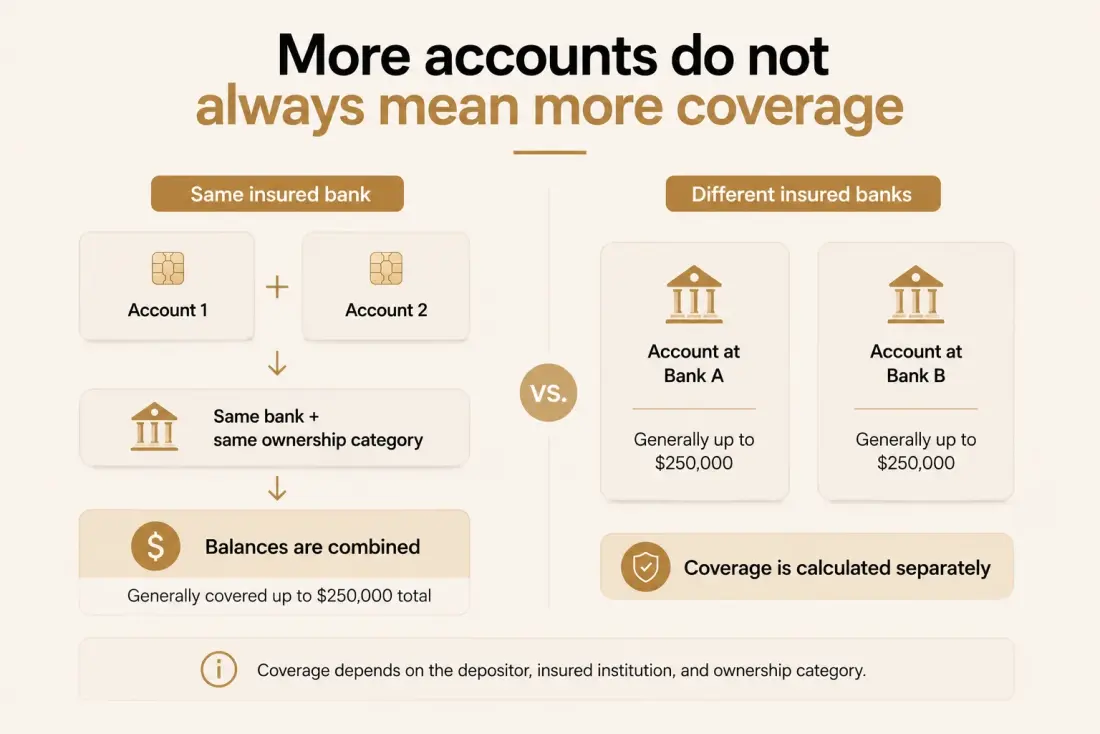
Opening several accounts at the same bank does not automatically increase protection. The FDIC adds together deposits held by the same person in the same ownership category at the same insured bank.
For example, two single-owner savings accounts at one insured bank are normally combined when coverage is calculated. Opening a third account at another branch of that bank does not create a new limit because all branches belong to the same institution.
Coverage at a separate FDIC-insured bank is calculated separately. Different ownership categories can also receive separate coverage when all FDIC requirements are met.
The same general principle applies to federally insured credit unions. Accounts at one insured credit union are reviewed together according to their ownership categories. Accounts at separate insured credit unions receive separate coverage.

5. Use different accounts for different features
The account with the highest APY may not offer the easiest access. Another provider may have a lower rate but provide an ATM card, faster internal transfers, or more useful savings tools.
Using multiple high-yield savings accounts lets each one serve a different need. You might use one for long-term emergency savings and another for a bill due in a few months.
Compare features such as:
- APY and rate conditions
- minimum-balance requirements
- monthly and transfer fees
- ACH processing times
- ATM or check access
- automatic deposits
- customer support
- deposit protection
If you plan to open a high-yield savings account online, check whether its main feature adds something your current account does not already provide.
How deposit protection works with multiple accounts
Deposit protection is based on the insured institution, account owner, and ownership category. It is not based only on the number of accounts.
Eligible deposits at an FDIC-insured bank are generally protected up to $250,000 per depositor, per insured bank, for each ownership category. Eligible accounts at a federally insured credit union receive similar NCUA protection, generally up to $250,000 per member-owner, per insured credit union, for each ownership category.
Multiple accounts at the same bank
If you hold three single-owner savings accounts at the same FDIC-insured bank, the FDIC generally combines all three balances. The combined total is then measured against the coverage limit for that ownership category.
Different brand names do not always mean different banks. A financial app may place deposits with a partner bank, and one banking company may operate several customer-facing brands. Confirm the legal name and FDIC certificate number of the institution holding the money.
Accounts at different banks
Eligible deposits at separate FDIC-insured banks are insured separately. An account at Bank A does not use the coverage available at Bank B.
This only works when the institutions are legally separate. Two branches of the same bank count as one bank. Confirm each institution through the FDIC BankFind Suite rather than relying on the provider’s marketing name.
Different ownership categories
FDIC coverage can also be separate across eligible ownership categories. Common categories include single accounts, joint accounts, certain retirement accounts, and trust accounts.
Changing an account title or adding a person’s name does not automatically create valid extra coverage. Each category has requirements. Use the FDIC’s Electronic Deposit Insurance Estimator or speak with the institution when the ownership structure is not simple.
NCUA coverage follows similar principles at federally insured credit unions. The NCUA provides its own Share Insurance Estimator for checking how its rules apply.
Fintech apps and partner banks
A fintech company may not be a bank even when its app includes a savings feature. It may place customer funds with one or more partner banks.
Ask which legal institution holds the deposit and whether the records meet the conditions for pass-through protection. If you already hold money at the same partner bank through another service, the balances may need to be combined under the applicable ownership category.
Federal protection does not cover every balance shown in a financial app. It applies to eligible deposits held through an insured institution when the coverage requirements are met.
Frequently asked questions
Can I open two high-yield savings accounts at the same bank?
Usually, yes, if the provider allows it. Some providers let customers open several accounts, while others offer one account with separate savings buckets.
Does opening several accounts at one bank increase FDIC protection?
Not by itself. Deposits held by the same person in the same ownership category at the same insured bank are generally added together. Several branches of the same bank also count as one institution.
Do accounts at different banks receive separate coverage?
Yes, eligible deposits at separate FDIC-insured banks receive separate coverage. Confirm that the banks are legally separate through FDIC BankFind.
Can I have multiple online savings accounts?
Yes. You can hold multiple online savings accounts if you meet each provider’s requirements and the providers approve the applications.
Will opening several savings accounts affect my credit score?
Opening a deposit account does not usually affect a credit score because you are not applying to borrow money. A provider may still review identity information or banking history when deciding whether to open the account.
Will I receive a separate tax form for every account?
Each provider reports taxable savings earnings under the applicable rules. You may receive separate Forms 1099-INT from different providers. If several accounts are held with one provider, the earnings may appear on one combined statement or on separate forms.
Is it better to use one account or several?
It depends on why the accounts are needed. One account is simpler. Several accounts can make different goals easier to track, provide different access methods, and spread eligible deposits across separate insured institutions.
Put Your Dollars Into Something Real
With PureFi, your projected earnings come from shares of real homes with tenants. Choose your properties from your phone, review the documents, and see every fee before you confirm.
Learn more about how PureFi can help you own real estate shares or download the app to get started today.