How to Set Up a High-Yield Savings Account

Setting up a high-yield savings account usually takes only a few minutes. Choosing the account deserves more time. The advertised APY may come with deposit rules, fees, access limits, or a short promotional period.
This guide takes you through each step and explains how the process works with PureFi.
What Do You Need to Open a High-Yield Savings Account?
The precise high-yield savings account requirements depend on the provider and your country. Most providers ask for enough information to confirm your identity, check your eligibility, and comply with financial regulations.
You may need:
- Your full legal name
- Your date of birth
- Your home address
- An email address and mobile number
- A government-issued identity document
- A Social Security number, tax number, or local equivalent
- A photograph or live selfie
- Details of the bank account or card used for funding
- A minimum opening deposit, if the provider requires one
Some providers approve applications immediately. Others may need more time to review an identity document, confirm an address, or check the source of a deposit.
Review the eligibility rules before starting. Many US bank accounts require a US residential address, Social Security number, and US mobile number. International platforms may support more countries but can have different services and funding methods in each location.
How to Set Up a High-Yield Savings Account

1. Decide What You Are Saving For
Let the purpose of the money guide your choice. An emergency fund needs reliable access and strong protection against loss. Money saved for rent, bills, or a purchase planned within the next few months should also remain easy to withdraw.
Longer-term savings may give you more room to consider accounts with higher projected earnings, different access rules, or some investment risk. That does not mean every long-term goal should take more risk. It means you can compare a wider range of options.
Set a clear goal and a rough date for using the money. This will help you judge whether an account’s APY, protection, and withdrawal process fit your needs.
2. Compare APYs, Fees, and Requirements
The highest advertised APY is not always the rate every customer receives. Some accounts require a payroll deposit, minimum monthly contribution, or specific balance. Others offer a temporary APY to new customers before moving them to the standard rate. Since most high-yield savings APYs are variable, the provider can raise or lower the rate after you open the account.
Before applying, compare:
- Current and standard APY
- Promotional period
- Monthly maintenance fees
- Minimum opening deposit
- Minimum balance
- Direct-deposit requirements
- Transfer fees
- Withdrawal options
- Transfer times
- Country eligibility
Also check whether the account offers the same APY on the full balance. Some providers limit their highest rate to a set amount.
3. Check How the Account Generates Earnings
A conventional high-yield digital savings account holds money as a bank deposit. The bank sets the APY and adds earnings to the account according to its schedule.
Not every high-yield account works this way. Some financial technology platforms generate returns through assets or outside financial programs. PureFi, for example, connects its projected APY to shares of income-producing homes. Earnings come from rent and changes in property values rather than a traditional bank deposit.
This difference affects both risk and protection. A projected return linked to an asset can change when the asset’s income or value changes. It may also expose the user to a loss of principal.
Read the product disclosures before depositing money. You should be able to explain where the earnings come from in plain language.
4. Review How Your Money Is Protected
Account security and financial protection are not the same thing. Encryption, two-factor authentication, identity checks, and fraud monitoring can help stop someone from entering your account. They do not guarantee that an investment will keep its value.
For a US bank account, check whether the bank is an FDIC member. Eligible deposits are insured within applicable limits and ownership categories. Eligible credit-union deposits may receive similar protection through the NCUA.
A non-bank high-yield savings app may use private insurance, licensed technology partners, or a self-custodial wallet. These protections do not automatically equal FDIC coverage. Read what the protection covers, who provides it, and what losses remain your responsibility.
If the account is connected to property, securities, digital assets, or another investment, check whether the value can fall.
5. Complete the Online Application
Once you have chosen a provider, open its official website or download its verified app. Avoid links in unexpected messages or online advertisements that lead to unfamiliar domains.
Select the option to create an account. You will usually enter your name, contact details, address, date of birth, and tax information. The provider may also ask about your employment, income, or intended account use.
Create a strong password that you do not use elsewhere. Turn on two-factor authentication when it is available. Read the account agreement before submitting the application. Pay particular attention to the APY terms, fees, withdrawal rules, insurance disclosures, and the provider’s right to restrict or close an account.
6. Verify Your Identity
Financial providers use identity verification to reduce fraud and meet Know Your Customer and anti-money-laundering requirements.
You may need to photograph your passport, national identity card, or driver’s license. Some apps also request a live selfie so they can compare your face with the photograph on your document.
Use clear images taken in good lighting. Make sure the name and address on your application match your documents. A mismatch can delay approval. Only upload identity documents through the provider’s official website or app. A legitimate support agent should not ask you to send a password or authentication code by email, text message, or chat.
7. Connect a Funding Method
The next step is choosing how to fund the high-yield savings account.
Available methods may include:
- ACH transfer
- Bank transfer
- Wire transfer
- Debit card
- Mobile check deposit
- Transfer from another account with the same provider
- Supported digital wallet
The provider may ask you to log in to your other bank through a secure connection. Another method is to enter the account and routing numbers manually. Small test deposits may be used to confirm that the account belongs to you.
Check the funding fee and expected processing time. Some deposits appear quickly but remain unavailable for withdrawal during a holding period.
8. Make Your First Deposit
Enter the amount you want to transfer and review the details before confirming. Some accounts can be opened with no deposit. Others require a minimum amount before the account becomes active or starts earning. A provider may also set daily, monthly, or account-level deposit limits.
Do not deposit more than you can comfortably leave in the account. Keep enough money in your everyday account for upcoming bills and expenses.
Check when earnings begin. Some providers start calculating them when the transfer is requested. Others begin only after the funds arrive and clear.
9. Set Up Automatic Contributions
Opening an account is only the first step. Regular contributions help turn it into a working savings plan.
Choose a weekly, biweekly, or monthly amount that fits your budget. You could schedule the transfer for the day after you receive income so the money reaches savings before it is spent elsewhere.
Start with an amount you can maintain. A smaller transfer that happens every month is more useful than an ambitious amount that causes missed bills or repeated withdrawals.
Many online savings app providers also let users create separate goals or savings buckets. These can help you keep emergency money apart from travel, home, education, or other plans.
10. Monitor the APY and Account Terms
A high-yield savings account does not run completely on its own. Review it every few months.
Check whether:
- The APY has changed
- A promotional period has ended
- New deposit conditions apply
- A monthly fee has been introduced
- Withdrawal or transfer limits have changed
- Your contact and beneficiary details remain correct
- Your balance is within applicable protection limits
You do not need to change accounts whenever another provider advertises a slightly higher APY. Consider the effort of transferring money, the new account’s conditions, and the length of time you expect to keep the funds there.
How to Set Up a PureFi High-Yield Savings Account
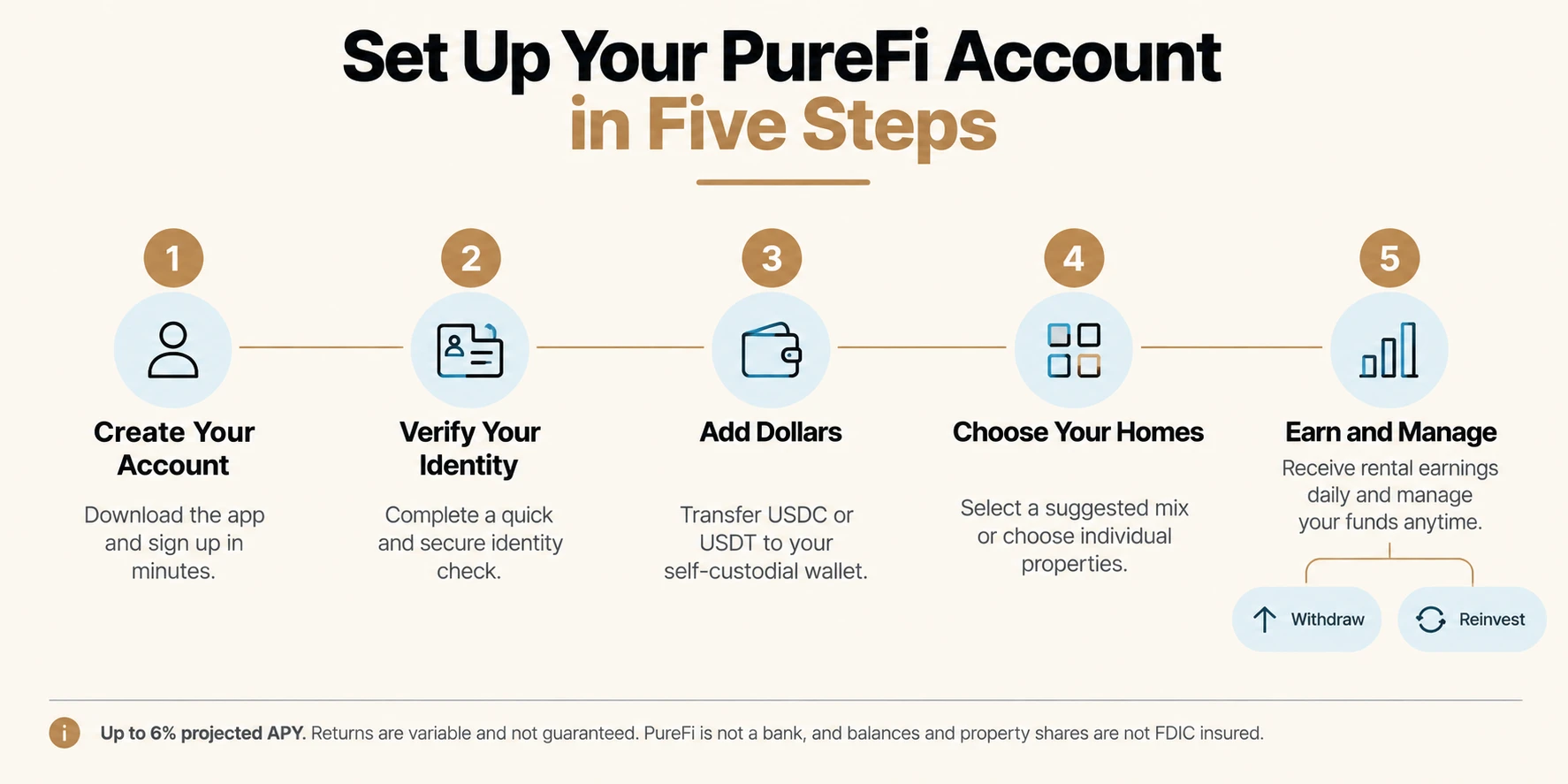
PureFi is a financial technology platform with a self-custodial dollar wallet. The projected earnings come from income-producing real estate.
The basic setup process is:
- Download the PureFi app. Use the official App Store or Google Play link provided by PureFi.
- Create your account. Enter your personal and contact information and create secure login details.
- Verify your identity. Complete the identity check required to activate account features.
- Add dollars. Fund the self-custodial wallet using an available method for your country.
- Review the available homes. PureFi says each home is bought outright, professionally managed, and supported by legal documents available in the app.
- Choose your property mix. Start with PureFi’s suggested mix or select individual homes.
- Review the order. Check the property details and the one-time purchase fee shown before confirmation.
- Monitor your earnings. When tenants pay rent, your share of the earnings appears in your balance. You can withdraw it or reinvest it.
PureFi advertises up to 6% projected APY. The return is variable and not guaranteed because it follows rent and property values. Shares may lose value. PureFi is not a bank, and its balances and real-estate shares are not FDIC insured.
Although PureFi does not charge a monthly account fee or require a minimum balance, a one-time fee may apply when property shares are purchased. Availability, funding options, and account features can also vary by country.
Put your dollars into something real
With PureFi, your projected earnings come from shares of real homes with tenants. Choose your properties from your phone, review the documents, and see every fee before you confirm.
Learn more about how PureFi can help you own real estate shares or download the app to get started today.
Up to 6% APY is projected, variable and not guaranteed. Property shares can lose value. PureFi is not a bank, and its balances and real estate shares are not covered by FDIC insurance or another government deposit scheme.