How to Protect Yourself From Currency Devaluation

Currency devaluation reduces the purchasing power of a currency relative to other currencies. For individuals and businesses that receive international remittances, hold foreign currency, or make cross-border payments, it can increase the cost of imports, overseas expenses, and international transfers.
Exchange rates change because of economic conditions, inflation, monetary policy, capital flows, and market expectations. While no one can prevent a currency from weakening, there are practical ways to reduce your exposure to exchange rate risk.
This guide explains four strategies that can help protect the value of your money when local currencies lose purchasing power.
What is currency devaluation?
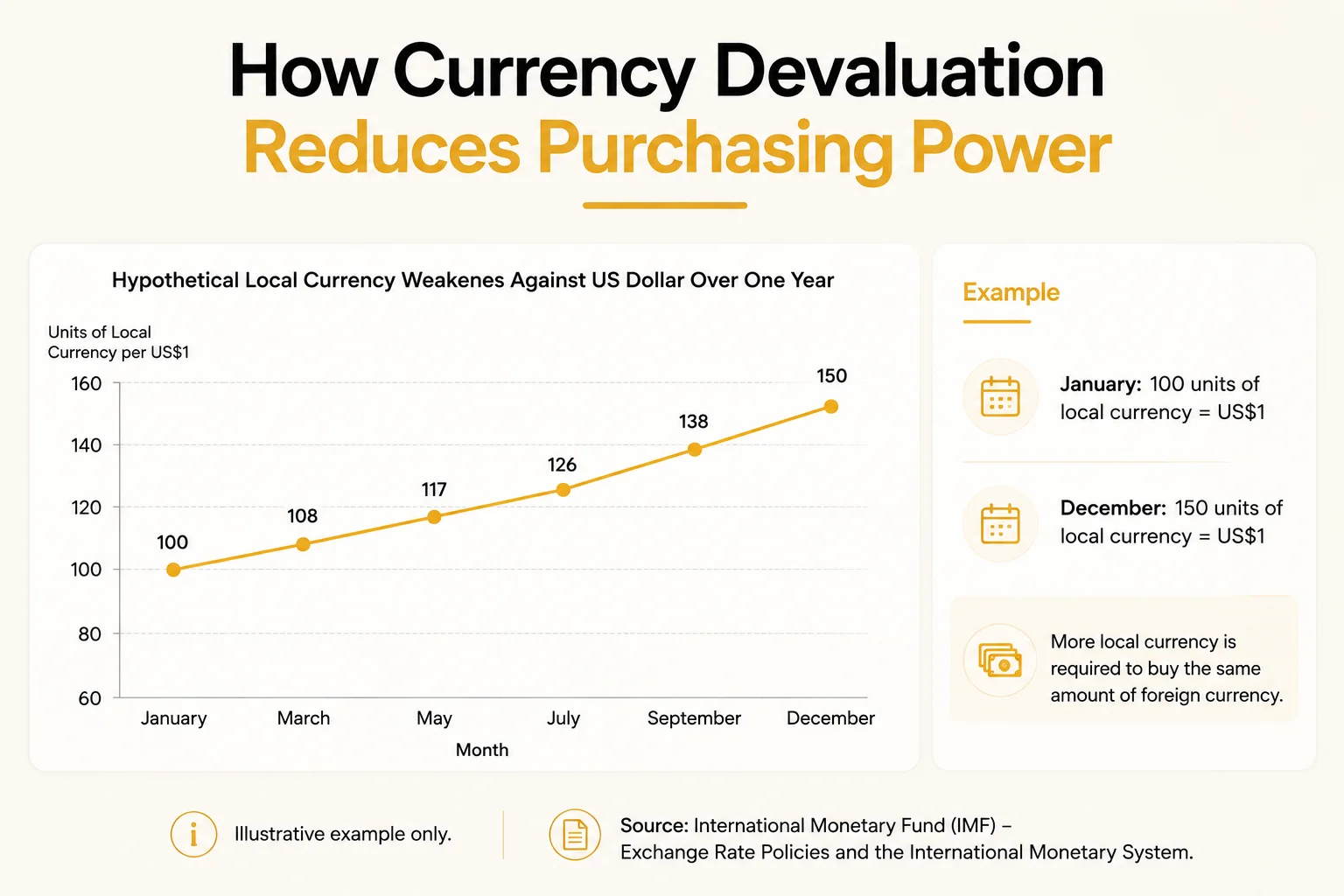
Currency devaluation occurs when a currency loses value relative to another currency.
In a fixed exchange rate system, a government or central bank may officially reduce the value of its currency. Under floating exchange rates, currencies can also lose value through market forces. Although economists distinguish between devaluation (an official policy action) and depreciation (a market-driven decline), both reduce the currency’s purchasing power.
For consumers, that often means imported goods become more expensive, overseas education and travel cost more, and exchanging local currency for foreign currency requires more money than before.
According to the International Monetary Fund, exchange rates are influenced by inflation, interest rate expectations, productivity, fiscal policy, and investor confidence. These factors can cause currencies to strengthen or weaken over time.
1. Hold more than one currency if you have international expenses
If your income, savings, or expenses span more than one country, holding a single currency may increase your exposure to exchange rate movements.
For example, someone who earns in US dollars but regularly pays school fees in another country may choose to keep part of their funds in the required currency instead of converting money every month. This reduces the number of currency conversions and provides greater flexibility if exchange rates become less favorable.
A digital multi-currency account, international currency bank account, or foreign exchange account can make it easier to hold supported currencies until you need them. Rather than converting funds immediately after every international remittance, you can decide when to exchange currencies based on your own payment schedule.
2. Reduce unnecessary currency conversions
Every currency conversion introduces exchange rate exposure. If you convert money each time you receive an international remittance or make cross-border payments, frequent fluctuations in exchange rates can gradually increase your overall costs.
Where appropriate, consider holding funds in their original currency until you need them. A foreign exchange account or digital multi-currency account can help reduce repeated conversions, allowing you to exchange currencies based on your payment requirements rather than immediately after every transfer.
Timing the market is rarely a reliable strategy. Instead, focus on reducing unnecessary conversions and comparing providers before exchanging currencies. Reviewing the exchange rate, transfer fees, and any currency conversion charges can help you better understand the total cost of a transaction.
The Bank for International Settlements (BIS) has identified greater transparency in pricing and foreign exchange costs as one of the key objectives of improving cross-border payments.
3. Consider financial products designed to maintain value
People living in countries with volatile currencies sometimes choose to hold part of their savings in financial products linked to more widely used currencies.
One example is a stablecoin, a digital asset designed to maintain a stable value relative to a reference asset, such as the US dollar. The Financial Stability Board (FSB) describes stablecoins as crypto-assets that seek to maintain a stable value but notes that they remain subject to operational, liquidity, governance, and regulatory risks.
Stable-value products may help reduce exposure to local currency fluctuations in some situations, but they are not risk-free and should not be viewed as a guaranteed store of value. Before using any product, understand how it works, how value is maintained, and what consumer protections apply.
4. Diversify how you hold your savings
Holding all of your savings in a single currency or financial product increases your exposure to one source of risk.
Depending on your financial needs, diversification may include holding different currencies, maintaining separate accounts for domestic and international expenses, or using financial products that serve different purposes. For example, someone who regularly receives payments from overseas may choose to separate spending money from longer-term savings instead of converting every incoming payment immediately.
Diversification does not eliminate exchange rate risk, but it can reduce the impact that a single currency movement has on your overall financial position.
The International Monetary Fund (IMF) has noted that managing foreign exchange exposure is an important consideration for households and businesses that operate across multiple currencies.
Should you review exchange rates before sending money internationally?
Yes, especially if your payment isn’t time-sensitive. Exchange rates change continuously as currencies are traded in global financial markets. Economic data, inflation, central bank decisions, geopolitical events, and market sentiment can all influence a currency’s value. While it’s difficult to predict short-term movements, reviewing the exchange rate before making an international remittance can help you understand how much your recipient is likely to receive.
If you regularly make cross-border payments, consider monitoring exchange rates over time instead of converting money immediately whenever funds become available. Many payment providers also let you view the exchange rate before confirming a transfer, making it easier to compare the total cost of different services.
Can holding part of your savings in a stable currency help?
For some people, yes. If you have future expenses in another country, such as tuition fees, overseas travel, or regular cross-border payments, holding part of your savings in that currency may help reduce the impact of future exchange rate movements.
For example, someone who expects to pay expenses in US dollars may choose to keep part of their savings in USD rather than converting funds back and forth each month. Likewise, people who regularly receive an international remittance in a foreign currency may decide to keep those funds in the original currency until they’re needed.
A multi currency savings account or international currency bank account can make this easier by allowing eligible users to hold supported currencies without converting them immediately. While this approach doesn’t eliminate exchange rate risk, it can provide greater flexibility over when and how currency conversions take place.
The right strategy depends on your financial needs, the currencies you use most often, and the products available in your country.
Conclusion
Currency devaluation can affect the value of your savings, the cost of international purchases, and the amount your money is worth across borders. While exchange rates cannot be controlled, they can be managed.
Holding more than one currency, reducing unnecessary conversions, planning international remittances carefully, and using suitable financial products can all help reduce exposure to exchange rate movements. Rather than reacting to short-term market changes, focus on building a strategy that reflects how you earn, save, and spend money internationally.
How PureFi can help
Managing money across borders means managing currency risk as well. PureFi helps eligible users make cross-border payments and international remittances across supported routes while providing greater flexibility in how they hold and use supported currencies. Available countries, currencies, payment methods, and features depend on local regulations and eligibility.
Learn more about how PureFi can help you send, save, and grow money across borders, or download the app to get started today.