How to Pick a High-Yield Savings Account
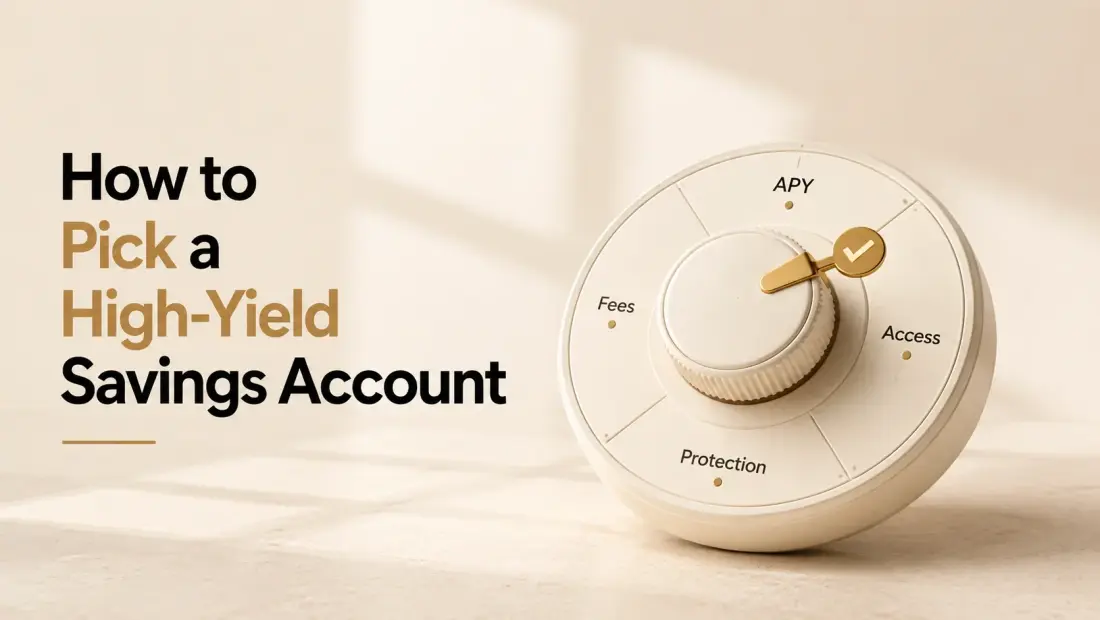
Picking a high-yield savings account starts with knowing what you need the money for. An emergency fund needs reliable access. Savings for a later purchase may stay untouched for months. These accounts do not need the same features.
The advertised rate matters, but it should not make the decision on its own. A high APY can lose its value if the account has monthly fees, difficult balance rules, or slow withdrawals. Protection and provider support matter too.
In this article, we explain how to compare APY, rate conditions, fees, minimum balances, access to funds, deposit protection, and the everyday features that can make one account a better fit than another.
1. Compare the APY
Annual percentage yield, or APY, shows how much an account could earn over one year if the balance and rate stayed the same. It also accounts for how often earnings are added to the balance.
Use APY when comparing accounts. It gives you a more complete figure than a basic rate on its own.
Check whether the APY is:
- available to every account holder
- limited to new customers
- offered for a short promotional period
- tied to a certain balance range
- dependent on monthly deposits or other activity
A provider may advertise its highest available APY even when that rate only applies to part of the balance or to customers who meet several conditions. Read the rate table rather than relying on the largest number on the page.
Also check when the rate was last updated. Most high-yield savings account rates are variable. The provider can raise or lower the APY after you open the account.
The highest rate online savings account today may not stay at the top. A slightly lower rate with simpler terms can be easier to use and may leave you with more money after fees.
2. Add up the account fees
Fees can reduce or cancel out what your savings earn. This matters most when the balance is small. Look for:
- monthly maintenance fees
- excess-withdrawal fees
- ATM charges
- outgoing wire fees
- account-closure fees
- charges for paper statements or checks
- fees linked to a minimum balance
Some online accounts have no monthly maintenance fee. That does not mean every service is free.
The account disclosure should state the amount of each applicable fee and when it can be charged. Read that document before opening the account. A short comparison of headline rates will not show the full cost.
If one account offers a higher APY but charges a monthly fee, calculate whether your expected earnings would cover that charge. Do not assume the account with the larger rate will leave you with the larger balance.
3. Check the minimum-balance rules
An account can have more than one balance requirement. There may be a minimum amount needed to:
- open the account
- avoid a monthly fee
- receive the advertised APY
- qualify for a promotional bonus
These amounts are not always the same. A provider might let you open an account with a small deposit but require a much larger balance to earn the top APY.
The disclosure should also explain how the balance is measured. Some providers use the balance at the end of each day. Others use an average over the statement period.
Choose a requirement you can meet without stretching your budget. If your balance regularly falls below the threshold, a lower-rate account without fees may work better.
4. Review how you can access your money
Before placing savings in an account, find out how you will get them out. An online savings account may offer:
- internal transfers to checking with the same provider
- ACH transfers to an external account
- ATM access
- a debit card
- bank checks
- wire transfers
Many online providers rely mainly on ACH transfers. These transfers can clear quickly, but completion may take several days. Weekends, holidays, security checks, and deposit holds can cause delays.
The former federal limit of six convenient savings withdrawals per month was removed in 2020. Providers can still set their own limits on the number or amount of withdrawals. They can also charge fees under the account agreement.
Ask these questions before depositing:
- How long does a standard withdrawal take?
- Is there a daily or monthly transfer limit?
- Can I withdraw cash directly?
- Are there fees for certain methods?
- How long are new deposits held?
If the account is for emergencies, access may matter more than a small APY difference.
5. Verify deposit protection
A bank account is not protected simply because its website looks established or its app appears in a major app store.
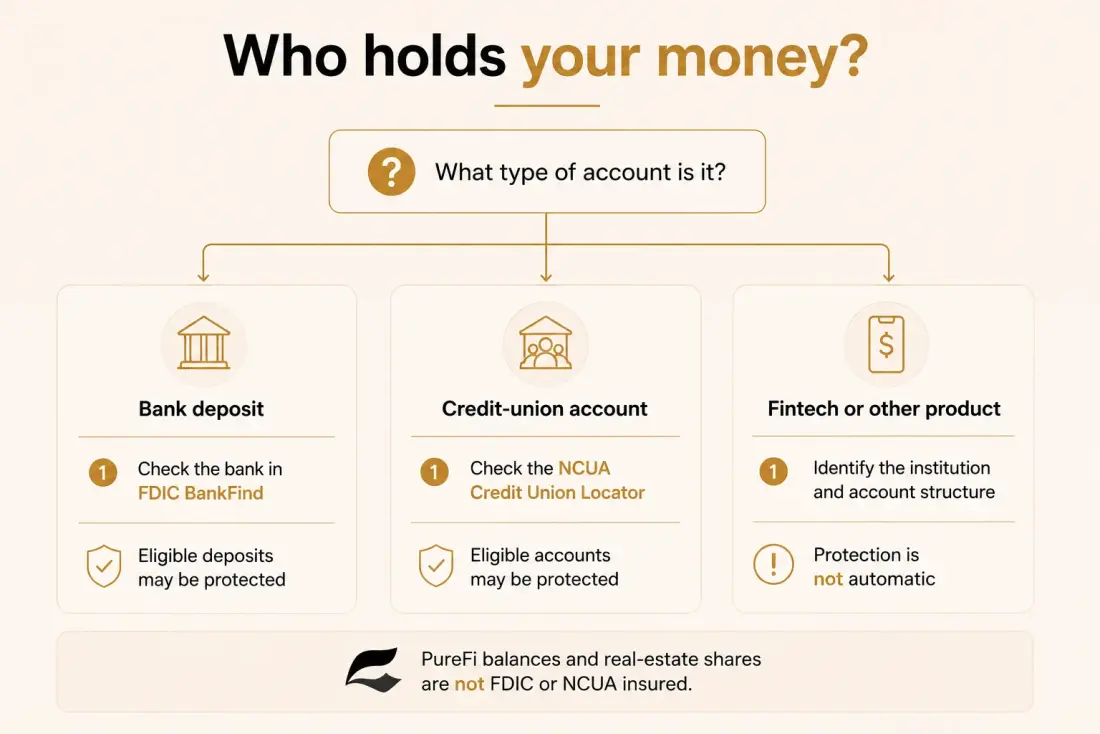
Eligible deposits at an FDIC-insured bank are generally covered up to $250,000 per depositor, per insured bank, for each ownership category. Eligible accounts at federally insured credit unions receive similar NCUA protection, generally up to $250,000 per member-owner, per insured credit union, for each ownership category.
Confirm the legal institution holding the deposit. You can search for a bank using the FDIC BankFind Suite and check a credit union through the NCUA’s locator.
This step needs extra care when a financial app is not itself a bank. The app may send customer funds to one or more partner banks. Read how the arrangement works and whether the account meets the requirements for pass-through coverage.
Federal protection applies when an insured institution fails. It does not cover every financial product, all types of fraud, or balances above the applicable limit.
6. Look at the app, security, and support
A good APY is less useful if you cannot get into your account or reach anyone when a transfer goes wrong.
Check whether the provider offers:
- secure login and account-recovery steps
- transaction alerts
- controls for linked accounts
- clear statements and tax documents
- support by phone, chat, or email
- a clear process for reporting unauthorized activity
Look at support hours as well as contact methods. An email address is not the same as immediate help. If you receive money from abroad or manage accounts in more than one country, confirm the provider’s eligibility rules. Some accounts require a U.S. address, U.S. tax number, or linked U.S. bank account. An online account is not automatically available worldwide.
7. Choose the account that fits how you save
The best high-yield savings account is the one that works for your balance, access needs, and savings goal. It is not always the account with the largest advertised APY.
An emergency fund may need fast transfers and no minimum balance. Money for a planned purchase may benefit more from a stronger APY if you do not expect frequent withdrawals.
Before choosing, compare the accounts side by side:
| What to check | Why it matters |
|---|---|
| APY and rate conditions | Shows what you may earn and what rules apply |
| Fees | Can reduce the amount left in the account |
| Minimum balance | May affect fees or the APY you receive |
| Withdrawal methods | Determines how you can access the money |
| Transfer time | Matters when the money is needed quickly |
| Deposit protection | Helps protect eligible deposits if an insured institution fails |
| Support and security | Matters when access or transactions go wrong |
If you plan to open a high yield savings account online, save a copy of the account disclosure. Rates and terms can change, and the document gives you a record of what applied when you opened the account.

Frequently asked questions
What should I look for first in a high-yield savings account?
Start with the APY and its conditions. Then check fees, minimum balances, withdrawal methods, transfer times, and deposit protection before opening the account.
Is the account with the highest APY always best?
No. A high APY may come with fees, balance requirements, promotional conditions, or limited access. Compare what you are likely to earn after meeting all the terms.
Can a high-yield savings account rate change?
Yes. Most high-yield savings account rates are variable. The provider can raise or lower the APY after the account is opened.
Should an online savings account be FDIC insured?
If it is presented as a U.S. bank deposit, confirm that the deposit is held at an FDIC-insured bank. Credit-union accounts may receive NCUA protection instead. Some fintech products are not bank deposits and do not qualify.
How much money do I need to open an account?
It depends on the provider. Some accounts have no minimum opening deposit. Others require a set amount to open, avoid a fee, or receive the advertised APY.
Is PureFi a high-yield savings account?
No. PureFi provides a self-custodial wallet and access to shares of real homes. Projected earnings come from rent and changes in property values rather than a bank deposit.
Put Your Dollars Into Something Real
With PureFi, your projected earnings come from shares of real homes with tenants. Choose your properties from your phone, review the documents, and see every fee before you confirm.
Learn more about how PureFi can help you own real estate shares or download the app to get started today.