How Much Does a High-Yield Savings Account Earn?
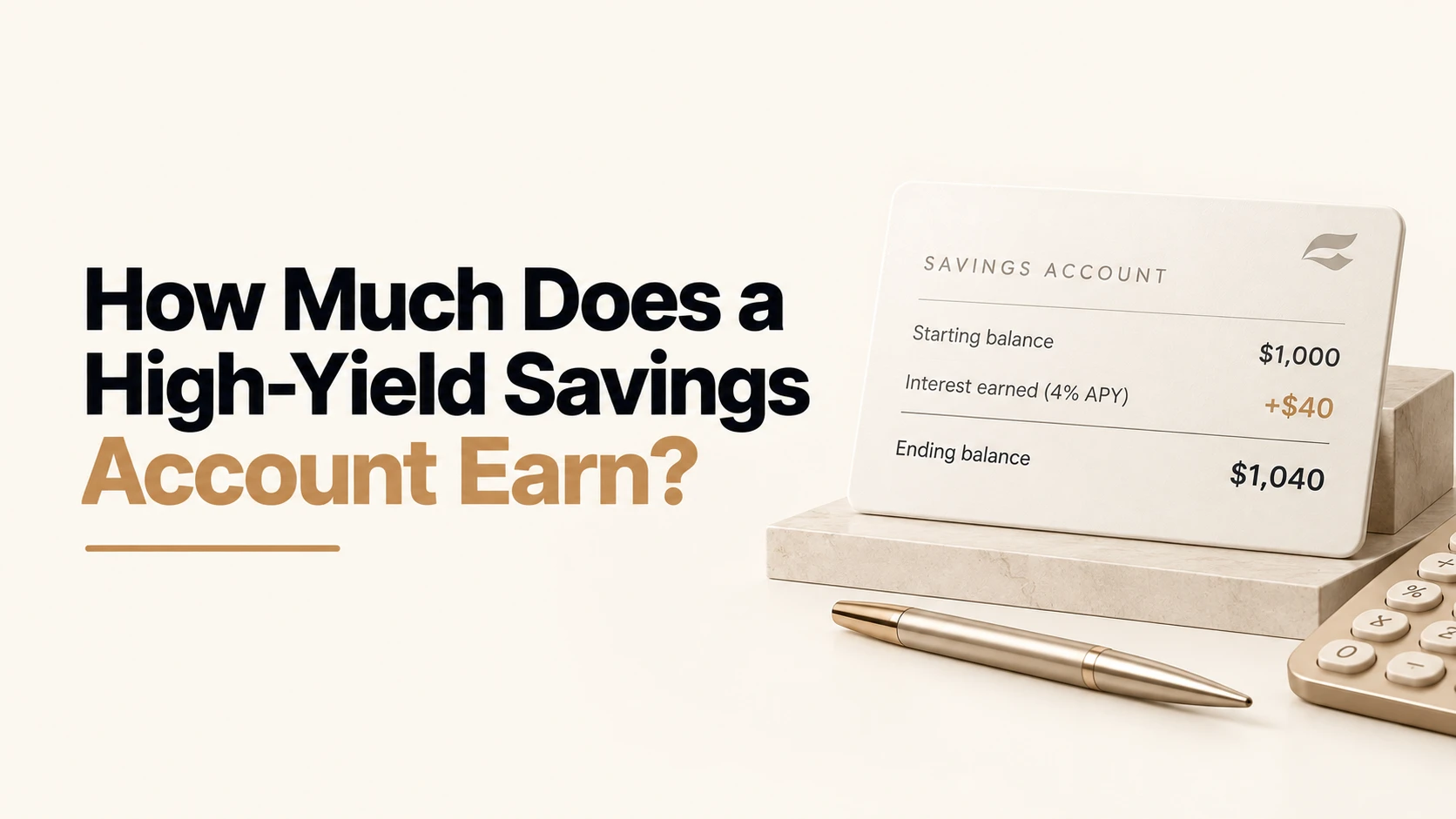
The amount a high-yield savings account earns depends on its APY, your balance, and how long the money remains in the account. Deposits and withdrawals also change the result. A person who adds money every month will earn more than someone who keeps the same starting balance.
The advertised APY is not always the rate you will receive forever. Most high-yield savings APYs are variable, so the provider can change them. Fees and qualification rules can reduce your actual earnings as well.
You should also understand where the return comes from. A conventional bank account earns on a cash deposit and may have FDIC protection within applicable limits. Other platforms may connect projected earnings to real assets and use a different protection structure.
The calculations below provide estimates. They are not guaranteed future results.
How Are High-Yield Savings Earnings Calculated?
A simple estimate starts with three pieces of information:
- Your account balance
- The current APY
- The amount of time the money will remain in the account
For a one-year estimate, you can use this calculation:
Estimated annual earnings = account balance × APY
If you have $5,000 in an account with a 4% APY, the simple estimate is:
$5,000 × 0.04 = $200
Your estimated balance after one year would be $5,200. This assumes the APY remains at 4%, all earnings stay in the account, and you make no further deposits or withdrawals.
What Does APY Include?
APY stands for annual percentage yield. It represents how much an account could earn over one year after including the effect of compounding.
APY makes it easier to compare accounts that calculate and add earnings on different schedules. A provider may calculate earnings daily but add them to the balance monthly. Another may use a different schedule. The APY gives you one yearly figure for comparison.
A higher APY produces more earnings when the balance, time, fees, and other conditions remain the same. However, you should check whether the displayed rate is standard, promotional, or tied to certain activity.
How Does Compounding Affect Earnings?
Compounding happens when previously added earnings begin generating further earnings.
Suppose an account calculates earnings every day. Each day’s amount is based on the qualifying balance and the provider’s calculation method. Once those earnings are added to the account, the balance becomes slightly larger. Future calculations then use that larger balance.
The effect looks small over a few days. It becomes more noticeable when the account holds a large balance or remains open for several years.
You do not need to calculate daily compounding yourself when comparing accounts. The advertised APY already reflects the provider’s compounding schedule, assuming the rate remains unchanged.
How Much Can Different Balances Earn?
The following table shows simplified one-year estimates at a 4% APY.
| Starting balance | Estimated earnings at 4% APY | Estimated balance after one year |
|---|---|---|
| $1,000 | $40 | $1,040 |
| $5,000 | $200 | $5,200 |
| $10,000 | $400 | $10,400 |
| $25,000 | $1,000 | $26,000 |
| $50,000 | $2,000 | $52,000 |
These estimates assume the APY stays at 4% for the full year. They also assume there are no additional contributions, withdrawals, or fees.
Actual high-yield savings account earnings may be different. A rate increase could produce more. A rate reduction, withdrawal, or monthly charge could leave you with less.
What Affects How Much the Account Earns?
Two accounts displaying the same APY can produce different results if they have different fees, deposit requirements, or contribution patterns. These are the main factors to review.
Starting Balance and APY
A larger balance produces more dollar earnings at the same APY. At 4%, a $1,000 balance earns an estimated $40 over a year, while a $10,000 balance earns about $400.
The APY also matters. A one-percentage-point difference may not look large on a small balance over a few months. It becomes more meaningful on a larger balance or over several years.
Check the conditions attached to the rate. Some high yield digital savings account providers reserve their highest APY for customers who receive payroll deposits, add a certain amount each month, or maintain a specific balance.
Contributions and Time
Regular contributions increase the balance available to generate future earnings. A monthly deposit also creates a saving habit that does not depend on remembering to make a manual transfer.
Time gives compounding more opportunities to affect the balance. Money deposited at the beginning of the year usually earns more than the same amount added near the end.
This is why two people contributing the same total amount may finish with different balances. The person who starts earlier gives each contribution more time in the account.
Withdrawals and Fees
A withdrawal reduces both the current balance and the amount that can generate future earnings. The earlier the withdrawal happens, the greater its effect may be over the rest of the year.
Fees also reduce net earnings. A $5 monthly maintenance charge costs $60 over a year. On a small balance, that could remove most or all of the benefit of a higher APY.
Other costs may include transfer charges, wire fees, currency-conversion costs, or asset-purchase fees. Review the full fee schedule rather than looking only at the APY.
Changes to the APY
Most high-yield savings APYs are variable. Providers may adjust them when market conditions, business needs, or related financial rates change.
A savings account earnings calculator often assumes one APY for the entire period. That makes the result useful for planning, but it does not predict future rate changes.
Run more than one estimate if you are planning several years ahead. You might calculate a lower-rate, expected-rate, and higher-rate scenario to see the range of possible outcomes.
How Much Will $10,000 Earn in a High-Yield Savings Account?
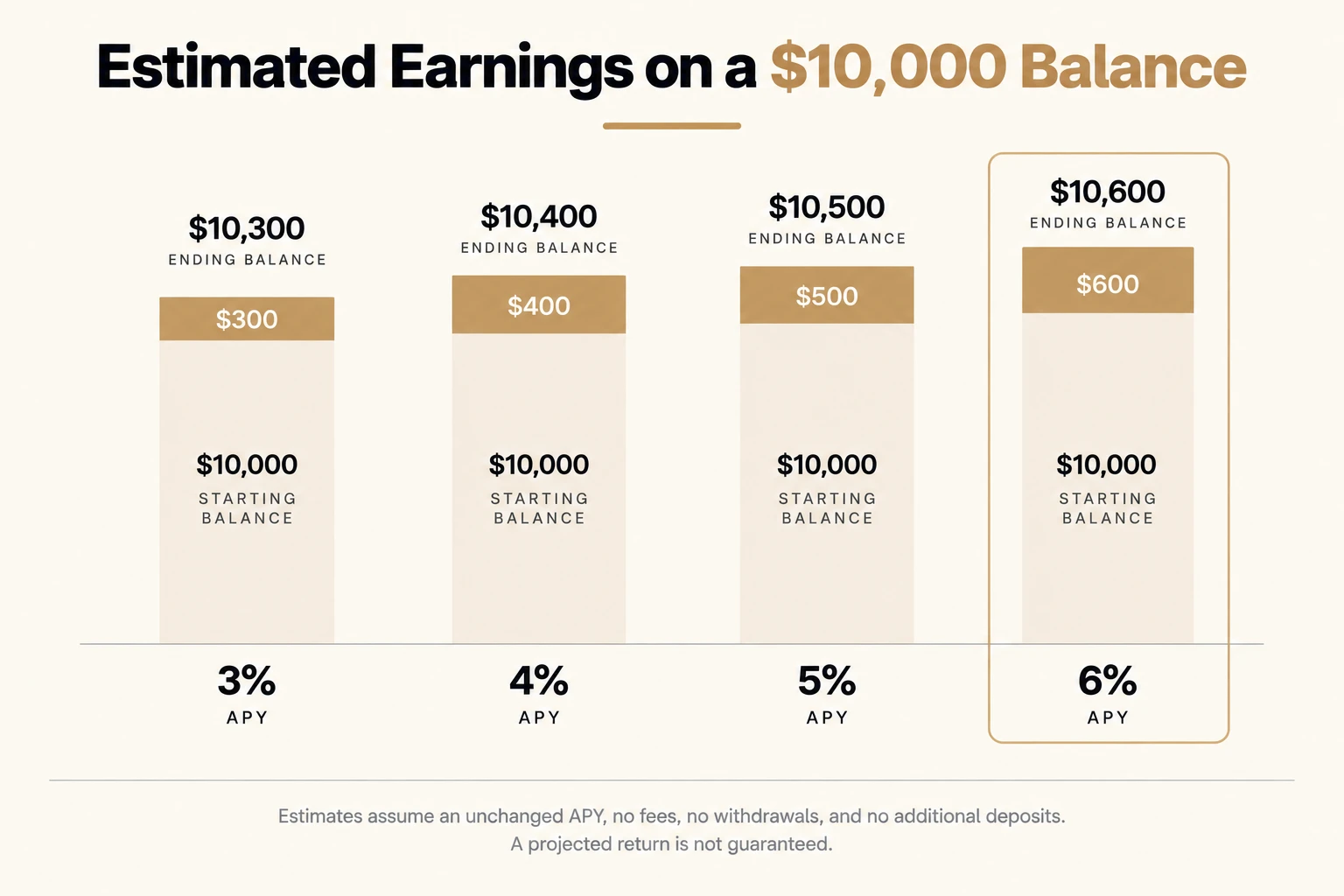
The following table shows how different APYs could affect a $10,000 starting balance over one year.
| APY | Approximate earnings after one year | Estimated ending balance |
|---|---|---|
| 3% | $300 | $10,300 |
| 4% | $400 | $10,400 |
| 5% | $500 | $10,500 |
| 6% | $600 | $10,600 |
These estimates assume that the stated APY remains unchanged and that all earnings stay in the account. They do not include fees, withdrawals, or additional deposits.
A projected 6% return tied to income-producing assets is not the same as a 6% APY on an FDIC-insured bank deposit. The two products can have different risks, protections, and withdrawal processes.
When comparing options, look beyond the ending number. Check whether the principal can lose value, how the provider generates the return, and what happens when you request your money.
How Do Monthly Contributions Change Your Earnings?
Monthly deposits can have a larger effect on your final balance than a small difference in APY.
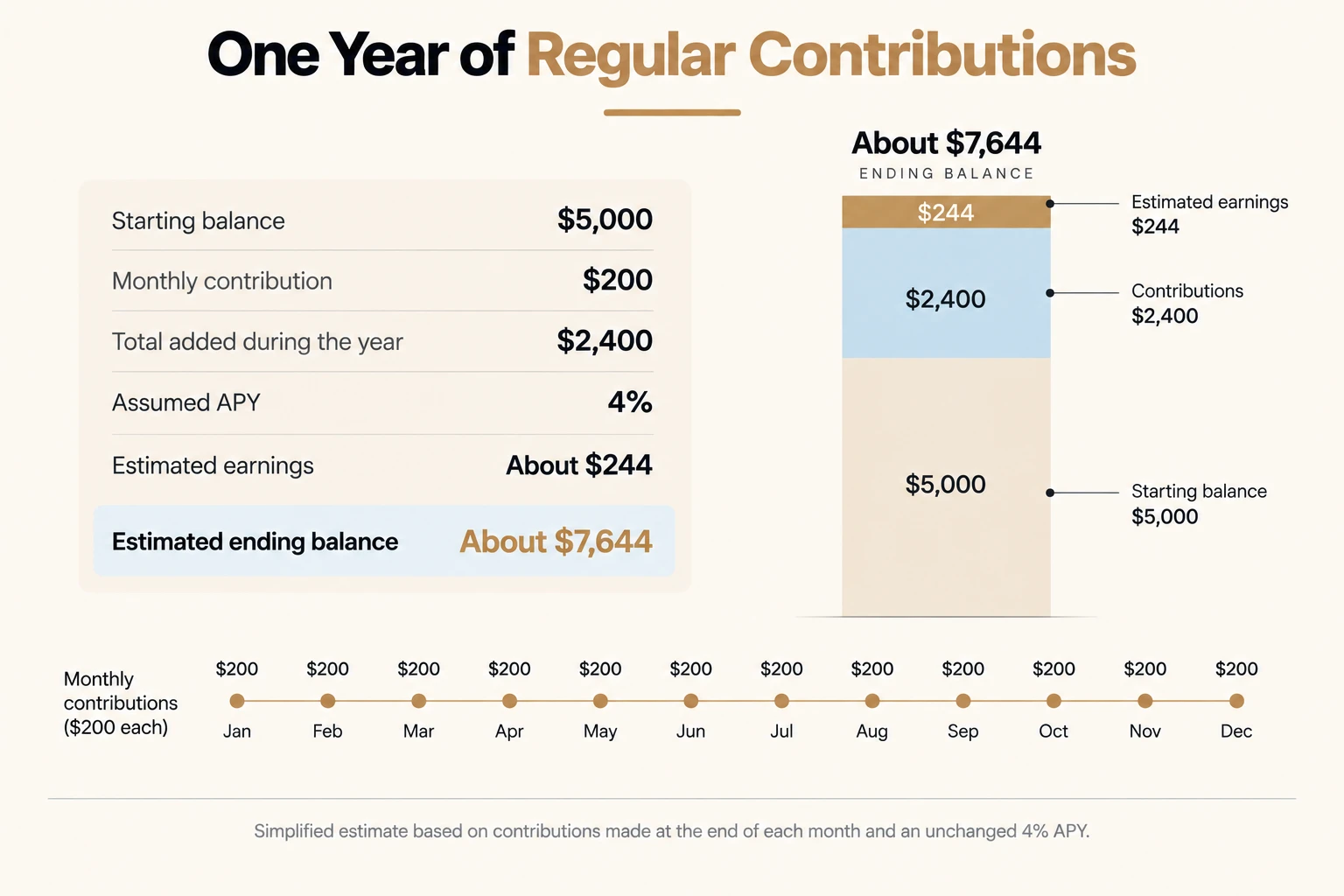
Suppose you start with $5,000, earn a steady 4% APY, and add $200 at the end of each month. You would contribute another $2,400 over the year. With estimated compounding, the balance could reach about $7,644 after one year.
The total amount you put in would be $7,400. The remaining amount, roughly $244, would come from estimated earnings. The exact result depends on when each deposit arrives and how the provider calculates earnings.
Deposits made early in the year have longer to grow. A contribution made in January affects more calculation periods than one made in December.
An automatic transfer can help you contribute consistently. Choose an amount that leaves enough money in your everyday account for bills and other expenses.
For longer periods, use a high-yield savings account calculator that allows you to enter:
- Starting balance
- Monthly contribution
- Expected APY
- Saving period
- Contribution timing
Treat the result as a planning estimate rather than a guaranteed balance.
How Much Can You Earn With PureFi?
PureFi is an online high-yield savings account offering up to 6% projected APY. It does not charge a monthly account fee or require a minimum balance.
PureFi generates the projected return through income-producing real estate. Users can purchase shares of homes that already have tenants. When rent is collected, each user receives earnings based on the shares they own. Returns can also change with property values.
The app lets users select a suggested mix of homes or choose individual properties. PureFi says each home is bought outright, professionally managed, and supported by legal documents available in the app.
If someone places $10,000 through PureFi and receives a full 6% return for one year, the estimated earnings would be $600. The estimated ending balance would be $10,600 if all earnings were reinvested.
Before getting started, review the available homes, purchase fee, access process, protection structure, and risks.
Learn more about how PureFi can help you own real estate shares or download the app to get started today.
Up to 6% APY is projected, variable and not guaranteed. Property shares can lose value. PureFi is not a bank, and its balances and real estate shares are not covered by FDIC insurance or another government deposit scheme.