How Much Can I Keep in a Savings Account?

How Much Can I Keep in a Savings Account?
You can generally keep as much as your account provider allows, but federal protection may not cover the full balance.
There is no universal legal savings account limit. However, individual banks and credit unions may set their own maximum balances, deposit limits or transfer limits. The APY may also change once your balance reaches a certain level.
In this article, we’ll explain how account limits work, how much federal protection you may receive, what happens above $250,000, and whether keeping everything in one account makes sense.
Is There a Maximum Amount You Can Keep in a Savings Account?
There is no standard maximum amount that applies to every savings account. One bank may allow a very large balance, while another may set a lower account limit. The provider may also limit how much you can deposit or transfer at one time.
These limits can apply to:
- The total account balance
- Daily deposits
- Electronic transfers
- Mobile check deposits
- Cash deposits
- Withdrawals
Your account agreement should explain these rules. If you are opening an online high-yield savings account, check the terms before sending a large amount.
A provider may also use balance tiers. This means different parts of your balance may earn different APYs. In some cases, the advertised APY applies only up to a set amount. In others, you may need a minimum balance to earn the highest APY.
The maximum amount in a savings account is therefore not the same as the amount protected by the federal government. Your provider may allow you to hold more than the standard coverage limit.
How Much Money Is Federally Protected?
The FDIC generally protects eligible deposits up to $250,000 per depositor, per insured bank and per ownership category. The NCUA provides similar protection for eligible accounts at federally insured credit unions.
An ownership category describes how an account is owned. Common examples include:
- An account owned by one person
- A joint account
- Certain retirement accounts
- Trust accounts
- Business accounts
The rules apply to your combined deposits within the same ownership category at the same bank.
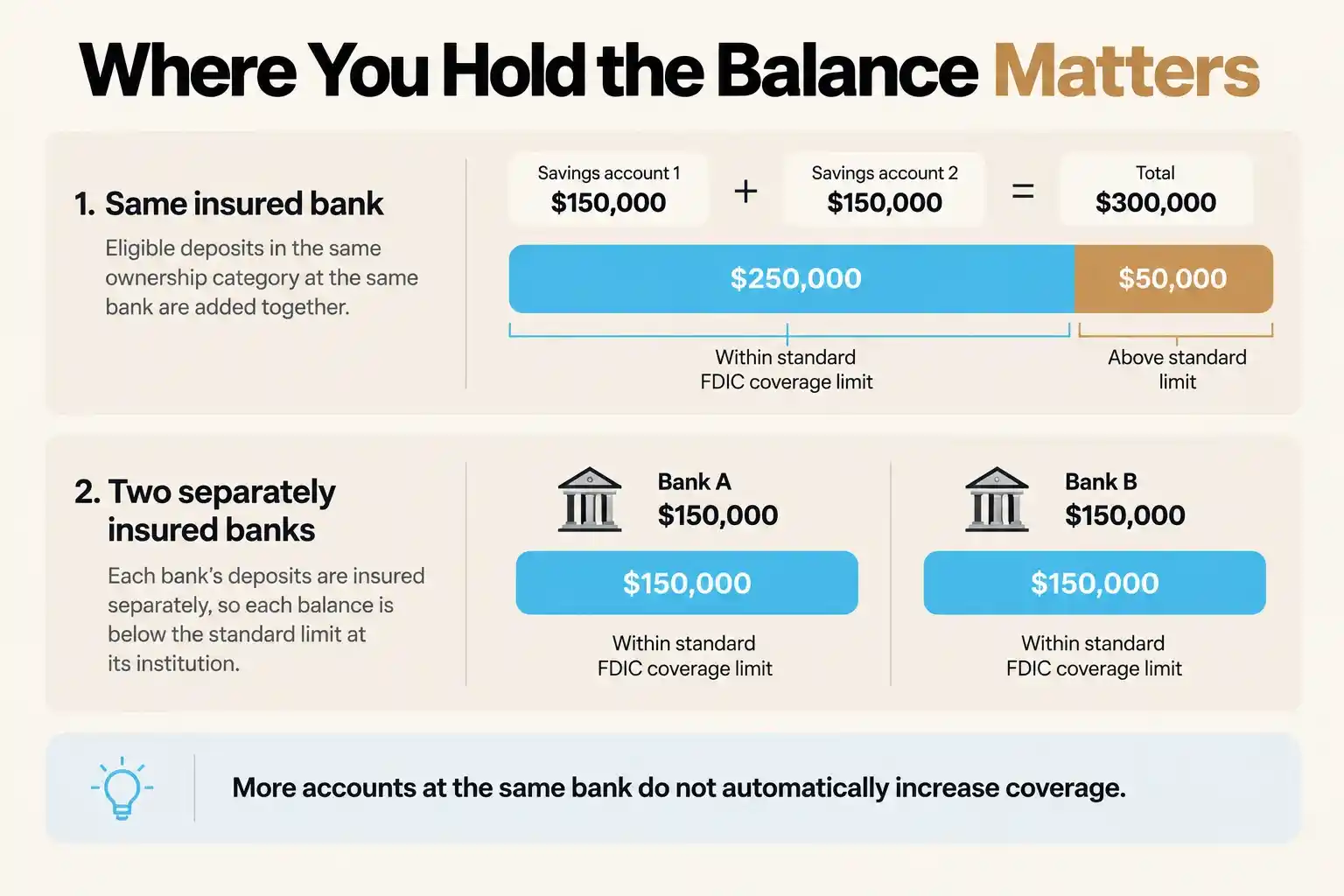
For example, imagine you have $150,000 in one savings account and $150,000 in another savings account. Both accounts are in your name alone and held at the same insured bank.
The FDIC would generally combine the accounts for coverage purposes. Your total in that ownership category would be $300,000. Opening the second account at the same bank would not automatically provide another $250,000 of protection.
The type of deposit account does not create separate coverage either. A checking account and savings account owned by the same person at the same bank may be added together when they belong to the same ownership category.
You can use the FDIC Electronic Deposit Insurance Estimator to check how coverage may apply to your accounts. Credit union members can review the NCUA coverage guidance .
Coverage also depends on whether the institution is federally insured. A financial app may display your balance without being the bank that holds the deposits. Check the name of the underlying institution and confirm its status before relying on federal protection.
Can You Keep More Than $250,000 in a Savings Account?
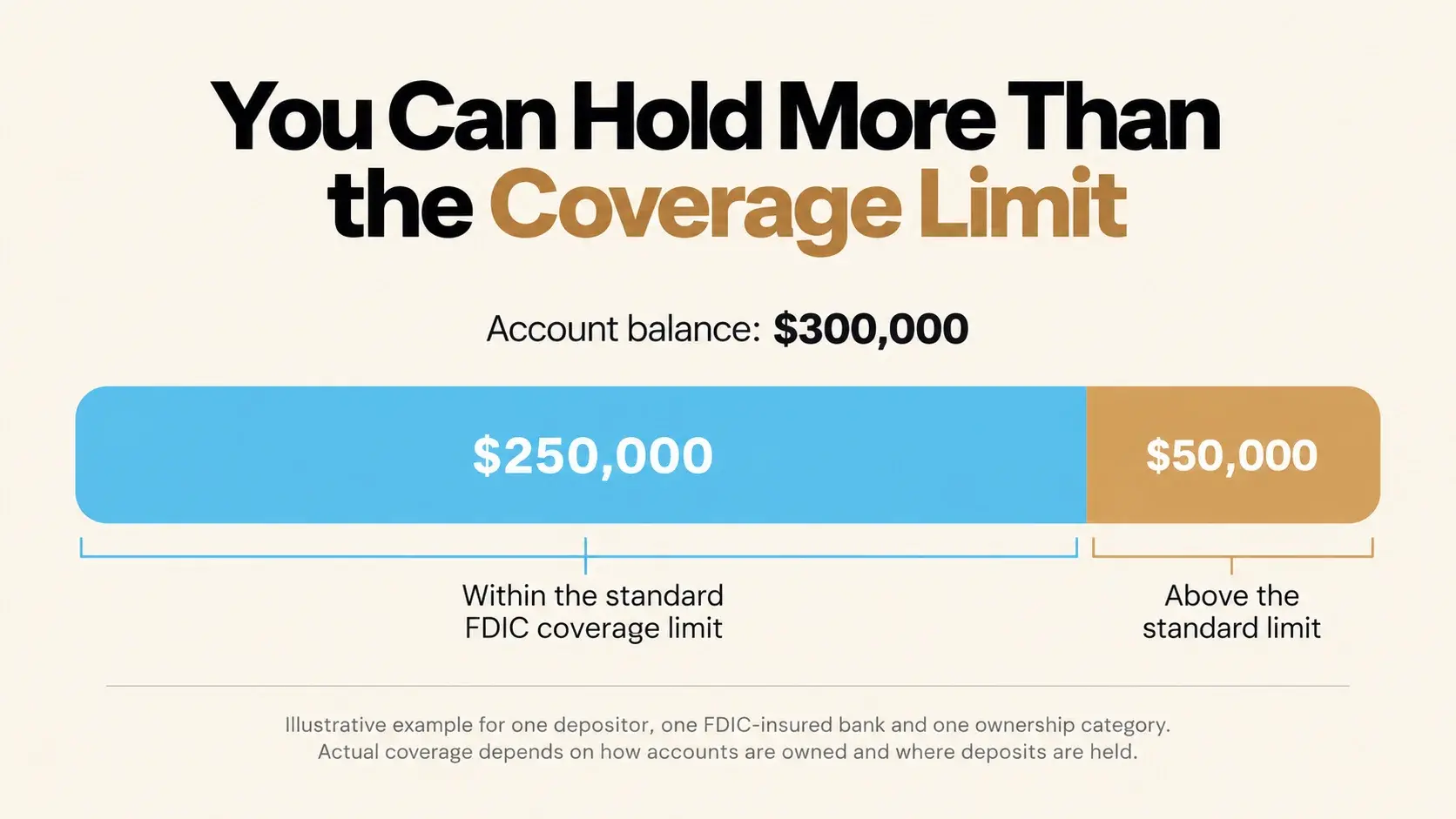
Yes. You can keep more than $250,000 in a savings account if the provider allows it.
The $250,000 figure is the standard FDIC coverage amount. It is not a general account balance limit.
If your deposits are above the amount covered, the remaining balance may be uninsured if the bank fails. This does not mean the money disappears as soon as your account passes $250,000. It means federal protection may not cover the full amount.
You may qualify for more than $250,000 of coverage in some situations.
Accounts at different banks
Eligible deposits at separately insured banks receive separate coverage. However, two banking brands may sometimes operate under the same insured institution. Check the bank’s legal name and FDIC certificate number. The FDIC BankFind tool can help you confirm whether institutions are separate.
Different ownership categories
Deposits in different ownership categories may receive separate coverage when all requirements are met. For example, eligible single and joint accounts can be covered separately. Joint accounts may receive up to $250,000 per co-owner when the account meets the FDIC’s requirements.
Simply changing an account label is not enough. The ownership arrangement must meet the federal rules.
Accounts at federally insured credit unions
Eligible accounts at federally insured credit unions receive NCUA protection instead of FDIC protection. The NCUA also applies coverage according to account ownership and institution. Because these rules can become complex, use the official coverage estimator or speak with the institution before holding a large balance.
Should You Keep All Your Savings in One Account?
You do not have to keep all your savings in one account. Using one account may be easier because you have fewer statements, passwords, and balances to manage. It can also make it easier to see how much you have saved.
However, one account may not be the best choice when your balance is above the federal coverage limit. You may also want separate accounts for different goals.
For example, you might use one account for emergency savings and another for a planned purchase. This can make it easier to track each goal.
If you use several accounts, check whether they are held at separate insured institutions. Opening several accounts through the same high-yield savings app may not increase your total protection if the funds are all placed at the same bank.
You should also compare:
- The APY applied to each balance
- Monthly account fees
- Minimum balance rules
- Withdrawal methods
- Transfer times
- Provider security
- Federal coverage
There is no single amount everyone should keep in savings. The right balance depends on the expenses you need to cover, when you will need the funds and how much access you want.
A savings account can be useful for money you may need soon. Funds intended for longer-term goals may require a different approach, depending on your situation and comfort with risk.
Put your dollars into something real
With PureFi, your projected earnings come from shares of real homes with tenants . Choose your properties from your phone, review the documents, and see every fee before you confirm.
Learn more about how PureFi can help you own real estate shares or download the app to get started today.
Up to 6% APY is projected, variable and not guaranteed. Property shares can lose value. PureFi is not a bank, and its balances and real estate shares are not covered by FDIC insurance or another government deposit scheme.