How Do Exchange Rates Work for International Money Transfers?
An exchange rate tells you how much one currency is worth in another currency. If you send money from the United States to a country that uses a different currency, your dollars need to be converted before the recipient can use the money in their local currency. The exchange rate determines how much of that currency your dollars buy.
For example, if the exchange rate were:
1 USD = 0.85 EUR
then:
$100 = €85
This is only an example rate, not a current exchange rate. Exchange rates matter for an international money transfer because even a small difference in the rate can change how much money reaches the recipient.
What is an exchange rate?
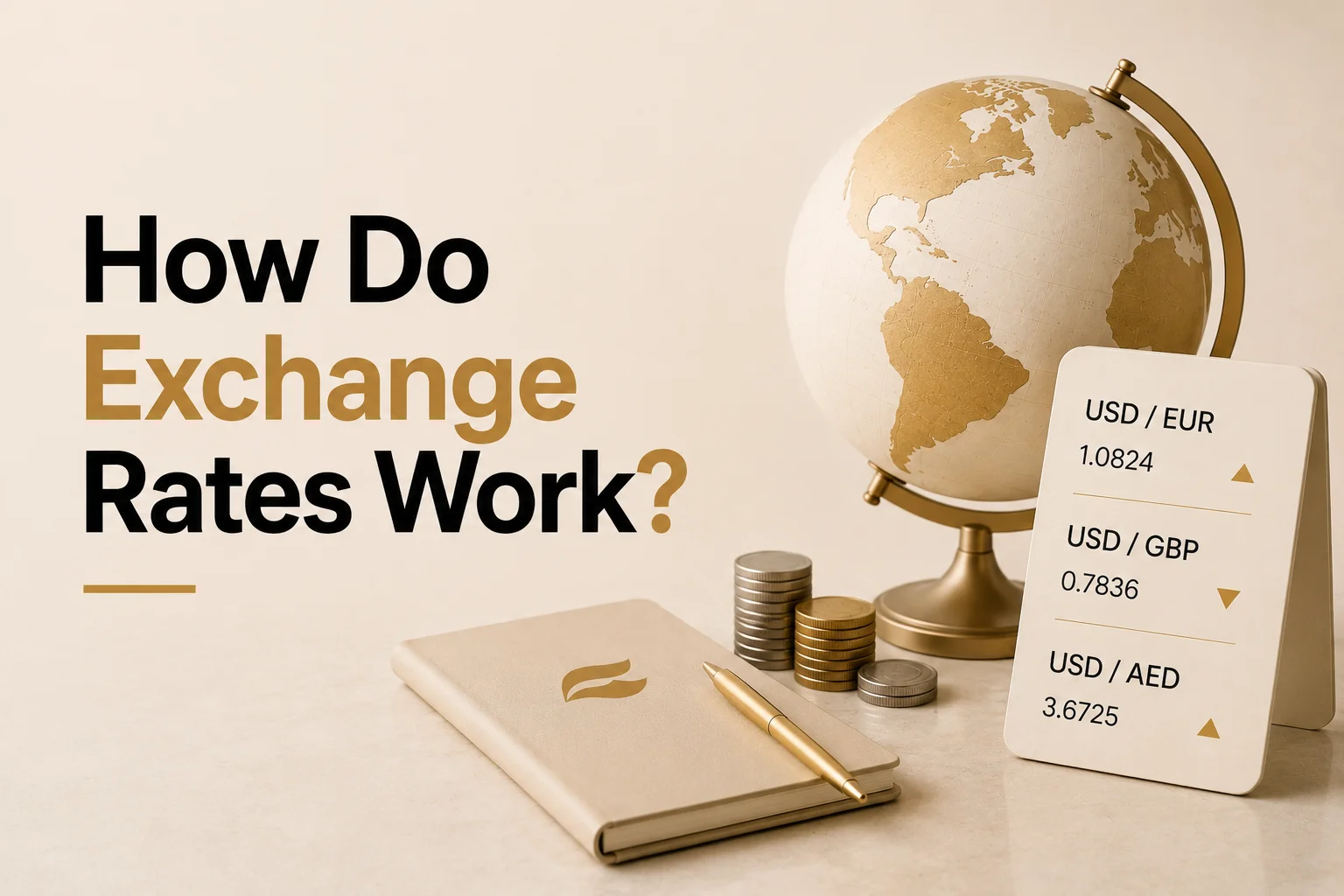
The International Monetary Fund defines an exchange rate as the price of one currency in terms of another. You will usually see exchange rates written as a pair of currencies. For example:
USD/EUR
GBP/USD
USD/AED
The two currencies tell you which currencies are being compared.
If an exchange rate tells you that:
1 USD = 0.85 EUR
it means one US dollar can be exchanged for 0.85 euros at that example rate.
For an international remittance, the exchange rate becomes relevant when the currency you send is different from the currency the recipient receives. If you send USD and the recipient receives EUR, some form of currency conversion needs to happen during the transfer.
How do exchange rates work?
Currencies have prices just like other financial assets. For currencies whose exchange rates are determined by the market, those prices can change as people, companies, banks, governments, and investors buy and sell currencies.
There are two parts to an exchange rate: the base currency and the quote currency. Take this example:
USD/EUR = 0.85
USD is the base currency. EUR is the quote currency. The rate tells us how much of the quote currency one unit of the base currency can buy.
So:
1 USD = 0.85 EUR
and:
$1,000 = €850
Again, this is a hypothetical example to show how the calculation works. Not every country’s currency works under the same exchange-rate system. The IMF notes that countries use different arrangements, ranging from floating exchange rates to systems where currencies are pegged or otherwise managed.
For someone making an international transfer, however, the main number to pay attention to is simpler: the exchange rate that will actually be applied to your transfer.
Why do exchange rates change?
Many exchange rates are not fixed permanently. They can move throughout the day as currencies are bought and sold. Several factors can affect demand for a currency.
Interest rates
Changes in interest rates can affect how attractive a currency is to investors. For example, the Bank of England explains that higher UK interest rates would typically increase demand for pounds because investors may want to invest more money in the UK.
Inflation and economic conditions
Inflation, economic growth, and confidence in an economy can also affect how investors and businesses view its currency.
Trade and international payments
Countries constantly receive and make international payments for goods, services, investments, and other transactions. These activities create demand for different currencies.
Market expectations
Currency markets also respond to what traders and investors expect to happen next. Economic data, expected interest-rate changes, and other developments can therefore affect exchange rates even before the expected event happens. This is why an exchange rate you see today may be different tomorrow, or even later the same day.
What is the mid-market exchange rate?
When currencies are traded, there is normally a price at which buyers are willing to buy a currency and another price at which sellers are willing to sell it. The mid-market rate sits between those two prices.
You may also hear it described as the market or interbank reference rate, although those terms are not always used in the same way. The important point for someone sending money is that the rate shown in the financial market and the rate offered by a transfer provider can be different.
For example:
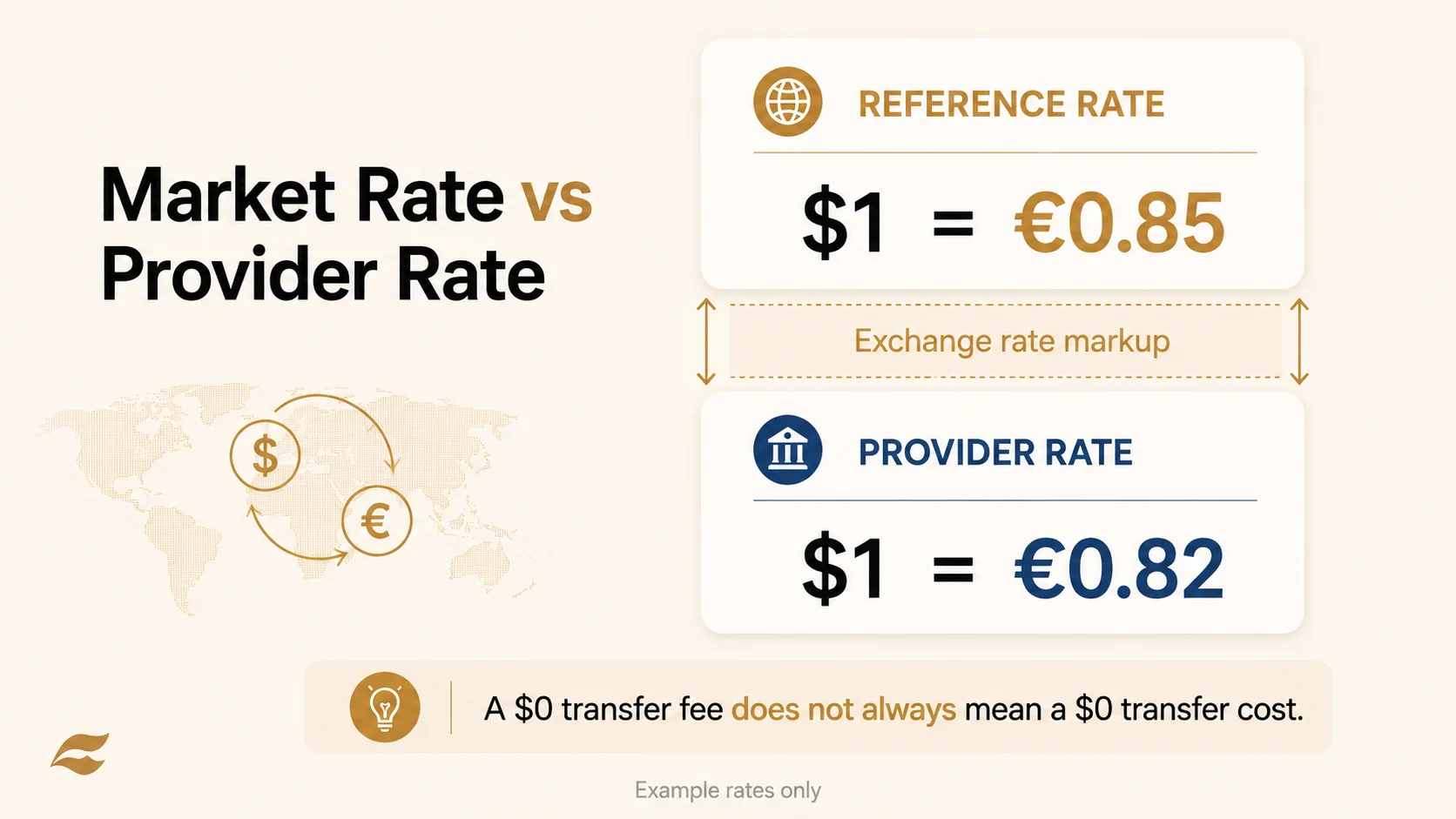
Reference rate: 1 USD = 0.85 EUR
Rate offered for your transfer: 1 USD = 0.82 EUR
In this example, the provider’s rate gives the recipient fewer euros for every dollar converted. That difference can form part of the cost of the transfer.
How do exchange rates affect international money transfers?
The exchange rate directly affects the amount of foreign currency produced when your money is converted. Consider two hypothetical providers.
You want to send $1,000, and the recipient needs euros.
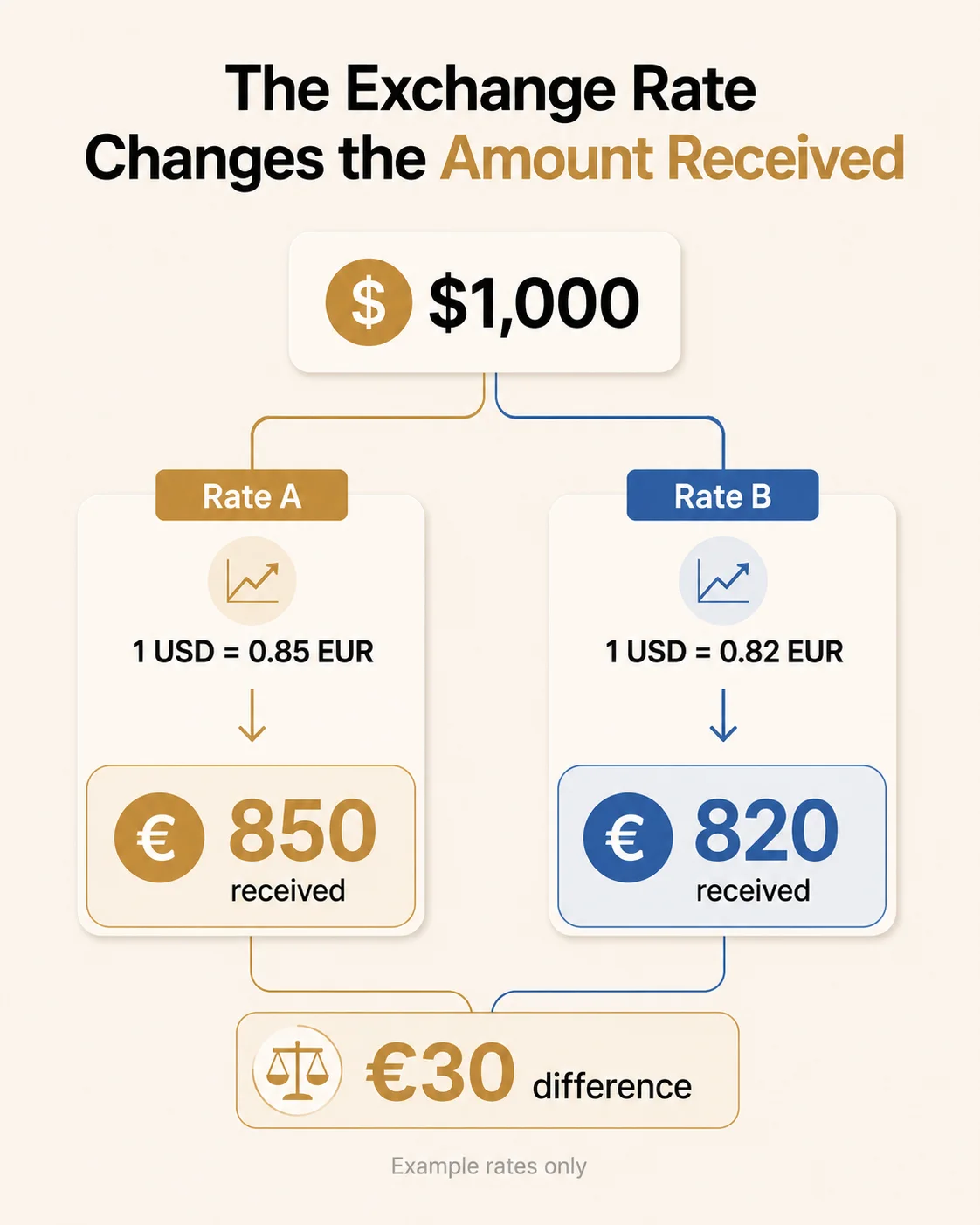
Provider A
Exchange rate:
1 USD = 0.85 EUR
Amount after conversion:
$1,000 × 0.85 = €850
Provider B
Exchange rate:
1 USD = 0.82 EUR
Amount after conversion:
$1,000 × 0.82 = €820
The difference is:
€30
The amount sent was the same. The difference came from the exchange rate. This is why the rate matters when comparing an international money transfer platform.
The CFPB identifies exchange rates as a key factor in both the price a remittance sender pays and the amount the recipient ultimately receives.
What is an exchange rate markup?
An exchange rate markup is a difference added between a reference or wholesale exchange rate and the rate offered to the customer. Suppose the reference rate is:
1 USD = 0.85 EUR
A transfer provider might instead offer:
1 USD = 0.82 EUR
The sender gets fewer euros for each dollar. This is important because currency conversion can cost money even when the transfer fee looks low.
For certain US remittance transfers where estimates are permitted, CFPB rules specifically refer to the wholesale exchange rate and any spread a provider or correspondent typically applies to that rate.
That is why looking only for a “$0 fee” does not necessarily tell you the full cost of a transfer. You also need to look at the exchange rate.
Exchange rate vs transfer fee
| Exchange rate | Transfer fee | |
|---|---|---|
| What is it? | Rate used to convert currencies | Charge for making the transfer |
| Can vary by provider? | Yes | Yes |
| Can affect the final amount received? | Yes | Yes |
| Should you compare it? | Yes | Yes |
For covered US remittance transfers, CFPB rules generally require providers to disclose the applicable exchange rate when the recipient receives a different currency. The disclosed amount received must also account for the exchange rate and applicable disclosed fees and taxes.
Send international transfers with PureFi
PureFi uses the mid-market exchange rate on supported transfers, so there is no PureFi exchange-rate markup added to the rate. PureFi also charges a $0 PureFi transfer fee.
Stablecoin-backed infrastructure is used behind the transfer process, and most supported transfers arrive in seconds. Before confirming a transfer, users can review the transfer details and the amount the recipient is expected to receive. Countries, currencies, limits, funding methods, and availability depend on the supported transfer route and user eligibility.
Learn more about how PureFi can help you send, receive, and grow money across borders, or download the app to get started today.
FAQs
What is an exchange rate in simple terms?
An exchange rate tells you how much one currency is worth in another currency. For example, if a hypothetical rate is 1 USD = 0.85 EUR, one US dollar would convert into 0.85 euros at that rate.
Who determines exchange rates?
It depends on the currency and its exchange-rate system. Some currencies have market-determined floating rates, while others are pegged or managed. For floating currencies such as the British pound, supply and demand in foreign exchange markets play a central role in determining the rate.
Why do exchange rates change every day?
For floating currencies, exchange rates change as supply and demand change. Interest rates, economic conditions, international trade, investment, and market expectations can all influence demand for a currency.
What is the mid-market exchange rate?
The mid-market rate is the midpoint between the prices at which a currency is being bought and sold in the market. A transfer provider may offer customers this rate or a different rate.
Can two money transfer providers offer different exchange rates?
Yes. Providers can offer different customer exchange rates even for the same currency pair. That is why it is useful to compare the actual rate and final amount received before making a transfer.
Does a better exchange rate mean the recipient gets more money?
If all other parts of the transfer are equal, a more favorable exchange rate means more of the recipient’s currency is produced from the same amount sent. Fees and other charges can still affect the final amount received.