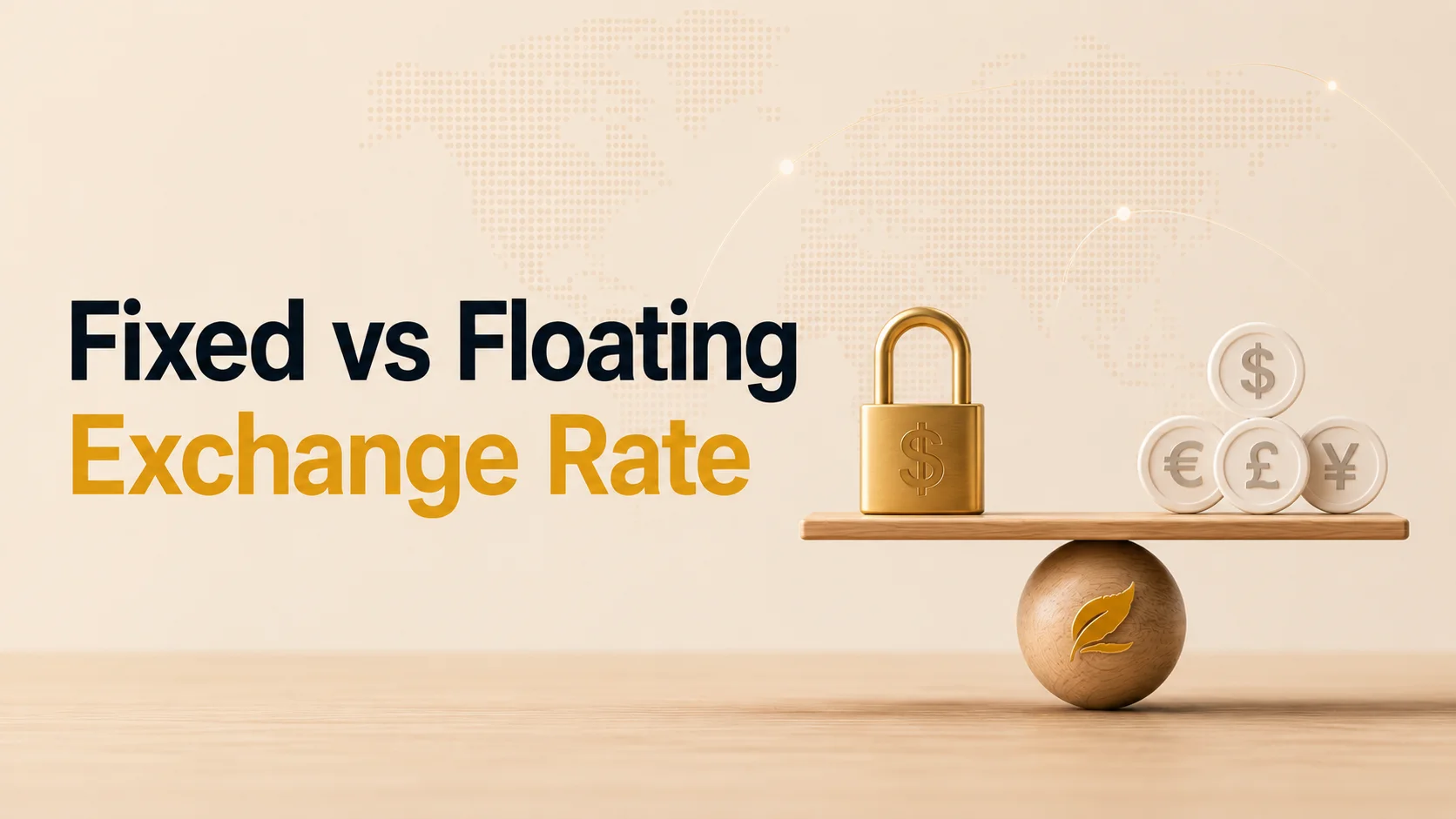
Fixed vs Floating Exchange Rate
Exchange rates play a bigger role in everyday life than many people realize. They affect how much you pay when you exchange currency, how much money someone receives in another country, and even the cost of imported goods and international travel.
But have you ever wondered why some currencies barely change in value while others rise and fall every day?
The answer lies in the country’s exchange rate system. Around the world, governments generally choose between two approaches: a fixed exchange rate or a floating exchange rate. Each system works differently and comes with its own advantages and challenges.
In this guide, we’ll explain how fixed and floating exchange rates work, compare their pros and cons, and look at countries that use each system.
What is a fixed exchange rate?
A fixed exchange rate is a system where a country’s currency is tied, or “pegged,” to another currency or a valuable asset such as gold. Instead of allowing the exchange rate to change freely, the country’s central bank works to keep it close to a set value.
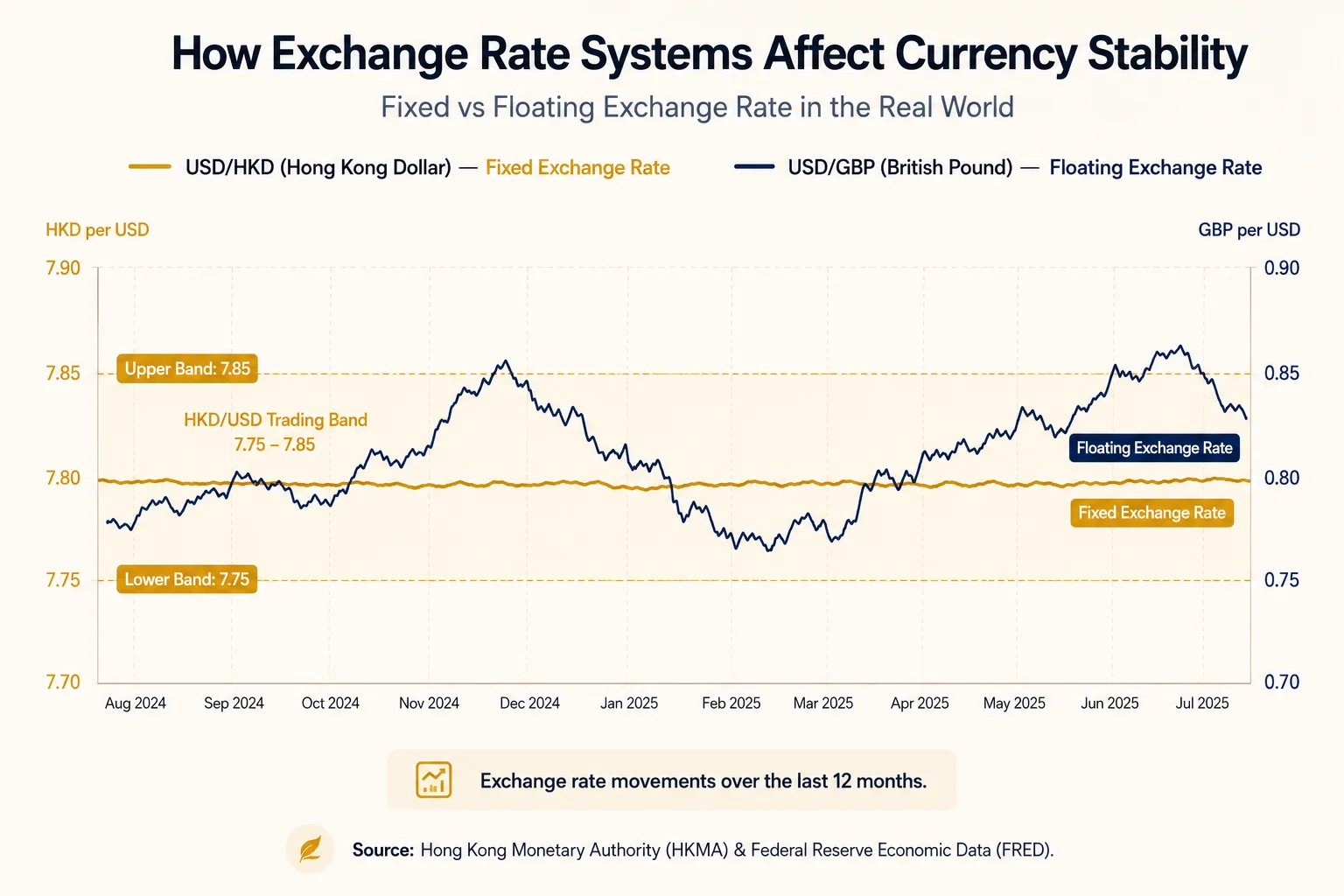
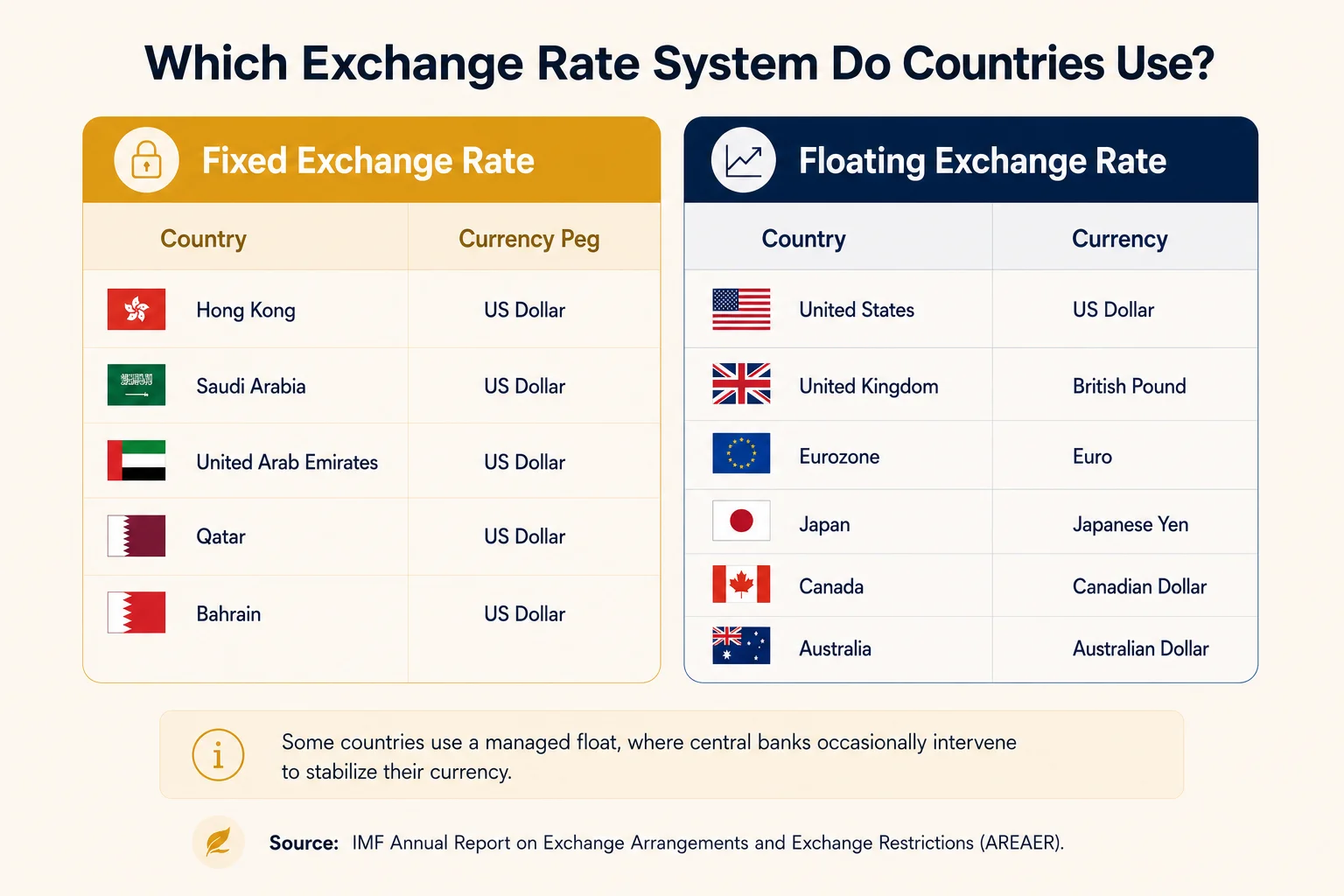
For example, the Hong Kong dollar is pegged to the US dollar within a narrow trading range, while the Saudi Arabian riyal has been pegged to the US dollar for decades. This means their exchange rates remain relatively stable instead of changing significantly from day to day.
To maintain the fixed rate, the central bank buys or sells its own currency in the foreign exchange market whenever necessary. It also keeps foreign currency reserves to help defend the peg during periods of high demand or economic uncertainty.
Advantages of a fixed exchange rate
One of the biggest benefits of a fixed exchange rate is stability. Businesses that import or export goods can plan their costs more accurately because exchange rates don’t fluctuate dramatically.
A fixed exchange rate can also help control inflation and increase investor confidence, especially in developing economies seeking to encourage international trade and investment.
For individuals, stable exchange rates make it easier to estimate the cost of an international remittance or other forms of international money sending, since currency values remain relatively predictable.
Disadvantages of a fixed exchange rate
Keeping a currency fixed isn’t easy. Central banks must hold large amounts of foreign currency reserves to maintain the exchange rate, and defending the peg can become expensive during economic crises.
A fixed exchange rate also limits a country’s ability to adjust interest rates or respond quickly to changes in its own economy. If economic conditions change significantly, maintaining the peg can become difficult and, in some cases, unsustainable.
What is a floating exchange rate?
A floating exchange rate is a system where the value of a country’s currency is determined by supply and demand in the global foreign exchange market. Instead of being fixed to another currency, its value changes throughout the day as people, businesses, investors, and governments buy and sell it.
This is the system used by many of the world’s largest economies, including the United States, the United Kingdom, the Eurozone, Japan, Canada, and Australia.
A floating exchange rate can rise or fall for many reasons. Interest rate changes, inflation, economic growth, political events, and global investor confidence all influence how much a currency is worth compared to others.
For example, if investors have confidence in a country’s economy, demand for its currency may increase, causing its value to rise. On the other hand, economic uncertainty or rising inflation can reduce demand and cause the currency to weaken.
Advantages of a floating exchange rate
One of the biggest advantages of a floating exchange rate is flexibility. Since the currency isn’t tied to a fixed value, central banks have more freedom to set interest rates and respond to changes in the domestic economy.
Floating exchange rates can also help absorb economic shocks naturally. If exports slow down or economic conditions weaken, the currency may fall in value, making the country’s goods and services more competitive in international markets.
Another benefit is that governments don’t need to spend large amounts of foreign currency reserves defending a fixed exchange rate.
Disadvantages of a floating exchange rate
The main downside is volatility. Because exchange rates change constantly, businesses and consumers may find it harder to predict the cost of international transactions. A currency that is worth one amount today could be worth noticeably more or less tomorrow.
This uncertainty can affect import prices, overseas investments, and the cost of an international remittance. It can also make it more difficult to find a cheap international money transfer, as the exchange rate available at the time of your transaction may differ from the one you saw earlier.
For this reason, many people compare exchange rates across providers before they send money internationally online, helping them get more value from their transfer.
Fixed vs floating exchange rate: What’s the difference?
| Feature | Fixed Exchange Rate | Floating Exchange Rate |
|---|---|---|
| Who sets the rate? | Central bank or government | Foreign exchange market |
| Exchange rate movement | Mostly stable | Changes throughout the day |
| Government intervention | Frequent | Usually limited |
| Monetary policy | Less flexible | More flexible |
| Foreign currency reserves | Large reserves required | Lower reserve requirements |
| Examples | Hong Kong Dollar, Saudi Riyal | US Dollar, Euro, British Pound |
Neither system is perfect. A fixed exchange rate offers stability and predictability but requires ongoing government support. A floating exchange rate gives countries greater economic flexibility but exposes businesses and consumers to fluctuating exchange rates.
Frequently asked questions
What is the difference between a fixed and floating exchange rate?
A fixed exchange rate is set by a government or central bank and remains tied to another currency or asset. A floating exchange rate changes based on supply and demand in the foreign exchange market.
Which countries use a fixed exchange rate?
Several countries use fixed exchange rates or currency pegs. Examples include Hong Kong, where the Hong Kong dollar is pegged to the US dollar, and Saudi Arabia, where the Saudi riyal has been linked to the US dollar for many years.
Which countries use a floating exchange rate?
Many of the world’s largest economies use floating exchange rates, including the United States, the United Kingdom, Canada, Japan, Australia, and the countries that use the euro.
What is a managed float exchange rate?
A managed float is a hybrid system where exchange rates are mostly determined by the market, but the central bank occasionally intervenes to reduce excessive volatility or support economic stability.
How do exchange rate systems affect international money transfers?
Exchange rate systems influence how much one currency is worth compared to another. In countries with floating exchange rates, currency values can change throughout the day, which may affect the final amount received when you make an international transfer.
Conclusion
Fixed and floating exchange rates both play an important role in the global economy, but they serve different purposes. A fixed exchange rate offers greater stability and predictability, while a floating exchange rate gives countries more flexibility to respond to changing economic conditions.
Although governments decide which system to use, understanding the difference can help individuals and businesses make more informed financial decisions.
How PureFi helps
PureFi makes supported international money transfers simpler by clearly showing fees, exchange rates, recipient details, and the expected payout before you confirm your transfer. This gives you a better understanding of your payment before it’s sent. Services and payment options may vary by country, supported route, and eligibility.
Learn more about how PureFi can help you send, save, and grow money across borders, or download the app to get started today.