Does Opening a High-Yield Savings Account Affect Your Credit Score?
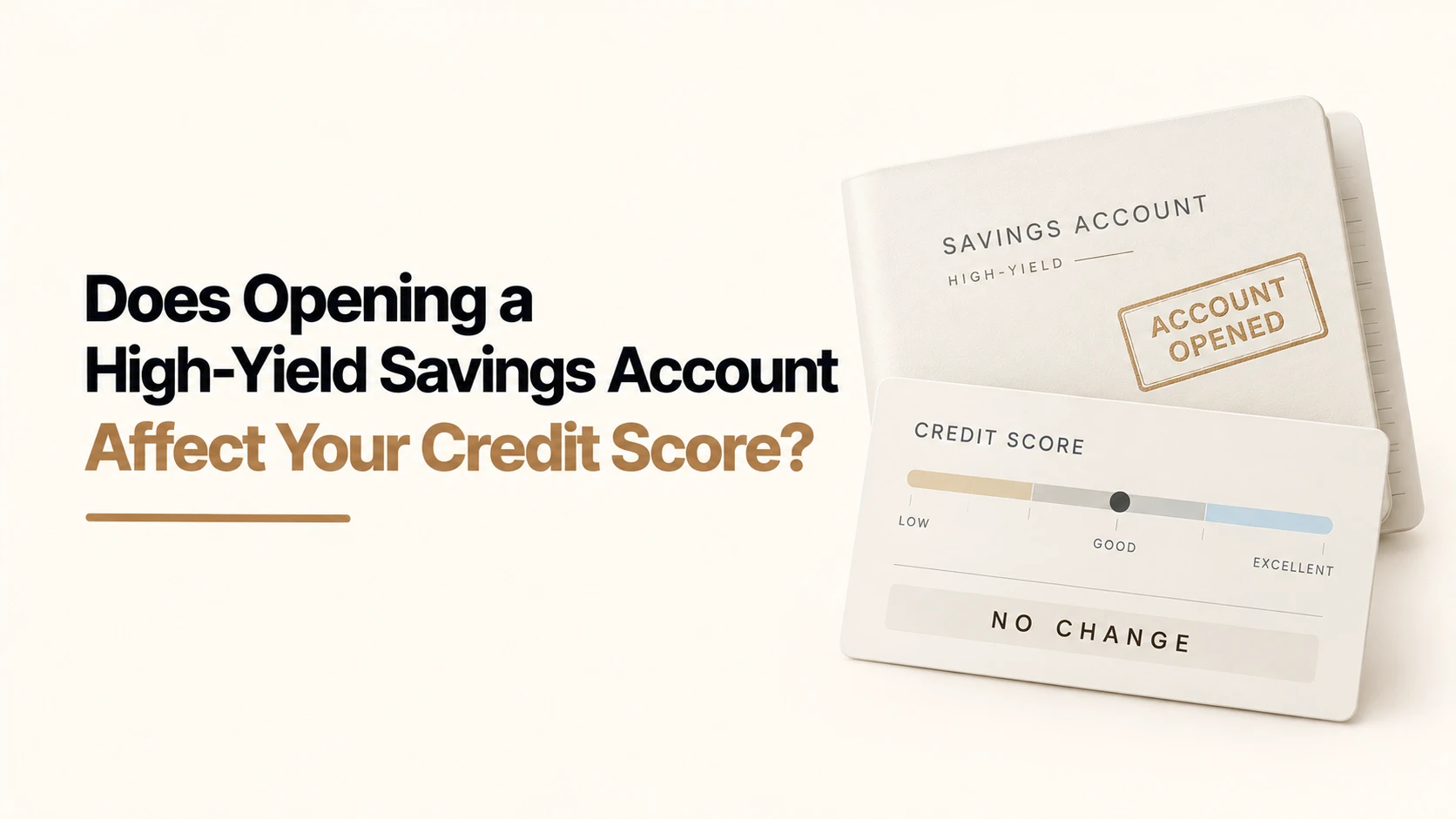
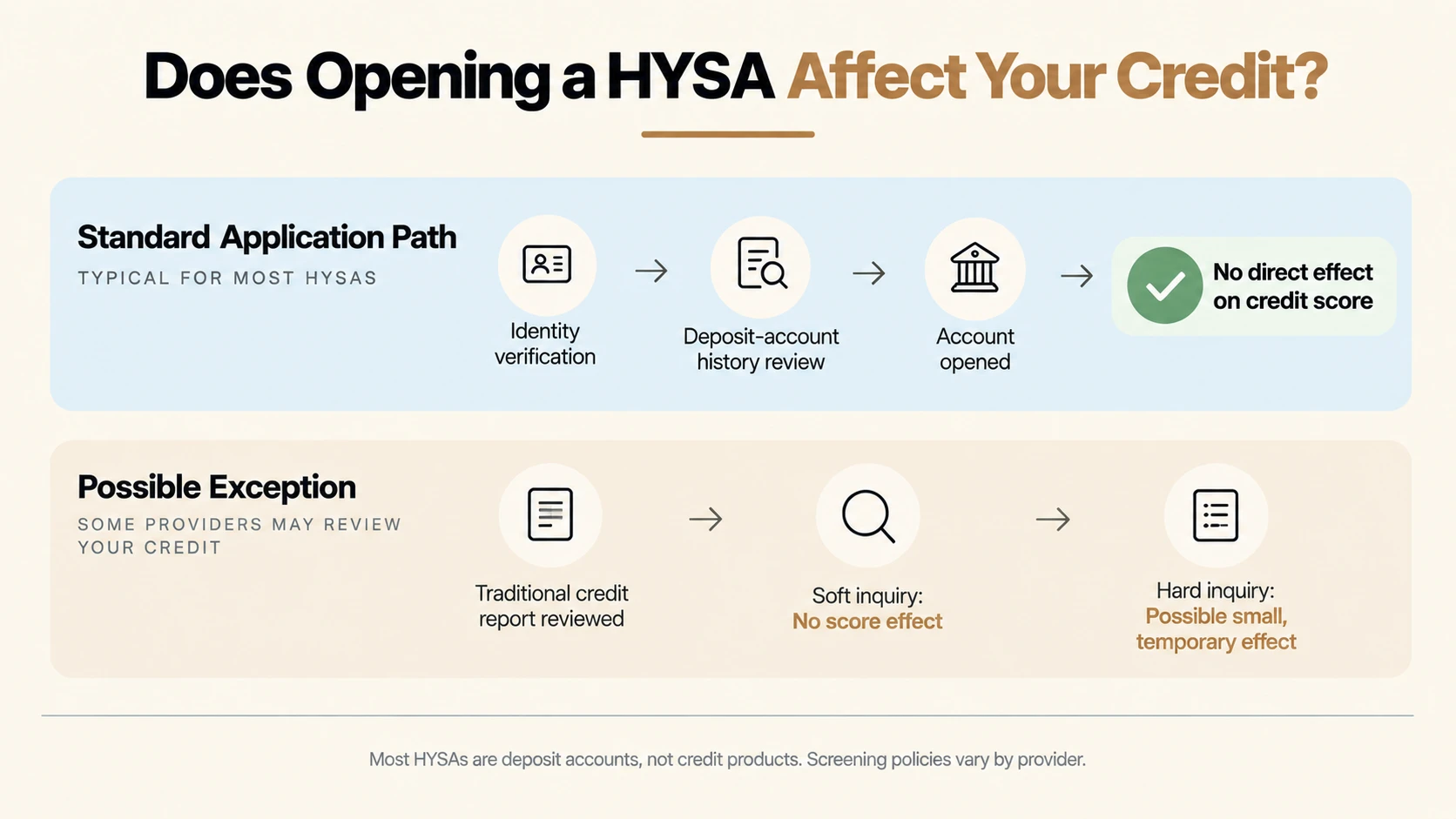
Opening a high-yield savings account usually does not affect your credit score. A HYSA holds your money instead of letting you borrow, so it is not normally reported as a credit account.
Banks pay yield on your deposited balance, and the variable APY can change. Access depends on the account rules, while eligible deposits at an FDIC-insured bank are generally protected within applicable limits.
Why Opening a HYSA Usually Does Not Affect Credit
Credit scores are mainly based on how you manage borrowed money. Credit cards, personal loans, auto loans, and mortgages can appear on your credit reports because they involve a lender extending credit to you.
A high-yield savings account works differently. You deposit your own money, and the bank pays a yield on the qualifying balance. You are not borrowing from the bank simply by opening the account.
As a result, a standard HYSA is not normally reported as a credit account to Experian, Equifax, or TransUnion. The account balance does not become part of your credit utilization, payment history, credit mix, or age of credit.
This means the following actions do not usually change your credit score:
- Opening a standard high-yield savings account
- Depositing money
- Withdrawing money
- Receiving yield payments
- Maintaining a large or small balance
- Closing the account in good standing
A HYSA also does not build credit. Keeping a high balance or leaving the account open for several years will not normally increase your score because the account is not part of your traditional credit history.
However, “usually” is important. Banks have different application and account-review policies. Some may check a traditional credit report, especially if another credit-based service is included with the application.
What Might a Bank Check When You Apply?
Opening a HYSA may not affect your credit score, but the bank still needs to decide whether it can open the account for you. It may verify your identity and review your previous banking activity.
Identity verification
Banks usually ask for personal information such as:
- Full legal name
- Date of birth
- Residential address
- Social Security number or taxpayer identification number
- Government-issued identification
- Phone number and email address
The purpose is to confirm that you are who you claim to be and to meet account-opening requirements. A bank may also ask questions based on information in public or private databases.
Providing your Social Security number does not automatically mean the bank is making a hard credit inquiry. The number can also be used for identity verification, tax reporting, and checking deposit-account history.
You may have trouble completing the application if your name, address, or identification details do not match available records. That is an identity-verification issue rather than a change to your credit score.
Deposit-account screening reports
Instead of reviewing a traditional credit report, a bank may use a specialty consumer reporting company. ChexSystems and Early Warning Services are two providers commonly associated with deposit-account screening.
These reports focus on banking history rather than loan repayment. They may include details such as:
- Accounts closed by a financial institution
- Unpaid negative balances
- Returned payments
- Suspected fraudulent activity
- Repeated account misuse
- Previous applications or banking inquiries
TheConsumer Financial Protection Bureau explains that banks and credit unions may use reports from account-screening companies when reviewing applications.
A ChexSystems report is separate from a traditional credit report. An inquiry into that report does not normally affect your FICO or VantageScore. However, negative information may cause a bank to deny your HYSA application.
ChexSystems allows consumers to request a free disclosure report at least once every 12 months. Its officialConsumer Disclosure page also explains that the report may help you understand an account denial when ChexSystems contributed to the decision.
A person can therefore have a strong credit score but still face difficulty opening a bank account because of negative banking history. The reverse is also possible. Someone with a low credit score may qualify for a savings account if their identity and deposit-account history meet the bank’s requirements.
Soft Inquiry vs. Hard Inquiry
Not every review of your credit information affects your score. The result depends on whether the bank performs a soft inquiry or a hard inquiry.
| Type of review | Visible to lenders? | Can affect your score? |
|---|---|---|
| Identity verification | Usually not shown as a credit inquiry | No |
| ChexSystems review | Appears on a separate specialty report | Not normally |
| Soft credit inquiry | Usually visible only to you | No |
| Hard credit inquiry | Can appear on your credit report | It may cause a small, temporary reduction |
Soft credit inquiries
A soft inquiry may be used to verify identity, review an existing relationship, or complete another non-lending check. It does not affect a FICO score.
You may be able to see a soft inquiry when reviewing your own credit report, but other lenders generally do not see it as an application for new credit.
Hard credit inquiries
A hard inquiry usually occurs when you apply for borrowed funds, such as a credit card or loan. It can appear on your credit report and may cause a small, temporary score reduction.
According tomyFICO, soft inquiries do not affect FICO scores. Hard inquiries may affect a score, although the effect varies by person and is generally small.
A standard HYSA application does not involve borrowing. However, application practices can vary. A provider may review a traditional credit report under certain circumstances, or the application may include an optional credit product.
For example, a bank may offer an overdraft line or ask whether you want to apply for another account at the same time. The savings account itself may not require a hard inquiry, but the additional borrowing feature could.
Before submitting an application, read the disclosure near the authorization checkbox. Look for language stating that the provider may obtain a consumer credit report or make a hard inquiry. If the wording is unclear, ask the bank whether the application will affect your credit file.
Do not assume that a bank will perform a hard inquiry simply because it asks for your Social Security number. At the same time, do not assume every digital savings platform follows the same process.
When Could a HYSA Indirectly Affect Your Credit?
A high-yield savings account normally has no direct effect on credit. Problems can arise when the account develops an unpaid balance, includes a borrowing feature, or involves a hard inquiry.
The bank makes a hard inquiry
If the bank performs a hard inquiry, the inquiry can appear on a traditional credit report and may cause a temporary score change.
This is more likely to be relevant when an application includes an overdraft line, credit card, loan, or another borrowing product. Check whether you are applying only for a HYSA or for a package containing several products.
The account develops a negative balance
A savings account can sometimes become negative because of:
- A deposit that is later reversed
- A returned electronic transfer
- A fee charged after most funds have been withdrawn
- A payment made using unavailable funds
- An error that is not corrected
- A linked overdraft or transfer feature
A negative balance does not necessarily appear on a traditional credit report immediately. The bank may first contact you and request payment.
If the debt remains unpaid, the bank could close the account and transfer the amount to a collection agency. If the collection agency reports the debt to the major credit bureaus, it could affect your credit report and score.
The bank may also report the account to a specialty banking database. This could make it harder to open another checking or savings account, even if the debt never appears on a traditional credit report.
You add a borrowing feature
A HYSA may be connected to another product, such as an overdraft line or linked credit account. Applying for that separate product may involve a hard inquiry.
Using borrowed funds can also create a balance that must be repaid. Late or missed payments on the credit product may be reported to credit bureaus.
The distinction matters. The HYSA is not causing the credit activity. The connected borrowing feature is.
You close the account with money owed
Closing a HYSA in good standing does not normally hurt your credit score. The account is not usually included in the age of your credit history.
Before closing it, make sure all deposits, withdrawals, and transfers have cleared. Check for pending fees and cancel any recurring transactions connected to the account.
Withdrawing the visible balance may not be enough if a pending transfer later reverses. Wait for final activity to settle and ask the bank to confirm that the account was closed with a zero balance.
Can You Open a High-Yield Savings Account With Bad Credit?

Having a low credit score does not automatically prevent you from opening a HYSA. Because the account holds your own money, the bank is not deciding whether to lend money to you.
A deposit-account report may matter more than your traditional score. A bank may want to know whether previous accounts were closed with unpaid balances or involved suspected misuse.
Approval policies still vary. One bank may approve an application that another bank rejects. Providers can use different screening companies, risk rules, identity-verification systems, and deposit requirements.
If you have poor credit but a clean banking history, you may still qualify for many savings accounts. If you have strong credit but negative information in ChexSystems, opening an account may be more difficult.
Before applying, consider whether you have:
- An unpaid balance with another bank
- An old account closed by a financial institution
- A recent fraud alert or security freeze
- Personal information that no longer matches official records
- Several recent bank-account applications
- A dispute that has not yet been corrected
If a bank uses ChexSystems and denies your application, request your consumer disclosure and review it for errors. You can dispute inaccurate information directly with the reporting company. You may also need to contact the bank that supplied the information.
A denial does not lower your credit score by itself. The result may appear in a specialty banking report, but it is not the same as missing a loan payment or carrying a high credit card balance.
Start Earning With PureFi
PureFi offers a different way to earn, with up to 6% projected APY connected to rental income and possible changes in property value. It is not a bank account, and its funds are not FDIC-insured. Returns can vary, and property shares can lose value.
Review PureFi’s eligibility checks, account structure, fees, access rules, and risks before signing up.
Learn more about how PureFi can help you own real estate shares or download the app to get started today.