Do Savings Accounts Earn Interest?

Most savings accounts earn interest. The bank pays you a small amount for keeping money in the account. How much you receive depends on the account’s rate, your balance, how the bank calculates earnings, and how long the money stays there.
Not every savings product works this way. PureFi is interest-free. Instead of earning through lending, PureFi users can buy shares of real homes and earn projected yield from rent and changes in property value.
Below, we explain how conventional savings accounts generate returns, what APY tells you, why the rate can change, and what to know before choosing an interest-based or interest-free option.
Disclaimer: This article is for general education only. It is not financial, investment, tax, or legal advice. Rates and projected returns can change. Investments may lose value.
How do savings accounts earn interest?
Banks accept deposits from customers. They keep enough funds available for normal withdrawals and use part of their funding to make loans and support other banking activities.
Borrowers pay the bank for using those funds. The bank may then pay a lower rate to people who keep money in savings accounts. The difference helps cover the bank’s costs and contributes to its earnings.
Your account earnings are usually based on your balance and the rate offered by the bank. Some banks calculate them using the amount in the account at the end of each day. The bank then adds the amount earned to your balance on a set schedule, such as monthly.
The calculation differs by provider. Account terms should explain:
- Which balance is used
- How often earnings are calculated
- How often they are added to the account
- Whether a minimum balance is required
- Whether the rate can change
The FDIC explains that banks can accept deposits and make loans, while eligible deposits at insured banks receive federal protection within the applicable limits.
What does APY mean on a savings account?
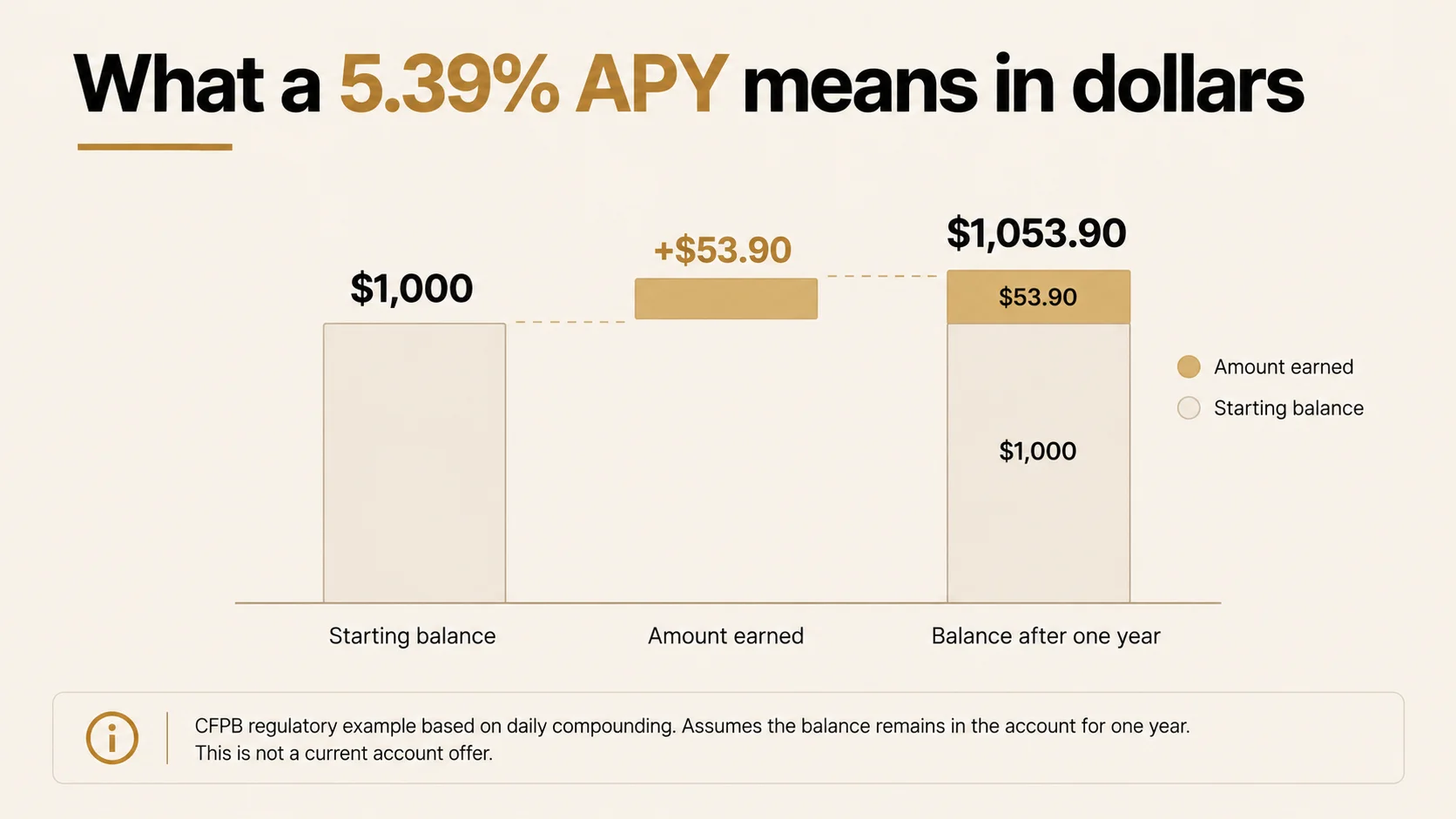
APY stands for annual percentage yield. It shows how much an account could earn over one year if the balance and rate stayed the same and the earnings remained in the account.
APY includes compounding. Compounding happens when new earnings are added to the balance. Future earnings are then calculated using the original balance plus the amount already earned. This makes APY more useful than looking at the basic rate alone. If two accounts calculate and add earnings at different times, APY gives you a more consistent way to compare them.
APY doesn’t tell you everything about an account. It doesn’t mean the rate will stay the same for a full year. It also doesn’t show how monthly fees, withdrawal charges, or minimum-balance rules may affect you.
The US Consumer Financial Protection Bureau defines APY as an annual figure based on the account’s rate and how often earnings compound. Its savings rules also require financial institutions to disclose key terms, including APY, minimum-balance requirements, and fees.
Why can the savings rate change?
Most standard savings accounts have variable rates. This means the bank can raise or lower the rate after you open the account.
Rates can change as wider market conditions and the bank’s funding needs change. A bank may also offer a temporary promotional rate to attract new customers. When the promotion ends, the account may fall to a lower rate.
Some accounts use balance tiers. You may receive one rate below a set balance and another rate above it. Other accounts require regular deposits or certain account activity to qualify for the advertised APY.
Before opening an online high-yield savings account, check:
- Whether the APY is variable
- How long any promotional rate lasts
- Whether the rate applies to the full balance
- Whether you must maintain a minimum balance
- Whether monthly fees apply
The highest advertised rate isn’t automatically the best deal. A slightly lower rate with simple terms and no monthly fee may leave you with more money.
What are the limits of interest-based savings?
Receiving interest can help a savings balance grow. But the headline rate doesn’t show the full result. There are several limits to consider.
Your earnings may not keep up with inflation
Inflation means that prices rise over time. When this happens, the same amount of money buys less than it did before. If your savings grow more slowly than prices, the number in your account may rise while its buying power falls. A high yield savings account may reduce this effect, but it doesn’t guarantee that your money will keep up with inflation.
The US Bureau of Labor Statistics uses the Consumer Price Index to measure changes in consumer prices. It also explains that as prices rise, the buying power of a dollar declines. Read the BLS explanation of purchasing power.
Fees can reduce what you earn
A monthly maintenance fee can take away part or all of the amount earned. Some accounts also charge for certain transfers, paper statements, overdrafts, or falling below a minimum balance.
Compare the possible yearly earnings with the full cost of keeping and using the account. An account with a strong advertised APY can still be a poor choice if its fees are too high.
The rate can fall
A variable rate can change at any time under the account terms. The rate you see when you open the account may not be the rate you receive several months later. This makes future earnings difficult to predict. Check the account regularly instead of assuming the opening rate will continue.
Earnings may be taxable
In the United States, bank interest is generally treated as taxable income. A bank may send the account holder a tax form showing the amount paid during the year. Tax rules differ by country and may also depend on residency and account type.
The IRS confirms that bank account interest is generally subject to US federal income tax. See IRS Topic 403. If you’re unsure what applies to you, speak with a qualified tax professional in your country.
The earnings come from lending
The conventional banking model is built partly around lending. Banks accept deposits, provide loans, and earn from the difference between what borrowers pay and what depositors receive.
This model is common, but it doesn’t suit everyone. Some people prefer not to earn from lending because of their personal or ethical values. Others prefer returns connected to ownership in a real asset or business activity.
That doesn’t make every asset-based product safer. It simply means the source of earnings is different. The risks still need to be understood.
Can you earn without interest?
Yes. A return can come from an income-producing asset rather than from lending money.
For example, a home may produce rental income. A business may generate profit from selling a product or service. An asset may also rise in value, allowing its owner to sell it for more than the purchase price.
These returns are usually described as income, earnings, or yield. They are linked to the performance of the asset. If the asset earns less than expected or falls in value, the owner’s return may also fall.
This is an important difference. A bank savings account normally keeps the deposited balance stable, subject to fees and account terms. An investment in a real asset can gain or lose value. An interest-free product is therefore not automatically risk-free. You still need to check what you own, where the yield comes from, what fees apply, and how you can sell.
How PureFi generates interest-free yield
PureFi is a financial technology company, not a bank or a conventional savings account. It provides a self-custodial wallet and access to shares of real, income-producing homes.
When you choose a home, your dollars buy property shares. Those shares are held in an account in your name. Each home’s legal documents are available through its page in the app.
PureFi’s projected yield comes from real estate. When tenants pay rent, your share is added to your balance. You can reinvest those earnings or take them out. Your property shares may also rise or fall with the value of the home.
Nothing is lent out. This makes the model interest-free. Your earnings are tied to ownership in real homes rather than payments made by borrowers.
PureFi currently projects up to 6% APY from real estate. This rate is not fixed or guaranteed. It is based on current rents and home values, so it can rise or fall. Property shares can also lose value.
There are no monthly fees. Each purchase has a one-time fee that is shown before you confirm the order. If you want to leave the investment, you can sell your shares at the current market price without a fixed lock-up.
PureFi balances and property shares are not bank deposits and don’t receive FDIC protection. Your wallet is self-custodial, which means you control it. You should still protect your login details, check every transaction, and understand the risks before buying.
See how PureFi earns from real estate.

Frequently asked questions
Do all savings accounts earn interest?
No. Many conventional savings accounts pay interest, but some pay very little or none at all. Other products may generate yield from assets instead. Always check how the provider describes the account and where the earnings come from.
How often do savings accounts pay interest?
It depends on the provider. A bank may calculate earnings daily and add them to the account monthly. Another bank may use a different schedule. The account disclosure should explain both calculation and payment timing.
Can a savings account rate change?
Yes. Most savings accounts have variable rates. Banks may raise or lower them under the account terms. Promotional rates may also end after a set period.
Can savings lose value because of inflation?
The account balance may not fall, but its buying power can. If prices rise faster than your savings grow, the money may buy less over time.
Is PureFi a savings account?
No. PureFi is a financial technology platform. It offers a self-custodial wallet and access to shares of real homes. These shares are investments, not bank deposits.
How does PureFi earn yield without interest?
PureFi users buy shares of homes with tenants. Projected earnings come from rent and changes in property value. Nothing is lent out.
Is interest-free yield guaranteed?
No. Interest-free doesn’t mean guaranteed. PureFi’s projected return can change, and property shares may lose value.
Put Your Dollars Into Something Real
With PureFi, your projected earnings come from shares of real homes with tenants. Choose your properties from your phone, review the documents, and see every fee before you confirm.
Learn more about how PureFi can help you own real estate shares or download the app to get started today.