Do HYSAs Compound Monthly?
Some HYSAs compound monthly, but many compound daily and credit earnings monthly. Banks pay yield on deposited balances, and APY already reflects compounding. Most HYSA rates are variable, so earnings can change even if the compounding schedule stays the same.
You can usually access funds through transfers, while eligible deposits at FDIC-insured banks are generally protected within applicable limits.
What Does Monthly Compounding Mean?
Monthly compounding means the bank adds the earnings from one month to your account balance. The new, larger balance is then used when calculating earnings for the next month.
Suppose you deposit $1,000 into an account. At the end of the first month, the account earns a small amount based on its rate. That amount is added to the original $1,000. During the second month, the bank calculates earnings using the original deposit and the amount added during the first month.
This creates a cycle:
Starting balance → Monthly earnings → New balance → Next month’s earnings
Over time, you begin earning on both your deposits and the earnings already added to the account. This is the effect of compounding.
Monthly compounding does not mean the APY is fixed for 12 months. A high-yield savings account normally has a variable rate. The bank can raise or lower it while keeping the same monthly compounding schedule.
For example, an account could compound monthly while its APY changes from 4.00% to 3.75%. Future calculations would use the new rate, but the bank would continue adding earnings to the balance according to its monthly schedule.
Compounding and Crediting Are Not the Same
Compounding and crediting are closely connected, but they describe different parts of the process. Confusing the two can make it seem as though an account compounds monthly when it actually compounds daily.
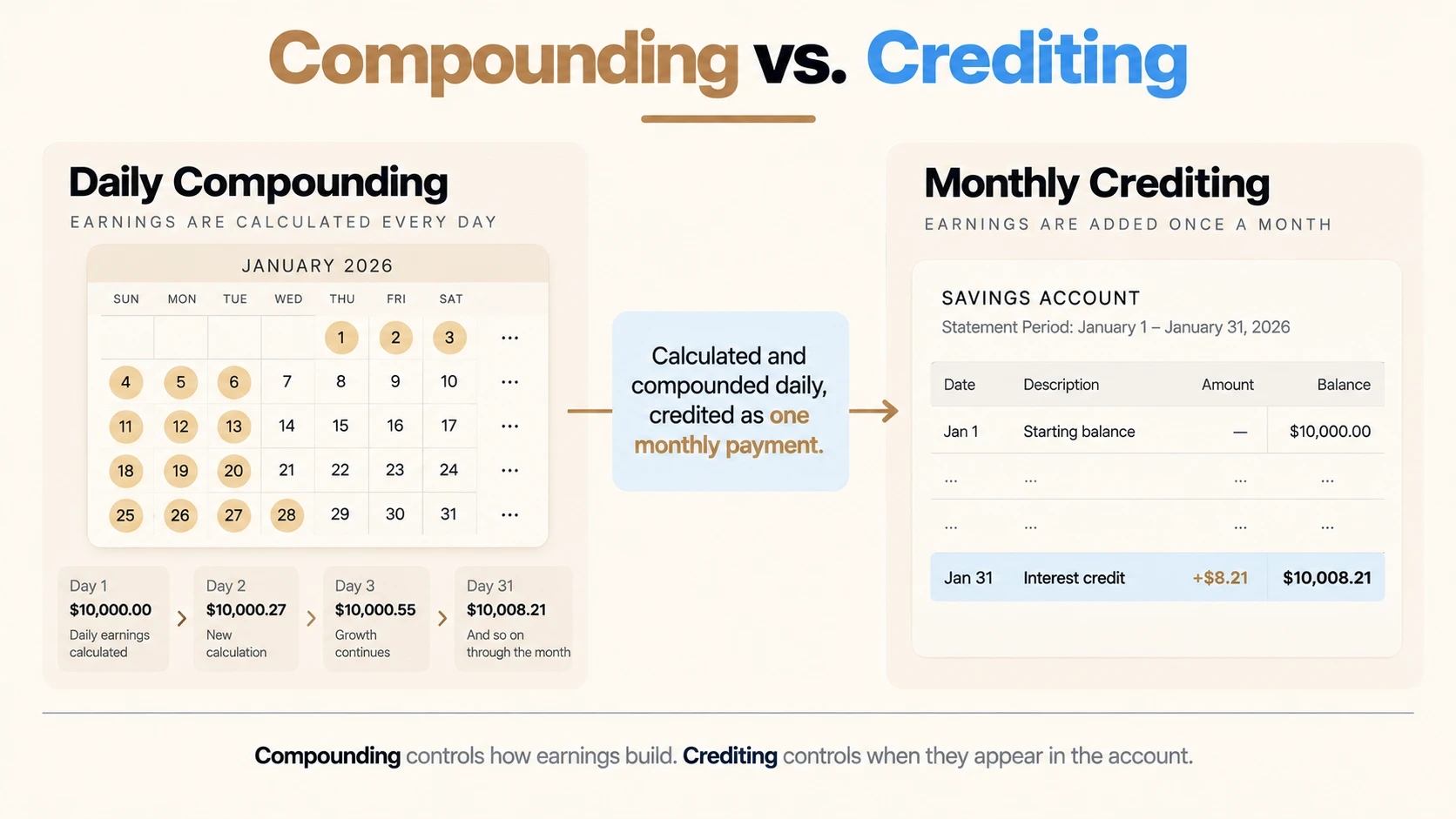
Compounding
Compounding refers to how often previously earned amounts begin contributing to future earnings. An account may compound:
- Daily
- Monthly
- Quarterly
- Annually
More frequent compounding can produce slightly more growth when the balance and annual rate before compounding are otherwise identical.
Crediting
Crediting refers to when accumulated earnings are posted to the account.
A bank might calculate and compound earnings daily but add the accumulated total to the visible account balance once each month. In that case, the account has daily compounding and monthly crediting.
You may not see a new transaction appear in your account every day. The amount can build behind the scenes and appear as one monthly payment on your statement.
Federal account-disclosure rules recognize compounding and crediting as separate terms. UnderCFPB Regulation DD, banks must disclose the frequency with which earnings are compounded and credited.
This means the phrase “paid monthly” does not tell you the full compounding schedule. It may only describe when the accumulated amount appears in the account.
Do All High-Yield Savings Accounts Use the Same Schedule?
No. High-yield savings accounts do not all follow one compounding schedule.
Many online savings accounts compound daily and credit earnings monthly. Others may compound monthly. The exact schedule depends on the provider and the account terms.
For example, Ally Bank states that its savings account compounds daily. Its rate is variable and may change after the account is opened.
American Express High Yield Savings also compounds daily and credits the accumulated earnings monthly. This is a clear example of why compounding and crediting should not be treated as the same thing.
Two accounts can therefore both show one payment per month while using different calculation methods. One might compound daily, while the other compounds monthly.
The schedule may also vary between products offered by the same bank. A savings account, money market account, and CD can each have different terms. You should not assume one product’s schedule applies to every account from that provider.
The same applies to high-yield savings apps. A banking app may show an account offered by a partner bank, so the partner bank’s deposit agreement usually contains the important details. The app’s general marketing page may not show the complete calculation and crediting rules.
How Daily Compounding With Monthly Crediting Works
Daily compounding with monthly crediting is common among high-yield savings accounts. The process normally happens in four stages.
First, the bank checks the balance used for that day’s calculation. The account agreement should explain whether the bank uses the daily balance, average daily balance, or another approved method.
Second, the bank calculates the amount earned for that day. The result may be a very small number, especially on a smaller balance.
Third, that amount becomes part of the ongoing compounding calculation. The bank repeats the process on following days using its stated method.
Finally, the accumulated amount is credited to the account, often at the end of the monthly statement cycle. It then appears as a transaction and becomes part of the visible balance.
The timeline looks like this:
Daily balance → Daily calculation → Daily compounding → Monthly credit
Suppose you keep $5,000 in an account throughout the month. The bank may calculate earnings each day, but you may not see 30 separate transactions. Instead, you may see one payment at the end of the statement period.
If you deposit more money during the month, the larger balance may begin earning once the deposit qualifies under the bank’s terms. If you make a withdrawal, later calculations will use the reduced qualifying balance.
The number of days in the statement period can also affect the monthly amount. A 31-day month may produce a different credit than a 28-day month, even when the balance and rate remain unchanged.
This does not necessarily mean the bank changed the APY. It can simply reflect the number of days included in the calculation.
Daily vs. Monthly Compounding
Daily compounding can produce slightly more than monthly compounding when both accounts begin with the same balance and use the same annual rate before compounding.
Consider a $10,000 balance with a 4.00% annual rate before compounding. Assume there are no deposits, withdrawals, fees, or rate changes during the year.
| Compounding schedule | Approximate balance after one year | Approximate earnings |
|---|---|---|
| Monthly | $10,407.42 | $407.42 |
| Daily | $10,408.08 | $408.08 |
Daily compounding produces approximately $0.66 more in this example.
Monthly compounding:
$10,000 x (1 + 0.04 / 12) raised to the power of 12 = $10,407.42
Daily compounding:
$10,000 x (1 + 0.04 / 365) raised to the power of 365 = $10,408.08
Daily compounding produces approximately $0.66 more in this example.
This calculation uses the same 4.00% annual rate before compounding. It does not compare two accounts advertising the same APY.
That difference matters because APY already includes the effect of compounding. If two accounts both advertise a 4.00% APY and that APY remains unchanged for a full year, each should produce approximately $400 on a constant $10,000 balance before fees. Their underlying annual rates may differ slightly to account for their different compounding schedules.
The difference between daily and monthly compounding is often smaller than people expect. A change in APY, a monthly fee, or a regular additional deposit can have a much larger effect on the final balance.
For example, depositing another $100 every month would add $1,200 in contributions during the year. That has a far greater effect than the $0.66 difference in the illustration above.

Why APY Matters More Than Compounding Frequency
APY is designed to show the estimated annual return after accounting for compounding. It gives savers a standard number they can use when reviewing accounts with different calculation schedules.
Suppose one account compounds daily and another compounds monthly. Looking only at the compounding schedule may make the daily account sound better. However, the monthly account could still produce more if it offers a higher APY.
Consider these two examples:
| Account | Compounding | APY |
|---|---|---|
| Account A | Daily | 3.75% |
| Account B | Monthly | 4.00% |
Account B has less frequent compounding, but its higher APY means it should produce more over a year if the APYs and balances remain unchanged.
APY is still not a guarantee of what you will earn. Most HYSA rates are variable. The bank may increase or decrease the APY after the account is opened.
Your actual total also depends on your balance. Depositing money earlier gives it more time to earn. Withdrawing funds reduces the balance used for later calculations. Monthly fees can also reduce or cancel out some of the account’s growth.
When looking at a high-yield digital savings account, we should therefore start with the APY rather than the words “daily compounding.” We should then review the account’s fees, balance requirements, withdrawal rules, transfer times, and protection.
An online savings app may make an account easy to manage, but a convenient app does not automatically mean the underlying account offers the strongest terms. Confirm which bank holds the deposits and whether that bank is FDIC-insured. TheFDIC BankFind tool can help verify an institution’s status.
PureFi Uses a Different Earning Model
PureFi is not a bank, so its projected yield should not be treated like the yield on a standard bank-based HYSA.
ThePureFi Earn product advertises up to 6% projected APY. Its earning model is connected to income-producing real estate. Yield comes from rent and possible changes in property value rather than a bank calculating earnings on a deposit balance.
PureFi’s projected APY can change and is not guaranteed. Rental income can vary, property values can rise or fall, and property shares can lose value.
Review the earning process, access rules, fees, and risks before deciding whether it fits your savings plan.
Learn more about how PureFi can help you own real estate shares or download the app to get started today.