Do High-Yield Savings Account Rates Change?
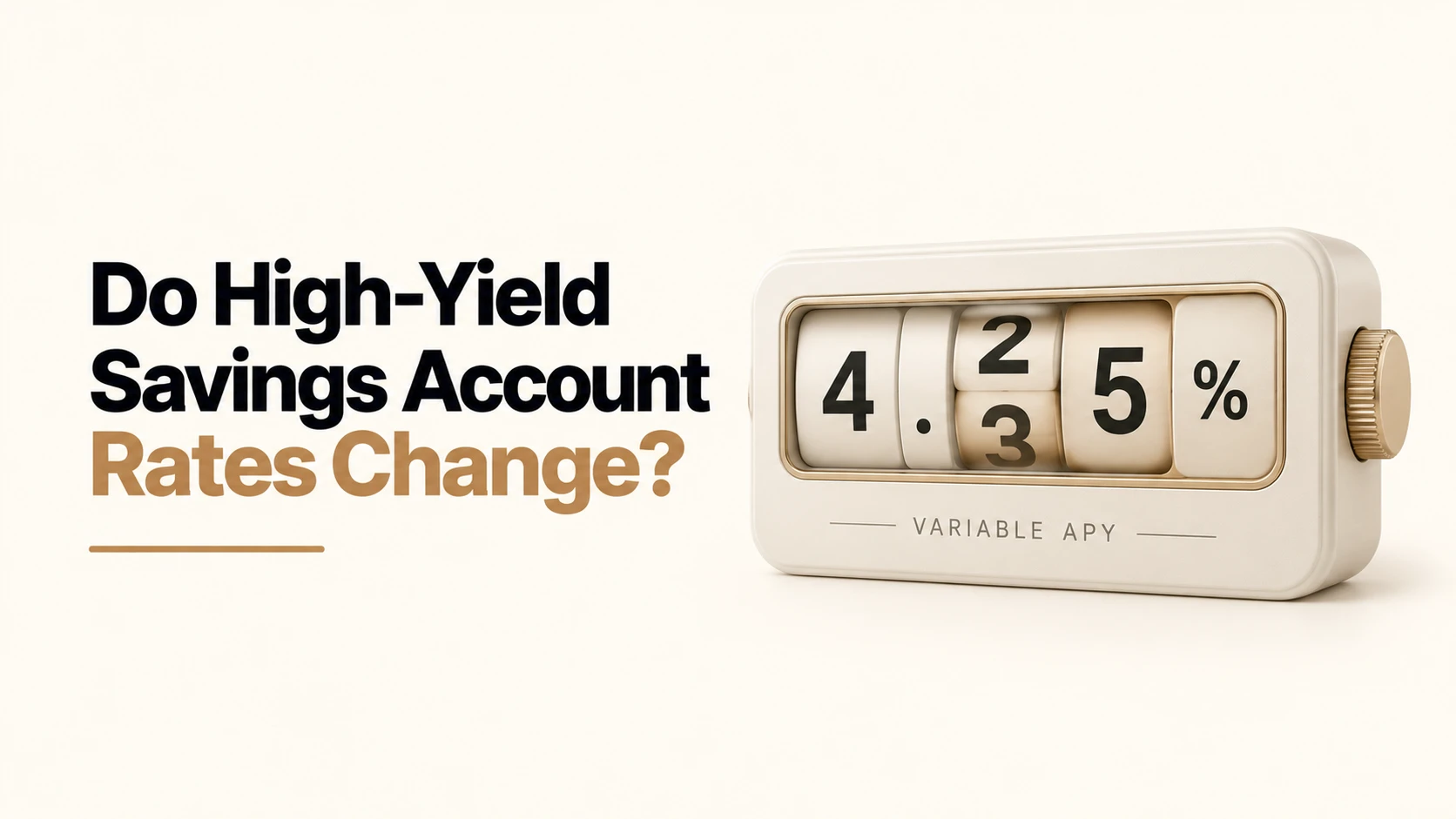
Yes, high-yield savings account rates change. Most of these accounts have a variable annual percentage yield, or APY. This means the bank can raise or lower the rate after you open the account.
Banks offer yield to attract and keep deposits. They can use those deposits as part of the funding for loans and other banking activities. The amount they offer can change based on Federal Reserve policy, market conditions, competition, and how much funding the bank needs.
A rate change does not usually stop you from accessing your money. You can normally continue making deposits and withdrawals under the account’s existing rules. Eligible deposits at an FDIC-insured bank also remain protected within applicable limits when the APY changes. The protection applies to your eligible deposit, not to a promised level of earnings.
The important point is that the APY shown when you open an account is not normally locked for a full year. It shows the annual yield you could earn if the rate and balance stayed the same, but either can change.
Are High-Yield Savings Account Rates Fixed?
Most high-yield savings accounts have variable rates. The bank can change the APY while your account remains open.
The account disclosure should tell you whether the rate is variable. UnderCFPB Regulation DD, banks offering variable-rate accounts must disclose that the APY may change. They must also explain how the rate is set, how often it may change, and whether any limits apply to those changes.
If the rate is set at the bank’s discretion, the account terms may state that it can change at any time. This does not mean the rate will change every day. It means the bank has not promised to keep it at the opening level for a set period.
This is different from a certificate of deposit. A traditional fixed-rate CD normally keeps the same APY until the end of its term. In return, you agree to leave the money deposited for a set period or accept a possible penalty for withdrawing it early.
A high-yield savings account provides more flexibility. You can usually add or withdraw money without waiting for a maturity date, but the APY is not locked.
Why Do High-Yield Savings Account Rates Change?
There is no single cause behind every savings rate change. Banks make their own pricing decisions, but several wider factors can affect those decisions.
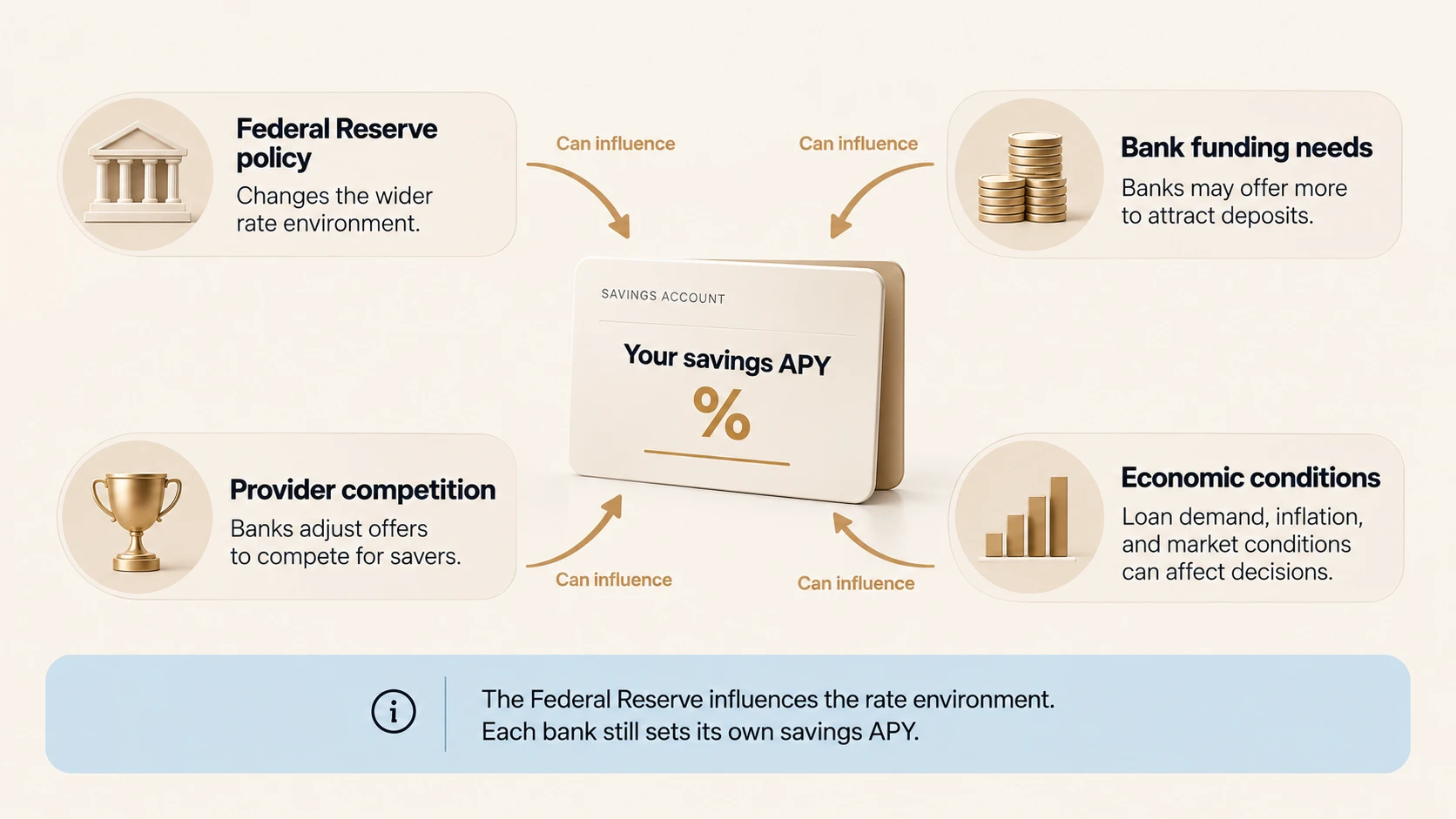
Federal Reserve policy
The Federal Reserve sets a target range for the federal funds rate, which affects short-term borrowing costs across the banking system. It uses tools such as open-market operations to support that target range. TheFederal Reserve’s rate history shows that the target can rise or fall as monetary policy changes.
When the target range rises, market rates often rise as well. Banks may then offer higher savings APYs to attract deposits. When the target range falls, banks may reduce the APYs they pay.
This is a general relationship, not a fixed rule. The Federal Reserve does not set the APY on your high-yield savings account. It also does not require every bank to change its APY by the same amount or on the same day.
One bank might respond within days. Another could wait several weeks. Some banks may leave their rates unchanged because they have different funding needs.
The bank’s need for deposits
A bank may raise its high-yield savings account APY when it wants to bring in more deposits. A competitive rate can encourage new customers to open accounts and existing customers to deposit more.
The bank may lower the rate once it has enough deposits to meet its needs. It may also reduce the APY if keeping a higher rate becomes too costly.
This is one reason online banks often appear near the top of high-yield savings account comparisons. An online bank may have lower branch-related expenses and may use competitive APYs to attract customers nationwide. However, being online does not guarantee that a bank will always offer the highest rate.
Competition between providers
Banks compete for customers. If several providers begin offering higher APYs, another bank may raise its rate to remain competitive.
A bank may also use a high promotional APY to bring in new customers. That offer could be limited to new accounts, certain balances, or a set number of months. When the promotion ends, the account may begin earning the bank’s standard variable APY.
Read the conditions carefully. An account advertised with a high rate may require a minimum deposit, recurring deposits, a linked checking account, or a specific balance. If you stop meeting the conditions, your APY could fall even if the bank’s general rate has not changed.
Economic and market conditions
Inflation, demand for loans, economic activity, and conditions in financial markets can all shape a bank’s funding decisions.
For example, a bank with strong demand for loans may want more deposits and could offer a higher APY. A bank with weak loan demand or plenty of available funding may have less reason to pay a leading rate.
These factors do not create a simple formula. High inflation does not automatically guarantee a higher savings APY. Banks consider several conditions before changing their offers.
Balance tiers and account terms
Some high-yield savings accounts use balance tiers. Each tier may have a different APY.
For example, a provider might offer one APY on balances below $5,000 and another on balances above that amount. Your rate could change when your balance enters a new tier, even if the bank does not change its published rates.
Other accounts offer their best APY only when you meet monthly requirements. These could include receiving a qualifying deposit, maintaining a certain balance, or holding another account with the same bank.
Check whether the advertised APY applies to your full balance. With some tiered accounts, one rate applies to the entire balance. With others, different portions of your balance may earn different rates.
How Often Can High-Yield Savings Rates Change?
There is no standard schedule for high-yield savings rate changes. A bank may keep its APY steady for several months or change it more than once during a shorter period.
Changes are more likely when the Federal Reserve adjusts its target range or when banks begin competing more strongly for deposits. However, a bank can also change its APY because of an internal funding decision that has little to do with a recent Federal Reserve announcement.
Banks may display the current APY on their website, mobile app, account dashboard, or periodic statement. The rate shown on an old article or comparison page may no longer be available.
It is also important to know that advance notice may not always be required. UnderCFPB rules for subsequent account disclosures, variable-rate changes are excluded from the general requirement for advance change-in-terms notice. A bank may still provide an alert, but you should not assume you will receive one before every APY adjustment.
Checking your account once a month can help you notice meaningful changes without watching the rate every day.
Do Banks Raise Savings APYs Automatically?
No. A Federal Reserve increase does not automatically raise the APY on every high-yield savings account.
Each bank chooses whether to adjust its rate, when the change will happen, and how large it will be. A bank may raise its APY by the full amount of a wider market increase, raise it by a smaller amount, or leave it unchanged.
The same applies when market rates fall. Some banks reduce their savings APYs quickly. Others keep their rates higher for longer to attract or retain customers.
This is why two accounts that started with the same APY can offer very different rates a few months later. The provider’s past behavior can offer useful context, but it cannot guarantee what the bank will do next.
When opening an account, do not focus only on a temporary position at the top of a rate table. A provider with a competitive long-term record, low fees, reliable transfers, and clear account terms may offer more value than one using a short promotional rate.
What Should You Do When Your Savings Rate Falls?
A lower APY does not always mean you need to close your account. Start by checking how large the change is and how much it affects your balance.
A practical review can include the following steps:
- Confirm the new APY on the bank’s official website or inside your account.
- Check whether the reduction applies to your full balance or only one balance tier.
- Look at competing accounts from FDIC-insured banks or NCUA-insured credit unions.
- Review monthly fees, minimum balances, transfer limits, and withdrawal options.
- Calculate the likely dollar difference before transferring your savings.
- Check whether the competing APY is promotional or has conditions attached.
- Make sure you will maintain applicable deposit protection after the transfer.
You should also consider how you use the account. A slightly lower APY may be acceptable if the account provides fast transfers, no fees, helpful customer service, or an app that makes saving easier.
If the gap becomes large and another reputable provider offers better terms, opening a new account may make sense. You do not always have to close the old account immediately. You can wait until transfers have cleared and confirm that scheduled deposits or withdrawals have been updated.

Is It Worth Transferring to an Account With a Higher APY?
The answer depends on your balance, the size of the rate difference, and how long you expect the higher APY to remain available.
Suppose you have $5,000 in savings and another account pays 0.25 percentage points more. The difference would be roughly $12.50 over one year before considering changes in the rate, balance, or compounding. That may not be enough to justify opening another account.
The same rate difference on $50,000 would be about $125 over one year. A larger balance makes even a small APY difference more meaningful.
You should still check the account’s full terms. A higher advertised APY may come with a monthly fee, a required balance, slow transfers, or conditions you cannot meet. The rate might also be a temporary promotion that ends shortly after you transfer the money.
Constantly switching accounts can create extra work. It may also lead to missed automatic transfers or periods when money is waiting to clear and is not earning the expected yield. Focus on meaningful differences rather than every small change.
Put Your Savings to Work With PureFi
Changing bank rates can make it harder to know what your savings may earn over time. PureFi offers a different model, with up to 6% projected APY supported by rent and possible changes in property value.
Review how the platform works, how you access your funds, and the risks involved before deciding whether it fits your savings plan.
Learn more about how PureFi can help you own real estate shares or download the app to get started today.