What Are the Best High-Yield Savings Accounts?

The highest APY does not always make an account the best place for your savings. A provider may charge fees, require regular deposits, restrict withdrawals, or reserve its best rate for new customers. You also need to consider how the account generates earnings and what protects your money.
In this article, we compared five high-yield accounts based on earnings, fees, account features, protection, and access to funds. Rates and terms can change, so check the provider’s website before opening an account.
1. PureFi: Best Overall for Higher Projected Earnings
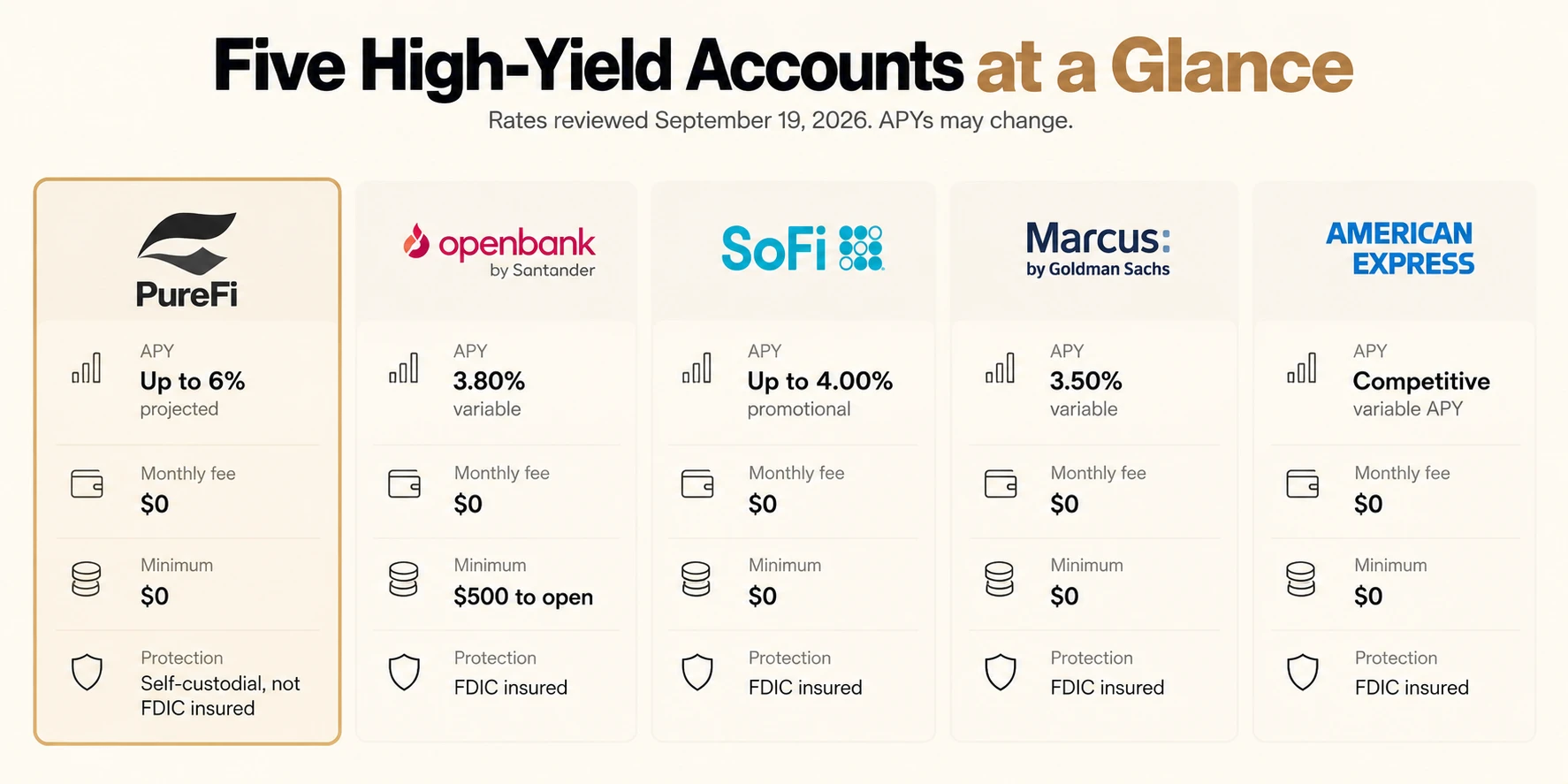
PureFi is an online high-yield savings account. It offers up to 6% projected APY with no monthly account fee or minimum balance. Users can add dollars, monitor their balance, and withdraw or reinvest their earnings through the PureFi app.
What makes PureFi different from a conventional high-yield digital savings account is where the earnings come from. PureFi uses income-producing real estate rather than a bank deposit. Users can purchase shares of real homes that already have tenants. When rent is collected, each user receives earnings based on the shares they own. Returns can also change with the value of the underlying homes.
With Purefi, each home is bought outright and professionally managed. Legal documents for each property are available through the app. Users can begin with a suggested mix of homes or select properties themselves.
The account is self-custodial. This means the dollar balance sits in a wallet controlled by the user rather than being held as a traditional bank deposit. Property shares are held in an account in the user’s name and are not pooled with other users’ shares.
Key features
- Up to 6% projected APY
- No minimum balance
- No monthly account fee
- Earnings calculated daily
- Earnings generated from rent and property values
- Shares of identifiable rental homes
- Suggested property mix or individual property selection
- Self-custodial dollar wallet
- Option to withdraw or reinvest earnings
- Shares can be sold at the current market price
- Access through the PureFi mobile app
- Available in multiple supported countries
There are no fees associated with the account. Each property-share purchase carries a one-time fee shown before confirmation. This fee should be reviewed before completing a purchase.
Pros
- Higher projected APY than the bank accounts reviewed here
- No monthly fee or minimum balance
- Earnings come from income-producing homes
- Nothing is lent out to generate the projected return
- Users can review individual properties and legal documents
- No stated lock-up period
- Users can withdraw earnings or reinvest them
- Available in more countries than US-only bank accounts
Cons
- PureFi is not a bank
- The APY is projected, variable, and not guaranteed
- Balances and property shares are not FDIC or SIPC insured
- Property shares can lose value
- A one-time fee may apply when property shares are purchased
- Shares sell at their current market price
- Access to cash may depend on selling the underlying shares
Who does PureFi suit best?
PureFi may suit people who want a high-yield savings account with higher projected earnings and exposure to real assets. It may also appeal to users outside the United States who cannot open the US bank accounts included below.
Users must be comfortable with its non-bank structure. PureFi may not be the right place for emergency money that must remain protected from market losses. Someone prioritizing FDIC insurance and predictable access may prefer a conventional digital savings platform.
2. Openbank High Yield Savings: Best for a Strong Standard APY
Openbank is the digital banking division of Santander Bank. Its High Yield Savings account offered a 3.80% variable APY when we reviewed it on September 19, 2026. It does not charge a monthly maintenance fee, but customers need at least $500 to open an account.
The account is managed through the Openbank app. Customers can view their balance, make transfers, and manage account security from their phones. Openbank uses trusted-device verification and supports face or fingerprint authentication.
This account does not include checks or a debit card. It is designed for accumulating savings rather than paying bills or making daily purchases. Deposits are held by Santander Bank and receive FDIC coverage within applicable limits.
Key features
- 3.80% variable APY at the time of review
- $500 minimum opening deposit
- No monthly account fee
- No direct-deposit requirement
- FDIC insured within applicable limits
- Mobile account access
- Biometric security
- Available to eligible US residents
Pros
- Competitive standard APY
- No monthly maintenance fee
- No payroll deposit requirement
- Backed by Santander Bank
- Simple mobile account management
- Available in all US states and Washington, DC
Cons
- Requires $500 to open
- Requires a smartphone and US mobile number
- No checks or debit card
- No Openbank branch access
- APY may change at any time
Who does Openbank suit best?
Openbank may suit US savers who already have at least $500 and want a competitive rate without payroll deposit rules. It is a good option for people comfortable using an online savings app and transferring money to another account before spending it.
3. SoFi Checking and Savings: Best for All-in-One Digital Banking
SoFi combines checking and savings in one account. Opening a SoFi savings account also opens a checking account, so customers can save, transfer, and spend without using a second bank.
The app includes Vaults that help users divide their savings by goal. Someone could create separate Vaults for an emergency fund, holiday, home deposit, or upcoming bill while keeping the money under one account.
At the time of our review, eligible new customers could earn up to 4.00% APY through a temporary boost. The standard savings APY was 3.10% for customers who completed eligible deposit activity. The exact requirements and promotional period should be checked before signing up.
Key features
- Up to 4.00% promotional APY for eligible new customers
- 3.10% standard savings APY with qualifying activity
- No minimum balance
- No regular account or maintenance fee
- Checking and savings offered together
- Vaults for separate savings goals
- Mobile check deposits
- Debit-card access through the checking account
- FDIC protection through SoFi Bank and its deposit program
Pros
- Saving and everyday banking in one app
- No minimum opening deposit
- No regular monthly account fee
- Useful tools for organizing savings
- Easy access through the connected checking account
- Suitable for automated deposits
Cons
- The best APY requires eligible activity
- The promotional boost has a time limit
- Customers cannot open only the savings account
- The rate may fall when qualification requirements are not met
- Some transfers and additional services carry fees
Who does SoFi suit best?
SoFi may suit people who want a high yield savings app that also handles everyday banking. It offers the most value to users who can meet the deposit requirements and want checking, savings, spending, and goal tracking in one place.
4. Marcus Online Savings: Best for Simple, No-Fee Saving
Marcus by Goldman Sachs offers a straightforward online savings account without a minimum deposit, monthly fee, or direct-deposit requirement. It offered a 3.50% variable APY when we reviewed it on September 19, 2026.
Customers fund the account by linking an external checking or savings account. Marcus says qualifying transfer requests of $100,000 or less can be processed on the same business day. Customers can schedule transfers online, through the app, or by phone.
Marcus currently places no stated limit on the number of withdrawals or transfers. However, it does not provide a checking account, debit card, or ATM access. Money usually needs to be transferred to an external bank before it can be spent.
Key features
- 3.50% variable APY at the time of review
- No minimum opening deposit
- No monthly fees
- No direct-deposit requirement
- Same-day transfers under qualifying conditions
- No stated withdrawal limit
- 24/7 support
- FDIC insured within applicable limits
Pros
- Simple account terms
- No minimum deposit
- No monthly fee
- Competitive APY without extra activity
- Same-day transfer option
- Support available by phone and chat
Cons
- No checking account
- No debit card or ATM access
- No cash deposits
- Money must usually be transferred before spending
- APY can change
Who does Marcus suit best?
Marcus may suit people who want to keep emergency or short-term savings separate from their everyday spending account. It is particularly useful for savers who prefer simple terms over extra banking features.
5. American Express High Yield Savings: Best for Existing Amex Customers

The American Express High Yield Savings Account offers a competitive variable APY without a minimum opening deposit or monthly maintenance fee. Earnings are calculated daily and added to the account monthly.
Customers can fund the account by linking another bank, transferring from an eligible American Express checking account, mailing a check, or using mobile check deposit. Some transfers may arrive on the same day, but processing times and deposit holds can vary.
The account does not include checks, a debit card, or ATM access. Customers need to transfer money to another account before using it for most purchases or payments.
Key features
- Competitive variable APY
- No minimum opening deposit
- No monthly maintenance fee
- Daily earnings calculation
- Mobile check deposit
- Online and mobile account access
- 24/7 customer support
- FDIC insured within applicable limits
Pros
- No minimum balance
- No monthly fee
- Several ways to add money
- Simple integration for existing American Express customers
- Same-day transfers may be available
- Support available around the clock
Cons
- No debit or ATM card
- No checks
- Limited savings organization features
- Money may need to be transferred before spending
- APY can change before or after account opening
Who does American Express Savings suit best?
This account may suit existing American Express customers who want to view their cards and savings through the same online savings app. It is also a practical choice for people who prefer a familiar provider and do not want minimum balance or direct-deposit conditions.
Grow Your Savings Through Real Assets With PureFi
With PureFi, your dollars buy shares of real rental properties. When tenants pay rent, your portion of the earnings goes into your PureFi balance.
If you understand the risks and want your savings connected to real, income-producing property, you can view the homes available through PureFi.
Learn more about how PureFi can help you own real estate shares or download the app to get started today.
Up to 6% APY is projected, variable and not guaranteed. Property shares can lose value. PureFi is not a bank, and its balances and real estate shares are not covered by FDIC insurance or another government deposit scheme.