What Are the Benefits of a High-Yield Savings Account?
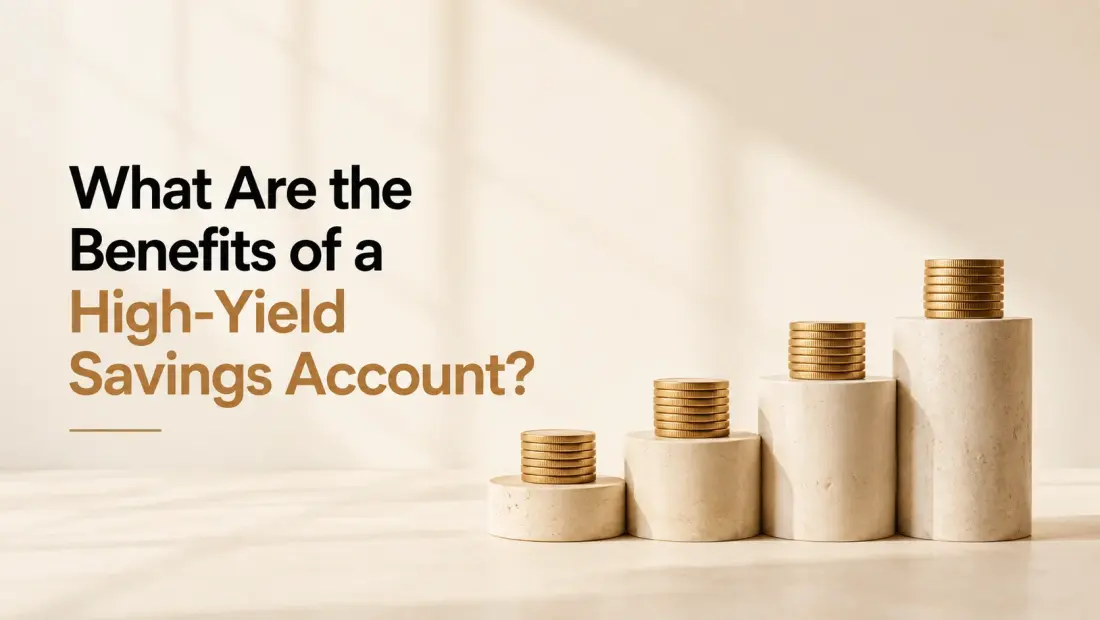
A high-yield savings account gives your savings more room to grow while keeping the money available for later. It works much like a traditional savings account, but it usually offers a higher annual percentage yield.
That does not make every high-yield account a good choice. Rates can change. Fees, balance rules, withdrawal methods, and protection also vary by provider. The rate shown in an advertisement is only one part of the account.
In this article, we explain seven benefits of a high-yield savings account, from stronger earning potential and easier access to federal deposit protection, lower fees, and simple online management.
1. Your savings can earn a higher yield
The main benefit is simple. A high-yield savings account usually pays a higher annual percentage yield than a traditional savings account.
APY shows how much an account could earn over one year if the balance and rate stayed the same. It also reflects how often earnings are added to the account. This makes APY more useful than looking at a basic rate alone when comparing savings products.
A higher APY can make a noticeable difference when money stays in the account for a long time. You do not need to trade assets or choose investments. The provider calculates the earnings and credits them according to the account terms.
The word “high” is not a promise that a provider will always offer the best rate. Savings rates are usually variable. A provider can raise or lower them as market conditions and its own pricing change.
Searching for the highest rate online savings account can be a useful starting point. You should still compare fees, balance requirements, access, and protection before choosing one.
2. Your earnings can build on your balance
When earnings are credited, they become part of your account balance. Future earnings can then be calculated using a larger balance. This process is known as compounding.
How quickly the balance grows depends on several things:
- the APY
- the amount in the account
- how often earnings are calculated and credited
- whether you add or withdraw money
- whether the rate changes
Some providers calculate earnings daily and credit them monthly. Others use a different schedule. The disclosure should explain the method.
Compounding does not create fast or guaranteed growth. It simply means that leaving credited earnings in the account can help the balance build gradually over time.
3. You can normally access your money when needed
A high-yield savings account is generally more accessible than a fixed-term product. Your money is not normally locked away until a set maturity date.
Common withdrawal methods include:
- an internal transfer to checking with the same provider
- an ACH transfer to a linked external account
- an ATM withdrawal if a card is included
- a bank check or wire transfer
Not every provider offers every method. Many online accounts rely mainly on electronic transfers. An external transfer can take several days to complete, depending on the providers, weekends, holidays, and security checks.
The old federal rule limiting convenient savings withdrawals to six per month was removed in 2020. Providers can still set their own transfer limits or charge fees under the account agreement.
If the account will hold emergency savings, check how quickly you can access the money. Easy access matters more than a small rate difference when an urgent expense comes up.
4. Eligible deposits can receive federal protection
Deposit protection is one of the most important advantages of a high-yield savings account held with an insured institution.
The Federal Deposit Insurance Corporation protects eligible deposits at an FDIC-insured bank. Coverage generally applies up to $250,000 per depositor, per insured bank, for each ownership category.
The National Credit Union Administration provides similar protection for eligible accounts at federally insured credit unions. Coverage generally applies up to $250,000 per member-owner, per insured credit union, for each ownership category.
This protection applies if an insured institution fails. It does not protect every financial product, prevent fraud, or cover a balance above the applicable limit.
An account is not insured simply because it is described as an online savings account. Confirm the legal institution holding the deposit. You can check a bank through the FDIC’s BankFind tool or a credit union through the NCUA’s locator.
If a financial app works with a partner bank, read how the account is structured and how coverage passes through to customers. Do not rely only on a logo displayed on the app’s website.
5. Many accounts have low fees
Many online providers offer accounts without a monthly maintenance fee. Some also have no minimum opening deposit or minimum balance requirement. These features help more of the account’s earnings remain in your balance. A monthly charge can offset the benefit of a higher APY, especially when the balance is small.
Not every high-yield savings account is free. Possible charges include:
- monthly maintenance fees
- excess-withdrawal fees
- outgoing wire fees
- ATM fees
- account-closure fees
- fees for falling below a required balance
The provider should disclose applicable fees and balance rules before you open the account. Read these terms carefully. “No monthly fee” does not necessarily mean there are no charges at all.
6. Online accounts are easy to manage
Most high-yield accounts are offered online. You can usually open the account, check the balance, download statements, link another account, and request transfers through a website or app.
You may also be able to set up automatic deposits. For example, you can arrange for part of each payment you receive to be transferred into savings. This can help you save regularly without submitting a new request each time.
Online access is useful for people who manage money across different accounts or countries. However, the provider may still operate only within one country or require a local bank account, address, or tax number.
Before you open a high-yield savings account online, check whether customer support is available when you need it. Look at the login security, account-recovery process, transfer controls, and the steps for reporting an unauthorized transaction.

7. It can keep short-term savings separate
Keeping savings in a separate account can make the money easier to track. It also reduces the chance that you will spend it during normal day-to-day payments.
A high-yield account can be used for:
- emergency savings
- rent or school fees due later
- a planned trip
- an upcoming purchase
- annual bills
- money being held before a cross-border transfer
The goal should match the account. A high-yield savings account is generally designed for money you want to protect and access in the shorter term. It is not built to provide the same long-term growth potential as investments, and it does not remove the effect of inflation.
You can also use separate accounts for separate goals if the provider allows it. Some apps offer savings buckets or labels without requiring several full accounts.
Frequently asked questions
What is the main benefit of a high-yield savings account?
The main benefit is the chance to earn a higher APY than a traditional savings account while keeping the money available for withdrawal.
Is a high-yield savings account low risk?
An eligible account at an FDIC-insured bank or federally insured credit union is generally considered low risk within the applicable coverage limits. You should still verify the institution, account structure, fees, and ownership category.
Can you lose money in a high-yield savings account?
The balance does not normally fall because of market price changes. However, fees, unauthorized transactions, or uninsured amounts can still create losses. Federal insurance only applies when the institution, deposit, and ownership structure qualify.
Can you withdraw money at any time?
You can normally request a withdrawal when you need it. Transfer limits, deposit holds, processing times, and account fees can affect when the money arrives.
Do high-yield savings account rates change?
Yes. Most rates are variable. A provider can raise or lower the APY, and promotional rates may expire.
Is PureFi a high-yield savings account?
No. PureFi is a financial technology platform that provides access to stablecoins and shares of real homes. Its projected earnings come from rent and changes in property values, not from a bank deposit.
Put Your Dollars Into Something Real
With PureFi, your projected earnings come from shares of real homes with tenants. Choose your properties from your phone, review the documents, and see every fee before you confirm.
Learn more about how PureFi can help you own real estate shares or download the app to get started today.