Are High-Yield Savings Accounts Worth It?
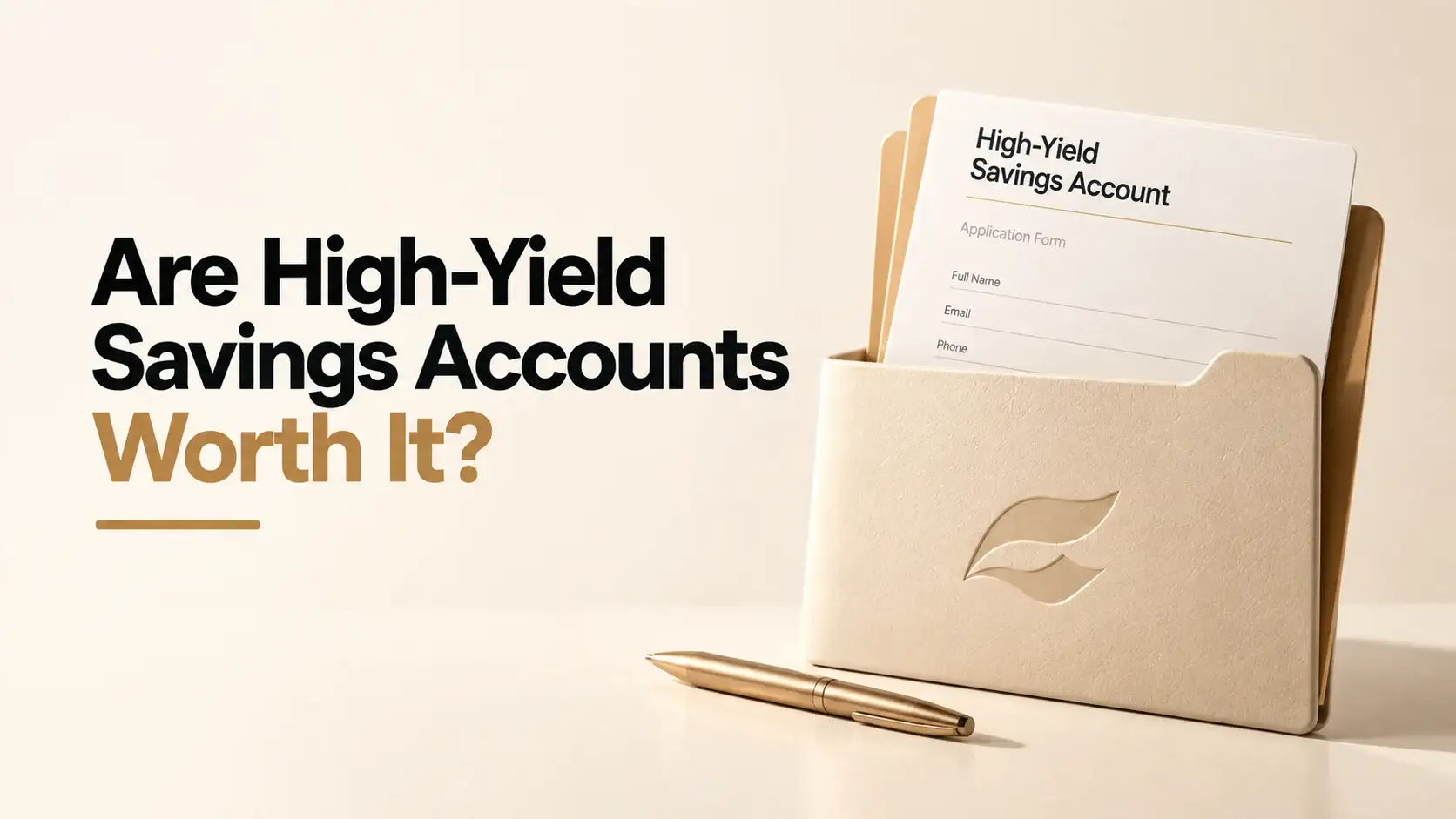
Are High-Yield Savings Accounts Worth It?
Yes. A high-yield savings account can be worth it for emergency savings and short-term goals because leading accounts currently offer up to 4.50% APY while keeping your money relatively accessible.
That is much higher than the national savings rate of 0.38% recorded in August 2026. On the same balance, a competitive high-yield account could earn almost 12 times as much as an account paying the national average.
However, APYs can change. Some accounts also have fees, balance requirements or withdrawal rules. Check the full account terms before opening one.
In this article, we’ll explain how much these accounts can earn, why the APY may change, how withdrawals work, and when federal protection applies.
How much more can a high-yield savings account earn?
The main benefit of a high-yield digital savings account is the higher APY. As of September 11, 2026, leading accounts offered up to 4.50% APY. The national savings rate was 0.38% in August 2026, according to FDIC data published through FRED.
Here is what that difference could mean for a $5,000 balance held for one year:
| APY | Estimated annual earnings | Estimated ending balance |
|---|---|---|
| 0.38% | $19 | $5,019 |
| 4.50% | $225 | $5,225 |
The difference is about $206 over one year.
These are illustrative figures. They assume the balance and APY remain unchanged for the full year. They also assume no fees apply.
Current offers can change at any time. The 4.50% figure is based on savings accounts available on September 11, 2026 .
What are the benefits of a high-yield savings account?

1. You can earn a higher APY
A high-yield account generally pays more than a standard savings account. You do not need to add more money to benefit from the higher APY. The difference becomes more noticeable as your balance grows. It also adds up when you leave your savings in the account for longer.
A high APY does not mean the account is automatically the best choice. But it can help your money earn more while you save for a near-term goal.
2. Your earnings can compound
Compounding happens when earnings are added to your balance. The next calculation can then use the larger amount.
For example, if your account adds earnings every month, the amount added in January becomes part of the balance used in February. The effect may appear small over a few months. It becomes more noticeable over longer periods or with a larger balance.
APY already includes compounding. This makes it easier to compare accounts that add earnings on different schedules.
3. Your money remains relatively accessible
A high-yield savings account does not have a fixed maturity date. You can usually transfer money when you need it. This makes the account useful for emergency savings and expenses with an uncertain date.
However, accessible does not always mean instant. A transfer to another bank may take several working days. Some providers also set daily or monthly transfer limits.
An online savings app may not provide a debit card or ATM access. In that case, you will need to transfer the money before spending it. Check how withdrawals work before relying on the account for emergencies.
4. Eligible deposits may have federal protection
Money held at an FDIC-insured bank may be protected up to the federal limit. Eligible accounts at federally insured credit unions may receive similar protection through the NCUA.
The standard FDIC amount is $250,000 per depositor, per insured bank and per ownership category. FDIC coverage guidance explains which accounts qualify.
The NCUA also provides up to $250,000 of federal share protection for eligible accounts at covered credit unions.
Do not assume that every high-yield savings app has this protection. Check the bank or credit union behind the account. Protection may apply through a partner institution rather than the app itself.
5. Many accounts have low fees
Many online banks offer high-yield savings accounts without a monthly maintenance fee. Some also have no minimum opening deposit. This is common, but it is not a rule.
A provider may require a minimum balance to earn its highest APY. It may also charge for wire transfers, ATM use or certain withdrawal methods. Check the fee schedule before applying. Even a small monthly charge can reduce the benefit of a higher APY.
6. They work well for separate savings goals
A high-yield savings account can help you keep savings away from everyday spending. You might use one account for emergencies and another for a planned expense. Some providers also let you create separate savings categories inside one account.
Keeping the money separate can make it easier to see how close you are to your target. You can still transfer funds when needed, subject to the provider’s rules.
What are the drawbacks of a high-yield savings account?
The APY can fall
Most high-yield savings accounts have a variable APY. The provider can raise or lower it. The APY offered when you open the account may not remain available. If market conditions change, your provider may reduce the yield.
A promotional APY may also last for only a few months. After the promotion ends, the account may return to a much lower standard APY. Check whether the advertised number is the standard APY or a temporary offer.
The highest APY may have conditions
Some providers use a high headline APY to attract customers, but not everyone qualifies for it. You may need to:
- Set up a qualifying direct deposit
- Keep a minimum balance
- Make regular monthly deposits
- Pay for a membership
- Hold another account with the provider
- Keep your balance below a stated limit
The highest APY may only apply to part of your balance. Any amount above the limit could earn less. Read the eligibility rules instead of relying on the number shown in the advertisement.
Transfers may take time
Online accounts can make saving easier, but taking money out may require an external bank transfer. These transfers may take several working days. Weekends, holidays and security reviews can add more time.
Some accounts also place holds on recent deposits. Money shown in your balance may not be ready to withdraw immediately. If you plan to use the account as an emergency fund, check how quickly you can access it.
Some accounts have limited support
An online savings app may not offer branch support. Help may be available only through chat, email or phone. This is not a problem for everyone. But it matters if you prefer to speak with someone in person or deposit cash at a branch.
Check the provider’s support hours and contact methods. It is also worth reading how it handles account access problems and disputed transfers.
Earnings may not keep pace with rising prices
A higher APY helps protect the buying power of your savings, but it may not always keep pace with rising prices. If prices rise faster than your account grows, the money may buy less over time. This is one reason savings accounts are usually better suited to short-term needs than long-term wealth building.
Long-term assets may offer more growth potential. They also carry more risk and can lose value. A high-yield investment platform should not be treated as a direct replacement for an insured savings account.
Earnings may be taxable
Savings earnings are generally taxable in the United States. The provider may send a tax form showing the amount earned during the year.
Tax rules depend on your country and personal circumstances. The APY shown by a provider does not account for the tax you may owe.
When is a high-yield savings account worth it?
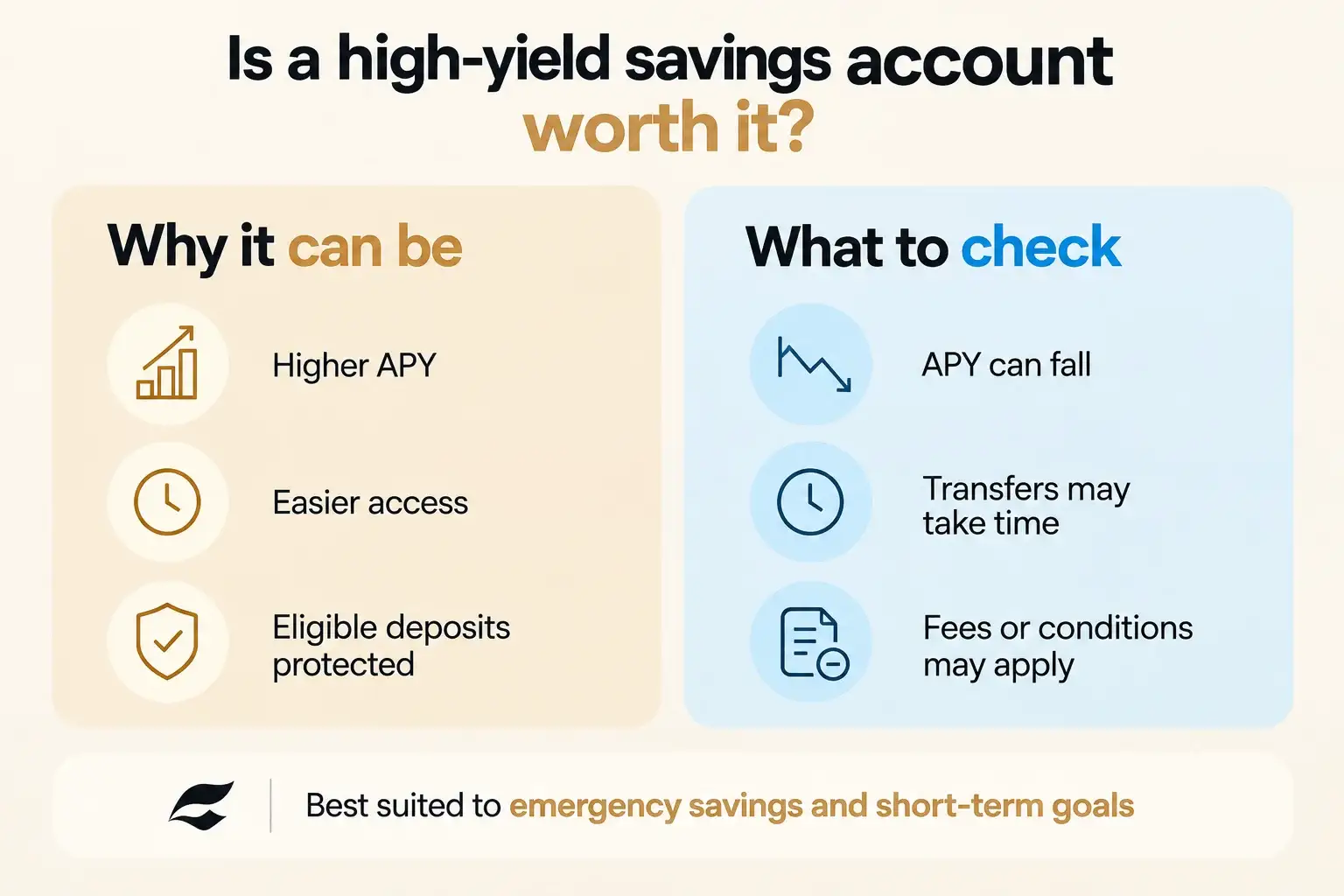
A high-yield savings account can make sense when you want your cash to earn while remaining available.
Common uses include:
Building an emergency fund
Emergency savings should be available when something unexpected happens. A high-yield account lets the balance earn without placing it in an asset that may fall in value. Make sure the withdrawal process is fast enough for your needs.
Saving for a short-term goal
A high-yield account may suit money you expect to use within the next few years. This can include savings for:
- A car
- A home deposit
- Tuition
- A wedding
- Travel
- Repairs
- A planned large payment
The balance remains separate from everyday spending but can still be transferred when the expense arrives.
Holding money temporarily
You may have money that you do not need today but are not ready to place in a long-term asset. A high-yield savings account can provide a temporary place for it. Your money can earn while you decide what to do next.
Keeping savings separate
Using a different account for savings can make it easier to avoid spending the money by mistake. Whether you use a bank website, digital savings platform or online savings app, check that the product is actually a savings account and that eligible deposits have the expected protection.
When may it not be the right choice?
A high-yield savings account may not be suitable for every goal.
You need the money for everyday spending
Savings accounts are not designed for regular bills and daily purchases. A checking or transaction account may provide better payment access.
You want a fixed APY
The APY on a high-yield savings account can change. If you want to keep the same APY for a known period, a fixed-term account may be more suitable. However, taking money out of a fixed-term account before maturity can lead to a penalty.
You are saving for many years
A savings account can protect short-term cash from market changes. It may not provide enough growth for a goal that is ten or twenty years away. Long-term assets may have greater growth potential, but their value can rise or fall. The right choice depends on when you need the money and how much risk you can accept.
The conditions are difficult to meet
A high APY is not useful if you cannot meet the deposit, balance or activity requirements. An account with a slightly lower APY and simpler rules may produce better results for you.
Put your dollars into something real
With PureFi, your projected earnings come from shares of real homes with tenants . Choose your properties from your phone, review the documents, and see every fee before you confirm.
Learn more about how PureFi can help you own real estate shares or download the app to get started today.
Up to 6% APY is projected, variable and not guaranteed. Property shares can lose value. PureFi is not a bank, and its balances and real estate shares are not covered by FDIC insurance or another government deposit scheme.