Are High-Yield Savings Accounts Safe?

A high-yield savings account is generally considered a low-risk place to keep cash when the money is held at an insured bank or credit union, and your balance falls within the applicable coverage limits.
The words “high yield” do not make an account less safe. The important questions are who holds the funds, whether the institution is insured, what type of product you are opening, and how much money you already have with that institution.
Insurance does not cover every problem. It will not repay account fees, protect you from every scam, or stop the APY from changing. It also does not apply to every product offered through a financial app.
Below, we explain what FDIC and NCUA insurance cover, which risks remain, and how to check the safety of an account before adding money.
When Is a High-Yield Savings Account Insured?
In the United States, an eligible savings deposit can receive federal protection when it is held at an FDIC-insured bank or a federally insured credit union.
The Federal Deposit Insurance Corporation protects eligible bank deposits. The National Credit Union Administration provides similar protection for eligible accounts at federally insured credit unions.
This protection is automatic. You do not need to buy it or submit a separate application. It applies because the institution participates in the federal insurance system and the account qualifies for coverage.
The standard FDIC limit is $250,000 per depositor, per insured bank, for each account ownership category. The NCUA also provides up to $250,000 of federal share insurance for individual accounts at federally insured credit unions. Different ownership categories can affect the total coverage available, so the limit is not always as simple as one person and one account.
Other countries have their own deposit protection systems. The limits and eligible products vary. If you live outside the United States, check the scheme that applies to the institution holding your funds.
What Does Deposit Insurance Cover?
Deposit insurance is there for a specific event: the failure of an insured bank or credit union. At an FDIC-insured bank, coverage generally applies to deposit products such as checking accounts, savings accounts, money market deposit accounts, and certificates of deposit. At a federally insured credit union, qualifying share savings and similar deposit accounts can receive NCUA protection.
Coverage includes the money in the qualifying account, up to the applicable limit. The account must be held by an insured institution. A familiar brand name, polished website, or mobile app is not enough by itself.
If an app works with a partner bank, find out which bank actually holds the deposit and how the account is recorded. The app itself might not be insured. Any protection normally comes through the partner institution and depends on the product structure.
What Doesn’t Deposit Insurance Cover?
Deposit insurance is not a general guarantee against every type of loss. It does not cover:
- Monthly account or transfer fees
- A lower APY after the provider changes its rate
- Loss of buying power caused by inflation
- Money sent to a scammer
- Unauthorized access caused by stolen login details
- Balances above the applicable insurance limit
- Stocks, bonds, mutual funds, or real-estate investments
- Digital assets that are not qualifying bank deposits
The NCUA states that its insurance does not cover investment products or digital assets, even when they are offered through a federally insured credit union.
The same distinction matters when a product displays an APY. An APY tells you about potential earnings. It does not tell you whether the product is a deposit, an investment, a lending product, or a real-asset purchase.
Are Online High-Yield Savings Accounts Safe?
An online high-yield savings account can be just as protected as an account opened in a branch. The delivery method does not decide whether insurance applies.
What matters is the institution behind the online savings account. Before opening one, check the legal name of the bank or credit union. In the United States, you can search for a bank through the FDIC BankFind Suite. For credit unions, use the NCUA Credit Union Locator.
Do not rely only on an FDIC or NCUA logo shown inside an app. Confirm the institution through the official government tool. Look at the exact name because financial brands can use names that differ from the regulated institution holding the funds.
Online security also matters. A provider should use encryption, identity checks, fraud monitoring, and secure login controls. These measures can reduce the chance of unauthorized access, but no system removes every risk.

Risks to Check Before Opening an Account
A saving account with high yield can be protected from institutional failure and still have drawbacks. Safety is not only about whether you can lose the full balance.
The APY can change
Most high-yield savings accounts have variable APYs. The provider can raise or lower the rate after you open the account. A lower APY does not normally reduce the money already in the account, but it changes what you earn going forward.
The highest rate online savings account today may offer a different rate next month. Check whether the advertised APY is temporary or tied to specific conditions.
Fees can reduce the balance
Review monthly fees, transfer charges, minimum-balance fees, and inactivity fees. On a smaller balance, a regular fee can remove much of the yield.
Transfers can take time
An online provider may need several steps to send money to another account. Check processing times and daily limits if you plan to use the account for emergencies.
Scams can bypass account security
A secure provider cannot stop you from approving a payment to a scammer or sharing a login code. Be careful with messages that create urgency, ask for one-time codes, or direct you to a sign-in page.
Use the provider’s official app or enter its web address yourself. Do not open account links sent through an unexpected message.
Third-party apps can make coverage harder to understand
Some financial apps place customer funds with one or more partner banks. Find out where your money is held, whether it is recorded in a way that qualifies for protection, and what happens if the app stops operating.
One institution can hold more than one of your accounts
Deposit insurance normally looks at your total eligible deposits at the same insured institution and within the same ownership category. Opening several accounts at one bank does not automatically multiply your coverage.
How to Check Whether a Provider Is Safe
If you plan to open a high-yield savings account online, complete these checks before sending money.
- Identify the institution holding the funds. Do not stop at the app or product name.
- Confirm its insurance status. Use the FDIC or NCUA’s official search tool.
- Read the account disclosures. Check the APY, fees, minimum balance, and withdrawal rules.
- Confirm the product type. Make sure you know whether you are opening a deposit account or using another kind of financial product.
- Review the security controls. Look for encrypted access, identity checks, fraud monitoring, and secure login options.
- Check how support works. Find out whether you can reach a real person if the account is locked or a transfer looks wrong.
- Use the official website or app. Avoid links from unsolicited messages.
If the provider does not clearly explain who holds the funds or what protection applies, do not assume the account is insured.
How PureFi Protects Your Account
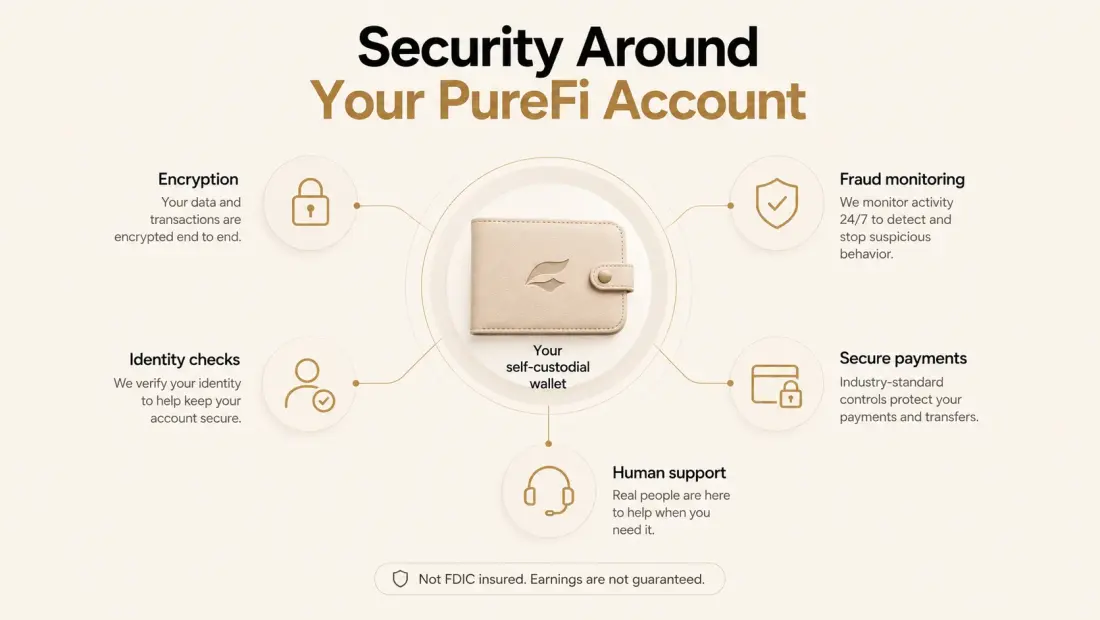
PureFi is a financial technology company, not a bank. PureFi does not hold customer deposits, and its balances and real-estate shares are not FDIC insured or protected by another government agency. That means PureFi’s protection works differently from deposit insurance.
PureFi accounts are self-custodial. Your dollar balance sits in a wallet that you control. PureFi operates with USDC, USDT, and other U.S. dollar stablecoins. These digital dollars are designed to stay close to the value of the U.S. dollar, but they are not insured bank deposits.
PureFi’s security page lists several controls used to protect accounts and personal information:
- Strong encryption
- Encrypted transactions
- Fraud monitoring
- Secure payment systems
- Identity verification
- Dedicated security teams
- Scam reporting
- Support through email and live chat
These controls are designed to protect account access, transactions, and customer data. They do not guarantee the value of a stablecoin or real estate share.
The key difference is simple. An insured savings account relies on government-backed deposit insurance. PureFi relies on self-custody, security controls, documented property ownership, and licensed technology partners. The protections and risks are not the same.
Frequently Asked Questions
Are all high-yield savings accounts FDIC insured?
No. FDIC insurance only applies to eligible deposits at FDIC-insured banks. A product can use the words “savings” or “high yield” without being an insured bank deposit. Confirm the institution and account structure before adding money.
Are online savings accounts less safe than branch accounts?
Not necessarily. An online account can receive the same deposit protection as a branch account when it is held at an insured institution and meets the coverage rules. Online accounts also carry digital security risks, so use strong login controls and watch for scams.
Can you lose money in a high-yield savings account?
Eligible deposits within the insurance limits are protected if the insured institution fails. Fees, scams, or balances above the limit can still lead to losses. Inflation can also reduce what your money can buy.
What happens if an online bank fails?
If the bank is FDIC insured and the account qualifies, eligible deposits are covered up to the applicable limit. Confirm the bank through the FDIC rather than relying only on the app’s claims.
Does NCUA insurance work like FDIC insurance?
It provides a similar form of federal protection for qualifying accounts at federally insured credit unions. The coverage rules depend on the account type and ownership structure.
Is PureFi FDIC insured?
No. PureFi is not a bank, and PureFi balances and real-estate shares are not FDIC insured or protected by another government agency. PureFi uses self-custody, encryption, fraud monitoring, identity verification, and other security controls to help protect users.
Own Real Assets With Security Built In
PureFi combines self-custody, encrypted transactions, fraud monitoring, identity checks, and human support. Review real homes and their documents from your phone before choosing where to put your dollars to work.
Learn more about how PureFi can help you own real estate shares or download the app to get started today.