What Is the Difference Between APY and Interest Rate?
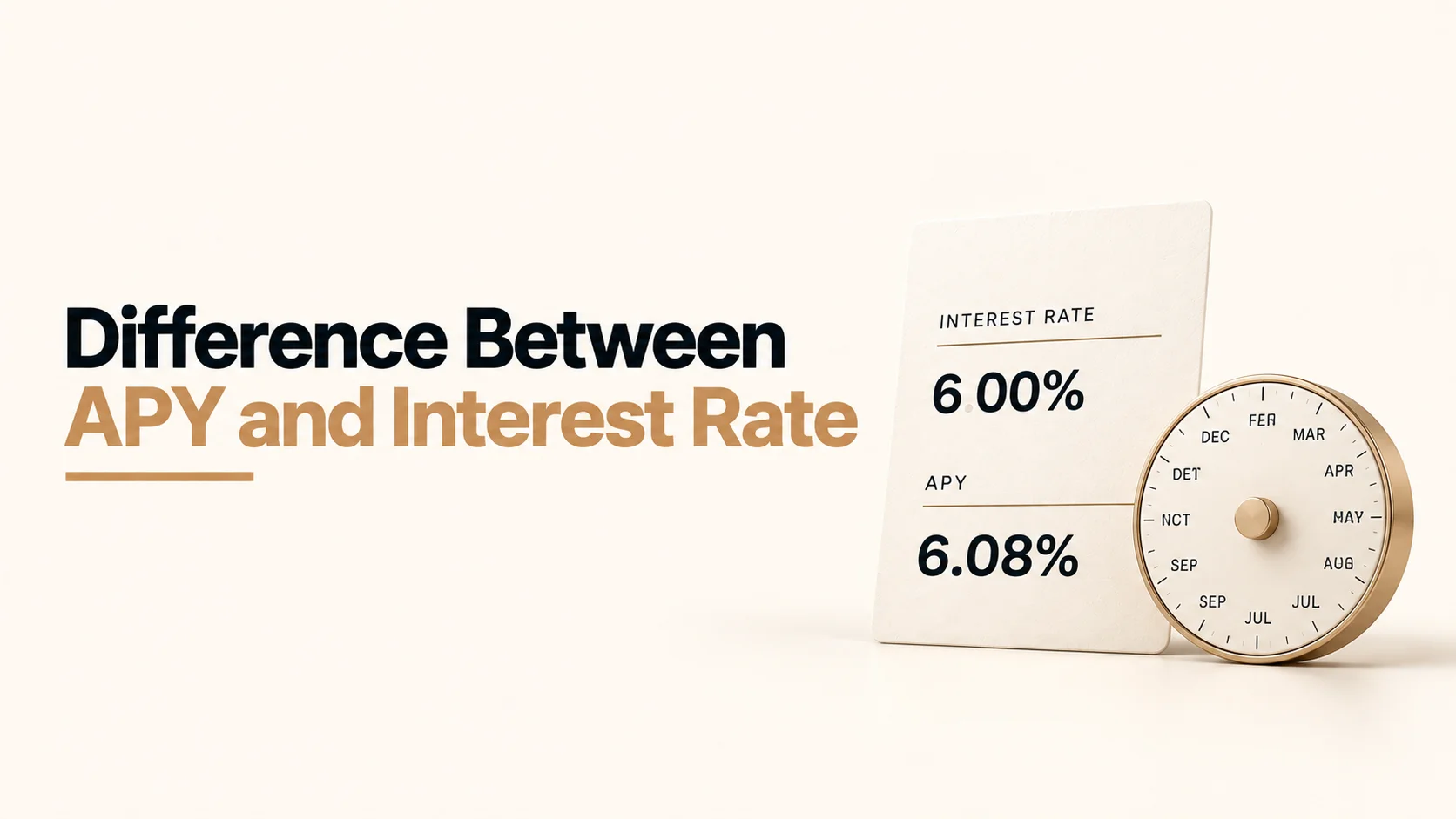
An interest rate is the base annual rate a bank pays on a savings balance. APY includes that rate plus the effect of compounding. Both figures can change on a variable-rate account. Access to your funds depends on the account rules, while protection depends on the provider and account structure. Understanding these differences helps you estimate your potential earnings and compare savings accounts more accurately.
APY vs Interest Rate at a Glance
An interest rate and APY are both percentages, but they measure different things.
| Feature | Interest rate | APY |
|---|---|---|
| What it shows | The base annual rate | Estimated annual earnings with compounding |
| Includes compounding | No | Yes |
| Best used for | Understanding the stated rate | Comparing potential account earnings |
| Can it change? | Yes, on a variable-rate account | Yes, when the underlying rate changes |
| Usually higher? | Usually the lower figure | Usually equal to or slightly higher |
| Guarantees earnings? | No | No |
What Is an Interest Rate?
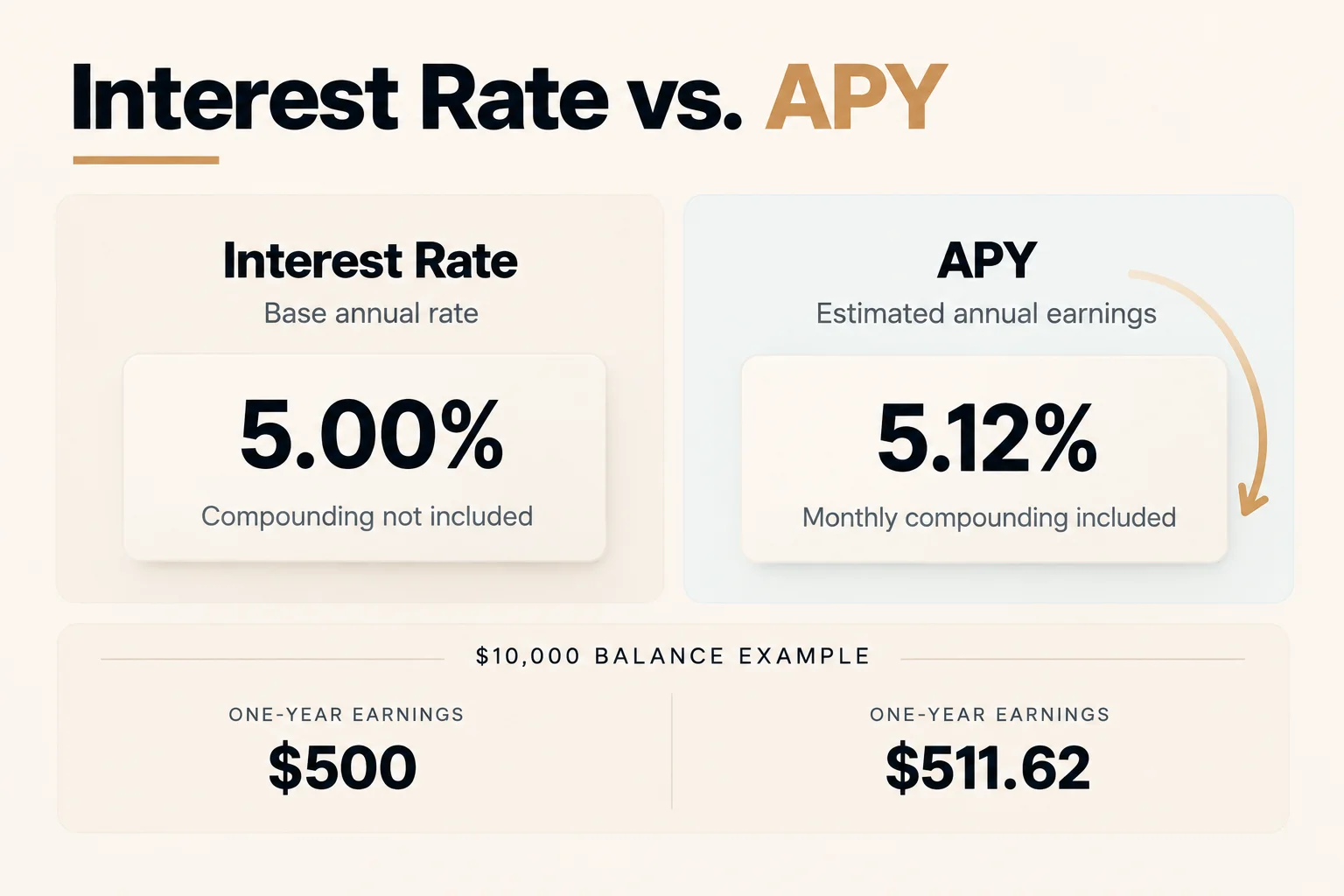
An interest rate is the annual rate a bank applies to the money held in an eligible account. It is normally displayed as a percentage.
For example, suppose a savings account has a 5.00% interest rate. If you maintained a $10,000 balance for one year and the bank did not compound the earnings, the basic calculation would be:
$10,000 × 5.00% = $500
You would earn $500 under those simplified conditions.
The Consumer Financial Protection Bureau defines the interest rate on a deposit account as the annual rate paid on the account before compounding is considered. This makes the interest rate useful for understanding the account’s base rate. However, it does not necessarily show the total amount the balance could earn.
Fixed and Variable Interest Rates
A fixed interest rate remains the same for a set period. This type of rate is commonly associated with certificates of deposit, or CDs. In return for the fixed rate, you may need to leave your money in the account until the term ends.
A variable interest rate can rise or fall after you open the account. Most traditional and high-yield savings accounts use variable rates. The bank may adjust the rate because of market conditions, funding needs, business decisions, or changes in broader benchmark rates.
If the interest rate changes, the APY will normally change as well.
What Is APY?
APY stands for annual percentage yield. It estimates how much an account could earn over one year when compounding is included.
The official APY calculation uses both the account’s interest rate and its compounding frequency. This gives you a more complete annual percentage than the interest rate alone.
Compounding happens when credited earnings become part of the balance used for future calculations. You then begin earning on your original deposit and the amounts previously added to the account.
Suppose two banks offer the same 5.00% interest rate. One compounds annually, while the other compounds monthly. The account that compounds monthly may have a slightly higher APY because credited earnings begin contributing to the balance sooner.
You can read What Is APY on a Savings Account? for a broader explanation of how banks display and calculate APY.
Is APY a Guaranteed Return?
APY is not always a guaranteed return. On a variable-rate savings account, it shows what the account could earn if the current rate and other conditions stayed the same for a full year.
Your actual dollar earnings can be different if you:
- Deposit or withdraw money
- Pay account fees
- Fall below a minimum balance
- Do not meet the requirements for the advertised APY
- Experience a rate increase or decrease
- Close the account before the year ends
APY still gives you a useful comparison figure. It simply needs to be considered alongside the account terms.
How Does Compounding Create the Difference?
The gap between an interest rate and APY comes from compounding. Banks may calculate earnings daily and credit them monthly. Others may compound monthly, quarterly, or annually. The account disclosure should explain the schedule.
Here is the standard formula in a copy-friendly format:
APY = (1 + interest rate ÷ number of compounding periods) raised to the number of compounding periods − 1
The interest rate must first be written as a decimal. A 5.00% rate becomes 0.05.
Example With Monthly Compounding
Suppose an account has:
- Starting balance: $10,000
- Interest rate: 5.00%
- Compounding schedule: Monthly
- Compounding periods: 12
The APY calculation is:
APY = (1 + 0.05 ÷ 12) raised to 12 − 1 APY = 0.05116 APY = approximately 5.12%
Estimated earnings after one year:
$10,000 × 5.116% = approximately $511.62
The interest rate is 5.00%, but the APY is approximately 5.12% because monthly compounding adds around $11.62 to the simplified annual result. Banks may use daily balances, additional decimal places, and their own rounding procedures. Your statement could therefore show a slightly different dollar amount.
Our guide to whether HYSAs compound monthly explains how daily and monthly compounding schedules work.
How Do APY and Interest Rates Affect Savings Earnings?
The interest rate supplies the base percentage used in the calculation. The compounding schedule determines how frequently credited earnings can become part of the balance. APY combines both pieces of information into one annual estimate.
Consider two savings accounts:
| Account | Interest rate | Compounding schedule | APY |
|---|---|---|---|
| Account A | 5.00% | Annually | 5.00% |
| Account B | 5.00% | Monthly | Approximately 5.12% |
Account B has the higher APY, even though both accounts have the same interest rate.
The difference may seem small on a modest balance over one year. However, it can become more noticeable when you maintain a larger balance or keep the money in the account for several years.
Your balance also affects the dollar result. A 5.00% APY produces around $50 on $1,000 but around $500 on $10,000, assuming the rate remains unchanged and no money enters or leaves the account.
For examples using several balances and APYs, read How Much Does a High-Yield Savings Account Earn?.
Can the Interest Rate and APY Change?
Yes. The interest rate and APY on most savings accounts are variable. When a bank lowers the underlying interest rate, the APY falls as well. When it raises the rate, the APY increases. The two figures remain linked because the interest rate is part of the APY calculation.
For example, an account might show:
- Interest rate: 4.90%
- APY: 5.00%
If the bank reduces the interest rate to 4.41%, the APY may fall to approximately 4.50%, depending on the compounding schedule.
A bank does not need to keep an advertised variable APY unchanged for an entire year. That is why a 5.00% APY does not necessarily mean your balance will earn exactly 5.00% over the next 12 months.
Fixed-rate CDs are different. Their interest rate and APY may remain unchanged during the stated term, although an early withdrawal penalty could reduce your earnings.
Read Do High-Yield Savings Account Rates Change? for more information about why savings rates rise and fall.
Which Figure Should You Use When Comparing Accounts?
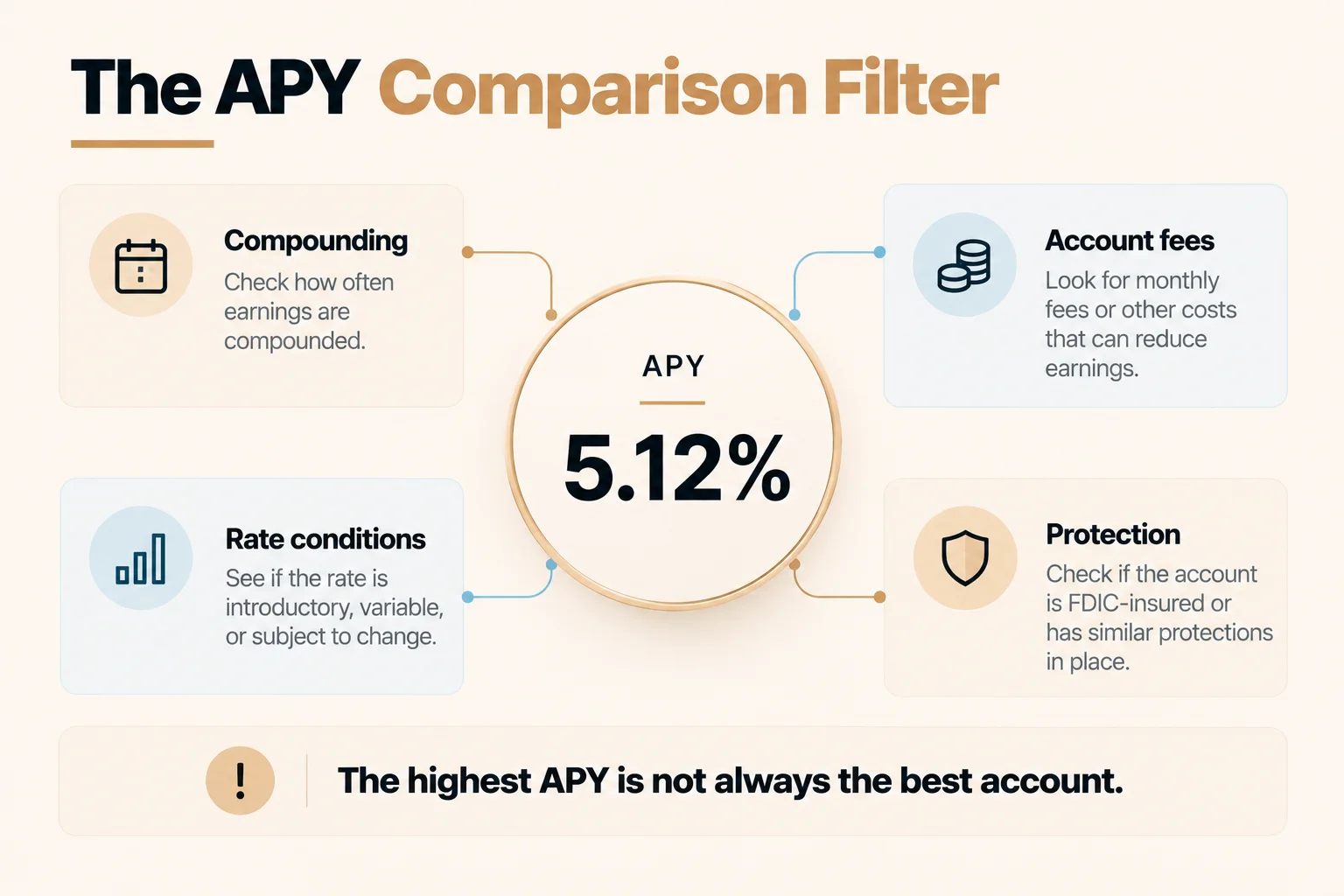
APY is generally the better figure for comparing similar savings accounts. It includes compounding and gives you one annual percentage to use across providers. Looking only at the interest rate could make two accounts appear equal even when they compound earnings on different schedules.
APY should not be your only consideration, though. You should also review:
- Monthly maintenance fees
- Minimum opening deposit
- Ongoing balance requirements
- Conditions for receiving the advertised APY
- Transfer and withdrawal options
- Customer support
- Federal deposit protection
A high-yield digital savings account with a 4.90% APY and no monthly fee might provide a better result than an account offering 5.00% APY with a recurring fee.
Access also matters. An account should allow you to access your money when you need it, especially when you are building an emergency fund. A high-yield savings app may offer convenient account management, but you should still check how long withdrawals and external transfers take.
Our guide to how a high-yield savings account works explains the other features worth comparing.
Check the Account’s Protection
Eligible deposit accounts at an FDIC-insured bank receive automatic federal protection. The standard limit is $250,000 per depositor, per insured bank, for each account ownership category.
If an online savings app works with one or more partner banks, read the account disclosures to determine where the funds are deposited and whether pass-through coverage requirements apply.
Investment products do not receive FDIC protection simply because they are available through a financial app. You need to confirm the type of product you are opening rather than relying on the APY alone.
Does APY Mean the Same Thing on Every Platform?
APY always presents a yearly percentage, but the source, certainty, and risk behind that figure can differ.
A bank savings account generally pays interest on deposited cash. A digital savings platform could use a partner-bank structure or offer access to non-deposit assets. A high-yield investment platform might project earnings from real estate, lending, or another underlying activity.
Before comparing their APYs, ask:
- Where do the earnings come from?
- Is the APY stated or projected?
- Can the underlying balance lose value?
- Can you withdraw or sell whenever you choose?
- Are there withdrawal or transaction fees?
- Is the account covered by FDIC insurance or another protection scheme?
PureFi provides a useful example of why these distinctions matter. PureFi displays up to 6% projected APY from shares of real homes with tenants. It is not a bank savings account, and the projection is based on rental income and changes in property value.
That projected APY should not be treated as identical to the APY on a bank savings account. The potential source of earnings, risks, access process, and protection are different.
Put Your Dollars Into Something Real
With PureFi, your projected earnings come from shares of real homes with tenants. Choose your properties from your phone, review the documents, and see every fee before you confirm.
Learn more about how PureFi can help you own real estate shares or download the app to get started today.
Up to 6% APY is projected, variable, and not guaranteed. Property shares can lose value. PureFi is not a bank, and its balances and real estate shares are not covered by FDIC insurance or another government deposit scheme.