
Why Did My High-Yield Savings Account Interest Rate Drop?
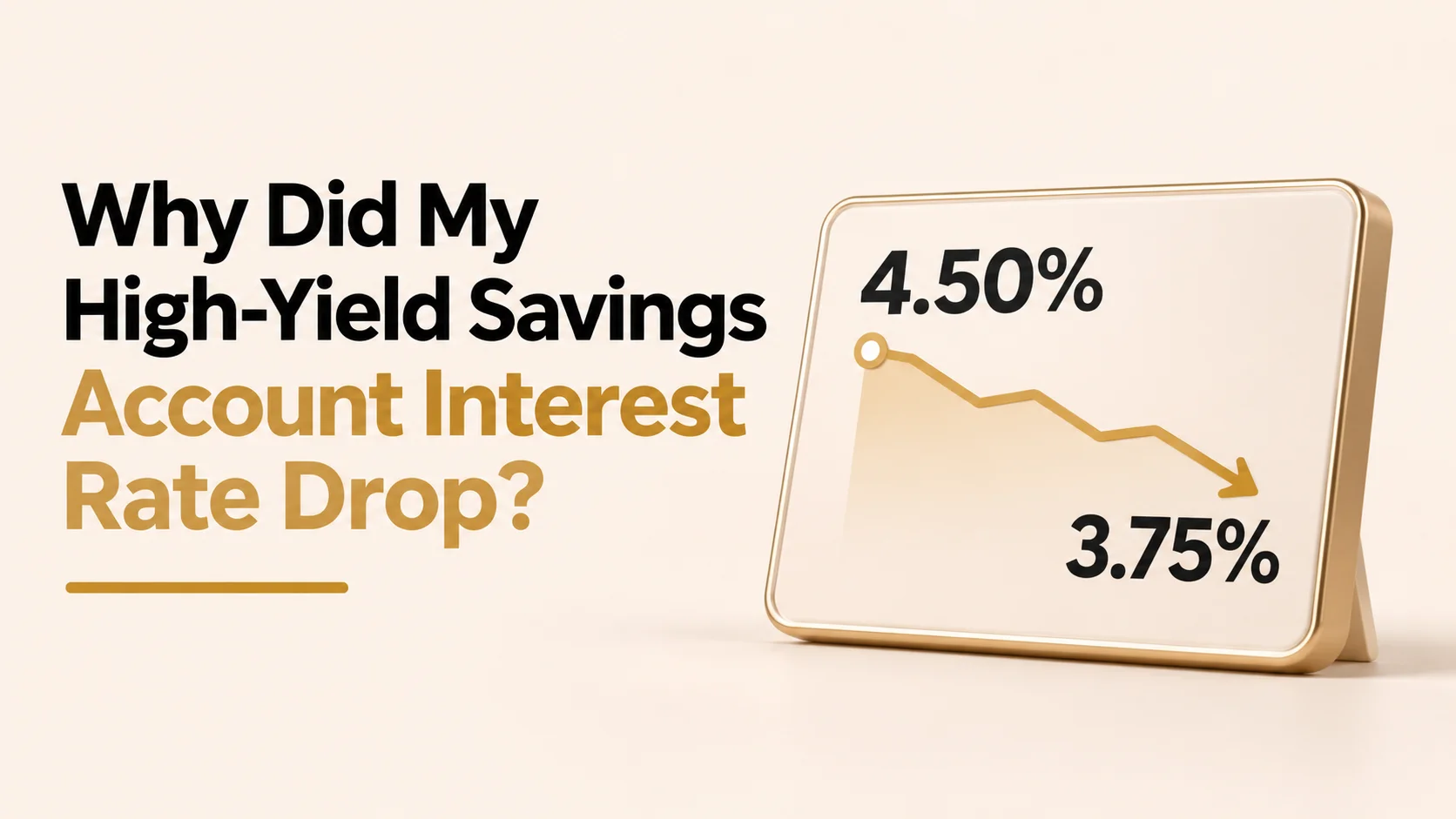
Your high-yield savings account rate probably dropped because the APY is variable. A bank can raise or lower it after the account opens.
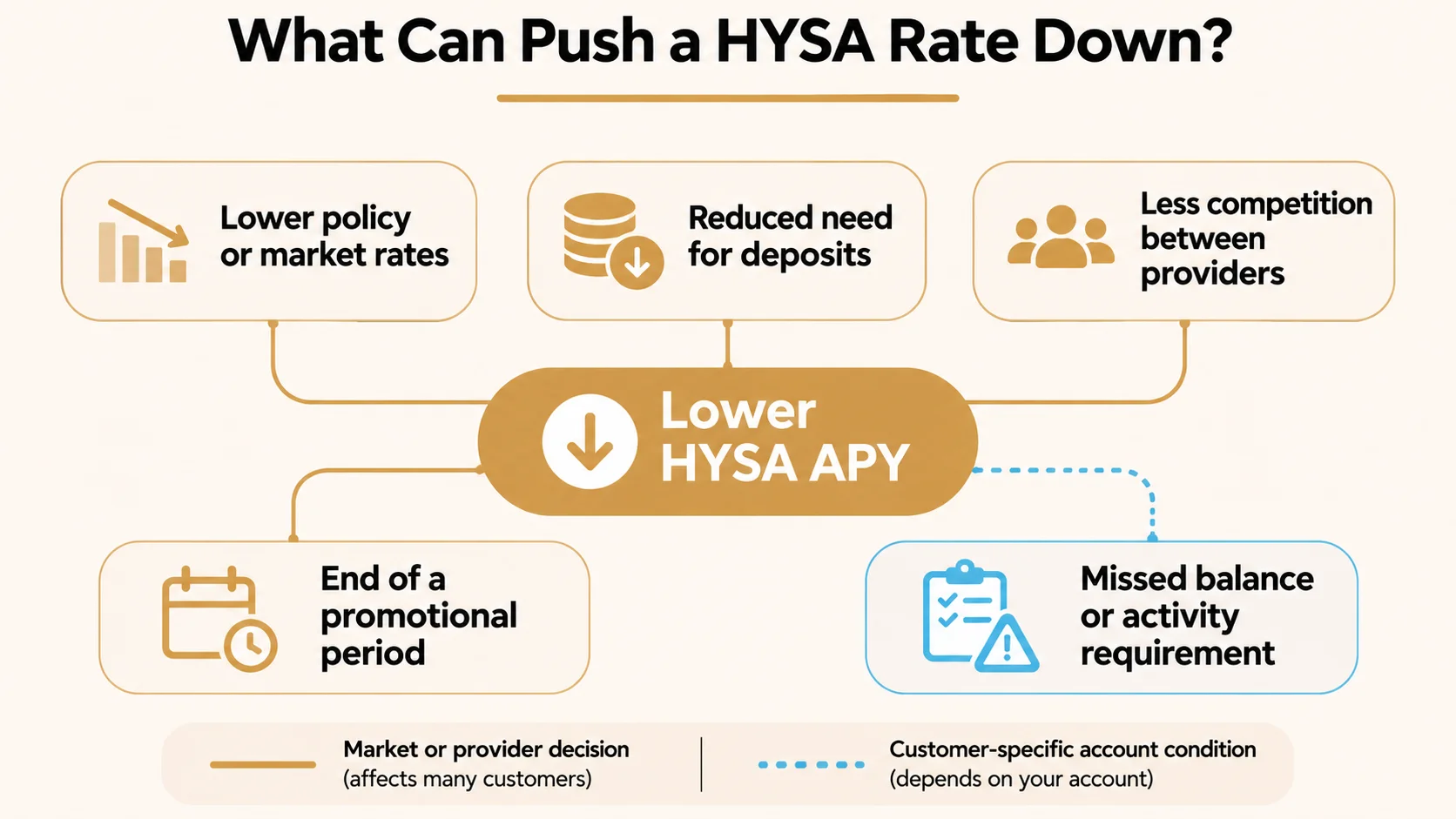
Federal Reserve policy can influence the wider rate environment, but it is not the only cause. A provider may need fewer deposits, face lower competition or end a promotional offer. Your account may also have balance or activity requirements that you stopped meeting.
A rate reduction does not normally mean anything is wrong with the account. However, it is worth checking how much the change affects your earnings and whether the account still offers competitive terms.
Is a High-Yield Savings Account Rate Fixed?
Most high-yield savings accounts have variable APYs. The figure shown when you open the account is not normally locked for a full year.
APY represents the yearly yield the account could produce if the rate and balance remained unchanged. When the provider changes the underlying rate, the APY changes too.
The account disclosure should explain:
- Whether the rate is variable
- How the rate is determined
- How often it may change
- Whether there is a limit on the change
- Whether different balances receive different APYs
A fixed-rate certificate of deposit works differently. A fixed CD normally keeps its stated APY until maturity. In return, the customer accepts a fixed term and a possible early-withdrawal penalty.
A HYSA gives you more access to the balance, but the rate can move. Our guide tohow high-yield savings account rates change explains this structure in more detail.
Why Did Your HYSA Rate Drop?
There is no single cause behind every APY reduction. Check both the wider market and your individual account conditions.
The Federal Reserve changed its policy stance
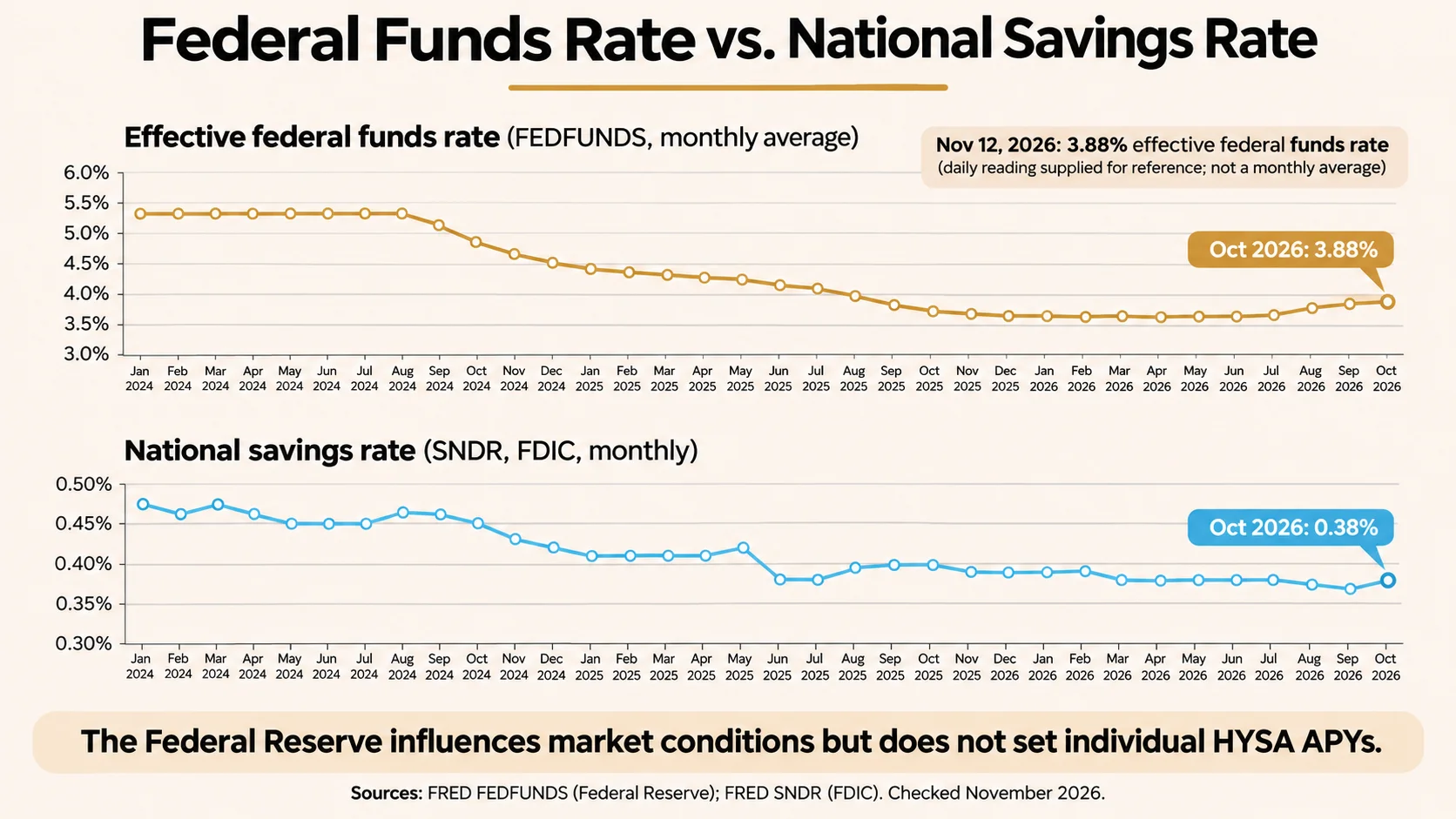
The Federal Reserve sets a target range for the federal funds rate. This rate affects short-term funding conditions across the financial system.
When the target range moves lower, banks may reduce what they pay on savings. They can often obtain funding at a lower cost and may have less reason to compete aggressively for deposits.
The Federal Reserve does not set your HYSA rate. It also does not require banks to reduce their APYs by the same amount or on the same day.
For current context, the Federal Reserve maintained a target range of 3.75% to 4.00% on October 28, 2026. The effective federal funds rate was 3.88% on November 12, 2026. Those are policy and market figures, not consumer savings APYs.
The bank needs fewer deposits
Banks use deposits as one source of funding. A competitive APY can attract new customers and encourage existing customers to keep larger balances.
Once a bank has enough deposits for its needs, maintaining a leading APY may become less useful. It can lower the rate even when the Federal Reserve has not announced a new policy decision.
Loan demand also matters. A bank with weak demand for loans may have less need to attract additional deposits.
Competing providers lowered their rates
Banks watch competing savings offers. If other institutions reduce their APYs, a provider may be able to lower its rate without losing many customers.
Online providers often use high APYs to compete nationally. That does not mean an online savings app will always stay near the top of the market.
The cost of attracting deposits, customer behaviour and the provider’s wider product strategy can all affect its decision.
A promotional period ended
The APY used to open the account may have been temporary. Promotional offers can apply:
- For a fixed number of months
- Only to new customers
- Only to new money
- Up to a balance limit
- While a linked account remains active
Once the promotional period ends, the account moves to its standard variable APY. Review the original offer rather than relying on an old advertisement or comparison page.
You stopped meeting a requirement
The provider may not have lowered its general rate. Your account may have moved to a different APY because a condition was missed. This can happen when you:
- Fall outside a qualifying balance tier
- Miss a required direct deposit
- Do not make the required monthly contribution
- Close a linked account
- Exceed a balance cap attached to the highest APY
Check whether the new rate applies to every customer or only to your account.
How Quickly Do Savings APYs Follow the Federal Reserve?
There is no fixed timetable. One bank might respond soon after a Federal Reserve decision. Another may wait several weeks. A third may keep its APY unchanged because it still wants deposits.
Banks also do not pass through every rate change in full. If the federal funds rate falls by 0.25 percentage points, a bank could lower its savings rate by the full amount, reduce it by less or make no immediate change.
Research from theFederal Reserve Bank of New York shows that deposit rates generally follow the federal funds rate but usually remain lower, especially when the policy rate is elevated.
This is why two accounts that once paid similar APYs can move in different directions.
Compare the current account against the wider market using official provider pages. Ourcomparison of savings account rates can help you identify the other terms that matter.
How Much Does a Lower APY Affect Your Earnings?
The percentage change may look significant without producing a large dollar difference.
Suppose you keep $10,000 in an account for one year:
- At 4.50% APY, estimated earnings would be about $450
- At 4.00% APY, estimated earnings would be about $400
- Approximate difference: $50
This is a simplified illustration. It assumes the balance and APY remain unchanged for the full year and that no fees apply.
On a $1,000 balance, the same 0.50-point difference would equal roughly $5 over a year. On a $50,000 balance, it would equal roughly $250.
The balance determines whether moving accounts is worth the effort. Use our guide tohow much a high-yield savings account can earn for more examples.
Should You Move to Another Account?
A lower APY does not automatically mean you should leave. First, calculate the likely dollar difference. Then review:
- The competing account’s current APY
- Whether the rate is promotional
- Monthly fees
- Minimum-balance requirements
- Transfer times
- Withdrawal methods
- Direct-deposit conditions
- Federal deposit protection
- Customer service and app reliability
A provider offering 0.10 percentage points more may produce little extra value on a small balance. Constantly moving money can also create delays and missed automatic transfers.
A larger rate difference may justify switching, particularly on a substantial balance. Still, confirm that the new account is eligible for FDIC or NCUA protection and that you can meet every condition attached to the advertised APY.
Our guide topicking a high-yield savings account covers these checks.
Put your dollars into something real
With PureFi, your projected earnings come from shares of real homes with tenants. Choose your properties from your phone, review the documents, and see every fee before you confirm.
Learn more about how PureFi can help youown real estate shares ordownload the app to get started today.
Up to 6% APY is projected, variable, and not guaranteed. Property shares can lose value. PureFi is not a bank, and its balances and real estate shares are not covered by FDIC insurance or another government deposit scheme.


