Best High-Yield Savings Accounts for Retirement

A high-yield savings account can hold cash you expect to use during retirement. It is not automatically a retirement account, though. An ordinary HYSA does not become an IRA simply because the money is intended for retirement.
This changes how the earnings are taxed and how FDIC coverage is calculated. It also helps define the account’s job. A HYSA can work well for near-term withdrawals and unexpected expenses. Money intended to grow for decades may need a different approach because cash can lose purchasing power to inflation.
Can You Use a High-Yield Savings Account for Retirement?
Yes. A retiree can use a high-yield digital savings account to hold upcoming withdrawals, medical reserves or other short-term cash. The money remains separate from daily spending while staying easier to access than many investments.
An ordinary HYSA and an IRA are not the same product. The IRS explains that an IRA is a tax-favored arrangement that can be established with a bank, insurer or another financial institution. Earnings inside an eligible IRA receive different tax treatment from earnings in an ordinary savings account.
If a bank offers an IRA savings account, the account must be opened and titled within that IRA structure. Renaming a normal savings goal “retirement” in an app does not create the tax treatment.
Where Does a HYSA Fit in a Retirement Plan?
A practical retirement plan may separate money into three time frames:
- Checking for current bills
- A HYSA for near-term withdrawals and emergencies
- Longer-term investments for future growth
The cash reserve can reduce the need to sell investments during a market decline. However, too much cash creates another risk. Investor.gov describes inflation as the main concern with cash equivalents because rising prices can outpace their returns.
A HYSA is therefore best treated as a cash tool, not the complete retirement portfolio.
How Much Retirement Cash Might You Keep in a HYSA?
Base the reserve on the gap between spending and reliable income, not automatically on total expenses.
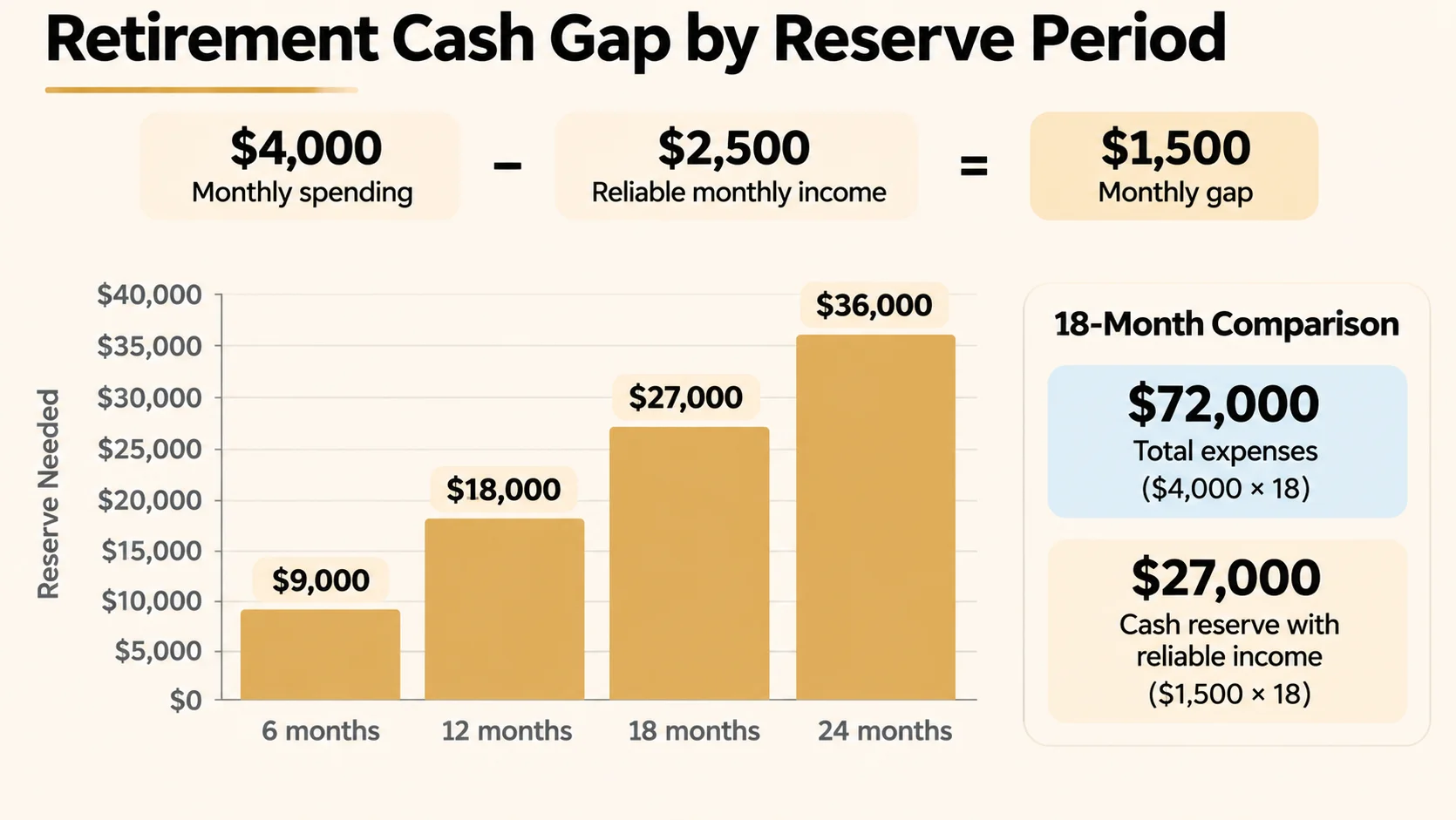
Suppose a retired household spends $4,000 a month and receives $2,500 from Social Security and a pension.
Monthly cash gap = $4,000 − $2,500 = $1,500
| Reserve period | Cash needed for the $1,500 monthly gap |
|---|---|
| 6 months | $9,000 |
| 12 months | $18,000 |
| 18 months | $27,000 |
| 24 months | $36,000 |
An 18-month reserve would be $27,000. Saving 18 months of total expenses would require $72,000, even though reliable income already covers much of the budget.
This is an example, not a universal target. Health costs, other income, family support, housing and risk tolerance can change the right number.
Five High-Yield Savings Accounts for Retirement Cash
Rates below were checked against official provider pages in November 2026. They are variable unless the offer states otherwise and can change after publication.
1. Pibank Savings
Best for: A strong APY without a minimum-balance condition.
APY and fees: Pibank lists 4.40% APY, no account fees and no minimum balance. The rate was marked valid as of October 21, 2026.
Access and protection: The account is managed through the Pibank app and is FDIC insured.
Watch for: The APY is variable. Retirees who prefer branch access or phone-based banking should confirm that the digital service model is comfortable for them.
2. Openbank High Yield Savings
Best for: A competitive introductory APY with no monthly fee.
APY and fees: Openbank lists up to 4.35% APY for new customers through a 0.35-point boost lasting six months. Its standard variable APY was 4.00% when checked. The account advertises no fees.
Access and protection: Openbank is part of Santander Bank and eligible deposits are FDIC insured.
Watch for: Compare the account using its standard APY, not only the six-month promotion. Confirm the current opening deposit before applying.
3. Vio Bank Online Savings
Best for: Savers comfortable with a short promotional rate and a $100 opening deposit.
APY and fees: Vio Bank lists a 4.40% promotional APY guaranteed for three months for eligible new accounts opened during the stated offer period. Its standard APY was 4.06% as of November 17, 2026. The account requires $100 to open.
Access and protection: Vio is the online division of MidFirst Bank, and deposits are FDIC insured through MidFirst.
Watch for: The promotion expires after three months. Paper statements cost $5, so electronic statements are the no-fee option.
4. Marcus Online Savings
Best for: Retirees who value simple terms and eligible same-day transfers.
APY and fees: Marcus lists 3.50% APY, no fees and no minimum deposit as of November 18, 2026.
Access and protection: Marcus states that eligible transfers of $100,000 or less requested before noon Eastern on a business day can be processed by 5 p.m. Deposits are held by Goldman Sachs Bank USA, Member FDIC.
Watch for: Processing on the same day does not guarantee the receiving bank will make the funds available that day. Maximum-balance and transfer conditions apply.
5. Varo Savings
Best for: A small retirement reserve funded with an eligible pension or government-benefit deposit.
APY and fees: Varo lists 3.75% APY on the first $5,000 after qualifying. The requirements include at least $800 in eligible monthly direct deposits and positive balances. Other balances earn 1.00% APY. There is no monthly fee or minimum balance.
Access and protection: Varo Bank is FDIC insured and provides automatic savings tools in its app.
Watch for: The higher APY only applies to the first $5,000. Confirm that a pension or government benefit is recognized as an eligible direct deposit.
How Do the Accounts Compare on $25,000?
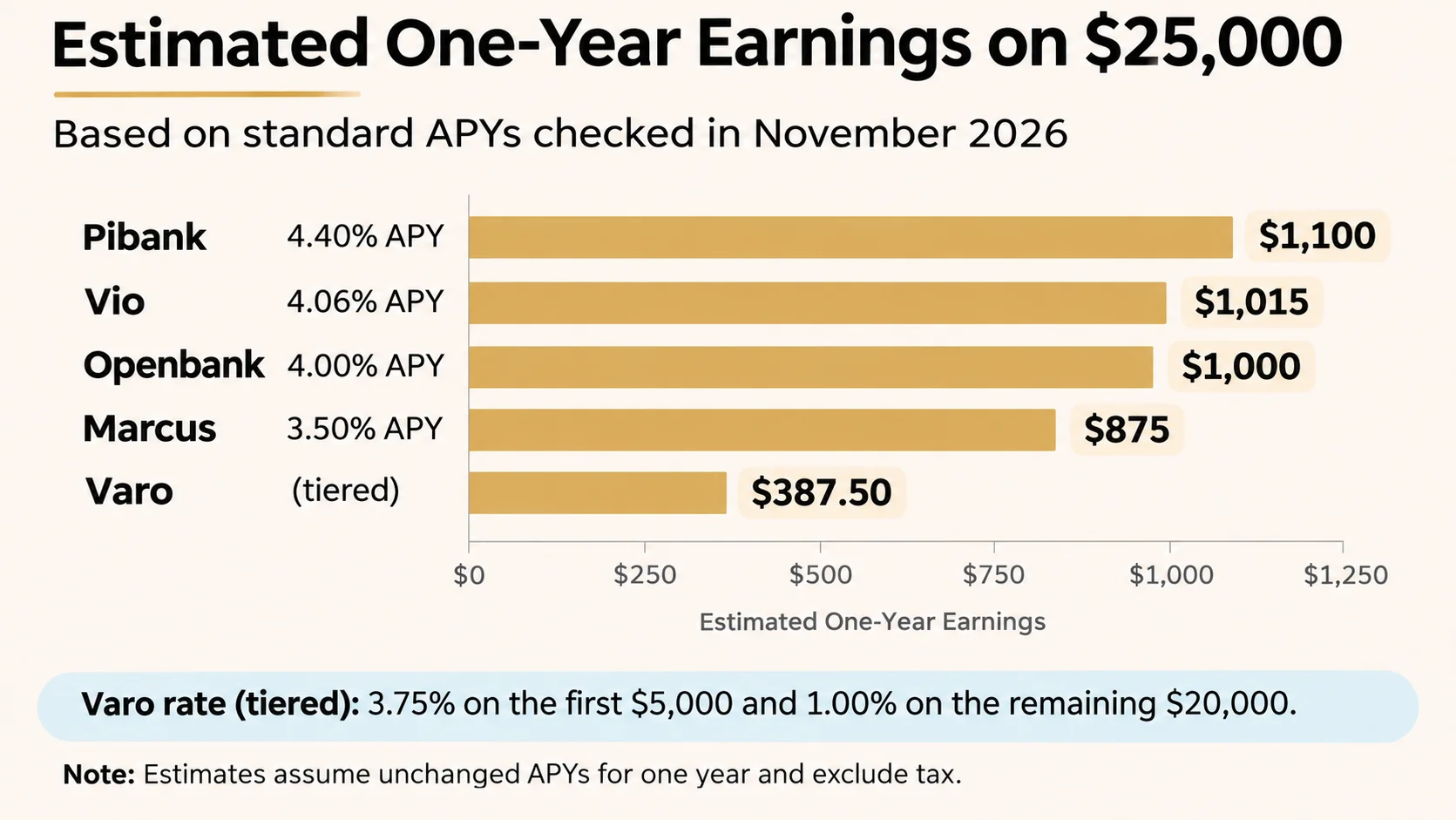
The following estimate uses each account’s standard or broadly available APY rather than a temporary promotion. It assumes the APY stays unchanged for one year, no withdrawals occur and no fees apply.
| Account | APY used | Approximate one-year earnings on $25,000 |
|---|---|---|
| Pibank | 4.40% | $1,100 |
| Vio standard APY | 4.06% | $1,015 |
| Openbank standard APY | 4.00% | $1,000 |
| Marcus | 3.50% | $875 |
| Varo | 3.75% on first $5,000; 1.00% on remaining $20,000 | $387.50 |
Varo’s headline APY does not apply to the whole $25,000. This is why the effective dollar result matters more than the largest percentage shown on a product page.
How Does FDIC Insurance Work for Retirement Cash?
The FDIC insures eligible deposits up to $250,000 per depositor, per insured bank, per ownership category.
Certain retirement accounts, including eligible IRA deposits, form a separate ownership category with coverage up to $250,000 per owner at one insured bank. An ordinary individual HYSA remains in the single-account category even when the owner intends to use it during retirement.
Accounts in the same ownership category at the same bank are generally added together. Check the legal bank behind an online savings app, especially when several brands share the same bank.
When Is a HYSA Not the Right Retirement Tool?
A HYSA may be a poor fit for money that will not be needed for many years. Its balance may stay stable, but its purchasing power can fall when inflation exceeds the APY.
It also does not provide market growth, and an ordinary account does not provide IRA tax treatment. When deciding how much should remain in cash, consider how the standard APY compares after promotions expire, and what fees or access restrictions apply.
For near-term money, focus on the standard APY after promotions, fees, transfer speed, FDIC ownership category, beneficiary options and customer support.
Put your dollars into something real
With PureFi, your projected earnings come from shares of real homes with tenants. Choose your properties from your phone, review the documents, and see every fee before you confirm.
Learn more about how PureFi can help you own real estate shares or download the app to get started today.
Up to 6% APY is projected, variable, and not guaranteed. Property shares can lose value. PureFi is not a bank, and its balances and real estate shares are not covered by FDIC insurance or another government deposit scheme.