
What Is a High-Yield Checking Account?
A high-yield checking account is an everyday transaction account that offers an above-average APY when certain requirements are met. Those requirements may include receiving qualifying direct deposits, making debit-card purchases, using electronic statements, or logging in to the account each month.
The highest APY may also apply only up to a balance limit. That makes the headline rate only one part of the offer.
Before choosing a high-yield checking account or digital savings platform, review what you must do, how much of the balance qualifies, the fallback APY, possible fees, and how you can access the funds.
How Does a High-Yield Checking Account Work?
A high-yield checking account combines everyday transaction features with the opportunity to earn. It commonly includes a debit card, ATM access, bill payment, direct deposit, checks, and electronic transfers.
The provider states an APY and the conditions for receiving it. APY represents potential annual earnings after compounding. The rate may be variable, and only part of the balance may qualify.
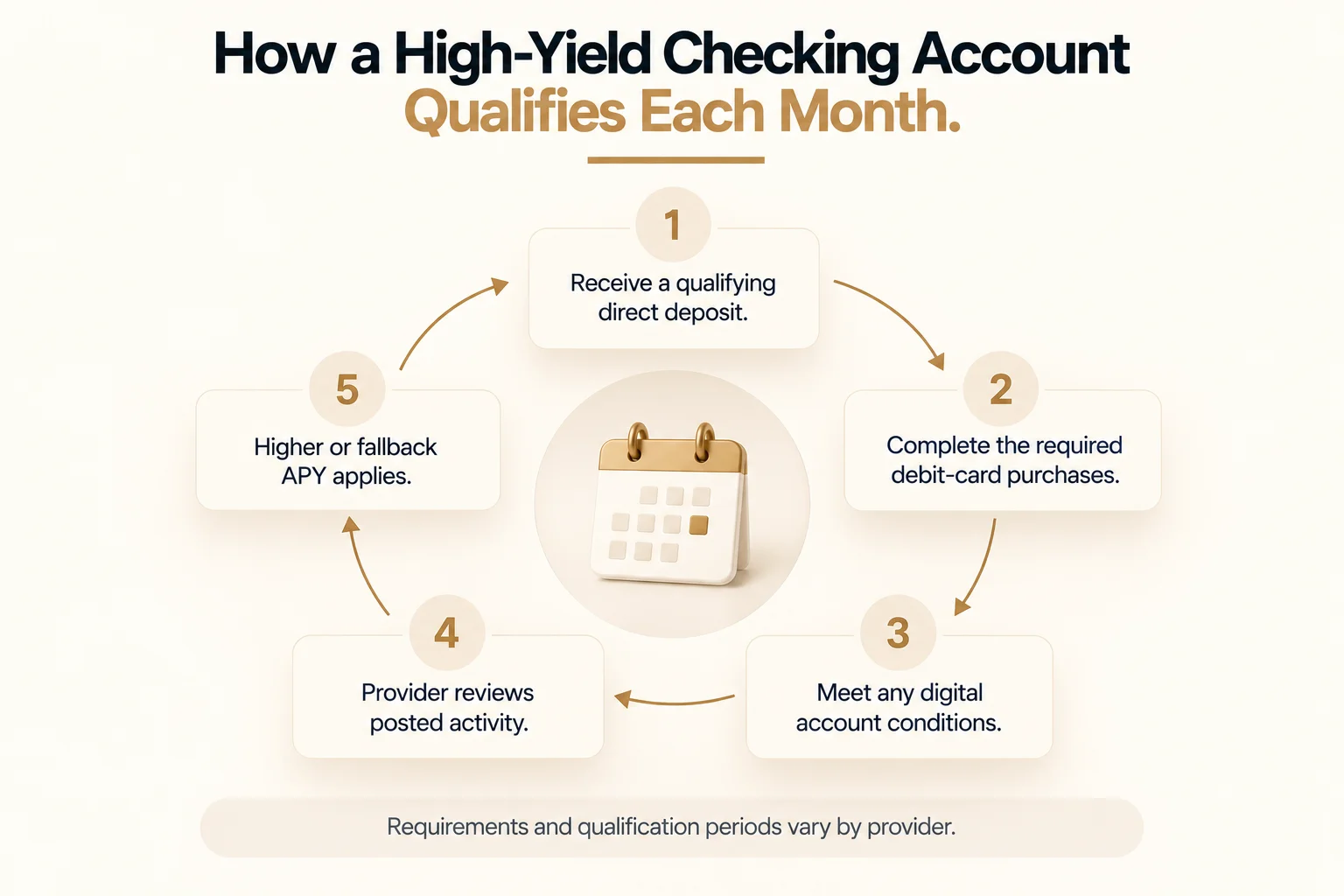
Providers usually review activity during a monthly qualification period based on a calendar month or statement cycle. Completing the required transactions can unlock the higher APY. Missing a condition may trigger a lower fallback APY for that cycle.
The disclosure should explain the APY, calculation method, fees, balance rules, and qualification period. Read it with the fee schedule because the marketing page may show only the best available APY.
What Requirements May Apply?
High-yield checking is often called rewards checking because the strongest APY rewards specific account activity. Requirements vary, so the account should fit the way you already bank. Spending or transferring money only to qualify can cancel out the benefit.
Qualifying Direct Deposits
A provider may require one or more direct deposits during each qualification period. It may also set a minimum combined dollar amount. Payroll, pension, and government payments commonly qualify, but the provider’s definition controls.
A transfer from another account in your name may not count. The same can apply to mobile checks or person-to-person payments. Check the provider’s definition before assuming an incoming payment qualifies.
A deposit may not count until it posts. Someone paid monthly should confirm that the payment schedule aligns with the qualification period.
Debit-Card Transactions
Some accounts require a minimum number of debit-card purchases. The exact target comes from the provider’s terms.
Purchases may need to settle before the deadline. Pending payments might carry into the next cycle, while refunds can reduce the final count. ATM withdrawals, transfers, and cash advances may not qualify.
The condition is easiest to meet when debit-card use is already part of your routine. Spending only to qualify weakens the account’s value.
Other Account Activity
A provider may also require electronic statements, online banking access, bill payments, or a minimum balance.
Check whether every condition must be met. Completing the card target but missing the deposit threshold may still trigger the fallback APY. The terms should also state when qualification begins.
How Do APY Tiers and Balance Limits Work?
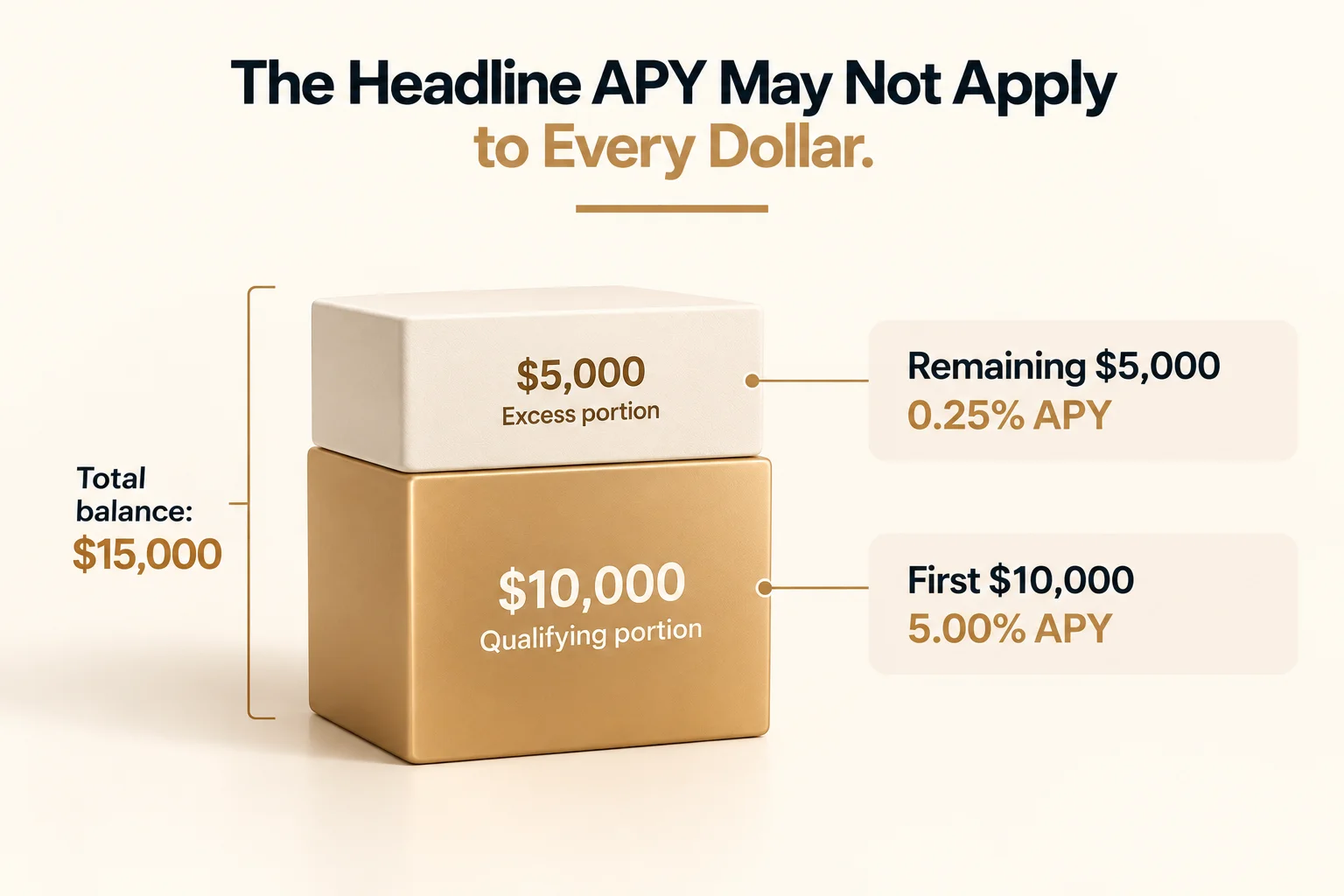
The highest APY often applies only up to a balance cap. Funds above it may receive a much lower APY, reducing the effective return across the full balance.
Imagine 5.00% APY on the first $10,000 and 0.25% above it. With $15,000, the first $10,000 would receive the higher APY and the remaining $5,000 the lower one. These illustrative figures do not represent a provider.
Other accounts reduce the APY on the entire balance after a cap is exceeded or use several tiers. Check the exact method.
Ask what the full balance would earn under the stated rules. Compare that result with fees and qualification work. Our guide to how much a high-yield savings account earns explains how APY and balance affect growth.
What Happens If You Miss the Monthly Requirements?
Missing a requirement normally means earning the fallback APY for that qualification period. It does not necessarily close the account or permanently remove the higher rate. If the conditions are met during the next period, the account may qualify again, depending on its terms.
Other benefits may also be affected. Some accounts reimburse out-of-network ATM charges only during months when all conditions are met. A missed transaction could therefore reduce earnings and remove an additional benefit.
Check four details before opening the account: the qualification deadline, whether transactions must post by that date, the fallback APY, and when the higher APY can resume. Automatic direct deposit can make one condition easier, but card-purchase targets and monthly logins may still require attention.
High-Yield Checking vs High-Yield Savings
Both products may offer a competitive APY, but they are designed for different activity.
| Feature | High-yield checking | High-yield savings |
|---|---|---|
| Main purpose | Everyday transactions | Holding funds for future use |
| Debit card | Usually included | Not always available |
| Bill payment | Commonly supported | May be limited or indirect |
| Higher APY | Often tied to monthly activity | Often based on balance or account status |
| Balance cap | Frequently used | Depends on the provider |
| Transaction frequency | Built for regular spending | Better for less frequent activity |
A high-yield digital savings account may be simpler without a monthly card target. High-yield checking works best when existing deposits and spending already satisfy the conditions.
A high-yield savings app or online savings app may still require transfers to checking for bills and card purchases. Compare transfer speed and withdrawal methods separately from APY.
For a closer comparison of the two account types, read High-Yield Savings Account vs Checking Account.
What Fees Should You Check?
A strong APY does not eliminate fees. Possible charges include maintenance, out-of-network ATM use, overdrafts, insufficient funds, paper statements, wires, and expedited transfers.
Fee-waiver rules may differ from APY requirements. One deposit might remove the monthly charge while a higher deposit total and card purchases unlock the advertised APY.
A $10 monthly fee costs $120 a year and can offset earnings on a modest balance. Also consider whether a card target would encourage unnecessary spending.
If avoiding recurring charges is important, review high-yield savings accounts with no monthly fees and compare the access tradeoffs.
Are High-Yield Checking Accounts Federally Protected?
Eligible balances at an FDIC-insured bank can receive deposit protection. The standard limit is $250,000 per depositor, per insured bank, for each ownership category. Federally insured credit unions offer comparable share protection through the NCUA.
Checking and savings balances in the same ownership category at the same institution are generally combined when coverage is calculated. They do not each receive a separate $250,000 limit merely because they are different products.
When an account is offered through a fintech app, verify which bank or credit union holds the deposit and how coverage applies. Do not assume the app itself is a bank. Investments displayed inside the same service are not automatically covered merely because a checking balance is insured.
Who May Benefit From High-Yield Checking?
High-yield checking may suit someone who receives qualifying deposits, uses a debit card, and stays within the highest-APY tier. Existing monthly activity can then produce earnings without changing normal behavior.
It may be less useful without eligible deposits, regular card use, or a balance that fits the cap. It also requires monitoring the qualification cycle.
Estimate how much of the balance qualifies, subtract likely fees, and decide whether the requirements fit your banking routine.
How Is PureFi Different From High-Yield Checking?
PureFi is not a checking account, savings account, bank, or credit union. It is a high-yield investment platform that allows users to buy shares of income-producing residential properties through a mobile experience.
The earnings source and account functions are different. High-yield checking holds deposits and supports direct deposits, debit-card spending, bill payments, and frequent transfers. With PureFi, projected earnings come from tenant rent and possible changes in property value. It does not provide ordinary checking features.
PureFi projects up to 6% APY, but the return is variable and not guaranteed. Property shares can lose value and may not provide immediate access. PureFi balances and real estate shares are not covered by the FDIC, NCUA, or another government deposit scheme.
Learn more about how PureFi can help you own real estate shares or download the app to get started today.
Up to 6% APY is projected, variable, and not guaranteed. Property shares can lose value. PureFi is not a bank, and its balances and real estate shares are not covered by FDIC insurance or another government deposit scheme.


