
What Is a Growth Savings Account and How Does It Work?
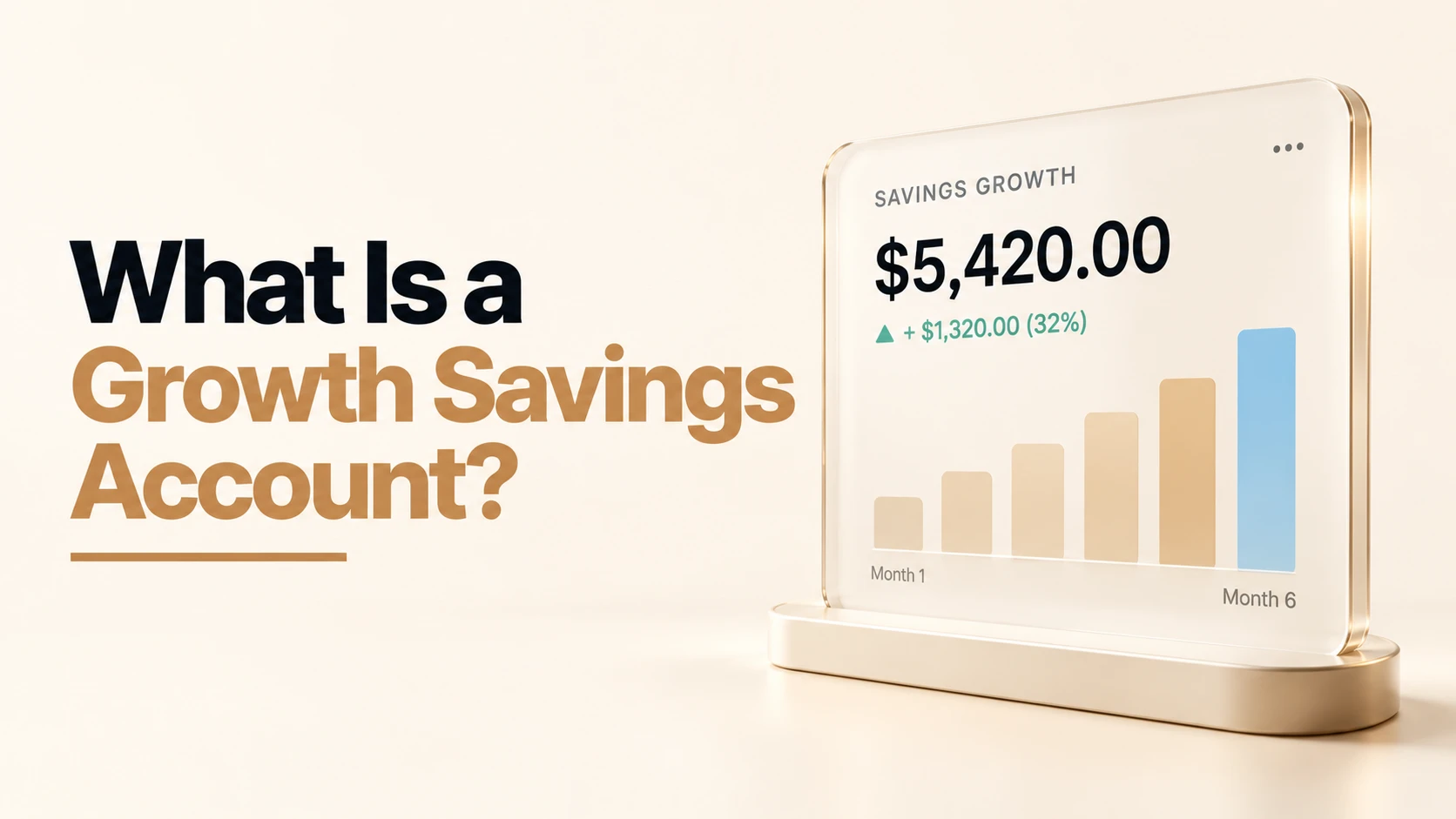
A growth savings account is designed to help your balance increase through an APY and regular deposits. However, “growth savings account” is not a standardized banking category. It is a product name used by different banks and credit unions.
One provider may use it for a high-yield account, while another may apply the name to a tiered-rate, promotional, youth, or relationship account. This means the name alone tells you very little. You need to check the APY, balance requirements, fees, withdrawal rules, and deposit protection before opening one.
How Does a Growth Savings Account Work?
A growth savings account works like other savings accounts. You add money, the provider applies its stated APY, and earnings are credited according to its schedule.
Your Balance Can Grow in Two Ways
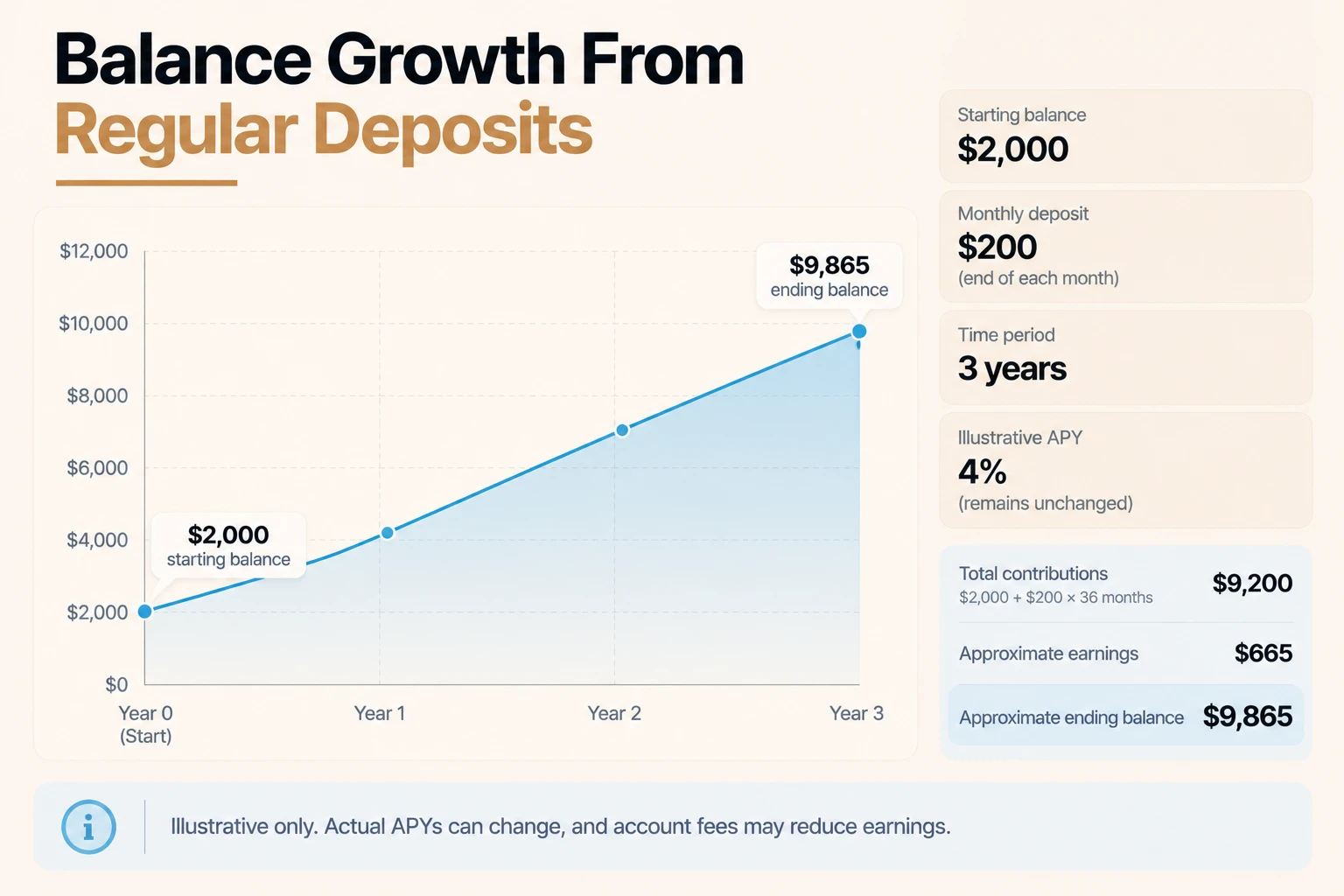
The account balance can increase through:
- New deposits you make
- Earnings credited by the provider
As the balance rises, future earnings are calculated using the larger amount. Regular deposits can therefore have a greater effect than relying on the APY alone.
For example, someone might open an account with $2,000 and add $200 each month. Each contribution increases the balance available to earn. Withdrawals have the opposite effect because they reduce that balance.
The APY Can Change
Most growth savings accounts have a variable APY. The provider can raise or lower it after the account has been opened. A competitive starting APY does not guarantee the same yield in the future.
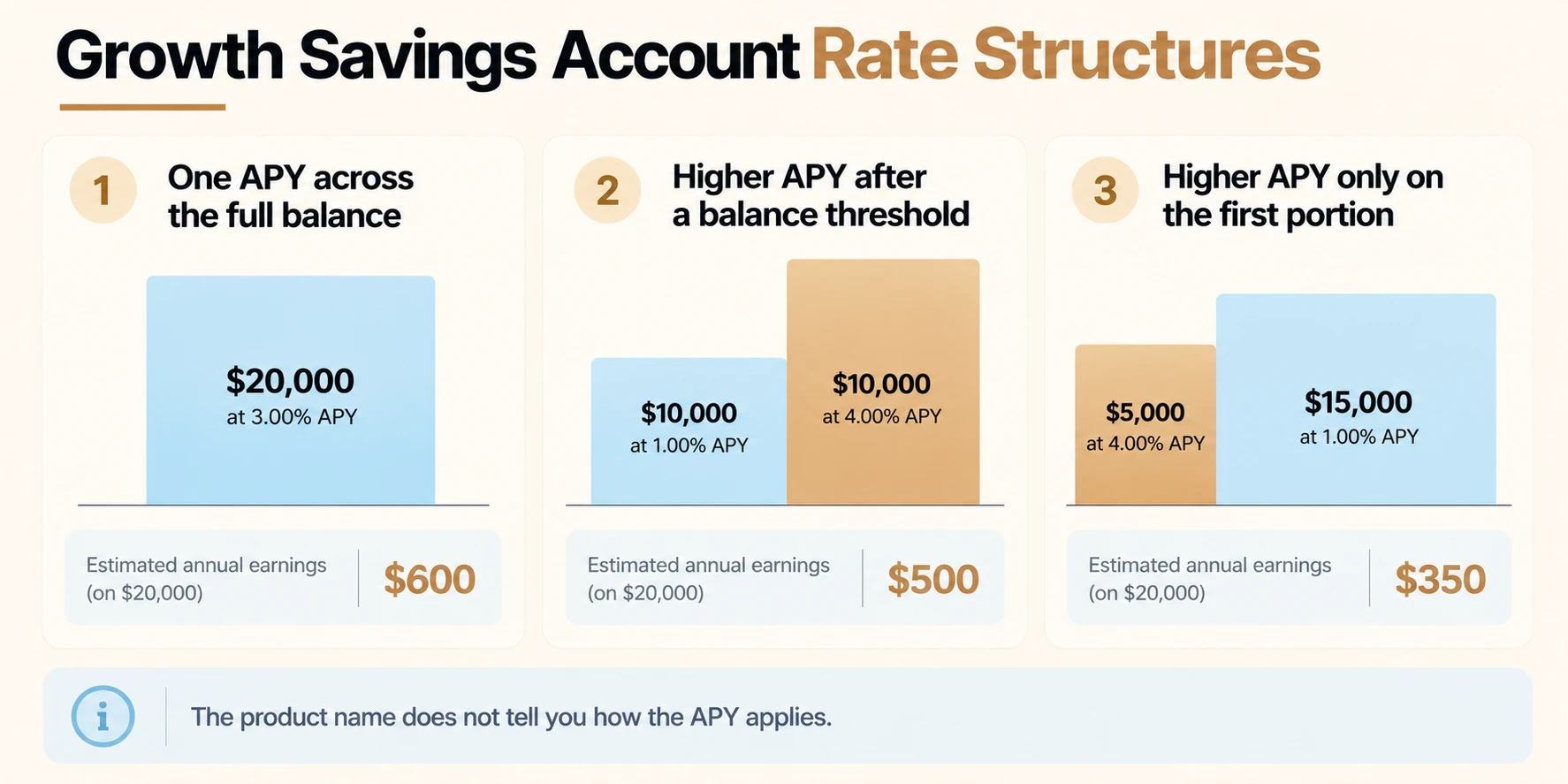
Some providers also use balance tiers. The APY may increase after the balance reaches a set level, or the strongest APY may apply only to a limited portion of the account.
Digital Tools Can Support Regular Deposits
A high-yield digital savings account may provide automated transfers, transaction alerts, and progress tracking through a mobile app. These features can make regular saving easier, but customers should still review the account’s fees, APY structure, and withdrawal rules.
What APY Does a Growth Savings Account Offer?
There is no standard APY for a growth savings account. The rate depends on the provider and how the account is structured.
Accounts using the “growth savings” name may follow different models:
- One APY may apply to the full balance.
- Different APYs may apply at different balance levels.
- The highest APY may apply only to a limited portion of the balance.
- New deposits may be required to qualify.
- A linked account or another monthly activity may be required.
The word “growth” is simply part of the product name. It does not guarantee that the account offers a competitive APY.
Check the APY That Applies to Your Balance
The highest advertised APY may require a larger balance than you plan to keep. It may also apply only to the first portion of the account rather than every dollar deposited.
Before opening the account, check:
- The APY available for your expected balance
- Whether the APY is variable
- Any minimum balance needed to qualify
- Whether the account uses tiers or balance caps
- What happens when a requirement is missed
Federal disclosure rules require banks to provide key information such as the APY, fees, minimum balances, balance-calculation method, and limits on deposits or withdrawals before an account is opened.
You can also use our guide to how much a high-yield savings account earns to estimate how a balance could change over time.
Common Growth Savings Account Features
The exact features depend on the institution, but several are common.
Variable APY
Most accounts do not lock the APY for a fixed term. The provider can change it in response to market conditions or internal policies.
Balance Tiers or Caps
A growth savings account may pay different APYs at different balance levels. Check whether the qualifying APY applies to the full balance or only the amount within a particular tier.
Minimum Opening Deposit
Some accounts can be opened with a small amount. Others require a larger initial deposit. The opening requirement may be different from the balance needed to earn the advertised APY.
Monthly Fees
A provider may charge a monthly maintenance fee or waive it when the balance remains above a certain level. The fee can reduce the practical value of the account, especially when the balance is small.
Digital Account Access
A digital savings platform may let customers schedule transfers, review their earnings, and receive balance alerts. A well-designed high-yield savings app should also show which APY applies to the current balance.
Automatic Deposits
Recurring transfers can be scheduled from checking or another linked account. This helps customers build the balance without initiating every deposit manually.
Our guide to adding money to a savings account regularly explains how recurring deposits affect account growth.
Growth Savings Account vs High-Yield Savings Account
A growth savings account and a high-yield savings account may be very similar. The main difference is how the provider names and structures the product.
“High-yield savings account” generally describes a savings account offering a stronger APY than a typical account. “Growth savings account” is usually a brand or product label chosen by the institution.
A growth account may offer a competitive APY, but it could also include balance tiers, new-money requirements, age restrictions, or relationship conditions. A HYSA can include many of the same rules.
Do not choose between them based on the names. Compare the APY that applies to your balance, monthly fees, withdrawal methods, minimum deposits, and digital features.
Our guide to the types of high-yield savings accounts explains how online, tiered, promotional, and relationship accounts differ.
Growth Savings Account vs Regular Savings Account
| Feature | Growth Savings Account | Regular Savings Account | | APY | May be competitive, tiered, or conditional | Often lower | | Minimum deposit | Varies by provider | Often low | | Monthly fee | May apply | May apply | | Branch access | Depends on provider | Common at traditional banks | | Digital tools | Often emphasized | Varies | | Balance requirements | May affect APY | May affect fees | | Withdrawals | Provider-specific | Provider-specific |
Read our full high-yield savings account versus regular savings account comparison for more detail.
Common Benefits of a Growth Savings Account
Potentially Stronger Yield
A competitive APY can help the balance increase faster than it would in a low-yield account. The benefit depends on maintaining enough money in the account and avoiding fees.
Support for Regular Deposits
Automatic transfers can help customers add a fixed amount every week or month. Regular contributions may have a greater effect on the final balance than small differences between APYs.
Separation From Everyday Spending
A separate growth account can hold an emergency reserve or money assigned to a particular goal. Keeping it away from checking may reduce unplanned spending.
Digital Account Management
An online savings app can make it easier to review deposits, monitor the balance, and adjust recurring transfers. Notifications can also alert customers when the APY or account terms change.
What Should You Check Before Opening One?
Start with the APY and confirm whether it applies to your full balance. If the account uses tiers, identify the exact rate available for the amount you plan to deposit.
Next, review the minimum opening deposit and ongoing balance requirements. Check whether falling below a threshold reduces the APY, creates a monthly fee, or both.
You should also review:
- Monthly and transaction fees
- Deposit and withdrawal methods
- External transfer times
- Balance caps
- Automatic deposit options
- Individual or joint ownership
- Branch and ATM access
- Deposit protection
Confirm that a bank is FDIC-insured or that a credit union is federally insured by the NCUA. The name of the account does not determine its protection.
Finally, compare the account with other savings products. A product described as “growth savings” is not automatically better than a standard HYSA. Focus on the actual numbers, requirements, and access rules.
Put your dollars into something real
With PureFi, your projected earnings come from shares of real homes with tenants. Choose your properties from your phone, review the documents, and see every fee before you confirm.
Learn more about how PureFi can help you own real estate shares or download the app to get started today.
Up to 6% APY is projected, variable, and not guaranteed. Property shares can lose value. PureFi is not a bank, and its balances and real estate shares are not covered by FDIC insurance or another government deposit scheme.


