
What Is a Cash Management Account and How Does It Work Today?

A cash management account, or CMA, combines banking-style features in one place. It may support deposits, bills, debit cards, ATM withdrawals, and a variable APY. A CMA is not always a bank account. Brokerages, investment firms, and fintech companies commonly offer them.
They may move customer cash to partner banks or money market funds. That structure affects the rate, access, and protection.
How Does a Cash Management Account Work?
A CMA provides one app or brokerage dashboard, while the cash may be held elsewhere.
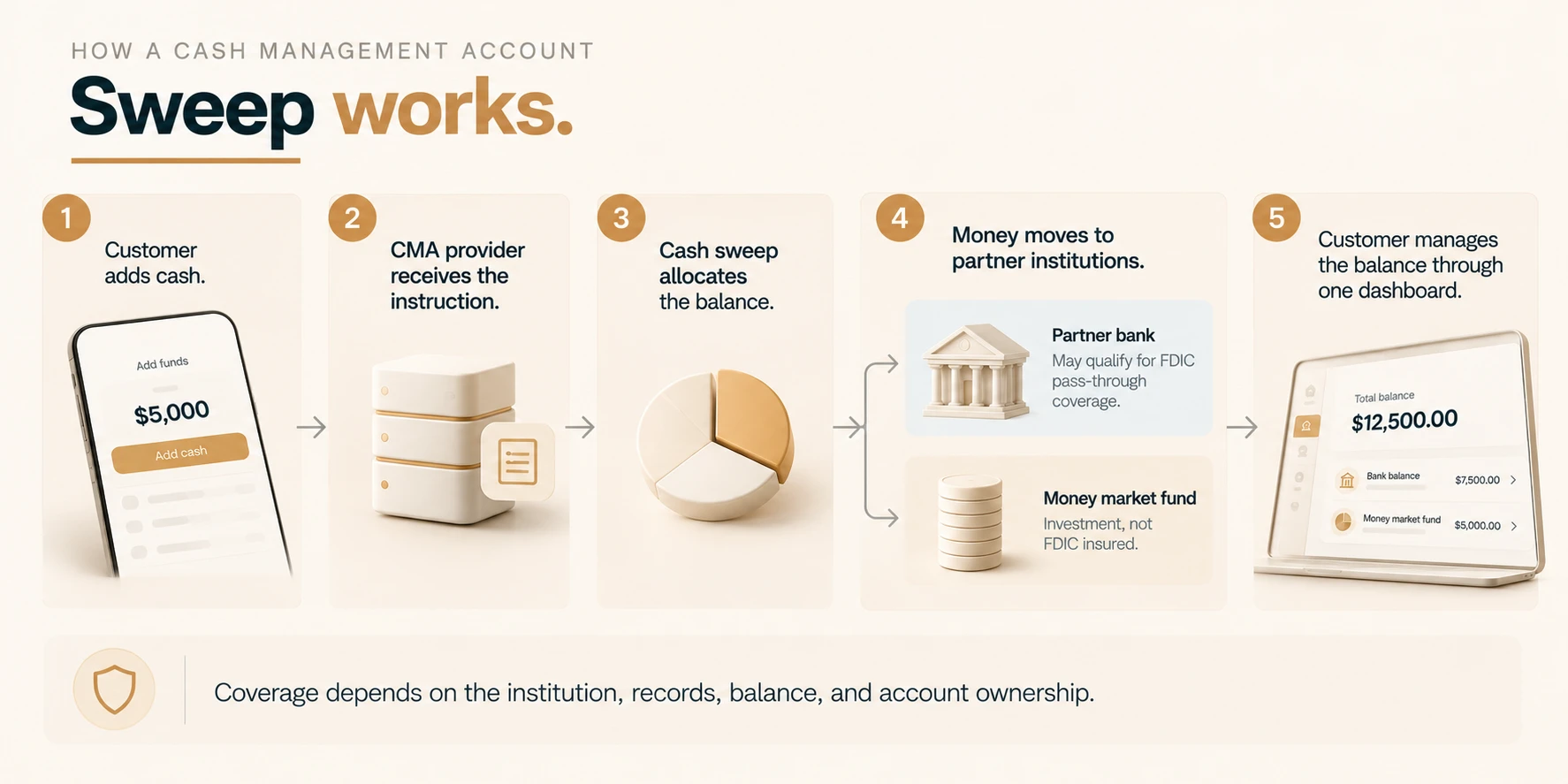
A typical bank sweep works like this:
- You add money to the cash management account.
- The provider receives instructions to allocate the cash.
- Unused cash is moved to one or more partner banks.
- The banks hold the money in deposit accounts.
- You continue managing it through the CMA provider.
The SEC’s brokerage account guide explains that uninvested cash may move to bank deposits, money market funds, or remain in the brokerage.
Not every CMA uses the same structure. Read the provider’s sweep disclosure before adding money.
What Is a Cash Sweep?
A cash sweep is an automatic transfer of unused cash under the provider’s schedule.
The cash may go to:
- An account at one partner bank
- Deposit accounts across several partner banks
- A money market mutual fund
- Another brokerage cash option
Bank deposits and money market funds have different risks and protection.
FINRA’s cash management guidance recommends checking the default cash option rather than assuming it offers the best available yield. Sweep rates can vary widely between providers.
Some firms let customers select a different sweep option. Others automatically use one default program.
Common Cash Management Account Features
CMAs often combine features found in checking, savings, and brokerage accounts.
Spending and Payment Features
Depending on the provider, you may receive:
- A debit card
- ATM access
- Direct deposit
- Bill payments
- Check writing
- Bank transfers
- Mobile deposits
ATM reimbursement rules and withdrawal limits vary.
Cash Earnings
Some CMAs pay a variable APY on partner-bank deposits. Money market fund yields also change. Either return may be lower than a high yield digital savings account, so check the live figure.
Brokerage Access
A brokerage CMA can move cash and sale proceeds into the default sweep automatically.
Its status depends on whether it sits at a bank, brokerage, or money market fund.
Is a Cash Management Account FDIC-Insured?
The CMA provider may not be a bank and may not carry FDIC insurance itself. Eligible cash can receive coverage after it reaches an FDIC-insured partner bank. This is called pass-through deposit insurance. The FDIC’s pass-through coverage guide explains the ownership and recordkeeping conditions.
Existing deposits at a partner bank may be combined with CMA cash when coverage is calculated. Some programs use several banks, which may increase eligible coverage. Check:
- The names of the program banks
- How the provider allocates deposits
- The maximum eligible coverage
- How existing deposits at those banks are treated
The FDIC warns that a nonbank app is not insured merely because it works with an insured bank. Its third-party banking guidance explains why the holding institution matters.
FDIC vs SIPC Protection
FDIC and SIPC protection cover different situations.
FDIC covers eligible bank deposits. SIPC may protect qualifying cash and securities when a member brokerage fails and assets are missing.
SIPC does not cover market losses or cash already moved to a partner bank.
The FINRA guide to SIPC protection explains how protection changes between brokerage cash, money market funds, and bank sweep deposits.
Check the location of the cash instead of relying on the account name.
Cash Management Account vs Checking Account
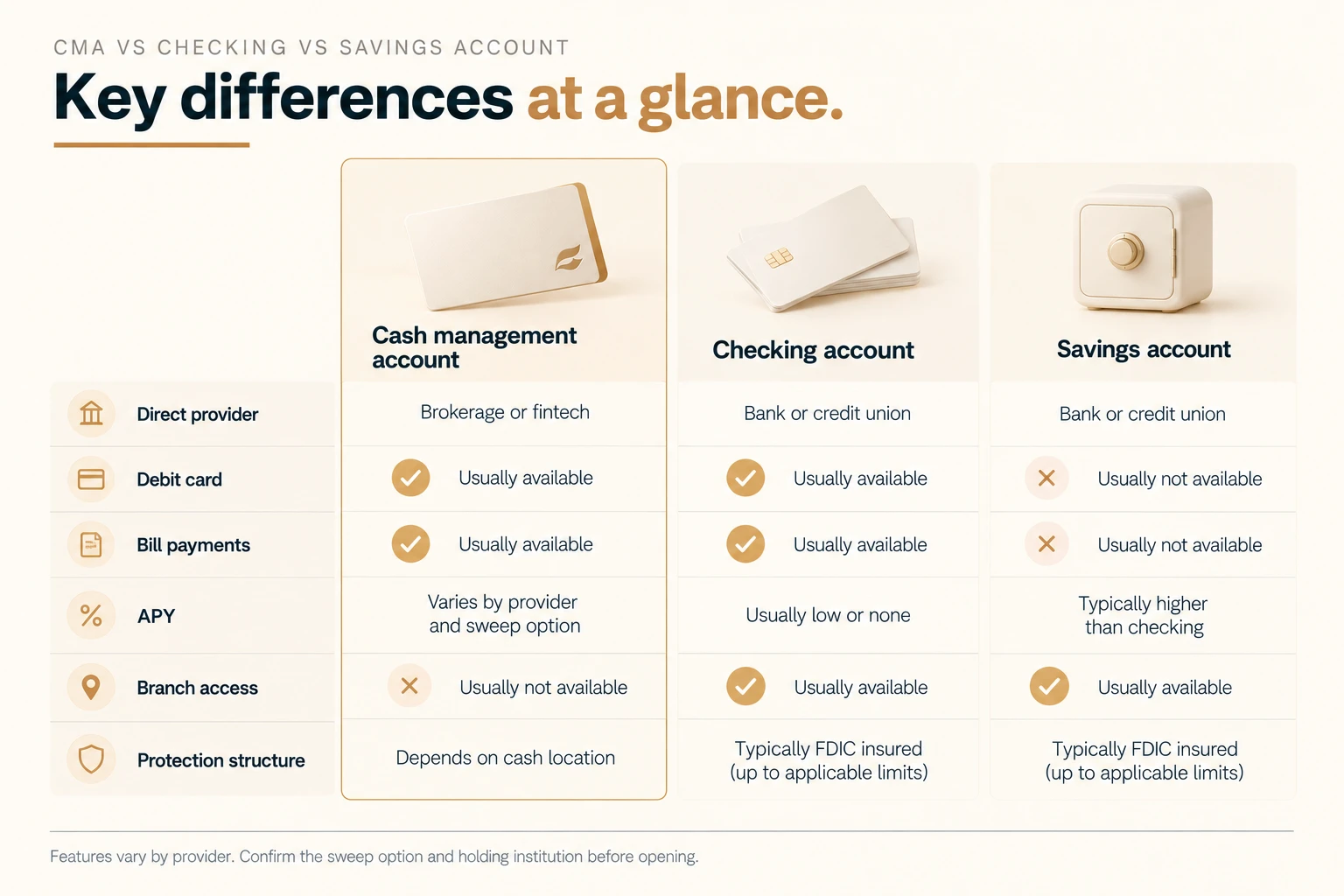
| Feature | Cash management account | Checking account |
|---|---|---|
| Provider | Brokerage, investment firm, or fintech | Bank or credit union |
| Main purpose | Manage and sweep cash | Everyday transactions |
| Debit card | Often available | Usually available |
| Direct deposit | Often available | Standard feature |
| Bill payments | Often available | Standard feature |
| APY | May be competitive | Often low or 0% |
| Branch access | Usually unavailable | Depends on the bank |
| Overdraft options | Limited or unavailable | May be offered |
| Protection | Depends on where cash is held | Eligible deposits may be federally protected |
A checking account is opened directly with a bank or credit union. A CMA may provide similar tools through a nonbank.
Read our checking vs savings account guide for a closer comparison of transaction and savings features.
Cash Management Account vs Savings Account
A savings account is a direct deposit account. A CMA may move cash to other institutions.
| Feature | Cash management account | Savings account |
|---|---|---|
| Account structure | May use a bank or fund sweep | Direct deposit account |
| Payment tools | May include cards, checks, and bills | Usually limited |
| APY | Depends on the sweep option | Set by the bank or credit union |
| Branch access | Rare | Available with some providers |
| ATM access | Often included | Varies |
| Protection | Depends on cash location | Applies to eligible deposits at insured institutions |
A high yield savings app may offer fewer spending tools but a stronger APY. With a direct online savings app, the holding bank may also be easier to identify.
Our guide to what a high-yield savings account is explains how direct savings products work.
Cash Management Account vs Money Market Account
A money market deposit account is a bank or credit-union product. Eligible deposits can receive federal protection.
A money market mutual fund is an investment. It is not FDIC-insured and can lose value.
A CMA can sweep cash into either structure, depending on the program. Check whether the provider uses a bank deposit or a fund.
Our money market account vs high-yield savings account guide covers the deposit-account comparison.
Benefits of a Cash Management Account
A CMA can place cash, payments, and brokerage transfers in one dashboard.
Other possible benefits include:
- Automatic cash sweeps
- A variable APY
- Debit card and ATM access
- ATM fee reimbursements
- Direct deposits and bill payments
- Access to several program banks
- Simple transfers between cash and investments
Features vary by provider.
Possible Drawbacks
The structure can be more complex than a bank account.
- The provider may not be a bank.
- The default sweep rate may not be competitive.
- Partner banks can change.
- Transfers may take time.
- Branch access is normally unavailable.
- Protection depends on where the cash is held.
- Existing deposits at partner banks can reduce available coverage.
- A money market fund can lose value.
A clean app does not remove these risks.
What Should You Check Before Opening a CMA?
Ask the provider:
- Where will my cash be held?
- Is the default sweep a bank deposit or money market fund?
- Which partner banks are used?
- What is the current APY or yield?
- Can I change the sweep option?
- Which fees apply?
- How long do transfers take?
- Are ATM fees reimbursed?
- How is FDIC or SIPC protection handled?
- What happens if the provider or a partner fails?
A digital savings platform can make cash easier to manage. The legal structure and holding institution still determine the main risks.
Who Might Use a Cash Management Account?
A CMA may suit someone who wants uninvested cash, payments, and brokerage transfers in one place. The user must still understand the sweep and protection structure.
Put your dollars into something real
With PureFi, your projected earnings come from shares of real homes with tenants. Choose your properties from your phone, review the documents, and see every fee before you confirm.
Learn more about how PureFi can help you own real estate shares or download the app to get started today.
Up to 6% APY is projected, variable, and not guaranteed. Property shares can lose value. PureFi is not a bank, and its balances and real estate shares are not covered by FDIC insurance or another government deposit scheme.


