What Are High-Yield Deposit Accounts?
A high-yield deposit account is a bank or credit-union account that offers a stronger APY than many standard deposit accounts. It gives deposited money a chance to earn while it remains with the financial institution.
The term does not describe one official account category. Banks may use it for savings accounts, money market deposit accounts, certificates of deposit, or checking accounts with competitive rates.
Each type works differently. Some allow regular withdrawals. Others lock the APY for a fixed period. Before opening one, check the account structure rather than relying on the words “high yield.”
How Do High-Yield Deposit Accounts Work?
The basic process is straightforward. You deposit money with a bank or credit union. The institution applies its current rate to the eligible balance and credits the resulting earnings according to its schedule.
Once credited earnings remain in the account, they can contribute to future earnings. This is compounding.
A bank might calculate earnings daily but add them to the balance monthly. Another may use a different calculation or crediting schedule. The account disclosure should explain both.
APY Makes Accounts Easier to Compare
Annual percentage yield, or APY, estimates how much a balance could earn over one year. It includes the effect of compounding. This makes APY more useful than the base rate when two accounts compound at different intervals. However, APY does not account for monthly fees or changes to the balance.
An advertised APY may also depend on conditions. The best rate might only apply when you:
- Maintain a minimum balance
- Receive qualifying direct deposits
- Make a stated number of card transactions
- Add a minimum amount each month
- Keep the balance below or above a set threshold
Check the APY that applies to the amount you expect to deposit.
Fixed and Variable APYs Work Differently
Savings, money market, and high-yield checking accounts usually have variable APYs. The provider can increase or reduce the rate after the account is opened.
A certificate of deposit normally provides a fixed APY for a defined term. The rate stays the same, but withdrawing money before maturity can trigger a charge.
A high advertised rate is therefore not enough information. You also need to know whether it is fixed, variable, promotional, or conditional.
Common Types of High-Yield Deposit Accounts
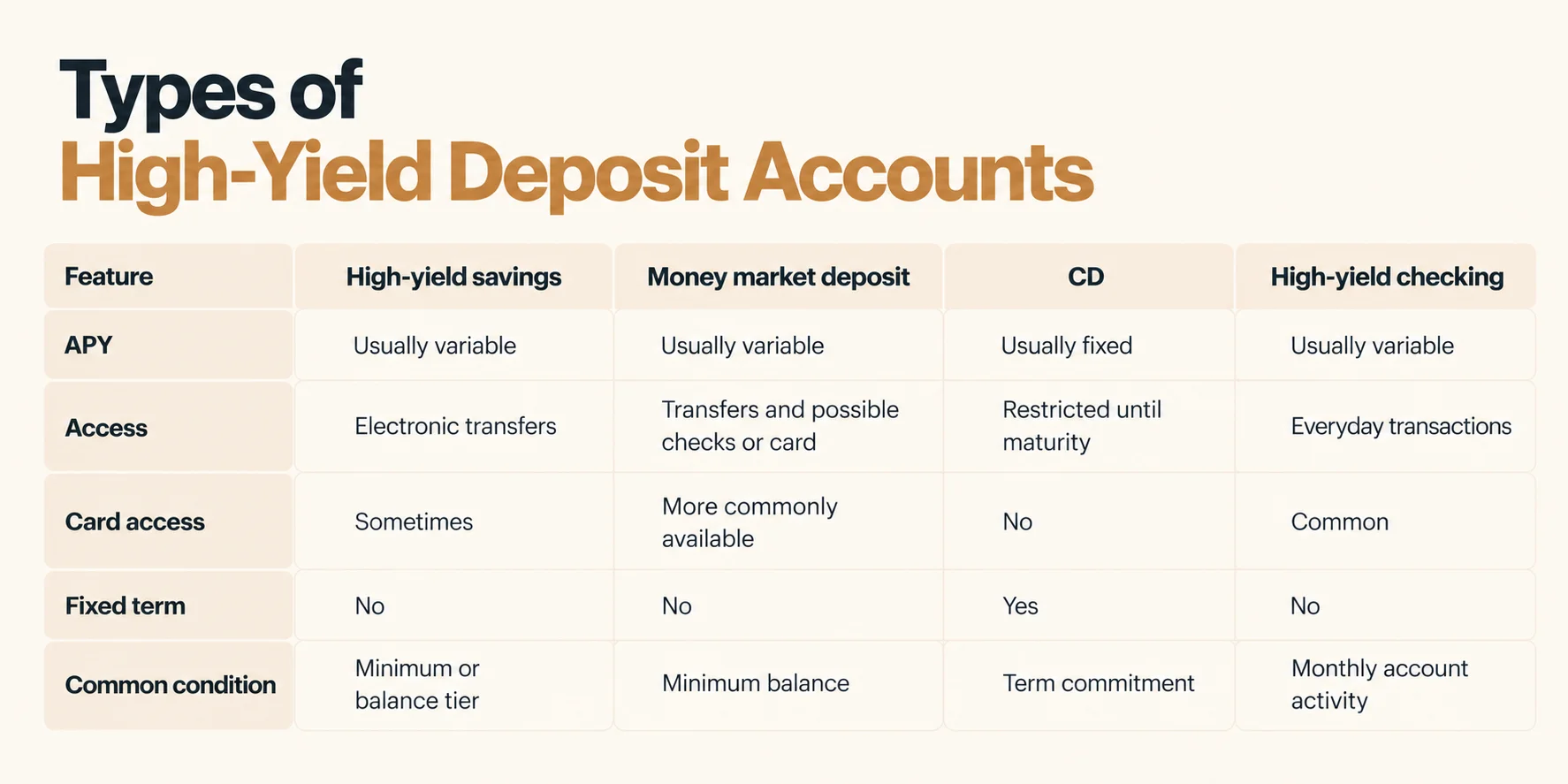
Several deposit products can be described as high yield. The right type depends on how often you need the money and which payment features matter.
High-Yield Savings Account
A high-yield savings account provides a variable APY without requiring the customer to keep the money deposited for a fixed term.
Most online accounts support electronic transfers to and from linked bank accounts. Some include an ATM card, while fewer offer a purchase-enabled debit card. Many require customers to transfer money to checking before spending it.
A high yield digital savings account may have no monthly fee or opening minimum. Others use balance tiers or deposit requirements to determine which APY applies. This account type often suits emergency funds, short-term goals, and money that is not needed for daily payments.
Our guide to the different types of high-yield savings accounts covers the available structures.
Money Market Deposit Account
A money market deposit account combines saving features with additional access methods. Depending on the bank, it may include checks, an ATM card, a debit card, or online bill payments.
It normally has a variable APY. The provider may require a larger opening deposit or minimum balance than it requires for a standard savings account.
Do not confuse a money market deposit account with a money market mutual fund. A money market deposit account is held at a bank or credit union. Eligible deposits can receive FDIC or NCUA protection.
A money market fund is an investment. Its shares are not protected by FDIC deposit insurance and can follow different withdrawal and settlement rules.
Read Money Market Account vs High-Yield Savings Account for a detailed comparison.
Certificate of Deposit
A certificate of deposit, or CD, normally provides a fixed APY for a chosen term. Common terms range from a few months to several years.
The customer agrees to keep the money deposited until the maturity date. Taking money out early can trigger a charge based on the amount withdrawn, the account’s earnings, or a specified number of days or months.
A CD can make sense when the money will not be needed during the term. It may be less suitable for an emergency fund or an expense with an uncertain date.
No-penalty CDs provide more flexibility. They allow an early withdrawal under stated conditions, although the customer may need to withdraw the entire balance and close the CD.
Our no-penalty CD and savings account comparison explains the access tradeoff.
High-Yield Checking Account
A high-yield checking account combines everyday banking features with an APY.
It may support direct deposits, debit-card purchases, checks, ATM withdrawals, bill payments, and recurring transactions. The highest APY often comes with monthly activity requirements.
For example, the customer may need to receive a qualifying direct deposit, make a set number of debit-card purchases, and use electronic statements. Missing one condition can result in a much lower APY for that month.
The highest rate may also apply only up to a balance cap. Money above the cap could receive a lower rate.
A high-yield checking account suits active spending money more than long-term savings. Read our guide to high-yield checking accounts for more detail.
How Much Can a High-Yield Deposit Account Earn?
A simple annual estimate uses the balance and APY:
Balance × APY = approximate annual earnings
Suppose you keep $10,000 in an account paying 4% APY:
$10,000 × 4% = approximately $400 over one year
This is a simplified estimate. It assumes the balance and APY remain unchanged for the full year.
Actual earnings can be different when:
- You add or withdraw money
- The variable APY changes
- A promotional rate expires
- Fees are deducted
- Different balance tiers apply
- You miss an activity requirement
The date of each deposit matters too. Money added halfway through the year does not receive a full year of earnings.
APY allows a cleaner comparison, but it is still based on assumptions. Our guide to how high-yield savings accounts work explains how balance changes and compounding affect the result.
What Are the Benefits of High-Yield Deposit Accounts?

The main benefit is the ability to earn more than the same balance might produce in a low-rate account.
Deposited Money Can Earn More
A higher APY can create a meaningful difference on a larger balance.
If $20,000 remains deposited for one year, a 4% APY would produce approximately $800. A 1% APY would produce about $200 under the same simplified assumptions.
The difference is approximately $600 without increasing the starting balance.
Different Accounts Support Different Uses
High-yield savings can hold an emergency reserve or money for a planned expense. A money market account may add checks or card access.
A CD can secure a fixed APY when the customer knows the money will not be needed during the term. High-yield checking can earn on money used for regular transactions.
Choosing the correct type is more useful than simply choosing the account with the highest displayed number.
Eligible Deposits Can Receive Federal Protection
Eligible accounts at FDIC-insured banks are protected within applicable federal limits and ownership categories. Federally insured credit unions provide comparable NCUA protection.
The standard FDIC limit is generally $250,000 per depositor, per insured bank, for each ownership category. Separate accounts at the same bank are not always insured separately. The ownership category determines how balances are combined.
Always verify the institution and the account structure. An app calling itself a digital savings platform does not automatically mean the balance is an insured bank deposit.
What Should You Compare Before Opening an Account?
Start with the APY, but do not stop there.
| Feature | What to check |
|---|---|
| APY | Current rate and whether it is fixed, variable, promotional, or conditional |
| Eligible balance | How much of the balance receives the advertised APY |
| Monthly fee | Whether it could reduce the account’s earnings |
| Opening deposit | Amount required to open the account |
| Ongoing minimum | Balance needed to avoid fees or qualify for the APY |
| Access | Electronic transfers, checks, ATM card, debit card, or term restrictions |
| Conditions | Direct deposit, card purchases, or monthly deposit requirements |
| Protection | FDIC or NCUA status and applicable ownership category |
| Crediting schedule | When earnings are added to the balance |
Transfer speed deserves particular attention. An online savings app may let you request a withdrawal at any time without delivering the money immediately.
External transfers can take one or more business days. Weekends, holidays, deposit holds, and security reviews may add time.
Check the fee schedule for outgoing wires, returned transactions, paper statements, ATM use, stop-payment requests, and early CD withdrawals.
A high yield savings app should show the current APY, available balance, pending transactions, transfer limit, and estimated arrival date clearly.
High-Yield Deposit Accounts vs Investment Platforms
A high-yield deposit account and a high yield investment platform can both display an APY. That does not make them the same product.
A deposit account holds money at a bank or credit union. The account may provide a fixed or variable yield. Eligible deposits can receive federal protection within applicable limits.
An investment platform may place money into real estate, funds, securities, or other assets. The value can rise or fall. Government deposit insurance does not normally protect the investment.
The source of the earnings should be clear before money is committed. If the yield comes from rent, market prices, or asset sales, the product should not be treated as an insured savings account.
Put your dollars into something real
With PureFi, your projected earnings come from shares of real homes with tenants. Choose your properties from your phone, review the documents, and see every fee before you confirm.
Learn more about how PureFi can help you own real estate shares or download the app to get started today.
Up to 6% APY is projected, variable, and not guaranteed. Property shares can lose value. PureFi is not a bank, and its balances and real estate shares are not covered by FDIC insurance or another government deposit scheme.