What Are Some Good Investment Options?
A good investment is one that fits what you need your money to do. It should match your goal, how long you can leave the money invested, how much risk you can accept, and how quickly you may need access to it.
There is no single investment that is right for everyone. An option that makes sense for money you won’t need for 20 years may be a poor place for next month’s rent. A product with a higher possible return may also have a greater chance of losing value.
In this guide, we compare popular types of investments, explain where their returns may come from, and cover the risks, access rules, fees, and protections worth checking.
Disclaimer: This article is for general education only. It is not financial, investment, tax, or legal advice. Investments can lose value, and projected returns are not guaranteed.
What makes an investment good?
A good investment should be understandable. You should know what you own, how it may earn, what could cause it to lose value, and how you can get your money back.
It should also fit your own plan. Before choosing an investment, consider these points:
- Your goal: Are you building money for retirement, a home, education, or another expense?
- Your timeline: Will you need the money soon, or can it stay invested for several years?
- Your risk level: How much of the original amount could you afford to lose?
- Access: Can you sell when you want, and how long will it take to receive the funds?
- Costs: Are there purchase fees, management fees, selling fees, or account charges?
- Protection: Who regulates the provider, and what protection applies if it fails?
- Source of return: Does the investment earn from rent, company profits, scheduled payments, or a rise in value?
The US Securities and Exchange Commission explains that every investment carries some risk. It also notes that your goal and investing timeframe should help shape the amount of risk you take. Investor.gov explains investment timeframes and risk.
6 Popular types of investments
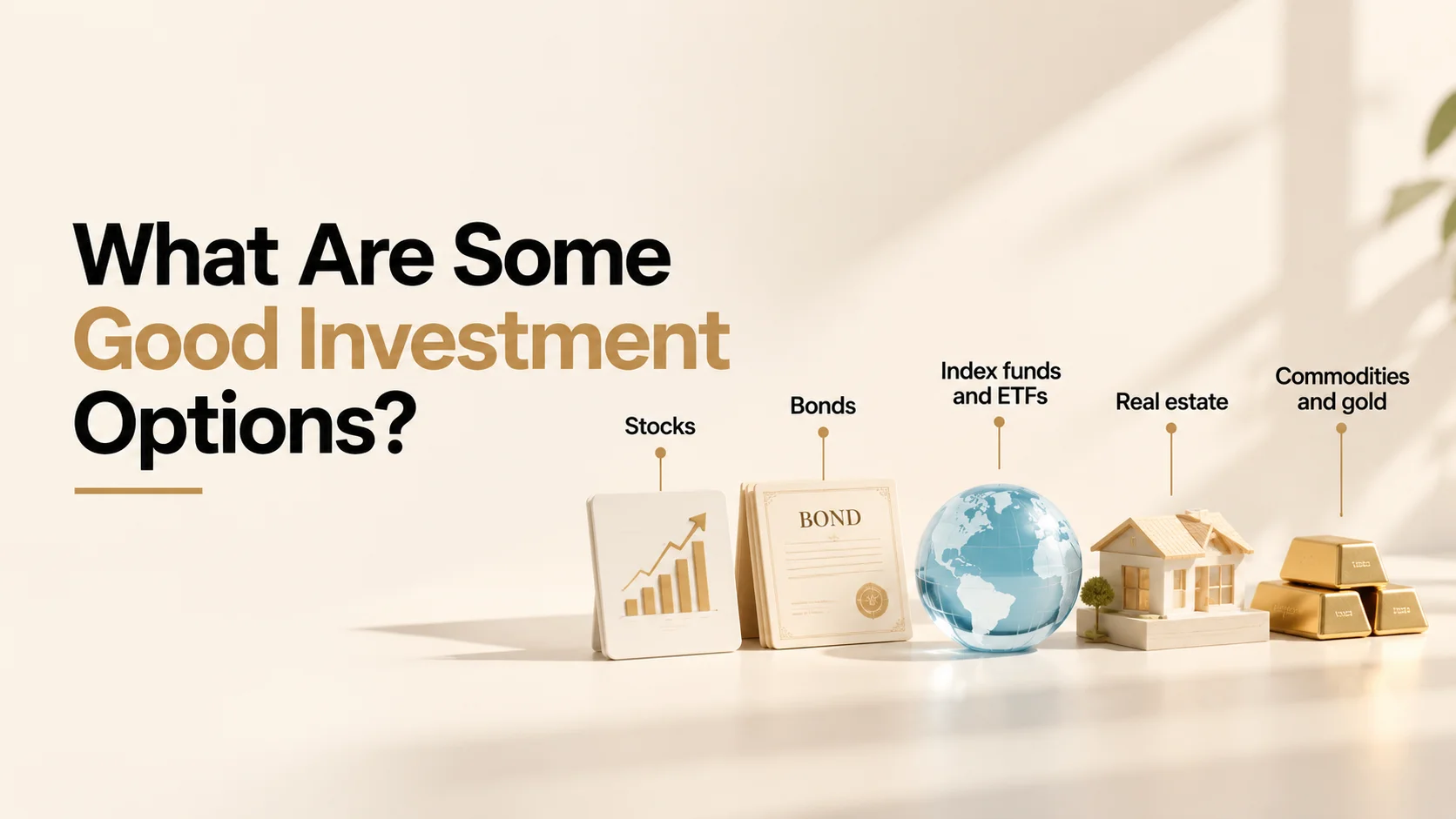
Good investments for beginners don’t have to be complicated. The main options include stocks, bonds, funds, real estate, and commodities. Each one works differently.
1. Stocks
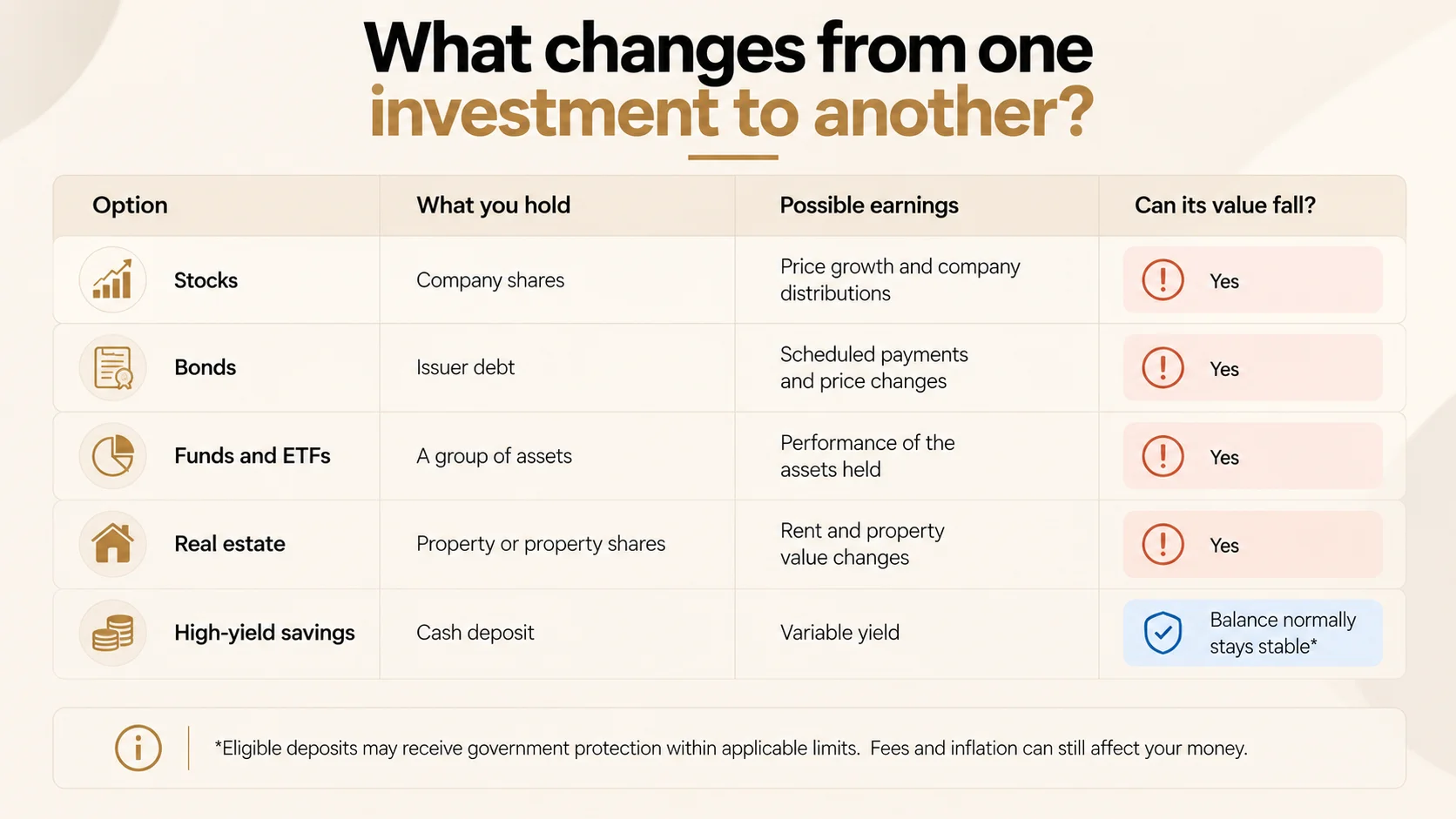
A stock is a small piece of a company. When you buy a share, you become one of its owners. You may earn if the share price rises and you later sell it for more than you paid. Some companies also distribute part of their profits to shareholders. Neither type of return is guaranteed.
Stock prices can rise and fall quickly. A company may lose customers, face higher costs, take on too much debt, or fail. Wider economic and market changes can also affect its share price.
Buying shares in only one company creates concentration risk. If that company performs badly, a large part of your investment may be affected.
2. Bonds
A bond is an agreement between an investor and a government, company, or other issuer. The investor provides funds. In return, the issuer agrees to make scheduled payments and repay the original amount under set terms.
Bonds are often less volatile than stocks, but they aren’t free from risk. The issuer may miss payments. The bond’s market price may also fall, which matters if you need to sell before it reaches the end of its term.
Different bonds carry different levels of risk. A government bond and a bond from a small company shouldn’t be treated as the same product.
3. Index funds and ETFs
An index fund or exchange-traded fund can hold shares in many companies, bonds, or other assets. Instead of selecting each holding yourself, you buy into a fund that contains a collection of investments.
This can make it easier to spread your money across different assets. It doesn’t stop losses, but it may reduce the effect of one company performing badly.
Funds can follow different markets and strategies. Some are broad and simple. Others focus on one country, industry, commodity, or type of company. Check what the fund holds, how much it charges, and how closely its price follows the assets inside it.
The SEC confirms that mutual funds and ETFs can hold stocks, bonds, short-term money-market instruments, and other assets. Read the SEC overview of investment products.
4. Real estate
Real estate is land or property. You can invest by buying a property yourself, buying shares in a real estate fund, or purchasing fractional shares of a property. Returns may come from rent and from a change in the property’s value. Both can change. A home may remain empty, repairs may cost more than expected, or local property prices may fall.
Direct ownership usually requires a large starting amount. It also leaves the owner responsible for maintenance, tenants, insurance, and local charges. Funds and fractional ownership can lower the starting amount, but they have their own fees, structures, and selling rules.
Before investing, check who owns the legal title, what your share represents, who manages the property, how rent is divided, and how you can sell.
5. Commodities and precious metals
Commodities include assets such as gold, silver, oil, and agricultural products. Investors may buy the asset itself or use a fund that follows its price.
Prices can change because of supply, demand, weather, political events, production costs, and currency changes. Many commodities don’t produce regular earnings. The investor often depends on selling at a higher price.
These assets may have a place in a wider portfolio, but they can be difficult for beginners to assess. The structure and fees also depend on how the investment is purchased.
6. High-yield savings accounts
A high-yield savings account is a savings product, not a market investment. It is designed to hold cash while paying a stated annual percentage yield.
An online high-yield savings account may suit an emergency fund or money needed soon. At an eligible US bank or credit union, the balance may receive federal deposit protection within the applicable limits. That protection doesn’t apply to every app or financial product that uses the word “savings.”
The yield can change. Fees, minimum balances, withdrawal rules, and deposit protection can also differ between providers. The highest rate online savings account isn’t always the best account if it has poor access, high fees, or unclear protection.
Saving and investing serve different purposes. Savings are generally used for stability and near-term access. Investments accept more uncertainty in exchange for the possibility of greater growth or income.
Why diversification matters
Diversification means spreading your money across more than one investment. This may include different companies, industries, countries, and types of assets.
For example, owning shares in several technology companies isn’t the same as holding a fully diversified portfolio. Those companies may all be affected by the same industry problem. Broader diversification may include stocks from different sectors alongside bonds, real estate, cash, or other suitable assets.
Diversification can’t prevent every loss. A broad market decline can affect many investments at once. Its purpose is to reduce the damage that one company, asset, or market segment can cause to the whole portfolio.
FINRA identifies asset allocation and diversification as tools for managing investment risk, while making clear that risk cannot be removed completely. See FINRA’s guidance on diversification.
Investing in real homes with PureFi
PureFi gives you access to shares of real, income-producing homes from your phone. The homes are bought outright and professionally managed.
When you buy, the shares are held in an account in your name. The legal documents for each home are available in the app. Your projected earnings come from rent and changes in the home’s value. Nothing is lent out.
When tenants pay rent, your share is added to your balance. You can reinvest it or take it out. You can also sell your property shares at the current market price without a fixed lock-up.
PureFi charges no monthly fee. A one-time purchase fee is shown before you confirm an order. Projected returns can rise or fall, and property shares may lose value. PureFi is a financial technology company, not a bank. Its property shares are not bank deposits and don’t receive FDIC protection. Balances sit in a self-custodial wallet controlled by the user.
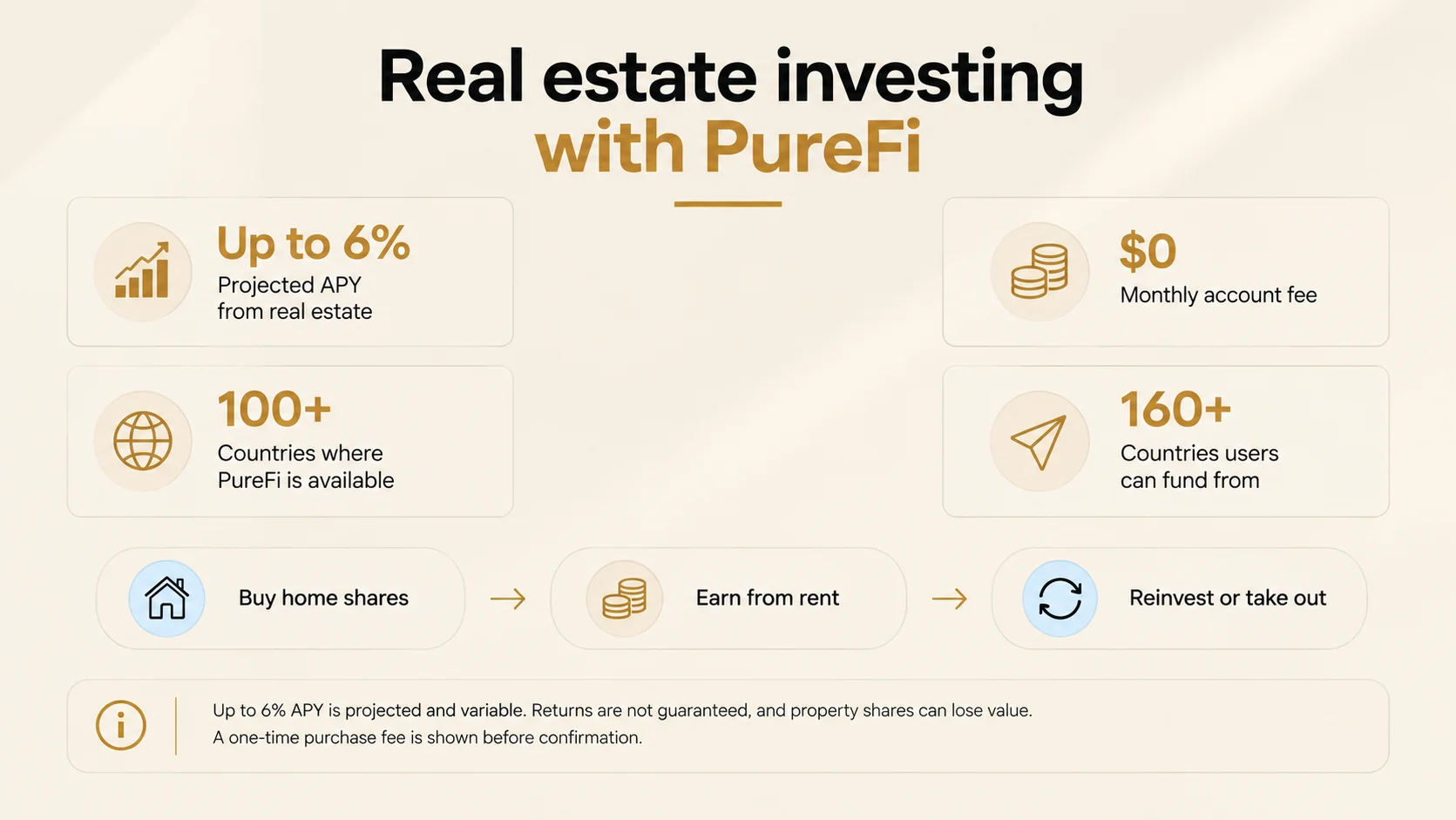
See how real estate investing works with PureFi.
Frequently asked questions
What are good investments for beginners?
Good investments for beginners are products they can understand and monitor. Broad funds may offer a simpler way to own many assets. Real estate can provide access to rent and property values. Savings products may be more suitable for money needed soon.
The right choice depends on the person’s goal, timeframe, risk level, and access needs.
What is the safest type of investment?
No investment is completely safe. Some government-backed products and insured deposit accounts carry less risk than stocks, commodities, or property shares.
Lower-risk options may also offer lower possible returns. Always check what protection applies and whether the value can fall.
Are high-yield savings accounts investments?
No. A high-yield savings account is normally a deposit account used to hold cash and earn a variable yield. It doesn’t work like a stock, fund, or property share.
If the account is offered through a fintech app, confirm which institution holds the money and whether deposit protection applies.
Is real estate a good investment?
Real estate may produce rent and may rise in value. It can also lose value, remain empty, or require costly repairs.
Whether it is suitable depends on its price, location, fees, management, selling terms, and the investor’s wider financial plan.
Can an investment lose money?
Yes. Stocks, funds, bonds, real estate, commodities, and other investments can lose value.
Some losses happen when market prices fall. Others happen because an issuer cannot pay, a property produces less rent, or fees reduce the return.
How many different investments should you have?
There is no number that works for everyone. What matters is whether your money is spread across enough companies, sectors, locations, and asset types to avoid relying too heavily on one result.
A single broad fund may hold many investments, while several narrow funds may still concentrate money in the same area.
Put Your Dollars Into Something Real
With PureFi, your projected earnings come from shares of real homes with tenants. Choose your properties from your phone, review the documents, and see every fee before you confirm.
Learn more about how PureFi can help you own real estate shares or download the app to get started today.