PureFi vs EverBank: Rates, Fees, Features and Access

PureFi and EverBank both offer digital ways to earn more from your balance, but they work very differently. PureFi’s projected APY comes from shares of real homes with tenants, while EverBank Performance Savings is an FDIC-insured bank account with a variable APY. Both provide digital access and charge no monthly account fee. However, their approach to earnings, protection, and access to funds differs. Here is what to compare before deciding which one fits your goals.
PureFi vs EverBank at a Glance
The most important difference is the underlying product. EverBank offers a conventional bank savings account. PureFi provides a savings-style experience backed by fractional ownership of real estate.
| Feature | PureFi | EverBank Performance Savings |
|---|---|---|
| Product structure | Shares of real homes | Bank savings account |
| Advertised APY | Up to 6% projected APY | 3.90% APY for new accounts |
| Source of earnings | Rent and changes in home values | Yield paid on bank deposits |
| Monthly account fee | None | None |
| Minimum balance | No minimum balance | No minimum balance |
| Compounding | Daily | Daily |
| Access to funds | App access; property shares can be sold at the current market price | Online transfers, mobile transfers, wires, and mobile deposits |
| Protection | Not FDIC insured | FDIC insured within applicable limits |
| Return status | Projected, variable, and not guaranteed | Variable and subject to change |
Rates and product details were checked in September 2026. EverBank’s advertised 3.90% APY applies to new Performance Savings accounts and may not apply to existing accounts. The rate is variable and can change without notice.
What Is PureFi?
PureFi is a digital savings platform that allows users to earn projected returns through shares of real residential properties. Instead of depositing money with a bank that lends or invests those funds, PureFi users choose shares of homes with tenants.
Each home is purchased outright and professionally managed. The property’s legal documents are available through the app, allowing users to review what they are buying. Property shares are held in an account in the user’s name rather than pooled with the holdings of other users.
Earnings come from two potential sources. The first is rent paid by tenants. When a property receives rent, the user’s share of those earnings is added to their balance. The second is a possible change in the value of the property. A home may rise or fall in value, which can affect the current market value of its shares.
PureFi advertises up to 6% projected APY. This figure is variable and based on current information about rents and home values. It is not a guaranteed return. Property shares can also lose value.
Readers who are unfamiliar with fractional property ownership can read our guide on how to invest in real estate.
What Is EverBank Performance Savings?
EverBank is a US bank offering checking, savings, money market, certificate of deposit, and other financial products. Its Performance Savings account is an online high-yield savings account intended for people who want a competitive yield without a monthly maintenance fee or minimum balance requirement.
New Performance Savings accounts currently earn 3.90% APY across all balances. There is no minimum deposit required to open the account, and the account begins earning regardless of the balance. Earnings compound daily.
The advertised APY is specifically described as a new-account rate. Someone who already has an EverBank account may receive a different APY. EverBank can also change the rate at any time because Performance Savings is a variable-rate account.
Customers can open the account online or by phone. Once the account is open, they can fund it using an online transfer, mobile check deposit, wire transfer, direct deposit, or eligible in-person deposit. EverBank also allows customers to schedule recurring transfers from external bank accounts.
EverBank Performance Savings is the closest option in this comparison to a conventional high-yield digital savings account. It keeps the familiar structure of a bank account while offering a higher APY than many traditional savings products.
For more background on this account type, see how a high-yield savings account works.
PureFi vs EverBank Rates and Earnings
Comparing the two advertised APYs alone does not provide the full picture. PureFi and EverBank generate earnings differently, and that affects the level of certainty attached to each figure.
How PureFi earnings work
PureFi advertises up to 6% APY as a projection. The earnings come from rent and changes in the value of the underlying homes. If rental income, occupancy, property expenses, or home values change, actual results may differ from the projection.
For example, a home could generate consistent rental income while its market value declines. Another property could increase in value but experience an empty period without a tenant. These factors mean the total result will not always follow a steady path.
PureFi may appeal to someone looking for a high-yield investment platform with exposure to tangible assets. However, the possibility of higher projected earnings comes with property-related risk.
How EverBank earnings work
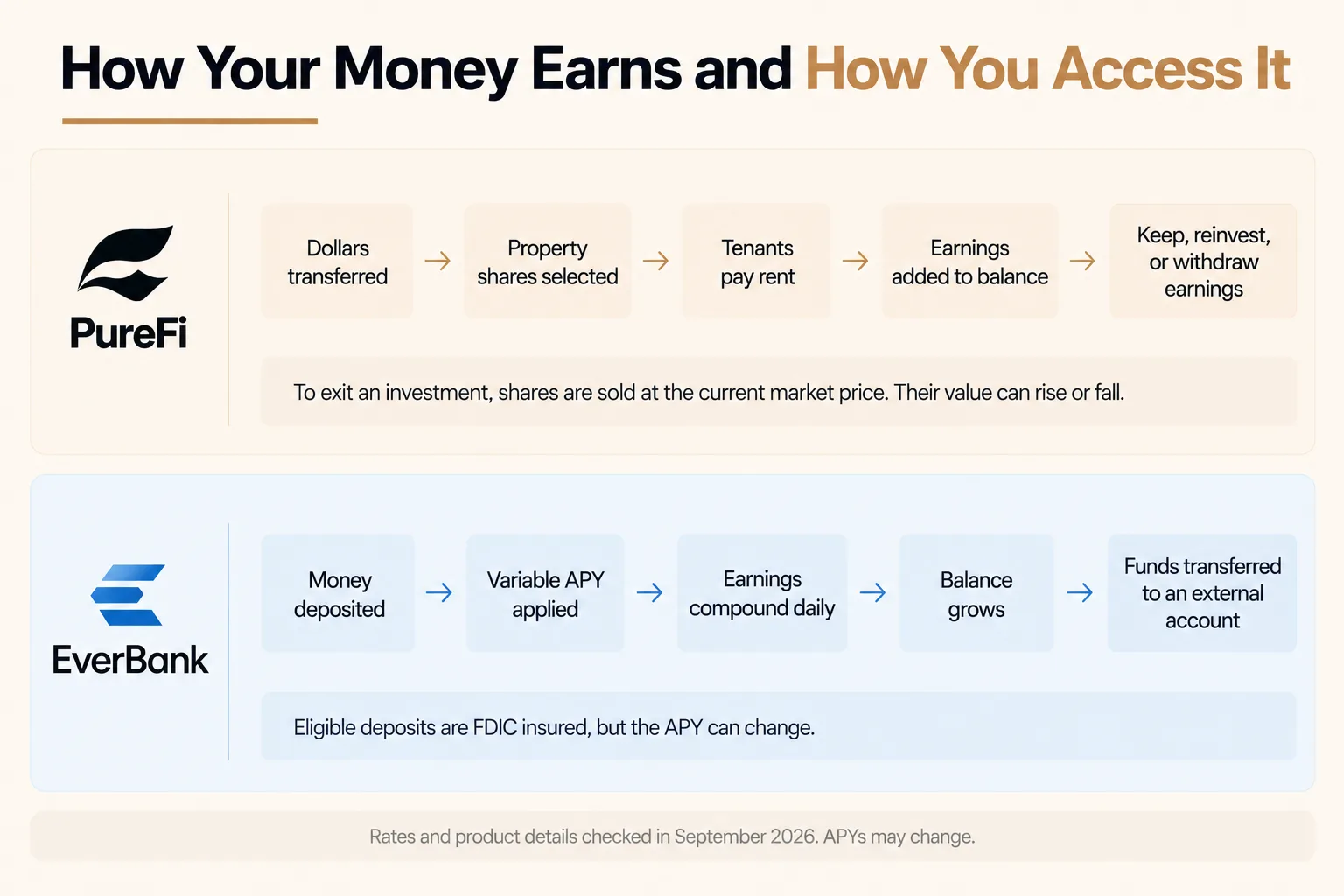
EverBank applies its current variable APY to the collected daily balance in the account. Earnings compound daily, meaning each day’s calculation can include earnings previously added to the balance.
The process is more predictable than property-based returns when the APY remains unchanged. However, the APY itself is not fixed. If EverBank lowers or raises its rate, the balance will begin earning at the new rate.
APY already accounts for compounding, which makes it more useful than comparing base rates alone. Our guide to the difference between APY and interest rate explains how the two figures affect advertised earnings.
A simple $10,000 comparison
If $10,000 earned exactly 6% APY for a full year, it would produce approximately $600 in earnings. At 3.90% APY, the same starting balance would produce approximately $390.
These figures assume the balance remains unchanged for one year. They also assume the quoted APYs remain in place. PureFi’s result is a projection rather than a promised return, while EverBank may change its variable rate during the year. Deposits, withdrawals, purchase fees, and changes in property value can also affect the final amount.
Fees and Minimum Balance Requirements
Neither PureFi nor EverBank Performance Savings charges a monthly account maintenance fee. Neither requires a minimum balance to keep the account open or earn at the advertised rate.
PureFi does not charge a monthly fee for the account. However, purchasing real estate shares involves a one-time purchase fee, which is shown before the user confirms the order. A user should review this cost because it affects how much of the transferred amount is invested and how quickly the investment may produce a positive overall return.
EverBank requires $0 to open Performance Savings and does not charge a monthly maintenance fee. It also lists no fee for mobile check deposits, incoming wires, assisted outgoing ACH transfers, account closure, or nonsufficient funds.
Some optional EverBank services can cost money. Its account summary lists fees for stop-payment requests, expedited bill payments, and certain outgoing domestic or international wires. These charges may not affect someone using standard online transfers, but they are still worth reviewing before opening the account.
The comparison is therefore not simply “fee versus no fee.” PureFi’s main transactional cost relates to purchasing property shares, while EverBank’s possible charges relate primarily to selected banking services.
Account Features and Digital Access
Both services are designed around digital access, but the actions available inside each platform reflect their different account structures.
Using the PureFi app
PureFi allows users to register, verify their identity, add dollars, review homes, and choose property shares from their phone. A user can start with a suggested mix of homes or select individual properties.
Before confirming a purchase, the user can review the one-time fee and available property documentation. The app also shows the user’s balance, shares, and earnings.
When tenants pay rent, the user’s portion is credited to the balance. It can be reinvested or withdrawn. If the user wants to exit a property position, the shares can be sold at the current market price without a fixed lock-up period.
However, “no lock-up” does not make a property share identical to cash in a savings account. The amount received depends on the share’s market price when it is sold. This distinction matters when deciding whether PureFi is appropriate for money that may be needed at short notice.
Using EverBank online and on mobile
EverBank customers can manage Performance Savings through its website or mobile app. Available tools include account tracking, mobile check deposits, alerts, internal transfers, and transfers between EverBank and linked external banks.
Transfers can be made once or scheduled to repeat. Customers can also fund the account through direct deposit, wire transfer, mail, or an eligible EverBank financial center. The mobile check deposit limit is currently listed as up to $50,000 per day, subject to EverBank’s account terms and funds-availability rules.
This makes EverBank the more familiar online savings app experience. The customer deposits cash, earns the applicable APY, and transfers cash through regular banking channels. PureFi provides a more investment-oriented experience in which users choose and hold property shares.

Who Is PureFi or EverBank Best For?
PureFi may suit someone who wants to put dollars into real assets and is comfortable with variable results. It may also appeal to users who want to select properties through a high-yield savings app and receive a share of rental earnings without purchasing and managing an entire home.
It is better suited to money that the user can expose to changes in property value. Someone considering PureFi should be comfortable with the lack of FDIC insurance and understand that selling shares at the current market price could produce a gain or a loss.
EverBank Performance Savings may suit someone who wants a straightforward place for cash, values FDIC coverage, and prefers access through conventional bank transfers. It can be useful for an emergency fund, a short-term savings goal, or cash that should not be exposed to investment-market fluctuations.
Its main limitation is that the 3.90% APY is variable and advertised for new accounts. Customers should check the rate they will actually receive rather than assuming the public rate applies indefinitely.
The products do not have to serve the same purpose. A person could keep short-term cash in an FDIC-insured savings account while using PureFi for money allocated to real estate. The appropriate split depends on access needs, time horizon, and tolerance for risk.
Put Your Dollars Into Something Real
With PureFi, your projected earnings come from shares of real homes with tenants. Choose your properties from your phone, review the documents, and see every fee before you confirm.
Learn more about how PureFi can help you own real estate shares or download the app to get started today.
Up to 6% APY is projected, variable, and not guaranteed. Property shares can lose value. PureFi is not a bank, and its balances and real estate shares are not covered by FDIC insurance or another government deposit scheme.