Remittance vs Bank Transfer: What's the Difference?
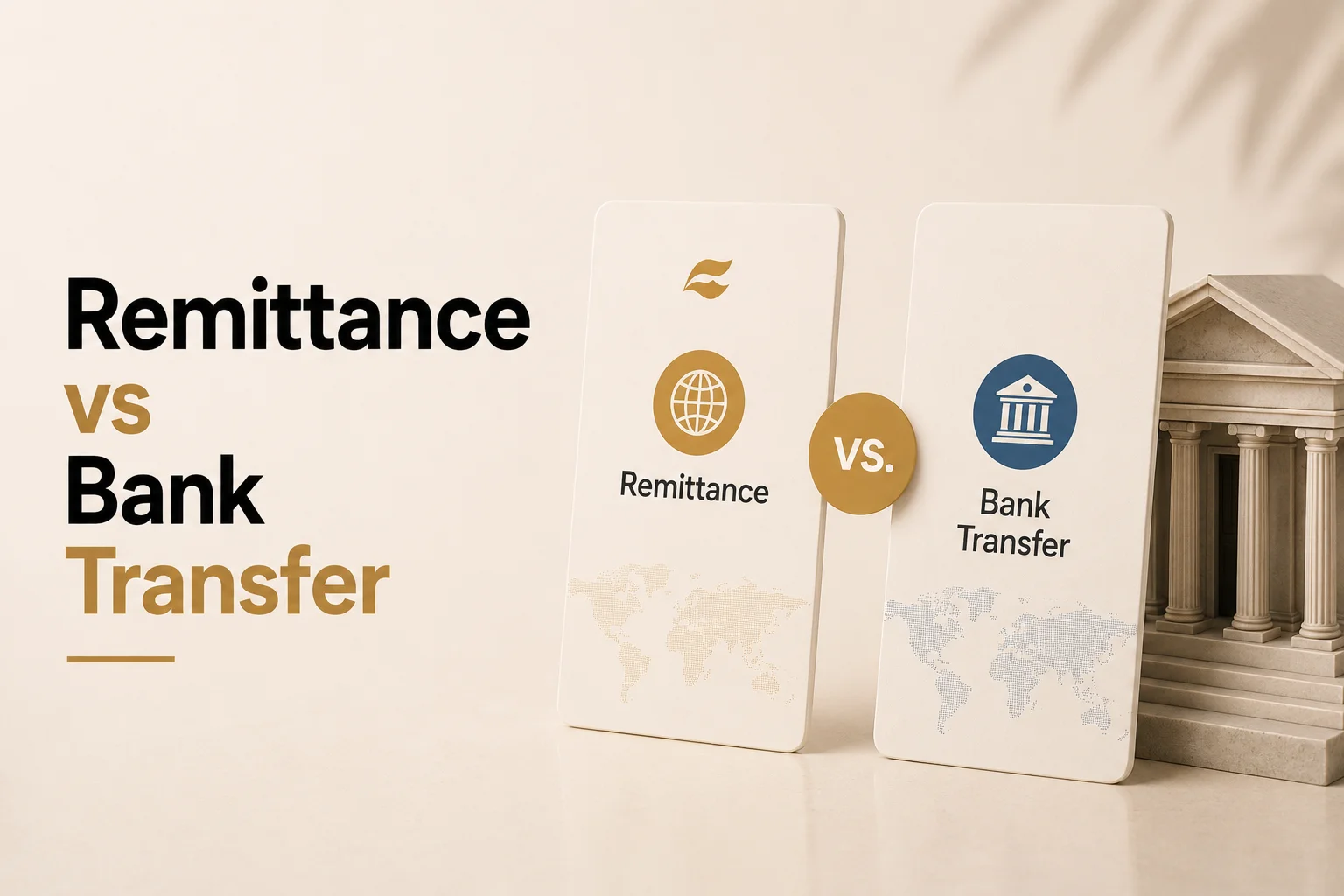
A remittance generally describes money sent to a recipient, often across borders for personal or family purposes. A bank transfer describes a way of sending money from one bank account to another.
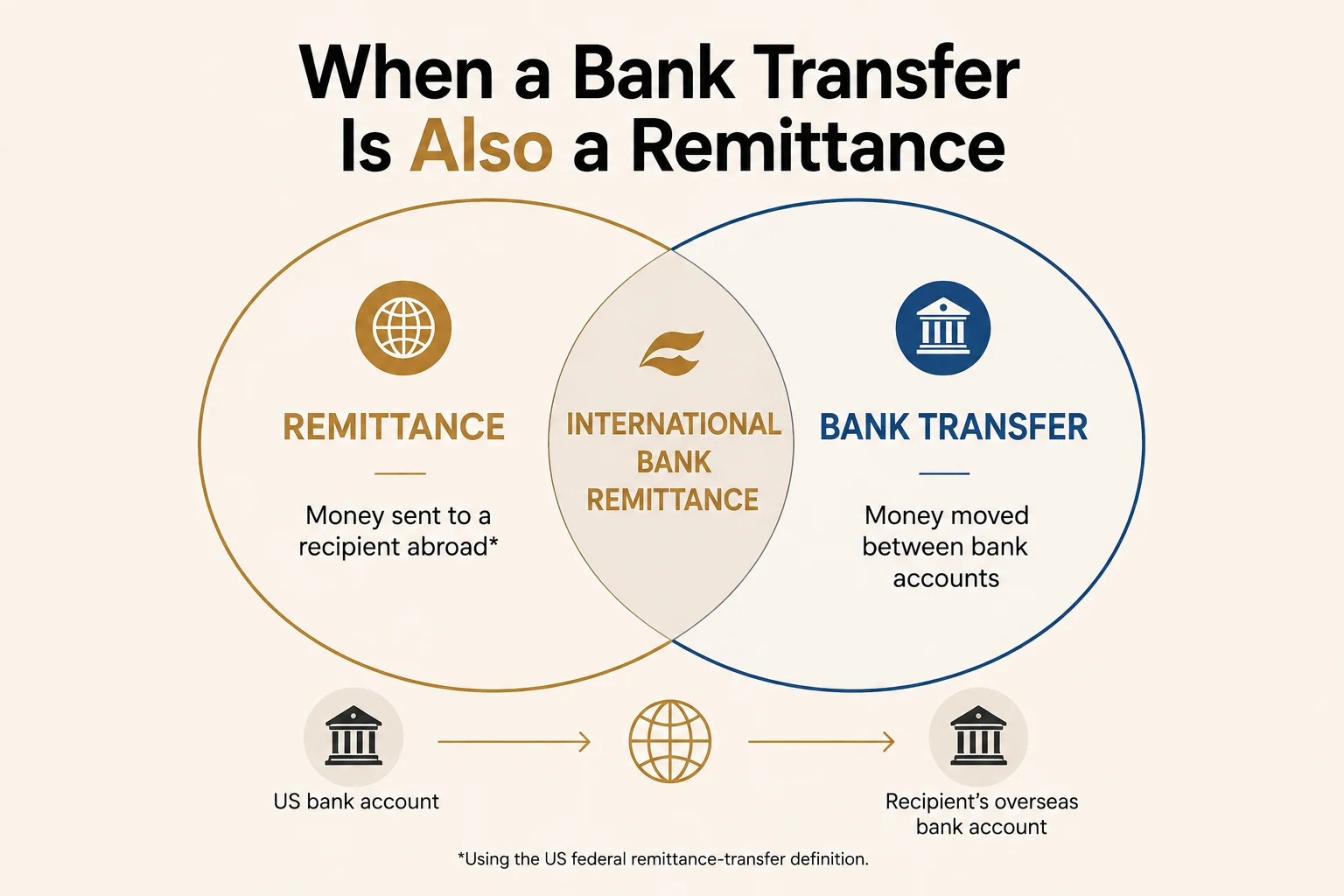
The two can overlap. In fact, an international bank transfer can itself be a remittance. The US Consumer Financial Protection Bureau (CFPB) includes consumer international wire transfers and international ACH transfers among examples of remittance transfers.
The main difference, then, is not simply international versus domestic. It is what each term describes and the methods available for completing the transfer.
What is a remittance?
A remittance is money sent to a recipient, commonly in another country. For example, someone working in the United States might send money to family living abroad. That payment can be considered an international remittance.
In the US, the legal definition is more specific. Federal rules generally define remittance transfers as electronic transfers of more than $15 sent by consumers in the US through remittance transfer providers to recipients in foreign countries.
Remittances do not have to be delivered to a bank account. Depending on the provider and destination, the recipient may be able to receive the money through:
- A bank account
- A mobile wallet
- A cash pickup location
- Another supported digital account
This flexibility is one reason remittance services are commonly used for international money sending.
What is a bank transfer?
A bank transfer is a method of transferring money between bank accounts. Unlike a remittance, it does not have to cross an international border.
You might use a bank transfer to send money from your checking account to another person’s account in the same country. You can also use one for an international money transfer.
The precise system used depends on the banks and countries involved. In the US, for example, ACH is an electronic system used for transfers between banks and credit unions. International transfers can also be made through wire transfers and other banking arrangements.
For a bank-to-bank transfer, the sender normally needs the recipient’s banking information. The exact details depend on the country and banking system.
Remittance vs bank transfer: Key differences
Here is a simple way to compare them.
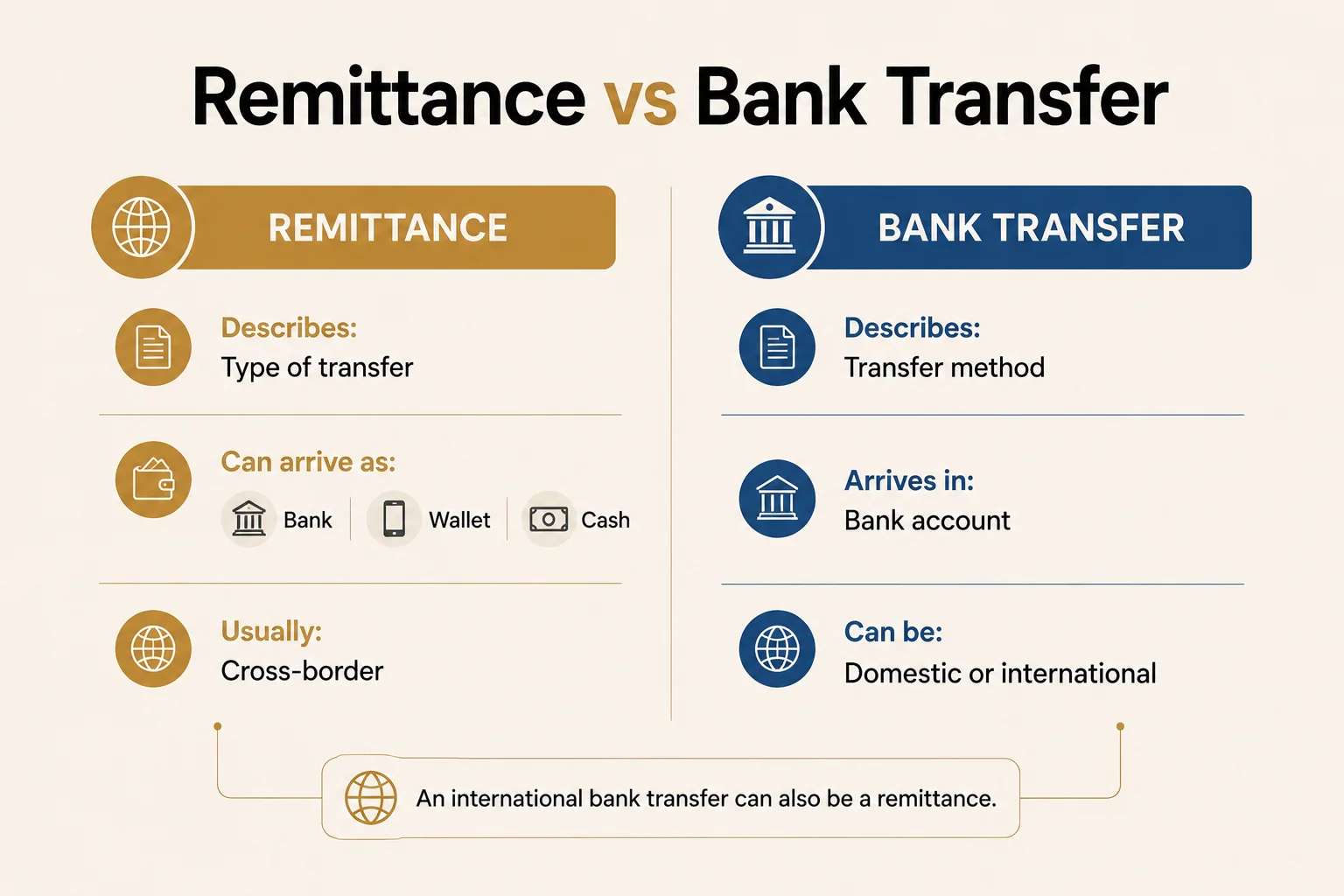
| Remittance | Bank transfer | |
|---|---|---|
| What it describes | A type or purpose of money transfer | A transfer method |
| Usually cross-border? | Often | Not necessarily |
| Bank account required? | Not always | Generally for bank-to-bank transfers |
| Receiving methods | Bank, wallet, cash or other supported methods | Bank account |
| Fees | Depend on provider and route | Depend on bank and route |
| Speed | Depends on method and provider | Depends on banking network |
The biggest difference is therefore flexibility.
A bank transfer moves money between bank accounts. A remittance can use a bank transfer, but it can also use other methods to get money to the recipient.
Is a remittance the same as an international bank transfer?
Not always. An international bank transfer can be one way to send a remittance.
Suppose you want to send money from your US bank account to your parent’s bank account in another country. If your bank sends the money internationally, the transaction can be both:
- An international remittance because you are sending money to a recipient abroad.
- A bank transfer because the money is being transferred between bank accounts.
The CFPB specifically includes consumer wire transfers and international ACH transactions among examples of remittance transfers covered by US rules.
How do remittance and bank transfer fees differ?
There is no single fee for either method. The amount you pay depends on the provider, countries, currencies, payment method, receiving method, and other parts of the transfer.
Remittance service costs
An international remittance can include:
Transfer fee: The fee charged for arranging or processing the transfer.
Exchange-rate margin: A provider may use an exchange rate that differs from the market reference rate.
Other charges: Depending on the route, additional charges or taxes may apply.
For US remittance transfers covered by federal rules, providers generally have to disclose information including the exchange rate, certain fees and taxes, and the amount expected to be delivered before the transfer is completed.
International bank transfer costs
A bank transfer can also involve several costs. These can include a fee charged by the sending bank, currency conversion costs, and charges associated with other institutions involved in the transfer. This is why comparing only the upfront fee can give an incomplete picture.
The World Bank’s Remittance Prices Worldwide database measures the total cost of remittances using both the transaction fee and exchange-rate margin. Its Q3 2025 data put the global average cost of sending $200 at 6.36%.
Which is faster: A remittance or bank transfer?
There is no universal answer. A remittance is not one specific payment network, so its speed depends on how the provider sends and delivers the money.
Some digital remittance services can complete supported transfers quickly. Other transfers can take longer because of the countries involved, payment method, receiving method, compliance checks, or local banking systems.
Bank transfers also vary. An international bank transfer may involve more than one financial institution before the money reaches its destination. Processing times can also be affected by weekends, holidays, cut-off times, currencies, and the receiving bank.
This makes it difficult to say that remittances are always faster than bank transfers. Instead, compare the estimated delivery time for the exact transfer you are making.
Send international remittances with PureFi
PureFi gives eligible users a digital way to send supported international remittances. Instead of relying entirely on traditional international banking rails, PureFi uses stablecoin-backed infrastructure behind the transfer process. Most supported transfers arrive in seconds.
Eligible users can send supported transfers with a $0 PureFi transfer fee and the mid-market exchange rate.
Before sending, users can review the transfer details and see the amount the recipient is expected to receive. Countries, currencies, limits, receiving methods, and availability depend on the supported transfer route and user eligibility.
Learn more about how PureFi can help you send, receive, and grow money across borders, or download the app to get started today.
FAQs
Can a bank transfer be a remittance?
Yes. An international bank transfer can be a remittance. US regulations specifically include certain consumer international wire and ACH transfers within the definition of remittance transfers.
Is a remittance always international?
Not in every everyday use of the word. However, when discussing regulated remittance transfers in the US, the CFPB definition covers qualifying electronic transfers from US consumers to recipients in foreign countries.
Do you need a bank account to receive a remittance?
Not necessarily. Depending on the provider and country, remittances can be received through cash pickup, mobile wallets, bank accounts, or other supported methods.
Is a remittance cheaper than a bank transfer?
Not necessarily. Costs depend on the provider, currencies, countries, payment method, exchange rate, and receiving method. Compare the total cost and the final amount the recipient will receive.
Can remittances arrive faster than international bank transfers?
They can, depending on the provider and transfer route. But remittances are not automatically faster. Some remittances are themselves bank transfers, and delivery times vary between services.