PureFi vs Wise Exchange Rate: Fees & Rates Compared
The exchange rate can make a noticeable difference when you send money abroad. A small markup means less money reaches the other person, even when the transfer fee looks low.
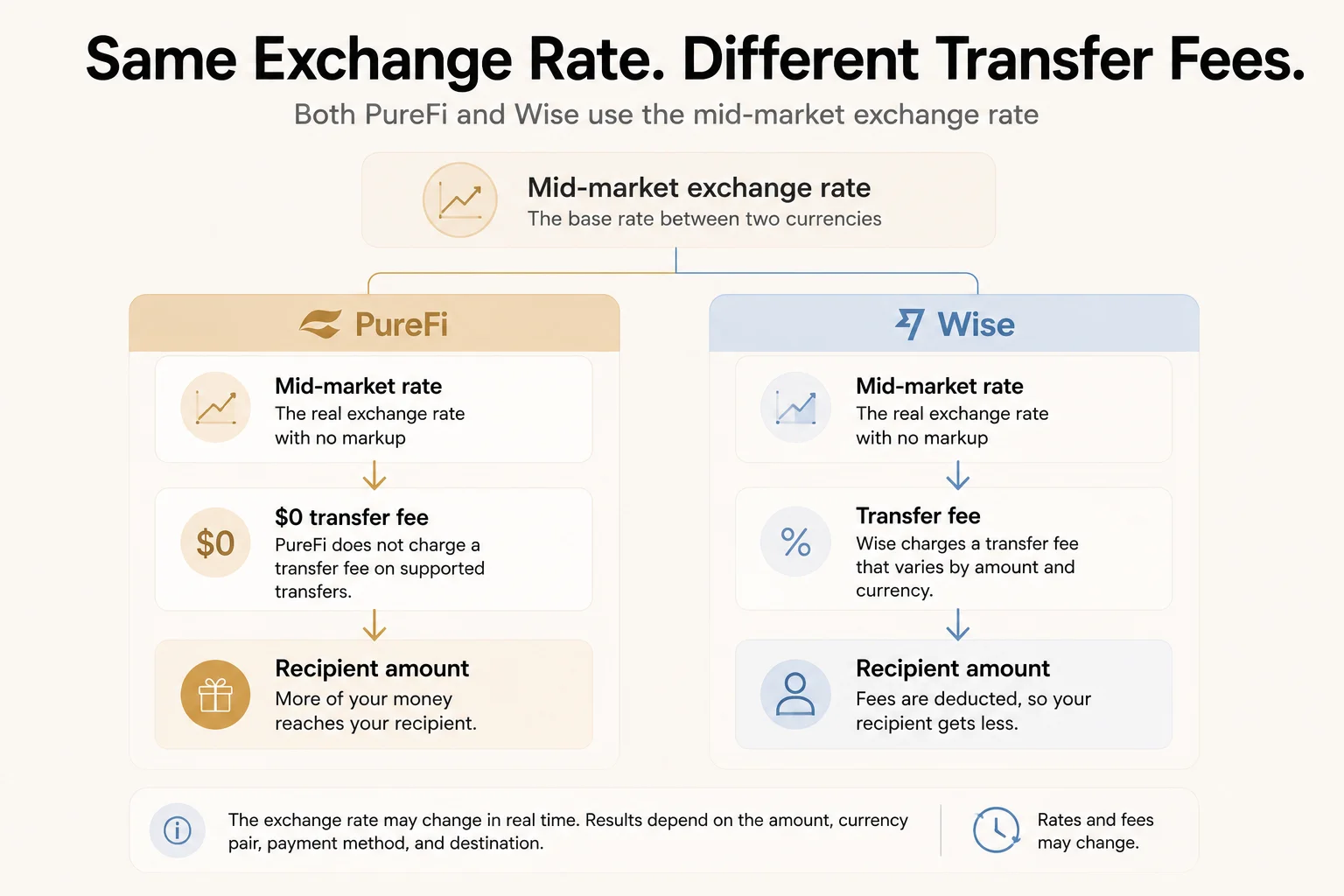
PureFi and Wise take a similar approach here. Both use the mid-market exchange rate instead of adding a hidden markup to the rate. The main difference is in the fees around the transfer and what each account lets you do.
PureFi currently charges a $0 transfer fee on supported transfers. Wise uses the mid-market rate but charges a separate fee that varies by currency and transaction.
If you’re choosing an international money transfer platform, the exchange rate is therefore only one part of the comparison.
PureFi vs Wise exchange rate at a glance
| Feature | PureFi | Wise |
|---|---|---|
| Exchange rate | Mid-market rate | Mid-market rate |
| Hidden FX markup | No | No |
| Transfer fee | $0 | Varies by currency and transaction |
| Transfer speed | Most supported transfers arrive in seconds | Many transfers are fast; timing varies |
| Currency holding | Digital-dollar focused | Hold 40+ currencies |
| Receiving money | Supported international transfers | Account details available for supported currencies |
| Balance earnings | Up to 6% variable APY | 3.14% APY on eligible USD balances for eligible US customers |
| Account model | Self-custodial | Multi-currency Wise Account |
Features and availability depend on your country. PureFi’s APY is variable and not guaranteed. Wise’s Interest feature is also eligibility-based and its rate can change.
Do PureFi and Wise use the same exchange rate?
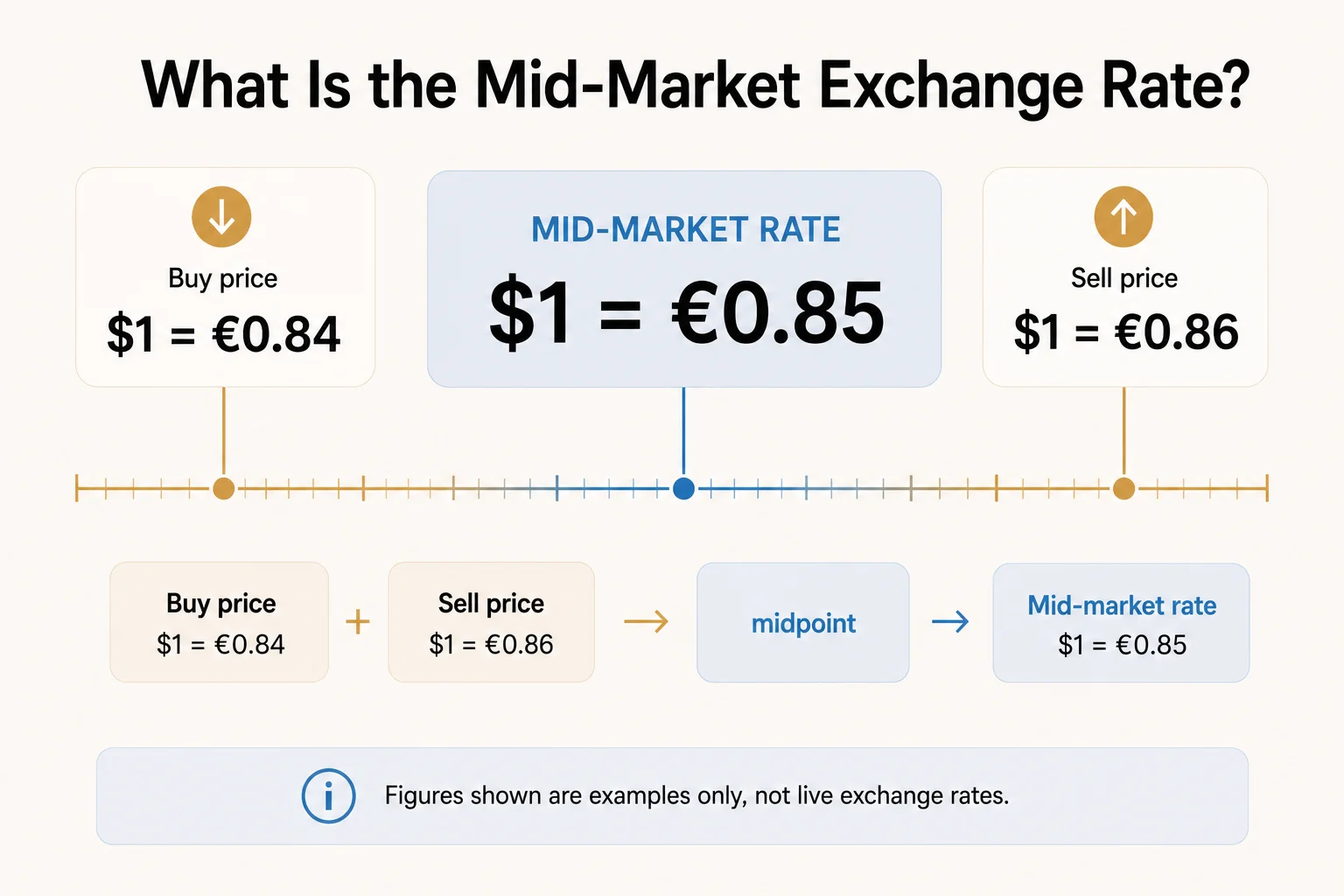
Both platforms say they use the mid-market exchange rate. The mid-market rate is the rate between the buy and sell prices for a currency. It is often the rate you see when you search for an exchange rate online.
For example, if the mid-market rate were:
1 USD = 0.85 EUR
a provider using that rate without a markup would use the same base rate when calculating the currency conversion. The example is illustrative; live exchange rates change continuously.
The rate PureFi shows for a transfer is the mid-market rate, with no hidden markup added to it. The rate and expected received amount are displayed before the transfer is confirmed.
Wise works in much the same way on the exchange-rate side. Wise says it uses the live mid-market rate and charges its transfer or conversion fee separately rather than hiding that cost in the rate.
So there is no meaningful reason to declare one the exchange-rate winner based on the published rate policy alone. Both use the mid-market rate. The difference becomes clearer when you look at fees.
PureFi vs Wise transfer fees
PureFi and Wise have different pricing models for an international remittance.
PureFi
PureFi currently charges a $0 transfer fee for supported transfers. It also uses the mid-market exchange rate without adding a hidden currency markup. Before confirming, the transfer screen shows information including the rate, transfer fee, expected received amount and arrival time. This makes the basic pricing model simple:
Mid-market exchange rate + $0 PureFi transfer fee
Other costs can still apply depending on the transaction. For example, a tax or third-party charge should not be confused with PureFi’s own transfer fee.
Wise
Wise also uses the mid-market exchange rate, but it charges a separate fee for sending or converting money. There is no single Wise fee that applies to every transfer. Its current US pricing says the fee varies by currency, with conversion and sending prices displayed before the transaction is completed.
The amount can also be affected by how you fund the transfer. This means Wise’s basic pricing works more like:
Mid-market exchange rate + applicable Wise fee
Wise shows the cost upfront, so the fee is separate from the exchange rate rather than hidden inside it.
Does a $0 transfer fee make PureFi cheaper than Wise?
PureFi has a clear advantage on its own advertised transfer fee: PureFi charges $0, while Wise charges a transaction-specific fee. But when comparing any cheap international money transfer, look at the complete quote rather than one number.
A useful comparison is:
Amount you pay → Exchange rate → Fees and other applicable costs → Amount the recipient gets
For example, Wise’s current US pricing lists sending fees that vary by currency. PureFi lists its own transfer fee as $0. That does not mean every possible PureFi transaction will have no outside costs. Funding methods, taxes, receiving institutions or other third parties can affect a particular transfer.
Check the final quote before sending money with either service.
Which is faster for international transfers?
Both platforms support fast international money sending, so it would be inaccurate to describe Wise as a slow alternative. According to PureFi, most supported transfers arrive in seconds, including transfers made on Sundays. Its transfer infrastructure uses stablecoins behind the scenes to transfer value across borders digitally.
The user does not need to manage the stablecoin process themselves. From the user’s side, it works as a normal digital transfer.
Wise can also deliver many transfers very quickly. Wise currently reports that 74% of its transfers arrive in under 20 seconds and 95% arrive in less than a day. The actual delivery time depends on factors such as how the transfer is funded and the route being used.
So speed is not as simple as:
PureFi = instant Wise = slow
Both can be very fast.
PureFi’s main difference is that stablecoin-backed transfers are a core part of its infrastructure, allowing most supported transfers to arrive in seconds. Wise uses its own international payment network and local payment infrastructure to deliver transfers quickly.
When you send money internationally online, check the estimated arrival time for the actual route rather than assuming one provider will always be faster.
PureFi vs Wise for holding money
The two accounts become much more different when you look beyond transfers.
PureFi
PureFi is focused primarily on a digital US dollar balance. Users can currently earn up to 6% variable APY on eligible balances. PureFi says the yield is backed by returns from real-world assets rather than interest-based lending.
The rate is variable and is not guaranteed. PureFi is also self-custodial. This means PureFi says the balance is held in a wallet controlled by the user rather than being held by PureFi itself.
PureFi is not a bank, and the balance should not be treated as an FDIC-insured bank deposit.
Wise
Wise is much more focused on holding different fiat currencies. Its US account currently lets users hold 40+ currencies in one place and convert between them using the mid-market exchange rate. This makes Wise useful if you regularly need USD, EUR, GBP and other currencies rather than primarily keeping a digital-dollar balance.
Wise also has an Interest feature for eligible US customers. Its current US account page advertises 3.14% APY on eligible USD balances. The rate can change, and users need to meet Wise’s eligibility requirements and opt in. So it would be incorrect to say that Wise balances simply earn nothing.
If you are looking for a digital multi-currency account, Wise offers a broader range of currencies. PureFi takes a different approach, combining a digital-dollar balance with stablecoin-backed transfers and a higher advertised variable APY.
PureFi vs Wise for receiving money
Both services can be used for receiving money from abroad, but the account structures are different.
Wise currently lets US account holders get account details for supported currencies. Its US account page says users can receive money internationally with account details for 20 currencies, although availability depends on location and currency. This can be useful if you regularly receive international payments in different currencies.
PureFi is more focused on receiving and sending money through its digital-dollar and remittance infrastructure. Supported transfers can be received into a PureFi account, with availability depending on the country, route and applicable requirements.
For someone choosing an app to receive money, the important question is what happens after the money arrives. If you regularly need to keep several fiat currencies and use local account details, Wise has the broader multi-currency setup.
If you primarily want a digital-dollar balance that can be used for fast cross-border transfers and earn an eligible variable yield while held, PureFi is built more around that use case.
PureFi vs Wise: Which should you use?
PureFi may be the better fit if you mainly want to send money internationally online and your required route is supported. Its main advantages are a $0 transfer fee, the mid-market exchange rate, stablecoin-backed transfers that mostly arrive in seconds, self-custody and up to 6% variable APY on eligible balances.
Wise may be the better fit if you need to hold and convert many currencies. Its account supports 40+ currencies, provides account details for supported currencies and offers a multi-currency card. Wise also uses the mid-market rate, although a separate fee normally applies when sending or converting money.
If you’re looking for the safest way to transfer money, don’t choose a provider based on one feature alone. Check whether the service is available where you live, how your funds are held, what protections apply, what the transfer costs, and how much the recipient will receive.
Learn more about how PureFi can help you send, receive, and grow money across borders, or download the app to get started today.