PureFi vs. Stearns Bank
PureFi and Stearns Bank both help people save and earn, but their accounts work differently. PureFi’s projected yield comes from rent and changes in home values. Stearns Bank pays a variable APY on bank deposits.
Rates can change on both platforms. PureFi users access funds by selling shares, while Stearns customers use bank transfers, branches, and ATMs. Stearns deposits have FDIC protection, but PureFi balances do not.
PureFi vs. Stearns Bank: Quick Comparison
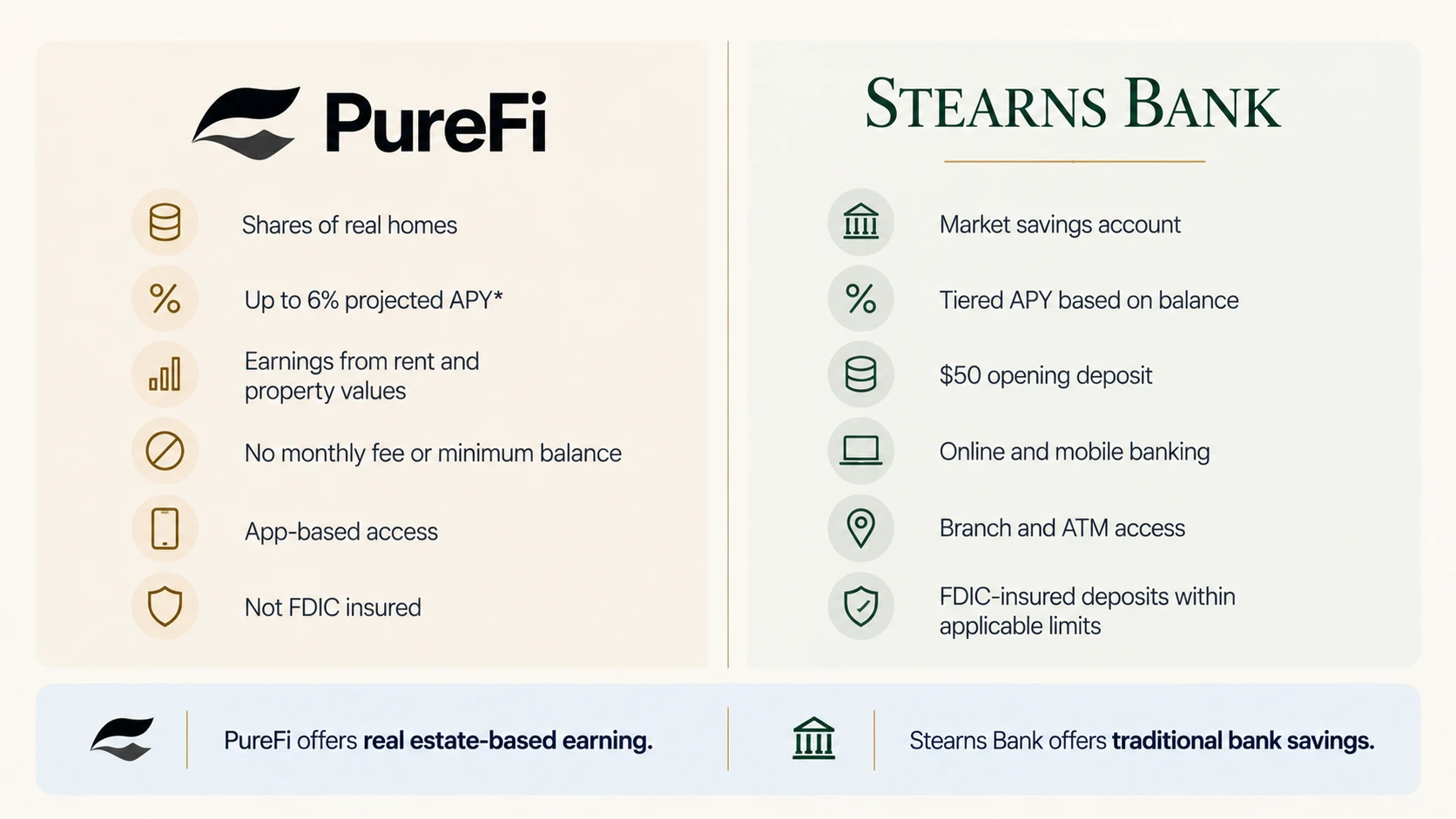
Stearns Bank holds eligible deposits in a conventional bank account. PureFi lets users purchase shares of real homes. That difference affects earnings, risk, protection, and access.
| Feature | PureFi | Stearns Bank |
|---|---|---|
| Provider type | Financial technology company | FDIC-insured national bank |
| Main savings option | Shares of income-producing real homes | Above the Norm personal market savings account |
| Advertised APY | Up to 6% projected APY | 0.85% to 2.99%, depending on balance |
| Source of earnings | Rent and changes in property value | Yield paid on bank deposits |
| Opening requirement | No minimum | $50 to open the market savings account |
| Ongoing fees | No monthly fee; a one-time fee applies to each property-share purchase | Fees can apply for certain services and may reduce earnings |
| Access | Sell shares at the current market price with no stated lockup | Online and mobile banking, transfers, branches, and ATMs |
| Protection | Self-custodial wallet; not FDIC insured | Eligible deposits are FDIC insured within applicable limits |
These APYs are not direct equivalents. PureFi’s figure is a real estate-based projection. Stearns Bank’s APYs apply to bank deposits protected within FDIC limits.
What Is PureFi?
PureFi is a digital savings platform built around fractional real estate. Users add dollars to a self-custodial wallet and buy shares of real homes with tenants. They receive their share of rent, while the value of their holdings may rise or fall with the homes.
PureFi advertises up to 6% projected APY. The rate is variable and not guaranteed. It is based on current rental income and property values, so actual results can be lower or higher. Property shares can also lose value.
Your purchased shares sit in an account in the user’s name, while the available balance remains in a wallet controlled by the user. This makes it different from a standard high-yield digital savings account. It may feel like a high-yield savings app, but its underlying assets are property shares, not bank deposits.
What Is Stearns Bank?
Stearns Bank is a full-service national bank. It offers checking, market savings, CDs, retirement accounts, and other banking services. Customers can apply online and manage their accounts through online or mobile banking.
For this comparison, the closest Stearns product is the Above the Norm personal market savings account. It requires at least $50 to open. As of September 1, 2026, Stearns Bank lists three APY tiers:
- 0.85% APY for balances of $99,999.99 or less
- 1.97% APY for balances from $100,000 to $499,999.99
- 2.99% APY for balances of $500,000 or more
Only $0.01 must remain in the account to earn the stated APY. The rates are variable and may change after the account is opened. Stearns Bank also notes that fees may reduce earnings.
The tier structure matters. Smaller balances receive the lowest listed APY, while the highest rate requires at least $500,000. PureFi does not use these tiers, but its projected APY carries asset risk.
Savings and Earning Options
PureFi Uses Real Estate to Generate Yield
PureFi’s projected yield comes from rental payments and changes in home values. PureFi says each home is purchased outright and professionally managed. Users can select individual homes or begin with a suggested mix. This gives PureFi some qualities of a high-yield investment platform, although its app is designed to keep the process simple.
Real estate returns are not fixed. Rent can change, property values can fall, and shares may sell for less than their purchase price.
Stearns Bank Offers Traditional Savings Products
Stearns customers deposit dollars with the bank and earn the APY for their balance tier. They do not need to select assets or track properties.
The bank also offers CDs for funds that can remain untouched for a defined term. Taking money from a CD early may result in a penalty. Its market savings account is more flexible because Stearns says the funds remain accessible without a withdrawal penalty. It may suit an emergency fund or planned purchase, while PureFi may suit users who accept changes in asset value.
Fees and Minimum Requirements
PureFi has no monthly account fee or minimum balance. Each property-share purchase has a one-time fee, and transfer costs may apply. These charges appear before confirmation.
Stearns Bank requires $50 to open its Above the Norm market savings account. Its savings page does not advertise a monthly maintenance charge for that account, but it says fees may reduce earnings. Its wider fee schedule lists charges for some services, including outgoing wires, duplicate statements, stop payments, and closing an account within 90 days.
Users should consider all possible costs, not only monthly charges.
Access to Funds and Account Features
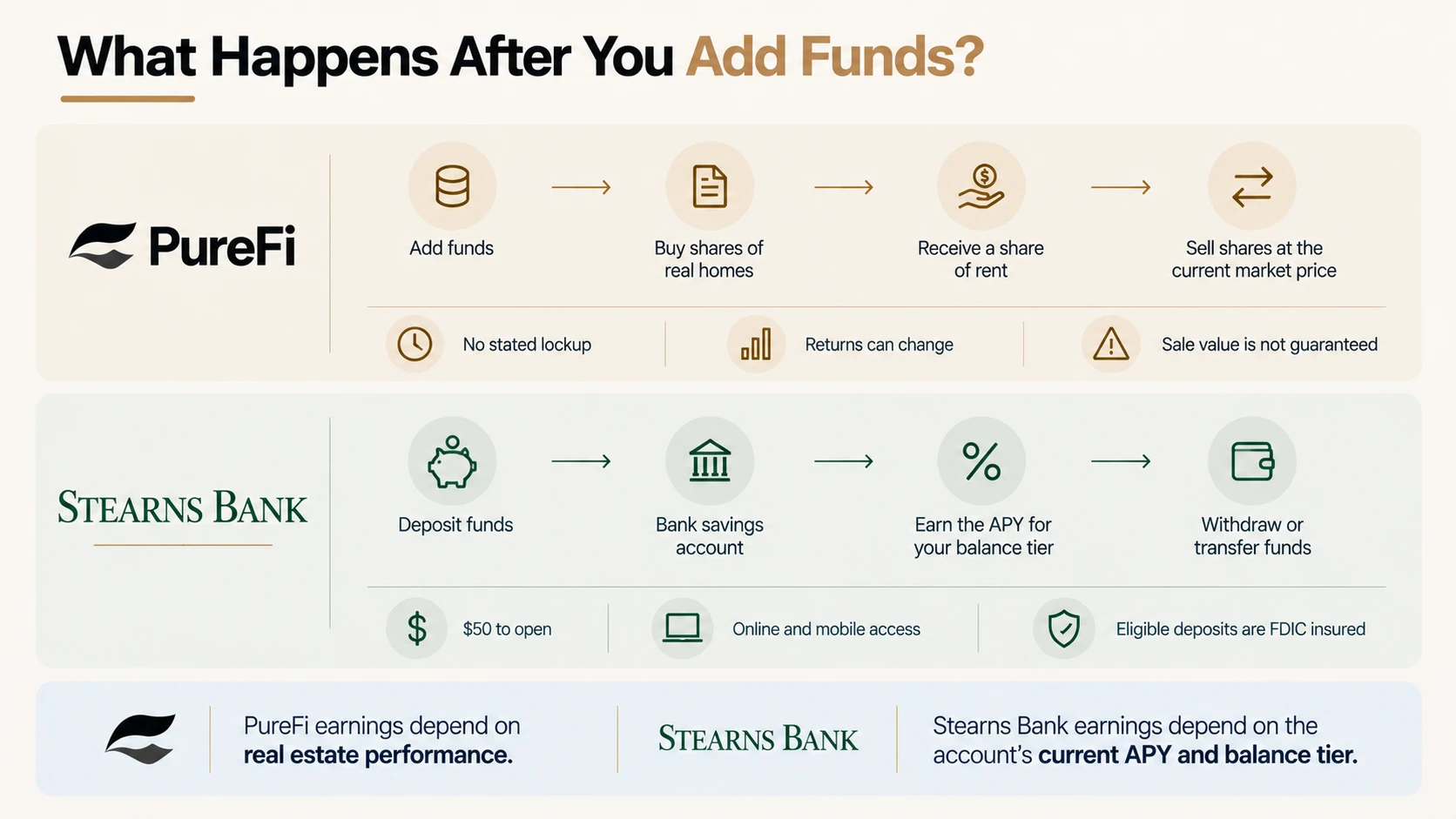
PureFi users can verify their identity, add funds, choose homes, track their balance, and sell shares through the app. PureFi says shares can be sold at the current market price with no lockups. The sale amount is not guaranteed because it depends on that market price.
Stearns Bank’s digital tools support account transfers, mobile check deposits, bill payments, statements, alerts, and Zelle. Customers can also use branches and 42,000 fee-free ATMs in the MoneyPass and Shazam networks.
Stearns says deposited funds are generally available on the first business day after receipt, although timing can vary. This may feel more familiar to someone who wants an online savings app backed by regular banking services.
Protection and Risk
Stearns Bank is an FDIC member. Eligible deposits are insured up to the legal limit for each depositor, ownership category, and insured bank. This protection applies if the bank fails.
PureFi uses a self-custodial wallet, so the user controls the available balance. It also says it uses encryption, identity checks, fraud monitoring, and secure payment systems. These measures help protect accounts and data, but not against falling property values.
PureFi balances and property shares are not FDIC insured, government insured, or guaranteed by PureFi. Stearns offers bank-deposit protection within FDIC limits, while PureFi users accept asset risk.
Who Is PureFi Best For?
PureFi may suit people who want no monthly fee, no minimum balance, and potential earnings connected to real homes. PureFi says the platform is available in more than 100 countries, subject to local rules. Users must accept variable returns and the possibility of losing value.
Who Is Stearns Bank Best For?
Stearns Bank may suit U.S. customers who want conventional banking, mobile check deposits, bill payments, branches, ATMs, and FDIC protection. Its higher APY tiers require balances of $100,000 or $500,000, so customers with smaller balances receive the lowest listed rate.
PureFi vs. Stearns Bank: Which One Is Better?
PureFi may be the better choice for someone who wants no minimum balance and potential yield from shares of real homes. Its projected APY is higher than the rates listed for Stearns Bank’s market savings account, but its return is not promised and its shares can lose value.
Stearns Bank may be better for someone who wants an FDIC-insured deposit account and everyday banking tools. Its highest APY requires a large balance, but the account follows a familiar bank structure.
The right choice depends on how soon the funds may be needed and how much change in value the user can accept.
Earn Through Real Homes With PureFi
PureFi gives you a simple way to own shares of real homes and receive your portion of rental earnings. There is no monthly fee or minimum balance, and every purchase charge is shown before you confirm.
Learn more about how PureFi can help you own real estate shares or download the app to get started today.
PureFi is a financial technology company, not a bank. Up to 6% APY as of August 25, 2026 is projected, variable, and not guaranteed. Returns come from rent and changes in property value. Property shares can lose value. PureFi balances are not FDIC insured or insured by another government agency. Availability varies by jurisdiction.