
PureFi vs Realberry: Real Estate Compared

PureFi vs Realberry: What you need to know
PureFi and Realberry both provide access to real estate, but they are built for very different investors.
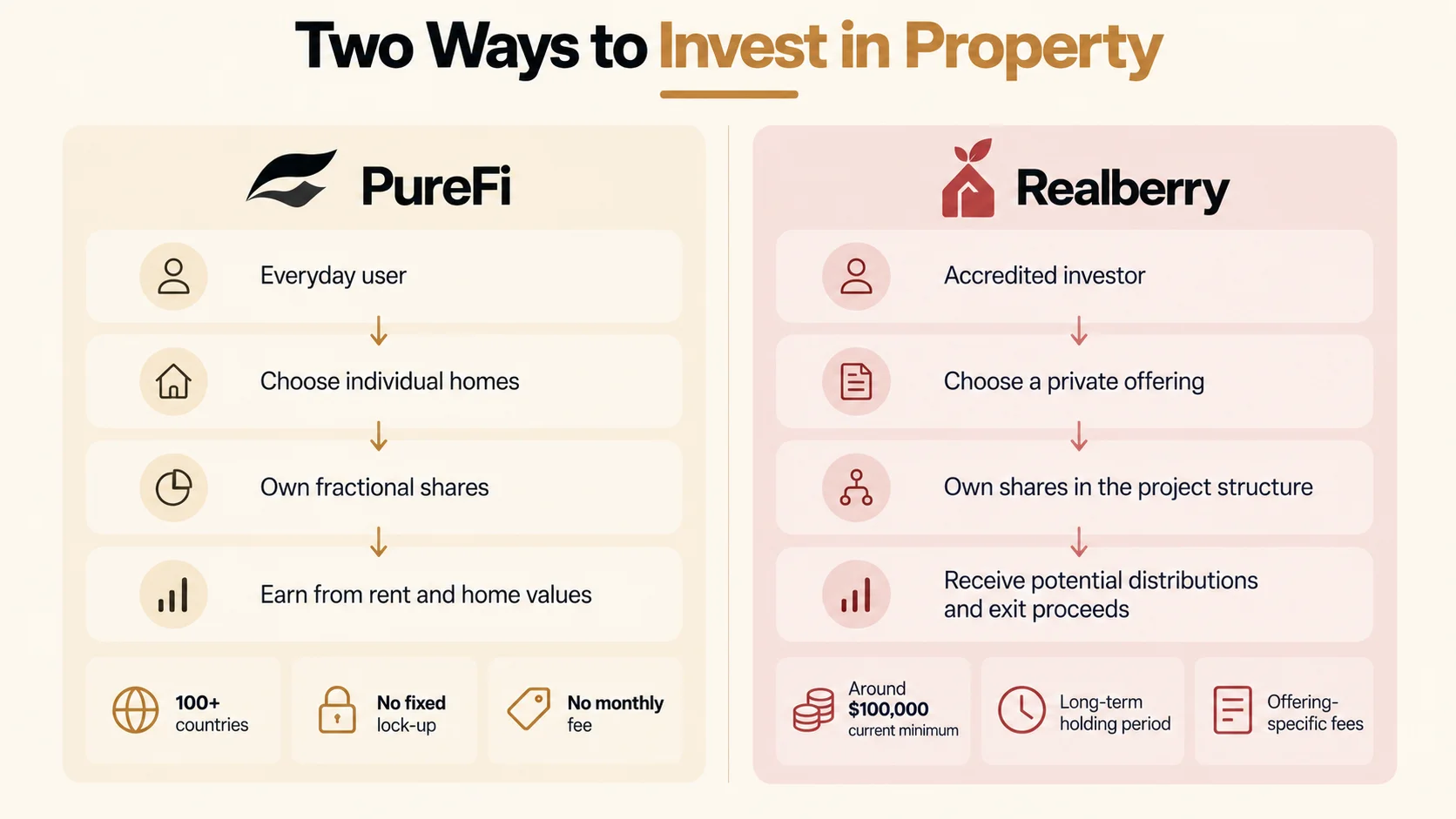
PureFi lets people buy fractional shares of individual residential homes through an app. Realberry provides private real estate deals for accredited investors who can usually commit much larger amounts.
In this PureFi vs Realberry comparison, we’ll look at the properties each platform offers, what investors own, where earnings come from, how much money may be needed, when investors can access their funds and what protection applies. This article provides general information. It does not recommend one platform over the other.
Note: The information below was checked in September 2026. Offerings, fees and eligibility rules may change.
PureFi vs Realberry at a glance
| Feature | PureFi | Realberry |
|---|---|---|
| Type of platform | App-based fractional property platform | Private real estate sponsor and investment manager |
| Main property type | Individual residential homes | Residential, commercial and development projects |
| What investors own | Shares of selected homes | Shares or units in a private offering |
| Who can invest | Users in more than 100 supported countries | Accredited or otherwise qualified investors |
| Published starting amount | Check the current amount in the app | Around $100,000 for current offerings |
| Source of earnings | Rent and changes in home values | Project income, distributions and possible gains at exit |
| Fees | One-time purchase fee; no monthly fee | Varies by offering |
| Access | Sell at the current market price; no fixed lock-up | Usually a long-term, illiquid investment |
| Account structure | Self-custodial dollar wallet | Private investment account |
| Best suited for | Wider access to fractional home shares | Larger private real estate deals |
What is PureFi?
PureFi is a financial technology platform that lets users buy shares of real, income-producing homes. The homes are bought outright and professionally managed. Users can review available properties and read their legal documents through the app. They can choose individual homes or begin with a suggested mix.
Shares of each selected home are held in an account in the user’s name. PureFi states that it does not pool one user’s property shares with those belonging to other users. Rental earnings are added to the user’s PureFi balance. That balance sits in a self-custodial dollar wallet controlled by the user. PureFi is available in more than 100 countries and supports funding from more than 160 countries. Access still depends on local laws and product availability. PureFi explains its current real estate product here.
What is Realberry?
Realberry is a private real estate developer, sponsor and investment manager. It was previously known as McWhinney and has operated in real estate for nearly 35 years.
Unlike a marketplace that lists projects from many unrelated companies, Realberry develops, acquires and manages the properties connected to its offerings. Investors work directly with the company acting as the project sponsor.
Its portfolio includes several types of property:
- Multifamily housing
- Mixed-use developments
- Hospitality
- Office buildings
- Industrial property
- Retail
- Planned communities
Realberry currently has assets across seven US states, with a main focus on the Mountain West.
What can you invest in?
PureFi focuses on residential homes with tenants. Users invest in shares of individual properties and can decide which homes they want in their account. This structure makes it possible to see the specific property connected to each investment. Real estate is currently PureFi’s first asset type. The company says more real assets are planned.
Realberry offers larger and more complex private real estate projects. These may include buying an existing property, developing a new building or managing a group of connected assets.
Each Realberry offering can have its own:
- Property type
- Business plan
- Legal structure
- Funding arrangement
- Minimum investment
- Holding period
- Distribution terms
- Exit plan
A Realberry investor is therefore choosing a private deal, not simply buying a small share of one rental home through a general consumer app.
Who can invest?
PureFi and Realberry have very different eligibility requirements.
PureFi eligibility
PureFi is available in more than 100 countries across Asia, Africa, Europe, and the Americas. Users must complete an identity check before investing. Availability can still vary by jurisdiction, and some funding methods may not be supported in every country.
Realberry eligibility
Realberry’s website and offerings are intended for accredited or otherwise qualified investors. In the US, common ways for an individual to qualify as an accredited investor include:
- A net worth above $1 million, excluding the value of the main home
- Annual income above $200,000 in each of the previous two years
- Joint annual income above $300,000 in each of the previous two years
- Certain professional licences or other qualifying positions
These are not the only ways to qualify. Eligibility depends on current securities rules and the structure of the offering. Investor.gov provides the official qualification criteria.
Realberry’s current deals have been reported as having minimum investments of around $100,000. This is not a permanent platform-wide minimum. The amount can change between offerings.
What do investors own?
With PureFi, users own shares of the individual homes they select. These shares are held in an account in the user’s name. Each home has its own legal documents. These explain the property, the ownership structure and the terms connected to the shares.
With Realberry, investors normally purchase shares or units in the legal entity connected to a private offering. They do not receive direct title to part of the physical building.
The exact rights depend on the offering documents. These documents should explain:
- The investor’s ownership stake
- How distributions are calculated
- Which fees apply
- Whether investors have voting rights
- How long the project may be held
- What happens when the property is sold
- Which risks apply to that deal
Both platforms provide exposure to real property, but the scale and legal structures are different.
How do investors earn?
Neither PureFi nor Realberry guarantees earnings or the return of the original investment.
How earnings work with PureFi
PureFi earnings may come from:
- Rent paid by tenants
- Changes in the value of the homes
When tenants pay rent, the user’s share is added to their PureFi balance. It can be reinvested in more property shares or taken out.
PureFi currently shows projected earnings of up to 6% APY. The projection is based on current rent and home values. It can rise or fall, and the value of the shares can also decline.
Nothing is lent out to generate this projected yield. The money is used to buy shares of homes with tenants. PureFi explains where its projected earnings come from here.
How earnings work with Realberry
Realberry does not use one standard earnings figure for every project. Depending on the offering, investors may receive:
- Distributions from property operations
- A share of rental or business income
- Possible gains when a property is sold
- Proceeds from another planned project exit
A development project may not produce income straight away. Money may first need to be used for planning, construction or leasing. An existing occupied property may begin producing distributions sooner.
The offering documents should explain the expected distribution schedule. Any figures shown are estimates, not promises. Construction delays, vacancies, higher costs and lower property values can all affect the result.
Starting investments and fees
PureFi costs
PureFi does not charge a monthly account fee. A one-time purchase fee applies to each property-share order. The exact amount is shown before the user confirms the purchase.
Realberry costs
Realberry’s minimum investment and fees vary by offering. Its current opportunities have been reported as starting at around $100,000, but future projects may use different minimums.
Realberry does not publish one simple fee schedule covering every private investment. Investors need to read the documents for the specific offering.
Fees may be connected to how the property is acquired, developed, operated or sold. The documents should also explain whether Realberry receives any payment based on the project’s performance.
This makes reviewing the full offering especially important. Two Realberry projects may have different costs even though they are provided by the same company.
Where are PureFi and Realberry available?
PureFi has the wider international reach. It is available in more than 100 countries, and users can fund from more than 160 countries. Its app-based structure is designed to make fractional home ownership accessible without requiring the user to live near the property.
Realberry invests in US real estate and mainly accepts accredited or qualified investors. The company currently operates across seven states, with a strong focus on the Mountain West.
Realberry may accept qualifying investors from different locations, but access depends on the rules of each private offering. Investors may also face tax and reporting requirements based on where they live.
How do security and investment risk compare?
Account protection cannot stop a property or project from losing value.
PureFi security
PureFi uses a self-custodial wallet. This means the user controls the wallet holding their dollar balance. PureFi states that it cannot transfer or spend that balance without the user.
Its security measures include:
- Identity verification
- 256-bit encryption
- Face ID
- Two-factor authentication
- Fraud monitoring
- Licensed technology partners
- Private cybersecurity insurance covering its systems and users
PureFi is not a bank. Its balance and real estate shares are not covered by FDIC insurance or another government deposit scheme. PureFi publishes more information about its security measures here.
Realberry security and regulation
Securities connected to Realberry offerings are provided through North Capital Private Securities, a registered broker-dealer and FINRA/SIPC member.
That structure does not guarantee the success of a property or protect investors from falling values. Realberry states that its private offerings are speculative, illiquid and may result in a complete loss of capital.
Realberry investors should consider risks such as:
- Construction delays
- Higher development costs
- Vacant space
- Lower rent
- Changes in property values
- Difficulties selling a property
- A holding period that lasts longer than planned
PureFi and Realberry are not savings apps
Neither platform works like a normal digital savings platform.
A high-yield digital savings account or high-yield savings app is generally used to hold cash. An online savings app may also provide government-backed deposit protection, depending on the provider and country.
A high-yield investment platform puts money into assets that can rise or fall in value. That description is closer to the PureFi and Realberry products discussed here. A multi-currency savings account also serves a different purpose. It holds balances in several currencies. It does not give the account holder ownership of a home or private development project.
PureFi includes a dollar wallet, but money used to purchase home shares becomes a real estate investment. It is no longer simply a cash balance.
Which platform may suit you?
PureFi may be worth considering if you:
- Want fractional shares of individual residential homes
- Live outside the US
- Want to begin with a smaller investment
- Prefer no fixed lock-up
- Want rental earnings added to a self-custodial wallet
- Do not want a monthly account fee
Realberry may be worth considering if you:
- Qualify as an accredited investor
- Can meet a much larger investment minimum
- Want access to private development or acquisition projects
- Are comfortable with a long holding period
- Want exposure to commercial or multifamily property
- Prefer to invest directly with the project sponsor
Review real homes with PureFi
See the homes available in the PureFi app, read their legal documents, and check the projected rental earnings before deciding where to invest.
Learn more about how PureFi can help you own real estate shares or download the app to get started today.
Projected earnings are variable and not guaranteed. Real estate shares can lose value. PureFi is a financial technology company, not a bank. Its balance and property shares are not covered by FDIC insurance or another government deposit scheme.