PureFi vs MoneyGram: Fees, Rates & Transfers Compared
PureFi and MoneyGram both let people send money internationally, but they work differently.
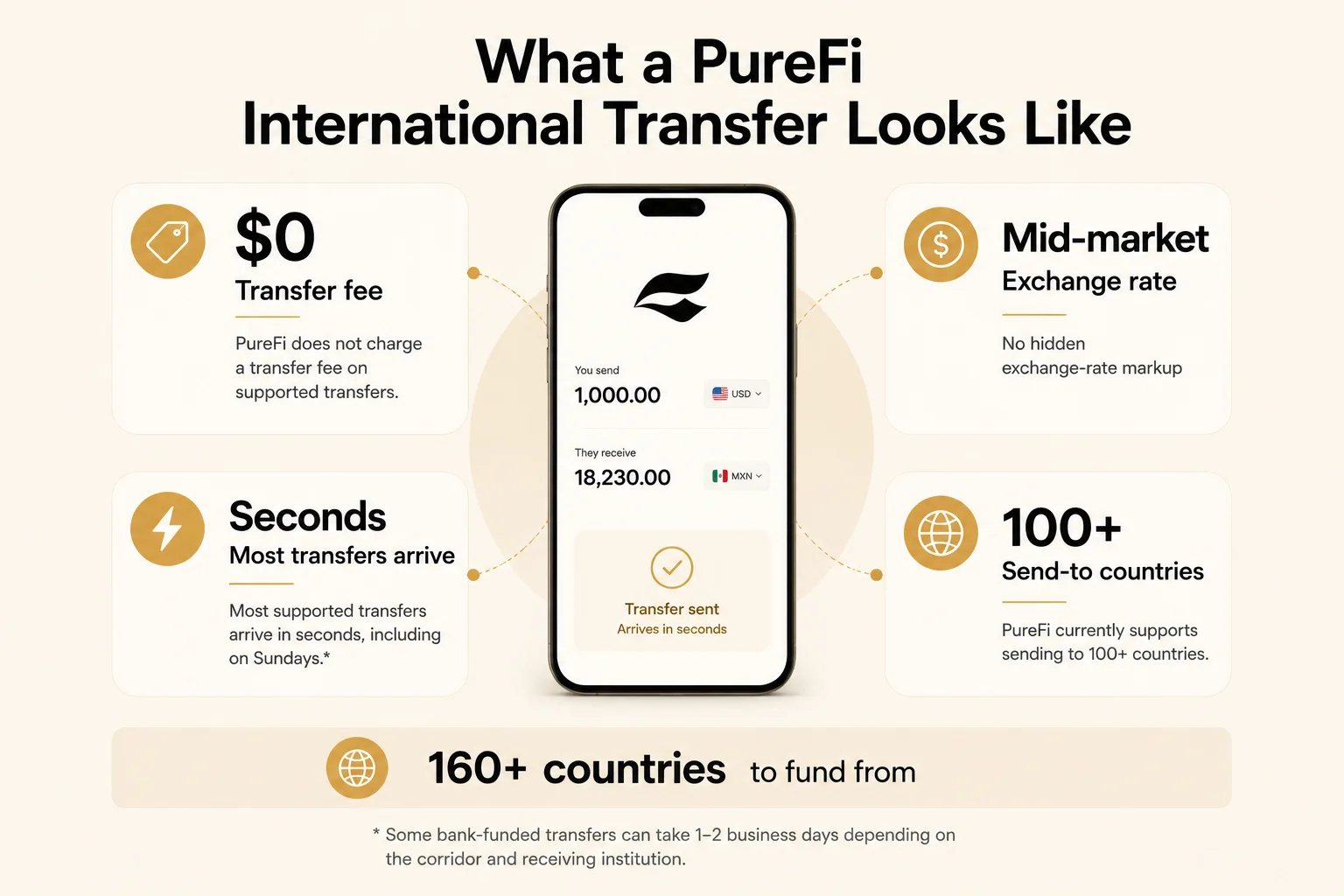
PureFi is a digital-first platform built around stablecoin-backed transfers. It uses a US dollar-backed stablecoin to send money across borders, which allows most transfers to arrive in seconds. PureFi also offers $0 transfer fees, the mid-market exchange rate, a self-custodial account, and up to 6% variable APY on eligible balances.
MoneyGram has a much larger traditional transfer network. It operates digitally and through more than 470,000 locations across 200+ countries and territories. Transfer fees and exchange rates vary based on the transaction.
Here is how the two compare.
PureFi vs MoneyGram at a glance
| Feature | PureFi | MoneyGram |
|---|---|---|
| Transfer fees | $0 transfer fee advertised on current send flow | Varies by transfer |
| Exchange rate | Mid-market rate with no hidden markup | MoneyGram exchange rate; varies by transfer |
| Transfer speed | Most transfers arrive in seconds | Varies; some transfers can be completed in minutes |
| Send-to coverage | 100+ countries | 200+ countries and territories |
| Physical network | Digital-first | 470,000+ locations |
| Technology | Stablecoin-backed | Traditional money transfer network |
| Account structure | Self-custodial | MoneyGram transfer service |
| Balance earnings | Up to 6% variable APY | Not a feature being compared here |
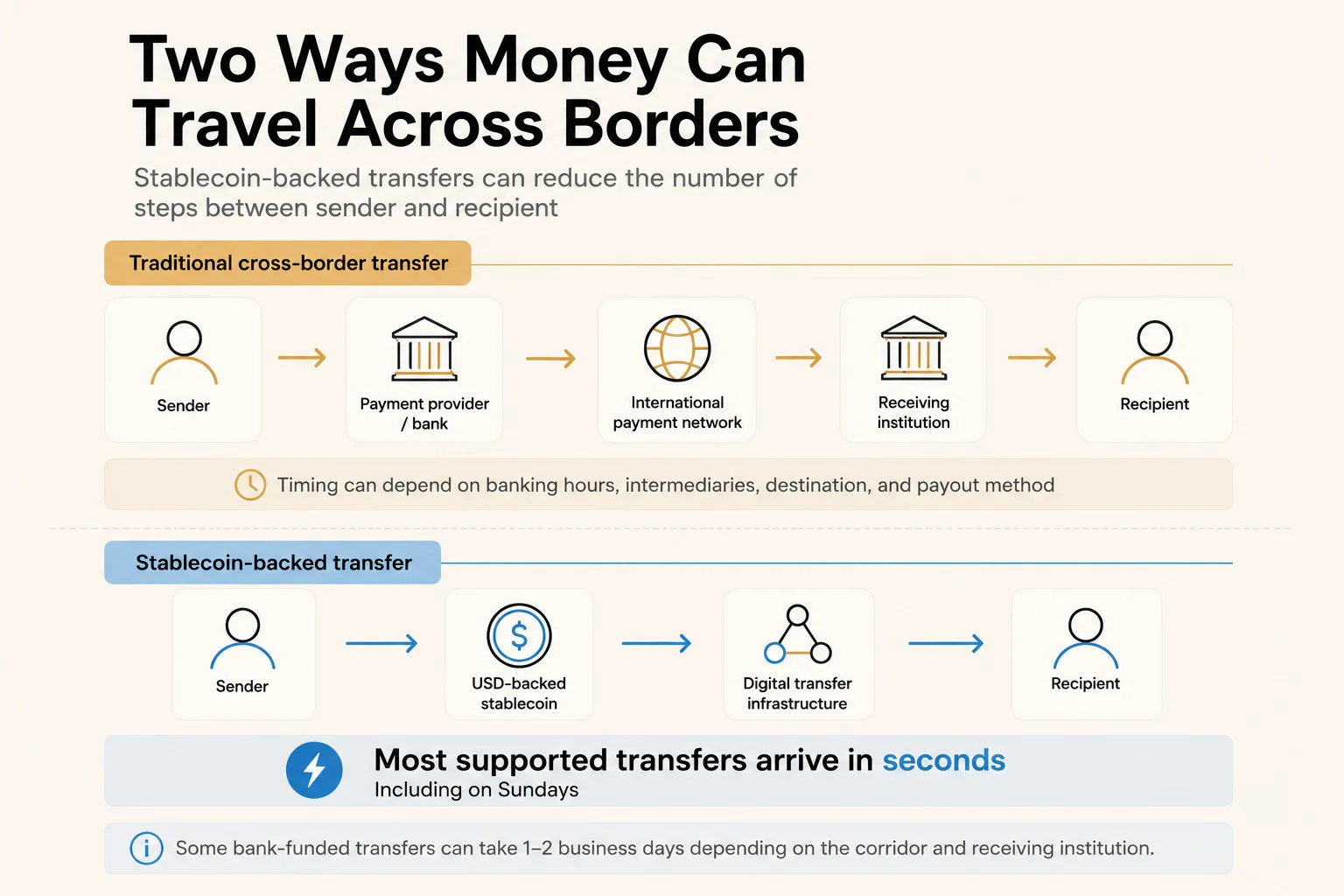
PureFi’s most transfers arrive in seconds, although some bank-funded transfers can take 1 to 2 business days, depending on the corridor and receiving institution. MoneyGram similarly notes that transfer speed depends on the destination, payment method, payout method, recipient bank, and other factors.
PureFi vs MoneyGram fees
The two platforms take different approaches to transfer pricing.
PureFi
PureFi currently advertises a $0 transfer fee on its send-money flow. It also says it does not add a hidden markup to the exchange rate. That means a PureFi user can see the rate and amount the recipient will get before confirming a supported transfer.
Costs may still apply beyond the basic PureFi transfer fee, depending on the transaction, funding method, corridor, or third-party service involved. The amount shown before confirmation is therefore the number to check for your specific transfer.
MoneyGram
MoneyGram does not have one standard fee for every international transfer. According to MoneyGram, the fee can change based on:
- How much you send
- Where you send it
- How you pay
- How the recipient receives the funds
The applicable exchange rate can also affect the final amount received. MoneyGram displays the transfer fee and exchange rate before the user confirms the transaction. This makes it difficult to say that a MoneyGram transfer always costs a certain amount. You need to price the specific transfer you want to make.
PureFi vs MoneyGram exchange rates
Exchange rates matter because a low transfer fee does not necessarily mean a low-cost transfer.
Suppose two providers both let you send $1,000. One charges a visible fee but offers a stronger exchange rate. Another has a lower fee but converts the money at a less favorable rate. The recipient can end up with different amounts.
PureFi uses the mid-market exchange rate and does not build a hidden markup into that rate. Its current send interface also shows the rate before confirmation.
MoneyGram uses its own applicable exchange rate. Its current guidance tells customers to check both the transfer fee and exchange rate because both affect the overall cost of an international transfer.
Which is faster: PureFi or MoneyGram?
Speed is one of the biggest differences between the two services, particularly because of the technology PureFi uses behind the transfer.
PureFi uses a US dollar-backed stablecoin as part of its transfer infrastructure. A stablecoin is a digital asset designed to maintain a stable value relative to another asset, in this case the US dollar.
Instead of relying entirely on the traditional chain of banks and intermediaries used for many cross-border payments, the stablecoin can be transferred digitally across borders. PureFi says this allows most transfers to arrive in seconds, including on Sundays.
The process is designed so that the user does not need to understand blockchain technology to make the transfer.
In simple terms:
You send money → PureFi uses stablecoin-backed infrastructure → Money reaches the supported destination
This infrastructure also works in the other direction. PureFi supports receiving money from abroad into a PureFi account, subject to the applicable route, currency, limits, and compliance requirements. Transfers between PureFi accounts are free.
MoneyGram can also be fast. Its current transfer pages say some transfers can be completed in minutes. But instant transfers are not available for every transaction. Timing depends on factors such as the destination, payment method, payout method, recipient bank, and eligibility.
So neither provider should be described as instant in every possible situation. But instant, stablecoin-backed cross-border transfers are a core part of PureFi’s product, while MoneyGram’s timing varies across its broader traditional and digital transfer network.
Can you earn a yield on your PureFi balance?
PureFi offers another feature that is separate from sending a remittance. Users can currently earn up to 6% APY on eligible balances while the money remains in their PureFi account.
The yield comes from returns generated by real-world assets rather than interest-based lending. The APY is variable and is not guaranteed. This is also not the same as interest on a bank savings account. PureFi is not a bank, and balances are not FDIC insured.
This feature can matter if you regularly keep money in the account between transfers. It does not make the remittance itself generate a 6% return.
How does custody differ?
PureFi describes its account as self-custodial. This means the balance sits in a digital wallet controlled by the user rather than being held by PureFi like money deposited with a traditional bank. PureFi cannot lend or spend a user’s balance because it does not hold the funds in that way.
Self-custody also comes with responsibility. Users need to protect access to their accounts and devices.
MoneyGram’s main consumer proposition is different. It is a money transfer service rather than a self-custodial digital-dollar account. You give MoneyGram the details of a transfer, pay using an available method, and MoneyGram processes the payment through the applicable transfer route.
So custody is not a simple case of one provider doing the same thing better. The underlying products are different.
PureFi vs MoneyGram: Which is better?
Neither service is the better option for every international transfer.
PureFi may make more sense if:
- You want to send remittances digitally
- You want most supported transfers to arrive in seconds
- You want a $0 transfer fee
- You want the mid-market exchange rate without a hidden markup
- Your country and transfer route are supported
- You want a self-custodial account
- You want the option to earn up to 6% variable APY on eligible balances
PureFi’s main difference is the infrastructure underneath the transfer. Its stablecoin-backed system is designed to let users send and receive money across borders without waiting for the traditional international banking process to settle the transfer. Most supported transfers arrive in seconds.
MoneyGram may make more sense if:
- You need access to a larger global network
- You need a physical MoneyGram location
- Your destination is not supported by PureFi
- You prefer a traditional money transfer service
- Your particular MoneyGram route offers the payment and delivery method you need
MoneyGram’s biggest advantage is reach. Its 200+ country and territory network and 470,000+ locations give it a physical presence that a digital-first platform such as PureFi does not currently match.
The bottom line
PureFi and MoneyGram solve the same basic problem in different ways. MoneyGram has the larger global and physical network. That can matter when you need a specific destination, transfer route, or in-person service.
PureFi is built around faster digital remittances. Its stablecoin-backed infrastructure allows most supported transfers to arrive in seconds, alongside a $0 transfer fee and mid-market exchange rate. It also gives users a self-custodial balance with the option to earn up to 6% variable APY.
The better choice comes down to your route, how quickly you need the money to arrive, and the total amount your recipient gets.
Learn more about how PureFi can help you send, receive, and grow money across borders, or download the app to get started today.