PureFi vs Mogul: Real Estate Apps Compared
PureFi vs Mogul: What you need to know
PureFi and Mogul both let users buy fractional shares connected to individual rental homes. This means several people can invest in one property without having to buy or manage the whole home themselves.
The basic idea is similar, but the details are not. PureFi buys homes outright and serves users in more than 100 countries. Mogul uses separate LLCs for its properties and focuses on US single-family rentals. Some Mogul properties may also use financing.
In this PureFi vs Mogul comparison, we’ll look at what users own, where earnings come from, how fees affect yield, when shares can be sold and what protection applies. This is an informational comparison, not a recommendation.
The information below was checked in September 2026. Features, fees and investment terms may change.
PureFi vs Mogul at a glance
| Feature | PureFi | Mogul |
|---|---|---|
| Main investment | Shares of individual homes | Shares in LLCs that own individual homes |
| Property focus | Income-producing residential homes | US single-family rental homes |
| Property funding | Homes bought outright | Some properties may use financing |
| Earnings | Rent and changes in home values | Potential monthly rental distributions and changes in property values |
| Starting amount | Check the current amount in the app | Varies by property |
| Main platform fee | One-time purchase fee shown before confirmation | One-time 5% fee included in the property’s starting capital |
| Holding period | No fixed lock-up | Usually 3 to 10 years |
| Early selling | Shares can be sold at their current market price | Secondary market listed as coming soon |
| Availability | More than 100 countries | Eligibility depends on the offering and local rules |
| Best suited for | International access and more flexible selling | Long-term investment in individual US rental homes |
What is PureFi?
PureFi is a financial technology platform that lets users buy shares of real, income-producing homes from their phones.
Each home is bought outright and professionally managed. Users can review the property information and legal documents before investing. They can choose individual homes or begin with a suggested mix. The property shares are held in an account in the user’s name. PureFi does not pool one person’s property shares with those belonging to another user.
PureFi also provides a self-custodial dollar wallet. This means users control the wallet holding their balance. Rental earnings are paid into this balance, where they can be reinvested or taken out. PureFi is currently available in more than 100 countries. Users can fund their accounts from more than 160 countries, although availability still depends on local rules. PureFi explains its real estate product here.
What is Mogul?
Mogul is a fractional real estate investment platform focused mainly on US single-family rental homes. Each property is placed inside a separate LLC. Investors buy shares in that LLC rather than receiving a direct part of the physical property title.
Mogul selects the property, arranges the purchase and manages it after funding. Investors can review available homes and decide which properties they want to add to their portfolios.
The platform also gives investors access to a dashboard showing rental distributions, valuations, and other property information. Investors may receive voting rights on certain decisions involving the property.
Mogul states that its properties are normally held for 3 to 10 years. Investors may receive rental distributions during that time and a share of the proceeds when the property is sold.
What can you invest in?
PureFi and Mogul both focus on individual properties. This gives users more control than a real estate fund that selects every property for them.
With PureFi, users buy shares of available residential homes. They can build their own mix or use a suggested mix. Real estate is currently PureFi’s first asset type, with more real assets planned.
Mogul also lets users select individual homes. Its main focus is single-family rental property in the US. Each home has its own information, costs and projections. Neither platform gives the investor exclusive ownership of the whole home. Property management remains the responsibility of the platform or its selected managers.
What do users own?
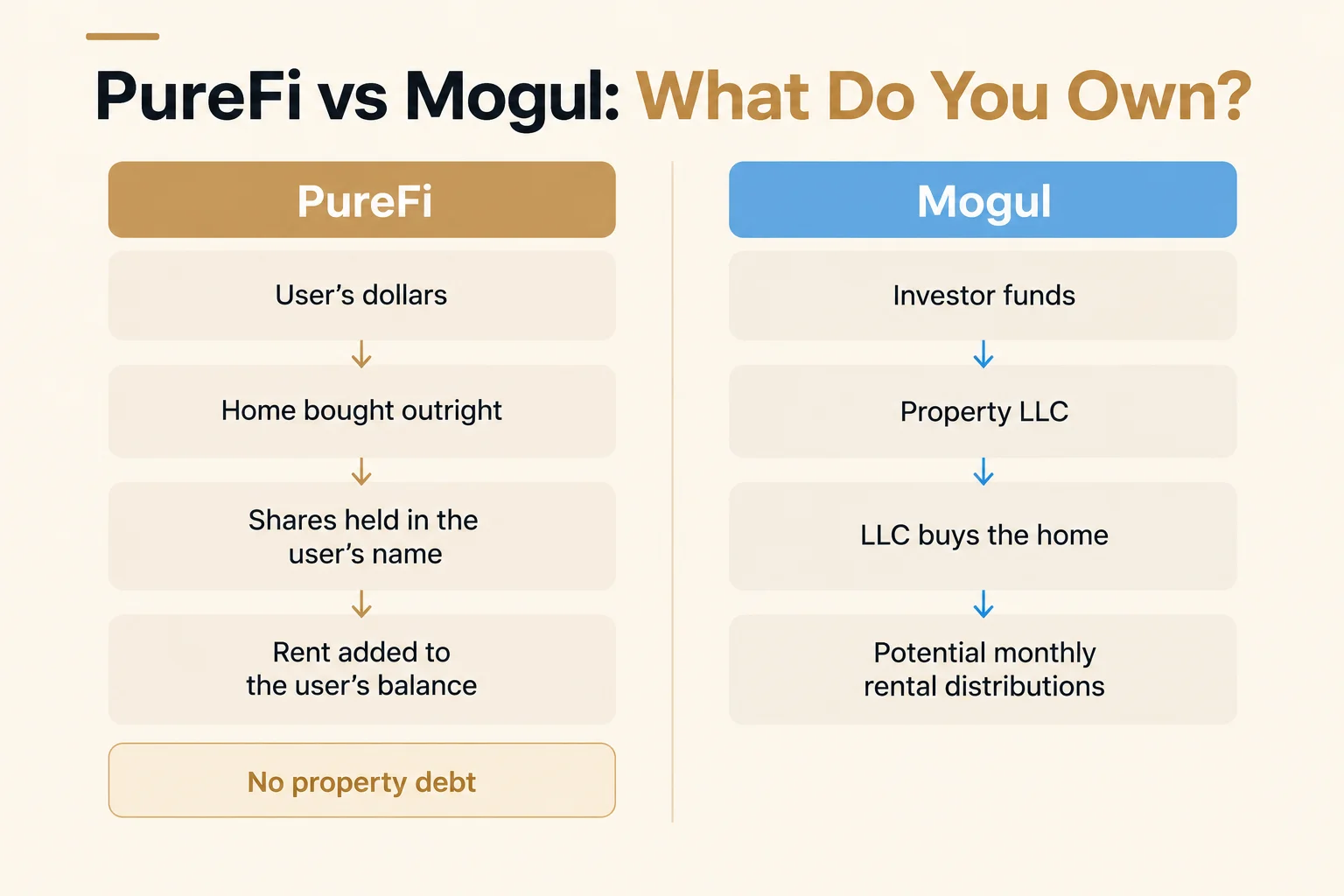
With PureFi, users own shares of each home they select. The shares are held in an account in the user’s name. Each home comes with legal documents that can be reviewed from its page in the app.
With Mogul, investors own shares in the LLC that owns the property. Their ownership percentage depends on the amount invested and the property’s total funding structure.
Mogul investors may also receive governance rights. These can allow them to vote on certain property decisions. The available rights should be explained in the documents for that specific property.
In both cases, users should check the legal documents rather than relying only on the property page. The documents explain what is owned, which rights come with the shares, and how sale proceeds will be divided.
How do users earn?
Both platforms aim to provide earnings through rent and property value changes. Neither guarantees that a user will make money.
How earnings work with PureFi
PureFi earnings come from:
- Rent paid by tenants
- Changes in the value of the homes
When rent is paid, the user’s share is added to their PureFi balance. The money can be reinvested in more property shares or taken out.
PureFi currently shows projected earnings of up to 6% APY. This projection is based on current rent and home values. It is variable and can change. Property shares can also lose value.
Nothing is lent out to produce the projected yield. The user’s money buys shares of homes that have tenants. PureFi explains where its projected APY comes from here.
How earnings work with Mogul
Mogul investors may receive monthly rental distributions. The actual amount depends on the rent collected after property costs and reserves have been deducted. Possible earnings can come from:
- Rent paid by tenants
- An increase in the property’s value
- Sale proceeds at the end of the holding period
Mogul provides projections for individual properties. These are estimates rather than promised results. Rent can be lower than expected, and a home may be sold for less than its original purchase price.
The platform also says investors may receive certain US property tax benefits. The result will depend on the investor’s tax position and the documents issued for that property. Users should seek qualified tax guidance when needed.
How are the properties purchased?
PureFi states that every home is bought outright. The projected yield comes from rent and property value changes rather than lending.
Mogul forms an LLC and purchases the property through that company. Its published process says its acquisition team negotiates the purchase price, repairs and any loan terms.
This means some Mogul properties may use financing. Mogul also states that some properties may be subject to encumbrances, which should be disclosed in the listing. Financing is not automatically good or bad. It can allow a property company to purchase a larger asset with less investor capital. It also creates added costs and payment obligations.
If property income falls, those obligations still need to be paid. This can reduce the money available for investor distributions. Users should check each Mogul listing to see whether financing is being used and how much debt the property carries.
Fees and starting amounts
The two platforms use different fee structures.
PureFi fees
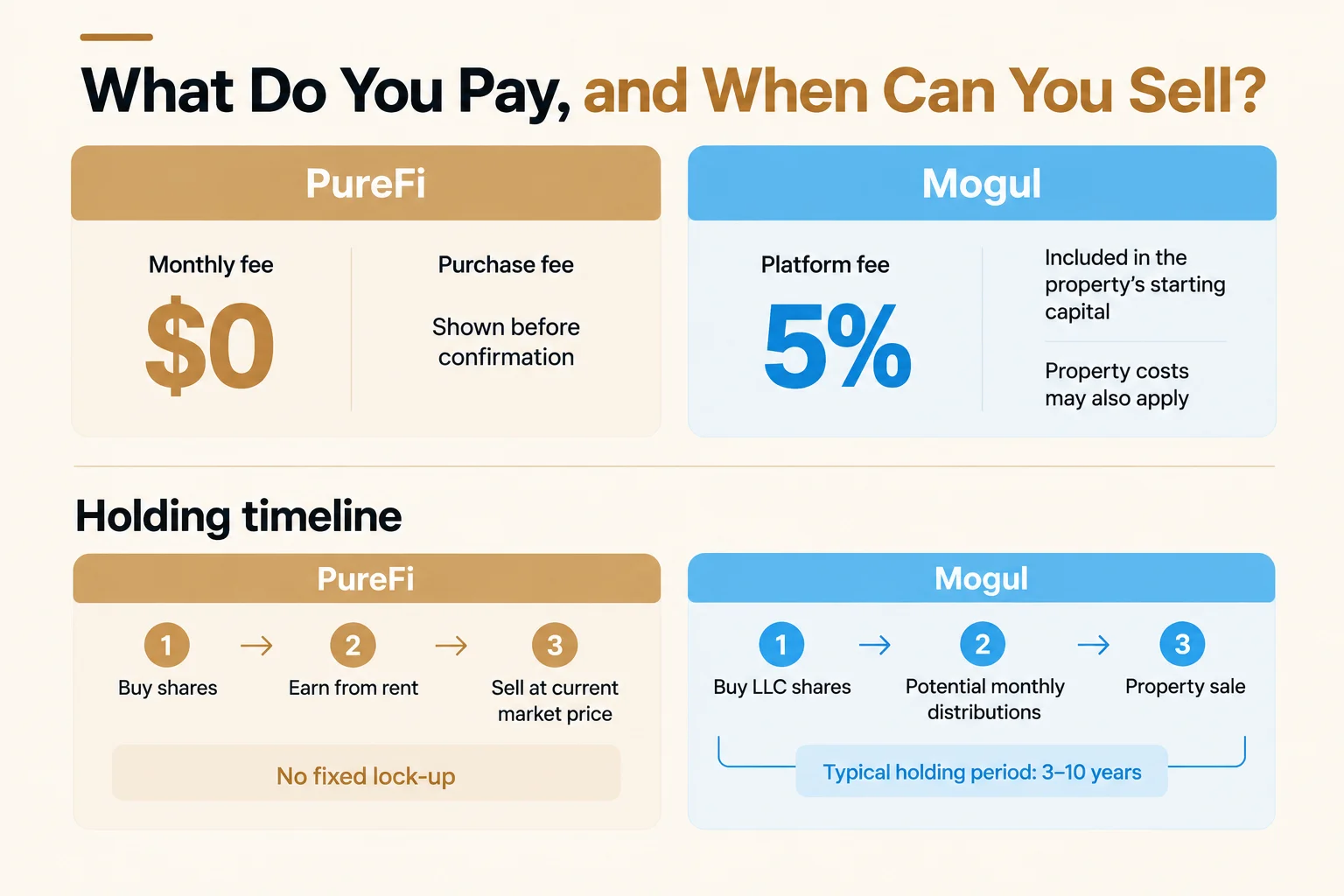
PureFi does not charge a monthly account fee. A one-time purchase fee applies when users buy property shares. The amount is shown on the order before the purchase is confirmed.
PureFi does not publish one starting amount for every home. Users should check the minimum shown in the app for the property they want to buy.
Mogul fees
Mogul states that it includes a one-time 5% platform fee in the property’s starting capital structure.
This means the fee is included when the investment is formed. It is not shown as a separate bill after the user invests. However, the fee still affects how much ownership the investment buys.
Property-level costs may also include:
- Repairs and maintenance
- Insurance
- Property taxes
- Property management
- LLC administration
- Sale costs
- Financing costs where applicable
The starting amount may vary between Mogul properties. Investors should check the listing and legal documents for the full cost before committing money.
How are rental earnings paid?
PureFi adds a user’s rental share to their balance when tenants pay. Users can choose to reinvest the money or take it out.
Mogul states that its properties can provide monthly rental distributions. Payments are made according to the investor’s share after expenses and reserves.
A monthly payment schedule does not mean the amount is fixed. A distribution may fall or stop if a home is vacant, rent is unpaid or the property needs repairs. The timing is therefore different, but the same basic risk applies to both platforms. Rental earnings depend on real tenants and real property costs.
How quickly can you access your money?
Access is one of the biggest differences in the PureFi vs Mogul comparison.
Selling PureFi shares
PureFi states that users can sell their shares at the current market price without a fixed lock-up. The money from the sale is returned to the user’s balance. The amount may be higher or lower than the original investment because the value of the shares can change.
Selling Mogul shares
Mogul says its usual property holding period is between 3 and 10 years. Investors generally receive their final share of the property’s value when Mogul sells the home. This makes the product better suited to money that will not be needed soon.
Mogul has described a secondary market where investors may be able to sell shares early. Its current published information still marks this feature as coming soon. Users should therefore not assume they can sell whenever they want. The safer approach is to plan around the full property holding period.
Where are PureFi and Mogul available?
PureFi is available in more than 100 supported countries across Asia, Africa, Europe and the Americas. Users can fund from more than 160 countries. This gives PureFi a much wider international reach. Access still varies by jurisdiction, and not every product or payment method may be available everywhere.
Mogul’s properties are located in the US. Investor eligibility can depend on account checks, local laws, and the rules of an individual offering.
Someone living outside the US should confirm whether they can invest, how they can fund an account and what tax documents they may receive before signing up.
How do security and investment risk compare?
Security protects an account from unauthorized access. It does not protect a property against vacancies, repairs or falling prices.
PureFi security
PureFi uses a self-custodial wallet. The user controls the wallet holding their balance, and PureFi states that it cannot transfer or spend that balance without the user.
Its security measures include:
- Identity verification
- 256-bit encryption
- Face ID
- Two-factor authentication
- Fraud monitoring
- Licensed technology partners
- Private cybersecurity insurance covering its systems and users
PureFi is not a bank. Its balance and property shares are not FDIC insured or covered by another government deposit scheme. PureFi provides more information about its security measures here.
Mogul security and property structure
Mogul requires users to complete identity checks before investing. Each property is held through a separate LLC, and the platform provides property documents and account information through its dashboard.
The separate LLC structure can keep one property’s ownership records apart from another property. It does not guarantee that the property will perform well. Mogul states that it is not a registered broker-dealer or investment adviser. It also explains that its real estate investments can result in partial or total loss.
Neither PureFi nor Mogul property shares are bank deposits. Users should not invest money they may need for regular bills or emergencies.
PureFi and Mogul are not savings apps
PureFi and Mogul are real estate investment platforms. They should not be treated like a normal digital savings platform.
A high-yield digital savings account or online savings app is generally used to hold cash. A high-yield savings app may also provide government-backed deposit protection when the account is offered through an eligible bank or credit union.
A multi-currency savings account lets users hold balances in different currencies. It does not normally give them ownership of income-producing real estate. A high-yield investment platform is different. The money is placed into assets that can gain or lose value. Rental earnings may change, and selling can take longer than withdrawing money from a savings product.
Which platform may suit you?
PureFi may be worth considering if you:
- Live outside the US
- Want homes that are bought outright
- Prefer no fixed lock-up
- Want rental earnings paid into a self-custodial wallet
- Do not want a monthly account fee
- Want to begin with a suggested property mix
Mogul may be worth considering if you:
- Want to select US single-family rental homes
- Prefer LLC-based property ownership
- Want potential monthly rental distributions
- Value voting rights on some property decisions
- Are comfortable reviewing property financing
- Can hold the investment for 3 to 10 years
Both platforms provide access to individual rental homes, but they are built for different users. PureFi offers broader international availability, outright property purchases, and more flexible published sale terms. Mogul provides an LLC structure, potential monthly distributions and governance rights, but its investments are designed for longer holding periods.
The right choice depends on your country, preferred ownership structure, access needs and comfort with property risk.
Review real homes with PureFi
See the homes available in the PureFi app, read their legal documents, and check the projected rental earnings before deciding where to invest.
Learn more about how PureFi can help you own real estate shares or download the app to get started today.
Projected earnings are variable and not guaranteed. Real estate shares can lose value. PureFi is a financial technology company, not a bank. Its balance and property shares are not covered by FDIC insurance or another government deposit scheme.