PureFi vs Fundrise: Real Estate Compared

PureFi vs Fundrise: What you need to know
PureFi and Fundrise both make real estate investing more accessible. You can start without buying, repairing, or managing an entire property yourself.
The way they do this is different. PureFi lets users choose shares of individual rental homes. Fundrise mainly places investors into managed funds that hold several properties and other private assets.
In this PureFi vs Fundrise comparison, we’ll explain what you own, where earnings come from, how fees affect your results, when you can access your money and what protection applies. This article provides general information. It does not recommend one platform over the other.
Note: The information below was checked in September 2026. Products, fees and availability can change.
PureFi vs Fundrise at a glance
| Feature | PureFi | Fundrise |
|---|---|---|
| Main real estate product | Shares of individual homes | Managed private real estate funds |
| Property selection | Choose homes or use a suggested mix | Choose a plan or fund |
| What you own | Shares of selected homes | Shares in funds holding several assets |
| Starting amount | Check the current amount in the app | $10 for a taxable account |
| Main fees | One-time purchase fee; no monthly fee | 0.15% advisory fee plus 0.85% real estate fund management fee each year |
| Source of earnings | Rent and changes in home values | Property income, real estate financing and changes in fund value |
| Diversification | Depends on the homes selected | Built into the fund structure |
| Access | Sell at the current market price; no fixed lock-up | Most requests reviewed quarterly and subject to limits |
| Availability | More than 100 countries | Permanent US residents with a valid US tax ID |
| Account options | Self-custodial dollar wallet | Taxable accounts and IRAs |
| Best suited for | Individual home selection and international access | Managed portfolios for eligible US investors |
What is PureFi?
PureFi is a financial technology platform that lets users buy shares of individual, income-producing homes through an app. Each home is bought outright and professionally managed. Users can review available properties, check their details and read their legal documents before making a purchase.
You can choose homes yourself or begin with a suggested mix. Shares of each selected home are held in an account in your name. When tenants pay rent, your share is added to your PureFi balance. That balance sits in a self-custodial dollar wallet controlled by you. PureFi is available in more than 100 countries. Users can fund their accounts from more than 160 countries, although access still depends on local rules. PureFi explains its real estate product here.
What is Fundrise?
Fundrise is a US private investment platform. It provides access to real estate, private credit and venture investments. For this comparison, we are focusing on Fundrise real estate.
Most Fundrise users do not choose individual properties. They select an investment plan or fund. Fundrise then manages the assets within that portfolio. Its real estate holdings may include:
- Build-to-rent housing
- Apartment buildings
- Industrial property
- Warehouses
- Data centres
- Commercial real estate
- Real estate financing
Fundrise manages property selection, portfolio allocation, reporting and distributions. Users can add money manually or set up recurring investments.
What can you invest in?
PureFi focuses on individual residential homes. You can see each available property and decide whether you want to buy its shares.
Real estate is currently PureFi’s first real asset type. The company says it plans to add more types of real assets later.
Fundrise mainly provides portfolios containing several properties or real estate-related investments. Instead of selecting one house, you normally choose a plan based on your goal. Fundrise currently groups its standard plans around income, balanced investing and long-term growth. The exact mix of assets depends on the selected plan and available funds.
The difference is straightforward:
- PureFi lets you choose individual homes.
- Fundrise chooses and manages a wider portfolio for you.
What do users own?
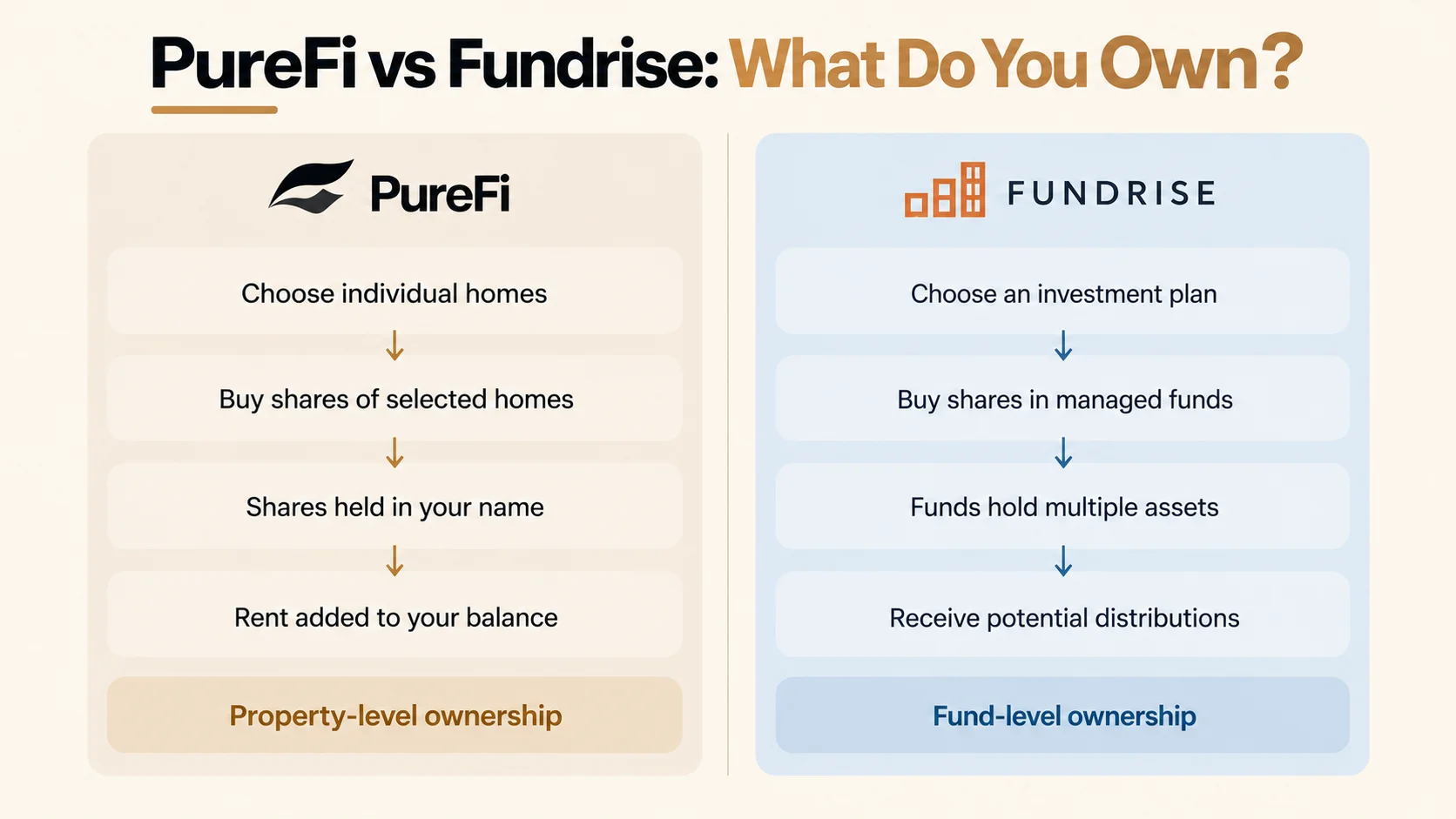
With PureFi, you own shares of the individual homes you select. Those shares are held in an account in your name. Every home has legal documents available through its page in the app. These documents explain the property and the terms connected to your shares.
With Fundrise, you generally own shares in one or more private funds. Those funds own the underlying properties, companies or real estate financing. You do not normally select or own shares linked to one specific home. Your account value depends on the value of your fund shares.
Fundrise uses net asset value, commonly shortened to NAV, to value its funds. NAV is the estimated value of the fund’s assets after its liabilities have been deducted.
Both platforms give users exposure to real estate. PureFi provides property-level ownership, while Fundrise provides fund-level ownership.
How do users earn?
Neither platform guarantees earnings. Property values, rent and other sources of income can change.
How earnings work with PureFi
PureFi earnings come from:
- Rent paid by tenants
- Changes in home values
When a tenant pays rent, the user’s share is added to their PureFi balance. It can be reinvested in more property shares or taken out.
PureFi currently shows projected earnings of up to 6% APY. This figure is based on current rent and property values. It is variable and can go up or down. The homes themselves can also lose value. A projected APY is not a promise that every user or property will earn the same amount.
PureFi states that nothing is lent out to produce the yield. The user’s money is used to buy shares of real homes with tenants. PureFi explains the source of its projected earnings here.
How earnings work with Fundrise
Fundrise real estate funds may earn money from:
- Rent and property operations
- Payments from real estate financing
- Property sales
- Changes in the value of assets held by the fund
Some Fundrise plans focus more on regular distributions. Others focus more on long-term growth. A balanced plan may combine both. Any distributions depend on the income earned after fund and property costs. The value of fund shares can also rise or fall.
Fundrise states that historical results and projections do not guarantee future performance. Investors may lose some or all of the money they put in.
Property choice and diversification
PureFi gives users more control over property selection. You can review the available homes and decide which ones to add to your account. If you buy shares in only one home, however, your results will depend heavily on that property.
A vacancy, repair, or drop in local property values could have a larger effect on an account holding only one home. Users can spread their money across several PureFi properties, but they must choose to do so. Fundrise provides automatic diversification through its funds. One fund may hold several properties across different locations and property types. This can reduce the effect of one property performing badly. It does not remove risk. Several assets can lose value at the same time, and the fund’s overall value can fall.
The trade-off is control:
- PureFi provides more control over individual property selection.
- Fundrise provides broader diversification with less property-level choice.
How quickly can you access your money?
Private real estate is not usually as easy to sell as cash or shares traded on a public exchange.
Access with PureFi
PureFi states that users can sell their property shares at the current market price without a fixed lock-up. Sale proceeds return to the user’s balance. The amount received may be higher or lower than the original purchase amount.
Having no fixed lock-up does not protect the value of the shares. The price still depends on the property’s current value.
Access with Fundrise
Fundrise describes its real estate funds as long-term investments. They are not listed on a public stock exchange. Most liquidation requests are reviewed quarterly. To request access, a user must submit a liquidation request before the end of the quarter.
Fundrise may then review the request during the following month. For example, a request submitted during January to March would normally be reviewed in April. A quarterly review is not a guarantee that the request will be completed. Requests remain subject to fund limits and available liquidity.
The Flagship Fund and Income Fund do not currently charge a liquidation penalty. Some older eREIT shares held for less than five years may have a penalty. Fundrise can also limit or suspend liquidations under certain conditions.
Where are PureFi and Fundrise available?
PureFi has a wider international reach. It is available in more than 100 countries across Asia, Africa, Europe and the Americas. Funding is supported from more than 160 countries. Availability still varies by jurisdiction.
Fundrise is currently limited to permanent US residents and eligible US-based entities.
Individual users must generally:
- Be over 18
- Have permanent US residency
- Have a valid US tax ID
- File taxes in the US
Fundrise does not currently accept international investors or residents of US territories. A person living outside the US may therefore be able to use PureFi but not Fundrise.
How do security and investment risk compare?
Account security and investment performance are separate issues. Security measures can help stop someone from accessing an account without permission. They cannot prevent a property or fund from losing value.
PureFi security
PureFi uses a self-custodial wallet. The user controls the wallet holding their balance. PureFi states that it cannot transfer, lend or spend the balance without the user.
Its security measures include:
- Identity verification
- 256-bit encryption
- Face ID
- Two-factor authentication
- Fraud monitoring
- Licensed technology partners
- Private cybersecurity insurance covering its systems and users
PureFi is not a bank. Its balance and property shares are not FDIC insured or protected by another government deposit scheme. PureFi provides more information about its security measures here.
Fundrise security and investment documents
Fundrise requires identity and tax information before opening an account. Investors can track their holdings and transactions through its online platform and mobile apps. Its private funds have offering documents and regulatory filings that explain their structure, fees and risks.
Fundrise investments are securities, not bank deposits. They are not protected against falling fund values, lower property income or losses.
The platform’s long operating history and regulatory filings provide information that users can review. They do not guarantee that an investment will make money.
PureFi and Fundrise are not savings apps
Neither real estate product works like a standard digital savings platform.
A high-yield digital savings account or high-yield savings app is generally designed to hold cash. Depending on the provider and country, eligible deposits may receive government-backed protection.
An online savings app may provide easier access to cash than a private real estate fund. A multi-currency savings account is also designed to hold balances in several currencies, not property investments. PureFi includes a dollar wallet, but money used to purchase home shares becomes a real estate investment. The value can rise or fall.
Fundrise places money into managed private funds. Those funds are also investments and may take time to liquidate. A platform offering higher possible yield is not automatically better. Users need to compare fees, risk, access and the assets producing the earnings.
Which platform may suit you?
PureFi may be worth considering if you:
- Live outside the US
- Want to select individual rental homes
- Prefer homes bought outright
- Want property shares held in an account in your name
- Prefer no fixed lock-up
- Want rental earnings added to a self-custodial wallet
- Do not want a monthly account fee
Fundrise may be worth considering if you:
- Are an eligible permanent US resident
- Want to start with $10
- Prefer a managed real estate portfolio
- Want automatic diversification
- Do not want to select individual properties
- Are comfortable with ongoing annual fees
- Can hold the investment for the long term
- Want a retirement account option
Neither platform is right for everyone.
PureFi provides more control over individual properties, wider international access and more flexible published sale terms. Fundrise provides a low starting amount, managed diversification and retirement account options for eligible US investors.
The better fit depends on where you live, how much control you want and when you may need your money.

Review real homes with PureFi
See the homes available in the PureFi app, read their legal documents, and check the projected rental earnings before deciding where to invest.
Learn more about how PureFi can help you own real estate shares or download the app to get started today.
Projected earnings are variable and not guaranteed. Property shares can lose value. PureFi is a financial technology company, not a bank. Its balance and real estate shares are not covered by FDIC insurance or another government deposit scheme.