PureFi vs. Fidelity
PureFi and Fidelity both help people put their money to work, but they do it in very different ways. PureFi offers up to 6% projected APY from rent and changes in home values. Fidelity offers cash management and a broad range of investments. Returns on both platforms can change. Access also works differently, and the type of protection you receive depends on where your money is held.
Account details and yields reviewed on September 19, 2026.
PureFi vs. Fidelity at a Glance
| Feature | PureFi | Fidelity |
|---|---|---|
| Platform type | Fintech and real-asset platform | Brokerage and financial services platform |
| Main purpose | Earning through shares of real homes | Investing, retirement, trading, and cash management |
| Current earning figure | Up to 6% projected APY | 3.36% seven-day SPAXX yield as of September 18, 2026 |
| Source of returns | Rent and changes in home values | Money market securities, bank deposits, or other investments |
| Investment options | Real estate, with more real assets planned | Stocks, ETFs, mutual funds, bonds, CDs, options, crypto, and more |
| Monthly account fee | $0 | $0 for the Cash Management Account |
| Minimum balance | None | None for the Cash Management Account |
| Spending features | App-based transfers and withdrawals | Debit card, checks, Bill Pay, mobile deposits, and ATM access |
| Protection | Self-custody and private cybersecurity insurance | FDIC or SIPC coverage, depending on where the money is held |
| Availability | More than 100 countries | Available to eligible Fidelity customers |
PureFi’s projected APY and SPAXX’s seven-day yield are not the same type of measurement. They should not be treated as a direct rate comparison. Both figures are variable and can change.
What Are PureFi and Fidelity?
The biggest difference in the PureFi vs. Fidelity comparison is the type of platform each company operates.
PureFi
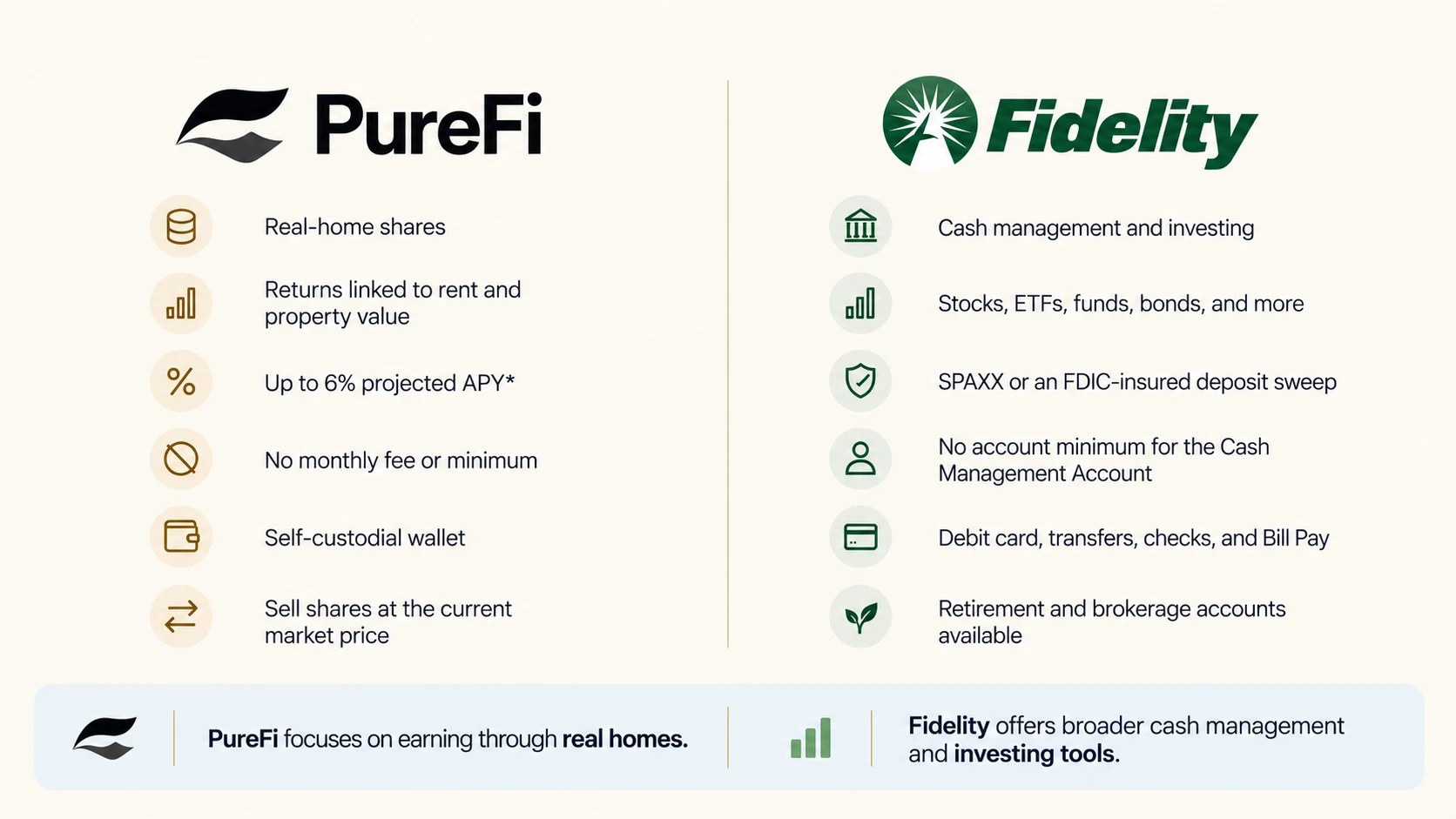
PureFi is a financial technology company focused on earning through real assets. Its first available asset is residential real estate.
Users purchase shares of real homes with tenants. When rent is paid, each user receives a share based on their ownership. The value of those shares can also rise or fall with the value of the property.
PureFi advertises up to 6% projected APY. This figure is based on current rental income and home values. It is not a guaranteed return, and PureFi states that property shares can lose value.
The platform uses a self-custodial structure. This means a user’s dollar balance sits in a wallet controlled by that user rather than being held by PureFi. Shares of each property are also held in an account in the user’s name.
PureFi is available in more than 100 countries and supports funding from more than 160 countries. This makes it much more widely available than many U.S.-focused financial platforms.
Fidelity
Fidelity is a large brokerage and financial services company. It provides brokerage accounts, retirement accounts, cash management, trading tools, managed portfolios, and financial planning services.
The Fidelity Cash Management Account is the closest Fidelity product to a savings account. However, it is a brokerage account, not a traditional bank savings account.
Customers can choose between two main core positions for their uninvested cash. The first is the Fidelity Government Money Market Fund, known as SPAXX. The second is Fidelity’s FDIC-Insured Deposit Sweep Program.
SPAXX held a seven-day yield of 3.36% as of September 18, 2026. That yield can change, and the fund’s value is not guaranteed. The deposit sweep works differently by sending eligible cash to participating banks.
Fidelity also provides access to a much wider selection of investments than PureFi. It is designed for people who want to manage several financial goals within one platform.
Which Is Better for Saving and Earning?
PureFi provides a simpler earning model. Your money purchases shares of real homes, and your return comes from rent and possible changes in property value. The company does not lend out your balance.
PureFi earnings compound daily. Users can reinvest those earnings or withdraw them. There is no minimum balance or monthly account fee.
PureFi’s up to 6% APY may appear higher than the yield shown for Fidelity’s SPAXX fund. However, the two figures measure different products with different risks.
PureFi’s figure is a projected APY tied to real estate performance. Rent can change, properties can gain or lose value, and property shares may be sold for less than their purchase price.
SPAXX reports a seven-day yield based on the fund’s recent earnings. SPAXX invests in short-term government securities and related holdings. Its yield can change as market conditions change.
The Fidelity Cash Management Account also offers an FDIC-insured deposit sweep. That option may provide a different yield from SPAXX, so users need to check the current rate for the core position they select.
PureFi may be more appealing to someone who wants a high-yield digital savings account built around real assets. Fidelity may make more sense for someone who wants cash management connected to a larger investment portfolio.
Neither option offers a permanently fixed return.
Which Platform Has More Investment Options?
Fidelity offers far more investment choices.
A Fidelity brokerage account gives customers access to domestic and international stocks, ETFs, mutual funds, bonds, brokered CDs, options, and crypto. Customers can also use retirement accounts such as Traditional and Roth IRAs.
Fidelity supports fractional shares, which allow users to begin buying eligible stocks and ETFs with as little as $1. It also provides research tools, market information, recurring investments, and more advanced trading platforms.
PureFi takes a narrower approach. Its current real-asset offering is focused on residential properties. Users can select a suggested mix of homes or choose properties themselves.
This limited selection may be a benefit for someone who does not want to choose between thousands of securities. The connection between the asset and the return is also easy to understand. A user owns property shares and receives a portion of the rent.
However, PureFi does not currently provide the same level of diversification as Fidelity. It does not offer the same range of stocks, funds, bonds, retirement accounts, or trading tools. PureFi says more real assets are planned, but real estate is the current focus.
Fidelity is the stronger option for building a broad portfolio. PureFi is the more focused option for adding income-producing real estate without buying and managing a complete property.
PureFi vs. Fidelity Fees
PureFi does not charge a monthly account fee and does not require a minimum balance. This makes it possible to create an account without committing to a large starting amount.
A one-time fee applies when a user purchases property shares. PureFi says the fee is shown before the purchase is confirmed. Any transfer costs are also presented before the transaction.
This means PureFi is free to maintain, but purchasing real estate shares is not free. Readers should review the displayed fee before signing each order.
The Fidelity Cash Management Account also has no account fee, maintenance fee, or minimum opening balance. Fidelity does not charge its own ATM fee and reimburses eligible ATM charges globally. It also provides free checks and Bill Pay.
Fidelity offers $0 online commissions for U.S. stock and ETF trades. However, this does not mean every investment or service is free. Options, certain mutual funds, managed accounts, and other products may have their own costs. Funds can also charge internal operating expenses that reduce returns.
PureFi has the simpler fee structure because it offers fewer products. Fidelity’s costs depend more heavily on which investments and services a customer uses.
Account Features and Access to Money
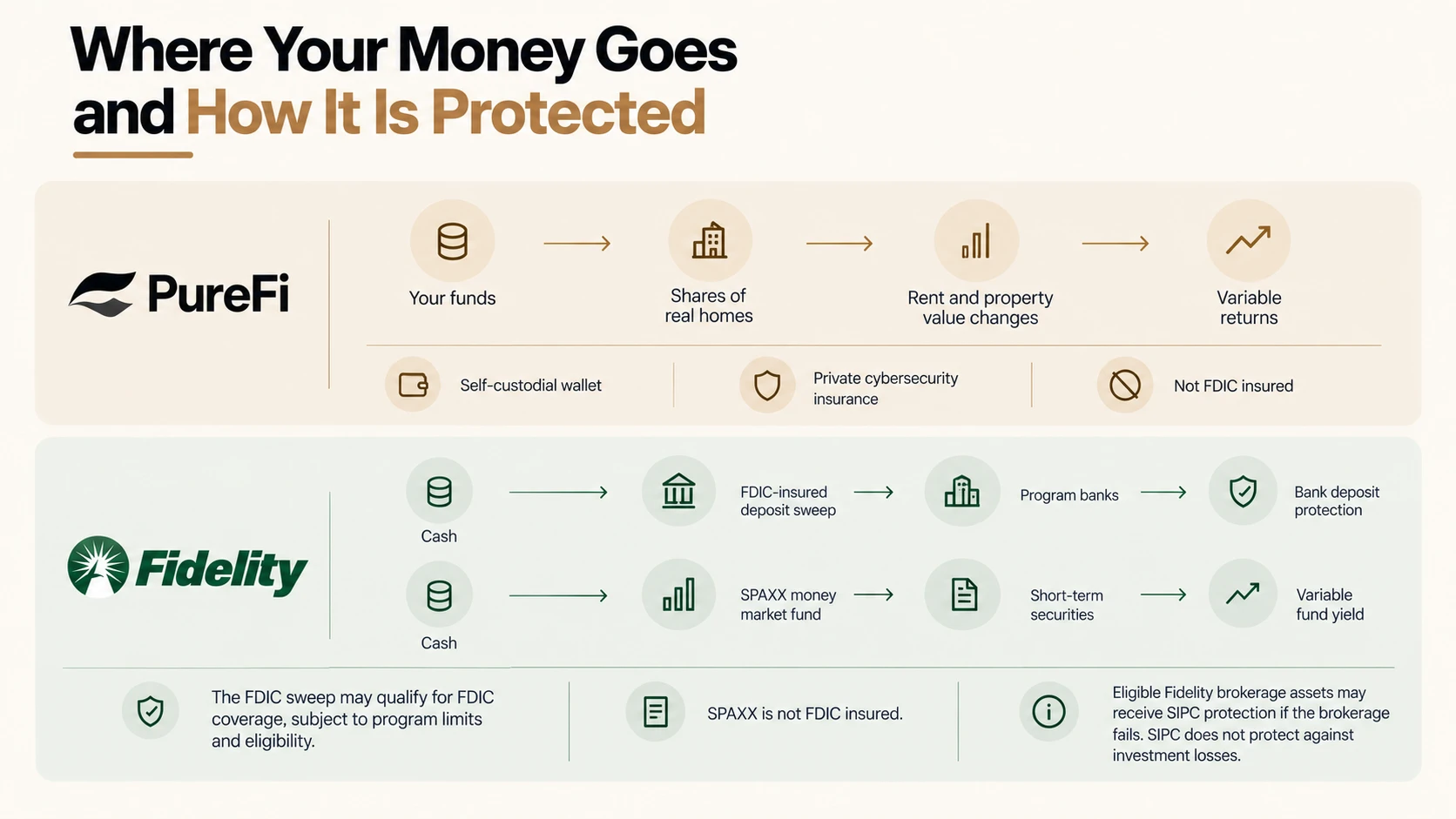
PureFi is built around a mobile app and self-custodial wallet. Users can add funds, review their balance, choose properties, reinvest earnings, and request withdrawals from one dashboard.
Users can sell property shares at the current market price without a set lock-up period. When the shares are sold, the proceeds return to the user’s balance. The sale price may be higher or lower than the original purchase price.
PureFi also supports Face ID, two-factor authentication, and 256-bit encryption. Its international availability is one of its strongest account features, especially for users who cannot access U.S.-only savings and investment products.
Fidelity provides more ways to use cash in everyday life. Its Cash Management Account includes a debit card, direct deposit, mobile check deposit, check writing, Bill Pay, and global ATM fee reimbursement.
Customers can transfer money between eligible Fidelity accounts. This makes it easier to transfer excess cash from the Cash Management Account to a brokerage or retirement account.
Fidelity also provides research, portfolio tracking, market data, recurring investments, and advanced trading tools. These features are useful for experienced investors, but they may feel excessive to someone who only wants a simple way to earn on savings.
PureFi offers a more focused app experience. Fidelity provides a much larger financial toolkit.
How Protection Differs
Protection is one of the most important differences between PureFi and Fidelity.
PureFi is not a bank. Its balances and property shares are not covered by FDIC insurance or another government guarantee.
The platform uses self-custody, which means PureFi cannot use or transfer a customer’s balance without that customer’s approval. PureFi also says it carries private cybersecurity insurance covering its systems and users.
That private coverage should not be confused with protection against investment losses. It does not guarantee the projected APY or prevent property shares from losing value.
Fidelity’s protection depends on where the customer chooses to hold money.
Cash in Fidelity’s FDIC-Insured Deposit Sweep Program is sent to participating banks. Fidelity states that the program can provide up to $4 million in FDIC coverage when enough program-bank capacity is available. Coverage also depends on any other deposits the customer holds at the same banks.
SPAXX does not receive FDIC protection because it is a money market mutual fund rather than a bank deposit. It is covered by the Securities Investor Protection Corporation as a security held in a brokerage account.
SIPC can help when a brokerage fails and customer assets are missing. It does not protect against market losses. Fidelity also warns that a money market fund can lose value even though it aims to maintain a value of $1 per share.
Fidelity therefore provides more established protection options, but customers must understand which core position they have selected. The deposit sweep and SPAXX do not carry the same type of coverage.
Who Is Each Platform Best For?
PureFi may suit someone who wants a simple digital savings platform connected to real estate. It is also worth considering for users outside the United States who want access to income-producing property shares without buying and managing an entire home.
The platform is easier to understand than a full brokerage account. Users select homes, receive a share of rental income, and can reinvest or withdraw their earnings. The trade-off is that the projected return is not guaranteed, property values can fall, and there is no FDIC protection.
Fidelity may suit someone who wants investing, retirement planning, cash management, and everyday spending features in one place. It offers far more investment choices and stronger research tools.
The Fidelity Cash Management Account is also more practical for paying bills, writing checks, withdrawing money from ATMs, and using a debit card. However, users must choose between different cash positions and understand the protection attached to each one.
Someone could also use both platforms for different purposes. Fidelity could hold a diversified portfolio and everyday cash, while PureFi could provide separate exposure to income-producing homes.
PureFi vs. Fidelity: Which Is Better?
Fidelity is the better choice for broad investing. It offers more assets, account types, trading tools, retirement products, and cash-management features. It also gives customers a choice between an FDIC-insured deposit sweep and money market funds.
PureFi is the better fit for someone who wants a simpler way to earn through real estate. Its up to 6% projected APY comes from rent and possible changes in home values, and its self-custodial model gives users direct control over their wallet.
The right choice comes down to the goal. Fidelity is built for managing a wider financial life. PureFi is built for focused earning through real assets.
Earn Through Real Homes With PureFi
PureFi lets you purchase shares of income-producing homes and receive your portion when rent is paid. There is no monthly fee or minimum balance, and you can manage your balance through a wallet only you control.
Returns are variable and not guaranteed, and property shares can lose value. Review the property details and one-time purchase fee before confirming an order.
See how earning with PureFi works.
Learn more about how PureFi can help you own real estate shares or download the app to get started today.