Money Market Account vs. High-Yield Savings Account
Money Market Account vs. High-Yield Savings Account
A money market account can be better for direct access, while a high-yield savings account can be better for simple online saving.
Neither account is automatically the better choice. Both can help you earn yield while keeping your money available. The main differences are how you access the funds, what balance you may need, and which fees the provider charges.
In this article, we’ll compare how each account earns, how its APY can change, how quickly you can access your money, and what protection may apply.
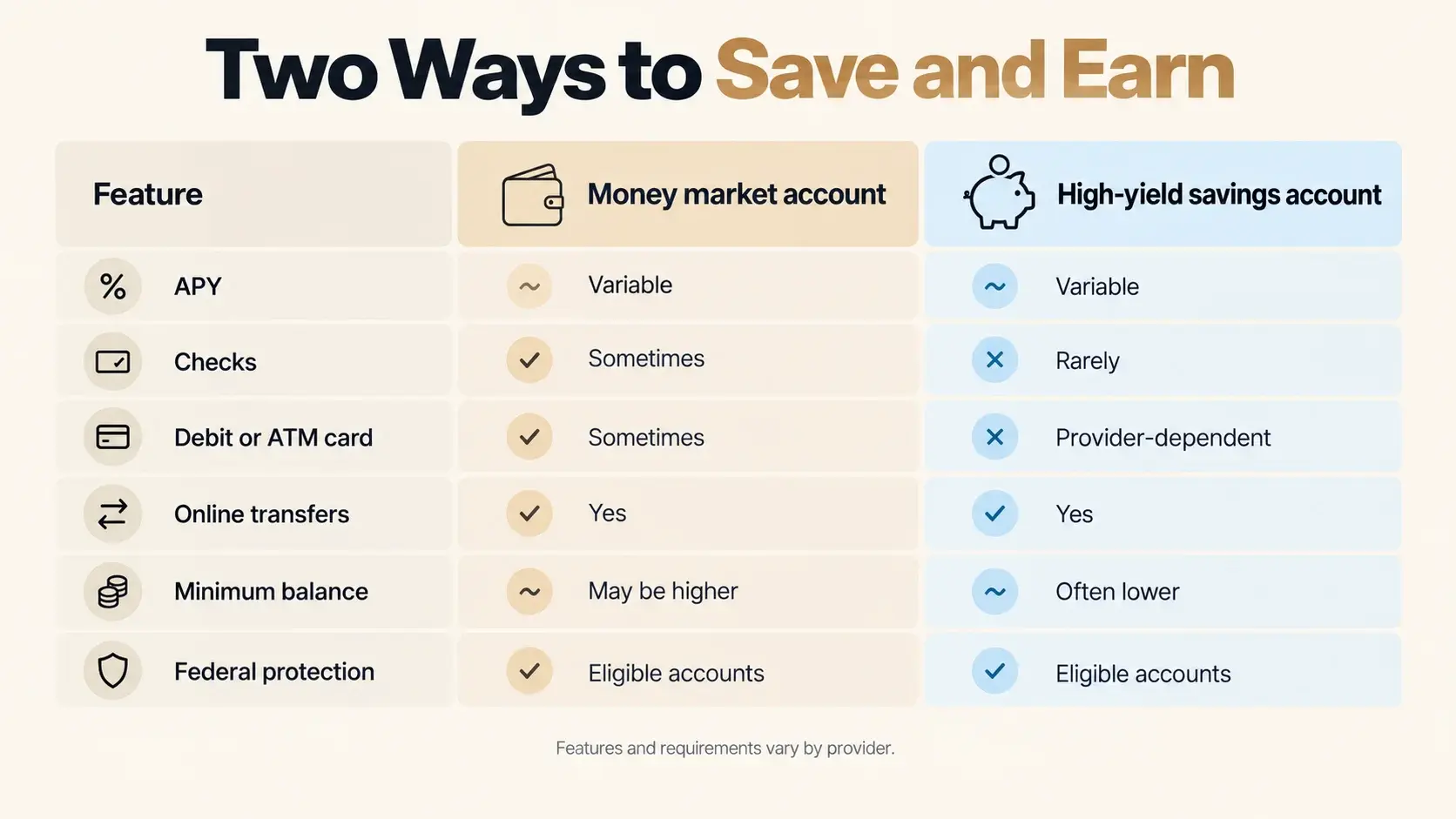
Money Market Account vs. High-Yield Savings Account at a Glance
| Feature | Money market account | High-yield savings account |
|---|---|---|
| Main purpose | Save while keeping some payment features | Save and earn a competitive APY |
| APY | Variable and set by the provider | Variable and set by the provider |
| Access | Transfers and, in some cases, checks or a debit or ATM card | Mainly electronic transfers; some providers offer ATM access |
| Minimum balance | May require a larger balance to open, avoid fees or earn the highest APY | Often available with a low or no minimum, but terms vary |
| Monthly fees | May apply | May apply, although many online accounts have no monthly fee |
| Federal protection | May be covered at an eligible bank or credit union | May be covered at an eligible bank or credit union |
What Is a Money Market Account?
A money market account is a deposit account offered by some banks and credit unions. It is designed for saving, but it may include features normally linked with a checking account.
Depending on the provider, you may receive checks, a debit card or an ATM card. This can make it easier to use the funds without first transferring them to another account. Some accounts require a minimum opening deposit. You may also need to keep a set balance to avoid a monthly fee or receive the highest advertised APY.
A money market account should not be confused with a money market mutual fund. A money market account is a deposit product. A money market mutual fund is an investment product and does not receive FDIC deposit protection.
What Is a High-Yield Savings Account?
A high-yield savings account is a savings account that offers a more competitive APY than many standard savings accounts.
Many of these accounts are offered online. You usually add or withdraw funds through electronic transfers, direct deposit or a linked checking account. Some providers also offer ATM access, but this is not included with every account.
A high-yield digital savings account can be useful for an emergency fund or another short-term goal. It keeps your savings separate from everyday spending while allowing the balance to earn.
Like a money market account, its APY is normally variable. The provider can raise or lower it over time.
Which Account Can Earn More?
Either account can offer the higher APY. A high-yield savings APY may be higher at one provider, while a money market account APY may be higher somewhere else. The account name does not tell you which one will earn more.
Compare the APY offered on the balance you plan to keep. Some providers use balance tiers. For example, the advertised APY may apply only after your balance reaches a set amount. Others may offer one APY for the full balance.
Also check whether a monthly fee could reduce what you earn. A strong APY may offer little value if you cannot meet the conditions needed to avoid the fee.
How Is Access to Your Money Different?
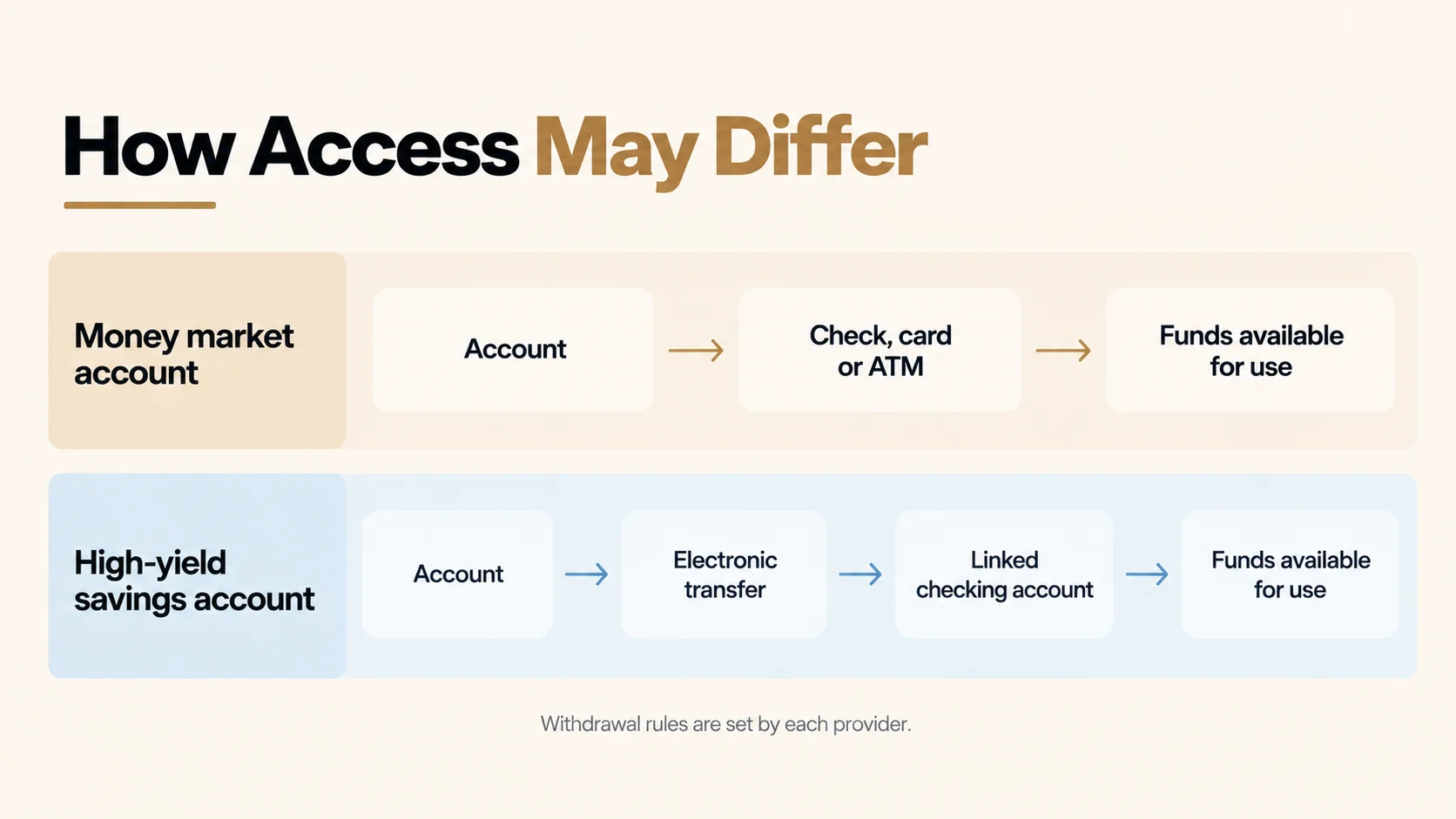
Access is often the clearest difference when comparing high yield savings vs money market accounts. A money market account may let you write checks or use a debit or ATM card. This can be useful when you need to pay directly from the account.
A high-yield savings account is more likely to depend on electronic transfers. If you need to send funds to a checking account first, the transfer may not arrive immediately. Timing depends on the provider and transfer method.
The Federal Reserve removed the federal limit of six convenient transfers per month from savings deposits in 2020. However, banks and credit unions may still create their own withdrawal rules or charge certain transaction fees. Check the account agreement before opening either account.
Fees and Minimum Balance Requirements
Fees and balance rules vary widely between accounts.
A money market account may require a larger opening deposit or minimum balance. If your balance falls below that amount, you could lose access to the highest APY or be charged a monthly fee.
Some high-yield savings accounts have no monthly fee or minimum opening deposit. Others have conditions you must meet. This is why it is important to read the account terms instead of relying only on the APY shown in an advertisement.
Before choosing an account, check:
- The minimum opening deposit
- The balance needed to earn the advertised APY
- Monthly maintenance fees
- ATM fees
- Transfer or withdrawal fees
- Charges for paper checks
An online savings app may look simple on the surface. You should still find out which institution holds the funds and what fees apply.
Are Both Accounts Protected?
Both accounts may receive federal protection when they are deposit accounts held with an eligible bank or credit union.
The FDIC generally covers eligible deposits up to $250,000 per depositor, per insured bank and per ownership category. The NCUA provides similar coverage for eligible accounts at federally insured credit unions.
Coverage is not based only on the name of the account. It depends on the institution holding your funds, the type of product and the way the account is owned.
If you use a high-yield savings app or another digital savings platform, check whether the company is a bank or whether it places customer funds with a partner bank. Read the coverage terms and confirm the name of the institution holding the deposits.
Money market mutual funds, stocks and other investment products are not deposit accounts. They do not receive FDIC protection simply because they are sold through a bank.
Which Account Is Better for You?
The better account is the one whose features match how you plan to use the funds.
A money market account may suit you if:
- You want to write checks from the account.
- You want debit or ATM card access.
- You can meet its minimum balance requirements.
- You want savings and limited payment features in one account.
A high-yield savings account may suit you if:
- Your main goal is to save and earn.
- You are comfortable managing the account online.
- You do not need to spend directly from the account.
- You want a low or no minimum balance.
- You can wait for an electronic transfer when withdrawing funds.
You can also use both. For example, you could keep emergency funds in the account with the fastest access and use another account for a separate savings goal. Just remember that more accounts mean more APYs, passwords, statements and rules to track.
Put your dollars into something real
With PureFi, your projected earnings come from shares of real homes with tenants . Choose your properties from your phone, review the documents, and see every fee before you confirm.
Learn more about how PureFi can help you own real estate shares or download the app to get started today.
Up to 6% APY is projected, variable and not guaranteed. Property shares can lose value. PureFi is not a bank, and its balances and real estate shares are not covered by FDIC insurance or another government deposit scheme.