
What Is a Joint High-Yield Savings Account and How Does It Work?

A joint high-yield savings account is owned by two or more people. Each owner can usually add money, view the balance, and make withdrawals. Meanwhile, the account earns a higher APY than many regular savings accounts. This structure can make it easier to manage an emergency fund or save for a shared expense.
However, shared ownership also gives each person significant control over the money. Before opening an account, both owners should understand the access rules, transfer limits, and what happens if they no longer want to save together.
How Does a Joint High-Yield Savings Account Work?
A joint high-yield savings account works much like an individually owned account. The main difference is that more than one person legally owns the account.
Both owners contribute to one balance. The bank or credit union applies its current APY to that balance and credits the earnings according to its stated schedule. Adding a second owner does not increase the APY. It only changes the account’s ownership and access.
For example, suppose two people open a joint account and deposit $5,000 each. The account has one $10,000 balance. Earnings are calculated on the combined balance rather than separately for each owner.
A high-yield digital savings account may also give each owner separate login credentials, transaction alerts, and access through a mobile app. The exact setup depends on the institution. Some providers require both people to complete the application together. Others let the first applicant invite a joint owner after opening the account.
The APY can also change. A higher starting APY is not a guarantee that the same yield will remain available. Banks can adjust variable savings rates as market conditions and their funding needs change.
Who Can Open a Joint High-Yield Savings Account?
Joint accounts are not limited to married couples. Depending on the provider, two or more eligible adults may be able to open one together.
Common arrangements include:
- Married or unmarried couples managing shared savings
- Parents and adult children saving for family expenses
- Relatives building a shared emergency reserve
- Household members preparing for a large joint purchase
Every applicant usually has to complete identity verification. This may require a legal name, date of birth, home address, Social Security number or tax identification number, and government-issued identification.
The institution may also ask how the account should be titled and whether it includes a right of survivorship. This detail can affect what happens if one owner dies. According to the Consumer Financial Protection Bureau, the outcome depends on how the owners agreed to hold the account. The account agreement should explain whether the balance passes to the surviving owner or is handled another way.
How Does Shared Ownership Work?
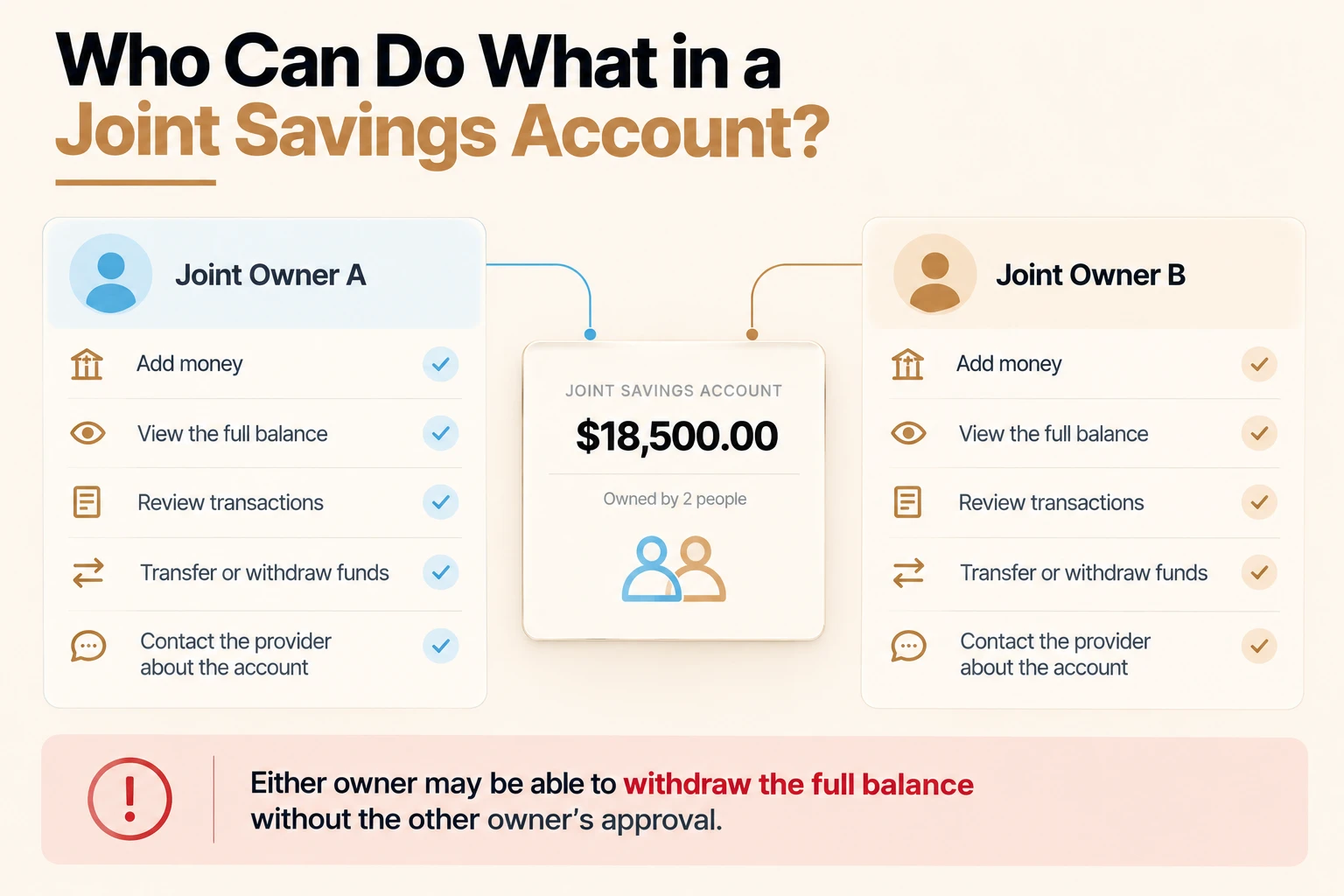
Joint ownership gives more than one person a legal claim to the same account. In most cases, each named owner can see and manage the full balance, even when the owners have contributed different amounts.
Equal Access Does Not Mean Equal Contributions
Two people do not have to deposit the same amount. One owner could contribute $15,000 while the other contributes $5,000. The account would still show a single $20,000 balance.
However, contributing more money may not give one owner greater control. If both people are full joint owners, the account agreement may allow either one to withdraw from the entire balance.
This is why contribution records can be useful. The bank’s transaction history shows where deposits came from, but both owners may also want to keep their own records when contributions are unequal.
Joint Owner Versus Authorized User
A joint owner and an authorized user are not the same. A joint owner has an ownership claim over the account. They can generally view the balance, make deposits, transfer money, and withdraw funds according to the account agreement.
An authorized signer may be allowed to complete certain transactions without owning the money. This arrangement is sometimes used when a family member or caregiver needs to help manage an account.
Anyone who only needs limited access should ask whether the institution offers an authorized-signer option. Adding that person as a joint owner may give them more control than intended.
Adding or Removing an Owner
Some providers allow an owner to be added after the account has been opened. Others require a new application or a completely new account.
Removing an owner can be more difficult. The institution may require consent from everyone named on the account. In some cases, the account must be closed and the remaining balance transferred to a new individually owned account.
The owners should check this process before depositing a large amount. It is much easier to understand the exit procedure before a disagreement occurs.
Who Can Deposit or Withdraw Money?
Both owners can usually deposit money into a joint account. Deposits may be made through bank transfers, direct deposits, mobile check deposits, or other methods supported by the provider.
Withdrawals require more attention. In most joint accounts, either owner can move money without receiving approval from the other person.
The CFPB explains that people named on a joint account can generally write checks, withdraw money, make transactions, transfer funds, or close the account. It also notes that a creditor may try to collect money from a joint account when one owner owes a debt.
That level of access is convenient when both owners are working toward the same goal. It can also create risk. One person may be able to withdraw the full balance or close the account without the other person’s permission. The CFPB confirms that, in most circumstances, either joint owner can withdraw the money and close a joint account.
Before opening an account, check:
- Whether either owner can withdraw the entire balance
- Whether both owners must approve an account closure
- Whether each person receives separate login credentials
- Whether transaction alerts can be sent to both owners
- How long outgoing transfers take
- Whether daily or monthly transfer limits apply
For more detail, read our guide to withdrawing from a high-yield savings account.
Are Joint Savings Accounts Limited to Six Withdrawals Per Month?
There is no longer a federal rule requiring savings accounts to limit customers to six convenient transfers or withdrawals per month.
The Federal Reserve removed that numerical limit from Regulation D in April 2020. However, the change did not stop individual banks and credit unions from setting their own limits or charging fees under their account agreements.
Joint owners should also consider how they plan to use the account. A high-yield savings account is generally intended for saving, not frequent spending. People who need debit-card purchases, bill payments, or regular cash withdrawals may also need a checking account.
Our comparison of a high-yield savings account versus a checking account explains the difference in access and everyday use.
Benefits of a Joint High-Yield Savings Account
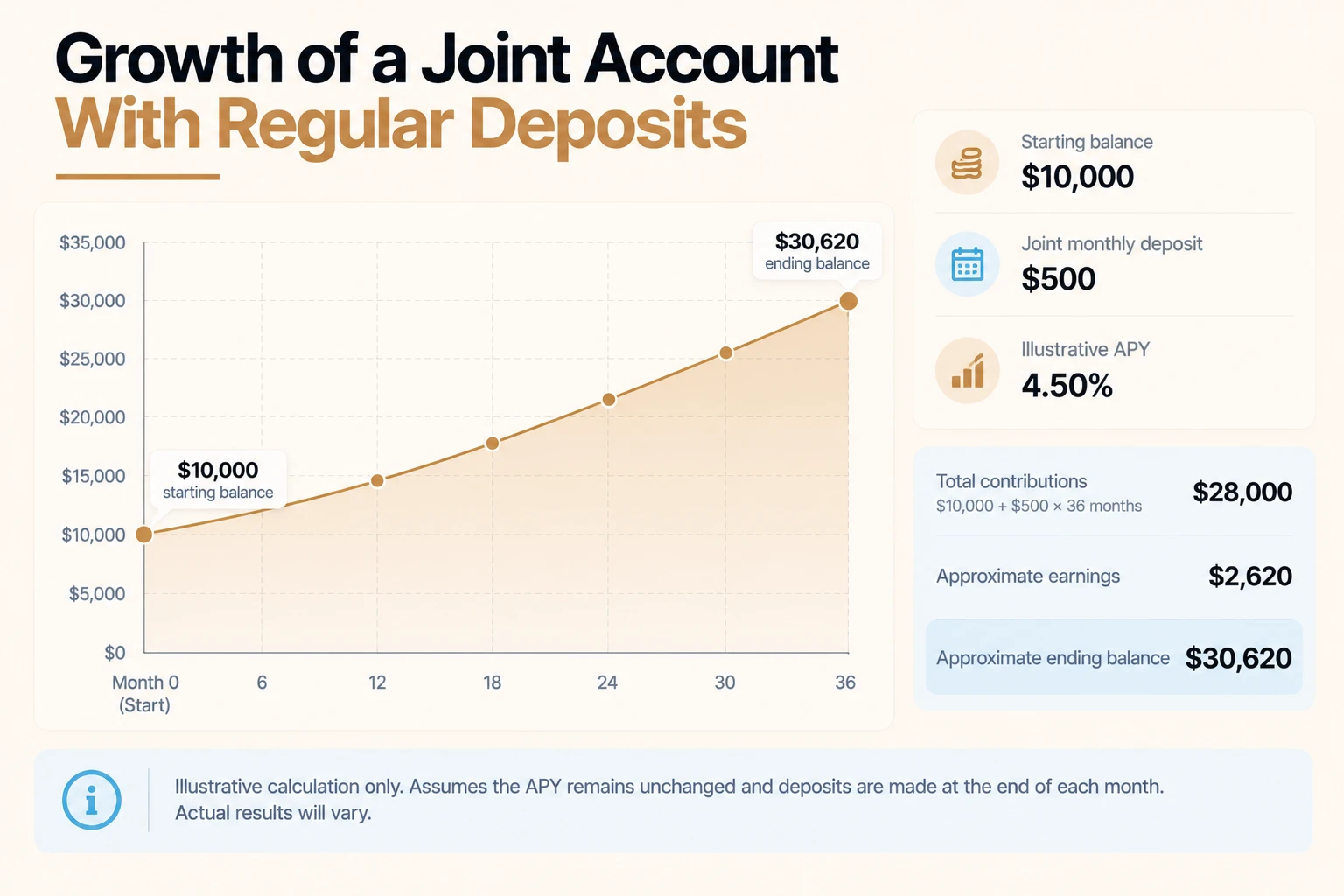
A joint account can make shared saving simpler. Both people can see the same balance and track progress without sending money back and forth between separate accounts.
One Account for a Shared Goal
A couple or family may use the account for a home deposit, emergency reserve, education cost, or major household expense. Keeping that money separate from everyday spending can make the goal easier to monitor.
The owners can also automate regular deposits. One person might transfer $300 per month while the other transfers $500. Both contributions enter the same balance and start earning according to the account’s APY.
People deciding between shared and separate accounts can also read our guide to holding multiple high-yield savings accounts.
Shared Visibility
Separate access can help both owners monitor deposits, withdrawals, and account changes. A good high-yield savings app may let each person receive alerts when money enters or leaves the account.
This visibility can make shared saving more transparent. However, notifications do not prevent transactions. An alert may tell one owner that money was withdrawn, but it may not require their approval before the withdrawal occurs.
Competitive Yield on the Combined Balance
A joint account may offer the same competitive APY as an individually owned account from the same provider. The benefit comes from placing pooled savings in an account that offers a stronger yield than a low-paying regular account.
The APY is applied to the balance, not divided according to who deposited the money. Both owners should agree on whether earnings remain in the account or can be withdrawn.
Risks to Consider Before Sharing an Account
The biggest risk is loss of individual control. If either owner can access the full balance, one person could remove money that the other person expected to remain available.
This does not mean joint accounts are unsuitable. It means the account should be opened with someone you trust and with clear expectations about how the money will be used.
Disagreements Over Contributions
Problems can arise when one owner contributes more but both have equal access. The owners should agree on whether contributions are treated as shared money and what should happen if they stop saving together.
Keeping records does not automatically change the bank’s ownership rules. However, it may help the owners understand how much each person added.
Creditor and Legal Risks
Money in a joint account may be affected when one owner has unpaid debts, faces a court judgment, or becomes involved in another legal dispute. The exact outcome depends on the circumstances and applicable state law.
Anyone concerned about creditor access, divorce, inheritance, or ownership disputes should obtain professional legal or tax guidance before combining a large balance.
Security and Privacy
Each owner should have their own login details. Sharing one password makes it harder to identify who completed a transaction and creates unnecessary security risk.
Both owners should enable transaction alerts and review statements. They should also agree on what to do if a phone is lost, an account is compromised, or an unfamiliar withdrawal appears.
Put your dollars into something real
With PureFi, your projected earnings come from shares of real homes with tenants. Choose your properties from your phone, review the documents, and see every fee before you confirm.
Learn more about how PureFi can help you own real estate shares or download the app to get started today.
Up to 6% APY is projected, variable, and not guaranteed. Property shares can lose value. PureFi is not a bank, and its balances and real estate shares are not covered by FDIC insurance or another government deposit scheme.


