
Is a HYSA Liquid?
Yes. A high-yield savings account is generally considered liquid because you can request a withdrawal without waiting for a fixed term to end. That does not mean the money is always ready to spend within seconds. It may need to move to a checking account first, and external transfers can take one or more business days.
The practical answer depends on the account. Before relying on a HYSA for emergencies, check its withdrawal methods, transfer times, deposit holds, transaction limits, and card access.
What Does Liquid Mean for a Savings Account?
Liquidity describes how easily you can access money without selling an asset, waiting for a maturity date, or accepting a large early-withdrawal charge.
A high-yield savings account is liquid because the balance is normally available for withdrawal. It does not have a fixed term like a traditional certificate of deposit. You can also add money when the account allows it instead of making one deposit and waiting for the product to mature.
However, three separate questions affect how useful that liquidity is:
- Are you allowed to withdraw the money?
- How long will the withdrawal take?
- Can you spend the money directly from the account?
A HYSA may pass the first test but not the other two. For example, an online account might let you request a withdrawal at any time, but the money may take two business days to reach your checking account.
That account is still liquid. It simply does not provide instant spending access.
How Can You Withdraw Money From a HYSA?
Withdrawal methods differ between providers. Many online accounts rely on electronic transfers, while some banks offer ATM access, checks, or in-branch withdrawals.
Transfer to a Linked Bank Account
An electronic transfer is the standard option for many online HYSAs. You connect a checking account or another bank account, choose an amount, and submit the transfer through the provider’s website or app.
The receiving account usually needs to be in your name. A provider may ask you to verify ownership before allowing the first transfer.
This method is convenient, but it is not always immediate. The transfer must pass through the relevant payment network and both institutions’ processing systems.
For a closer look at the withdrawal process, read our guide to withdrawing from a high-yield savings account.
Transfer Between Accounts at the Same Bank
Moving money from savings to checking at the same institution is often faster. The balance may appear in checking immediately or later that day.
Even then, check the available balance before spending. An amount can appear in your transaction history while still being subject to a temporary hold.
ATM or Card Withdrawal
Some high-yield savings accounts include an ATM card. This can provide direct access to cash without moving the balance to checking first.
A purchase-enabled debit card is less common. Savings accounts are not generally designed for everyday transactions, so many providers offer no card at all.
An ATM card and a debit card are not necessarily the same. An ATM card may work only for cash withdrawals and balance checks. Our article on whether high-yield savings accounts have debit cards explains the difference.
Wire or Official Check
A bank may allow an outgoing wire or issue an official check from the account. A wire can be useful for a large or time-sensitive payment, but it may carry a fee.
Official checks take longer if they are sent by mail. Large cash withdrawals at a branch may also require advance notice because the branch may not keep enough physical currency on hand.
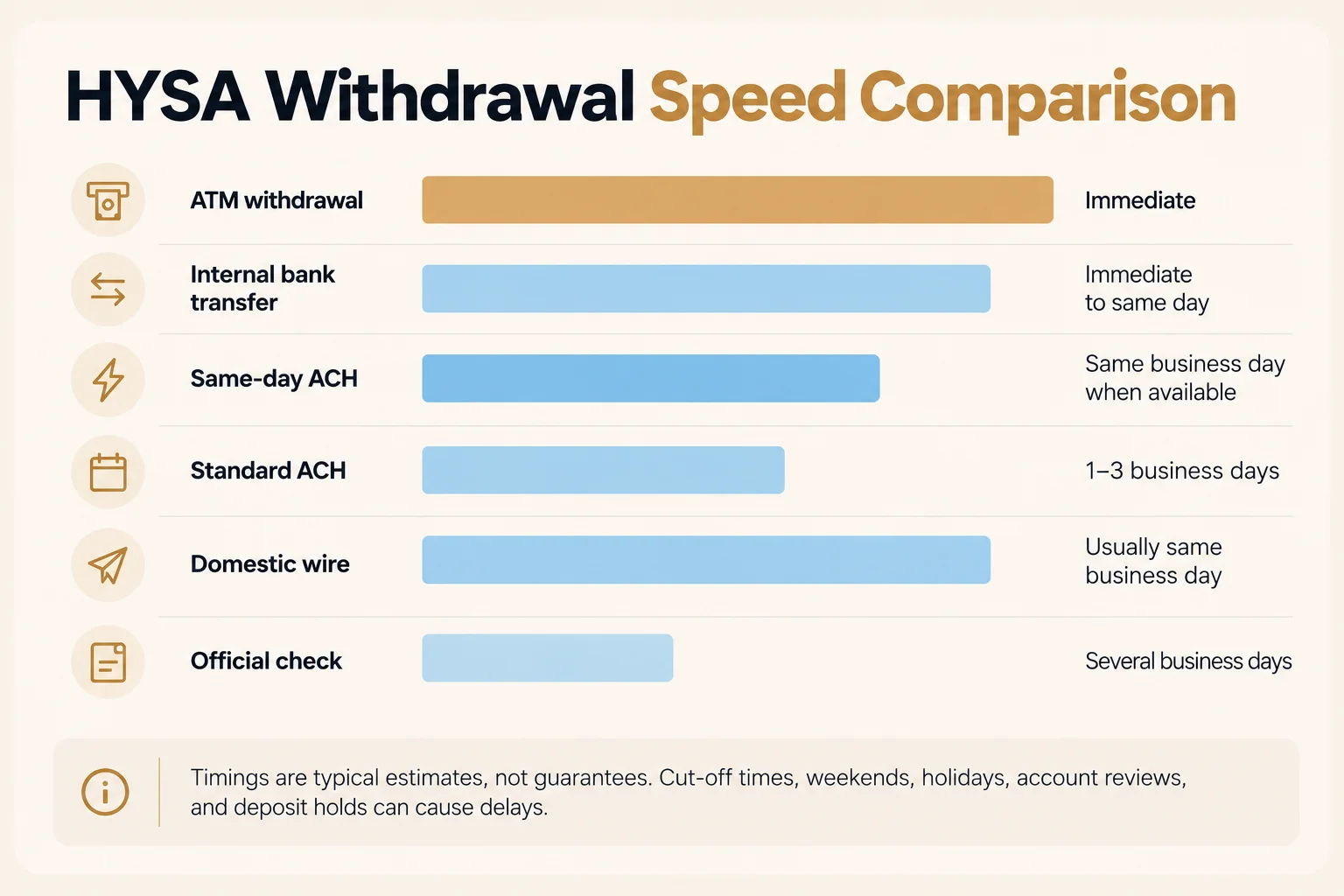
How Long Does It Take to Withdraw From a HYSA?
Transfer speed depends on the method, submission time, and provider.
| Withdrawal method | Common timing | Possible delay |
|---|---|---|
| Transfer within the same bank | Immediate or same day | Internal processing or account review |
| Standard ACH transfer | One to three business days | Weekends, holidays, and cut-off times |
| Same-day ACH transfer | Same business day when available | Eligibility and submission deadline |
| Domestic wire | Usually the same business day | Verification, cut-off times, and fees |
| ATM withdrawal | Immediate | ATM availability and daily limits |
| Official check | Several business days | Processing, delivery, and deposit holds |
Nacha, which administers the ACH Network’s operating rules, estimates that 80% of ACH payments settle in one banking day or less. Settlement speed is not the only factor, though. The sending bank and receiving bank may have their own processing schedules.
Transfers also tend to slow down around weekends and bank holidays. A request placed on Friday evening may not begin processing until Monday. If Monday is a holiday, the transfer could start even later.
A high-yield savings app should show the estimated arrival date before you confirm a withdrawal. It should also separate available money from deposits or transfers that are still pending.
Why Might Your Money Be Temporarily Unavailable?
A liquid account can still have short access delays. These usually come from processing or security controls rather than a fixed lock-up period.
A Recent Deposit Is on Hold
A bank may allow the deposit to appear in your total balance before making all of it available for withdrawal. This is common with checks, newly linked accounts, large deposits, and recently opened accounts.
The provider’s funds-availability policy should explain when different deposit types can be withdrawn.
The Transfer Missed the Daily Cut-Off
Banks process transfers in scheduled windows. A request entered after the cut-off may be treated as though it arrived on the following business day.
This can make two transfers submitted only a few minutes apart arrive on different days.
The Provider Needs Additional Verification
An unusual withdrawal may trigger a security review. That can happen when you connect a new external account, use a new device, request a large transfer, or change your contact information shortly before withdrawing.
These checks can be inconvenient, but they are intended to reduce unauthorized transfers.
The Receiving Bank Has Not Released the Funds
A transfer can leave one account before it becomes available in another. Check the status at both institutions instead of assuming that the money has disappeared.
Do HYSAs Have Withdrawal Limits?

The Federal Reserve removed the former federal limit of six convenient transfers or withdrawals per month from savings deposits in April 2020. Banks are therefore not required by that rule to restrict customers to six monthly transfers.
Individual banks and credit unions can still set their own limits. Depending on the provider, these may include:
- A maximum amount per transfer
- A daily or monthly withdrawal limit
- A lower limit for recently opened accounts
- ATM cash limits
- Fees for wires or expedited transfers
- Limits on the number of linked external accounts
Do not assume that every HYSA now permits unlimited activity. Read the current account agreement and fee schedule. Older articles may still describe the six-withdrawal rule as a federal requirement, but that information is no longer current.
Is a HYSA Liquid Enough for an Emergency Fund?
A HYSA can work well for an emergency fund when its access time matches the type of emergency you are preparing for.
Suppose your car needs a repair and the garage accepts a credit card. You may be able to pay with the card, move money from savings, and use the transferred balance to pay the card before it is due.
The situation changes if you need cash today. A HYSA that requires a two-day external transfer may not help in time.
One practical setup is to keep a smaller buffer in checking and the rest of the emergency fund in savings. Checking covers urgent payments. The HYSA keeps the larger balance separate while allowing it to earn.
Our high-yield savings account versus checking account comparison explains how the two can handle different parts of your finances.
How Does HYSA Liquidity Compare With Other Accounts?
Liquidity is not simply “available” or “unavailable.” Different products provide different levels of access.
| Product | General liquidity | Main access issue |
|---|---|---|
| HYSA | High | External transfers may take several business days |
| Checking account | Very high | Built for card use, bills, and regular withdrawals |
| Cash management account | High | Access depends on the provider and where money is held |
| No-penalty CD | Moderate to high | A withdrawal may require closing the CD |
| Traditional CD | Lower | Early withdrawal can trigger a charge |
| Investment account | Varies | Assets may need to be sold before cash can be withdrawn |
A cash management account often provides debit-card, ATM, and bill-payment features. However, the company offering the interface may move customer cash to partner banks or another cash position. Read our HYSA versus cash management account comparison before treating the two products as interchangeable.
A no-penalty CD provides more access than a traditional CD, but its rules may still be less flexible than a savings account. Some products require the full balance to be withdrawn at once or prohibit access during the first several days. See No-Penalty CD vs Savings Account for a detailed comparison.
An investment account works differently. Marketable assets may be easy to sell, but their value can move before the sale. Settlement and withdrawal processing can add more time. A high-yield investment platform should not be described as equivalent to an insured savings account simply because both can display a projected return.
What Should You Check Before Opening a HYSA?
Do not judge liquidity from a provider’s use of words such as “flexible” or “easy access.” Look at the actual account terms.
Start with the available withdrawal methods. Find out whether you can use an ATM, request a wire, receive an official check, or only transfer money to a linked account.
Next, check the timing. A digital savings platform should explain its standard processing window and show whether faster transfers are available. Look for cut-off times, weekend handling, security-review policies, and any waiting period for a newly linked account.
Fees matter too. A high-yield digital savings account may have no monthly charge but still apply an outgoing wire fee or expedited-transfer fee.
Finally, check transaction limits. Confirm both the number of withdrawals allowed and the dollar amount you can move. A high APY has less practical value if the account cannot release the amount you need when you need it.
Put Your Dollars Into Something Real
With PureFi, your projected earnings come from shares of real homes with tenants. Choose your properties from your phone, review the documents, and see every fee before you confirm.
Learn more about how PureFi can help you own real estate shares or download the app to get started today.
Up to 6% APY is projected, variable, and not guaranteed. Property shares can lose value. PureFi is not a bank, and its balances and real estate shares are not covered by FDIC insurance or another government deposit scheme.


