
Is a High-Yield Savings Account Good for an Emergency Fund?
A high-yield savings account can be a good place for an emergency fund. It allows your money to earn a competitive APY without exposing the balance to normal investment-market changes. You can usually transfer the funds to checking when an unexpected expense appears.
However, access is not always immediate. Transfer times, withdrawal methods, fees, and account rules vary by provider. Before choosing an account, check how quickly you can reach your money and whether eligible deposits are protected by the FDIC or NCUA.
Why Use a High-Yield Savings Account for an Emergency Fund?
An emergency fund is money reserved for expenses you could not reasonably plan for. This could include a medical bill, urgent home repair, essential car repair, or temporary loss of income.
The money needs to be safe and accessible. It should not depend on selling an investment at a good time. At the same time, leaving a large balance in a checking account may mean earning little or no yield.
A high yield digital savings account can provide a middle ground. Your balance earns while it waits, but it is not locked away for a fixed term.
Your emergency money can earn
A higher APY allows an emergency balance to produce more earnings than it may receive in a standard savings account. Suppose you keep $10,000 in an account for one year:
At 0.50% APY, the approximate earnings would be $50.
At 4.00% APY, the approximate earnings would be $400.
The difference would be about $350, assuming the balance and APYs remain unchanged.
Actual earnings may vary because savings APYs are usually variable. The provider can raise or lower the APY after you open the account. Deposits and withdrawals also change the balance used to calculate earnings.
A higher APY is useful, but it should not be the only reason you choose an emergency account.
Your balance remains relatively accessible
A HYSA normally allows withdrawals and transfers. That makes it more liquid than investments that must be sold before the money can be used.
Many accounts let you transfer money electronically to a linked checking account. Some offer an ATM card, while others require all withdrawals to be completed online.
Transfer speed matters. A standard ACH transfer may take one to three business days, depending on the institutions involved, the time of the request, and whether the transfer requires additional review.
Our guide to HYSA liquidity explains what access can look like in practice.
Eligible deposits may receive federal protection
A savings account at an FDIC-insured bank generally receives deposit insurance within the applicable limits. The standard limit is $250,000 per depositor, per insured bank, for each account ownership category.
Federally insured credit unions provide similar protection through the National Credit Union Share Insurance Fund. You can review the official coverage rules through the FDIC and NCUA. This protection does not prevent an account’s APY from changing. It protects eligible deposits if the insured institution fails.
Check the institution itself rather than relying only on an app’s branding. Some financial technology companies place customer deposits with partner banks. The provider should explain which bank holds the money and how deposit insurance applies.
What Should an Emergency-Fund Account Offer?
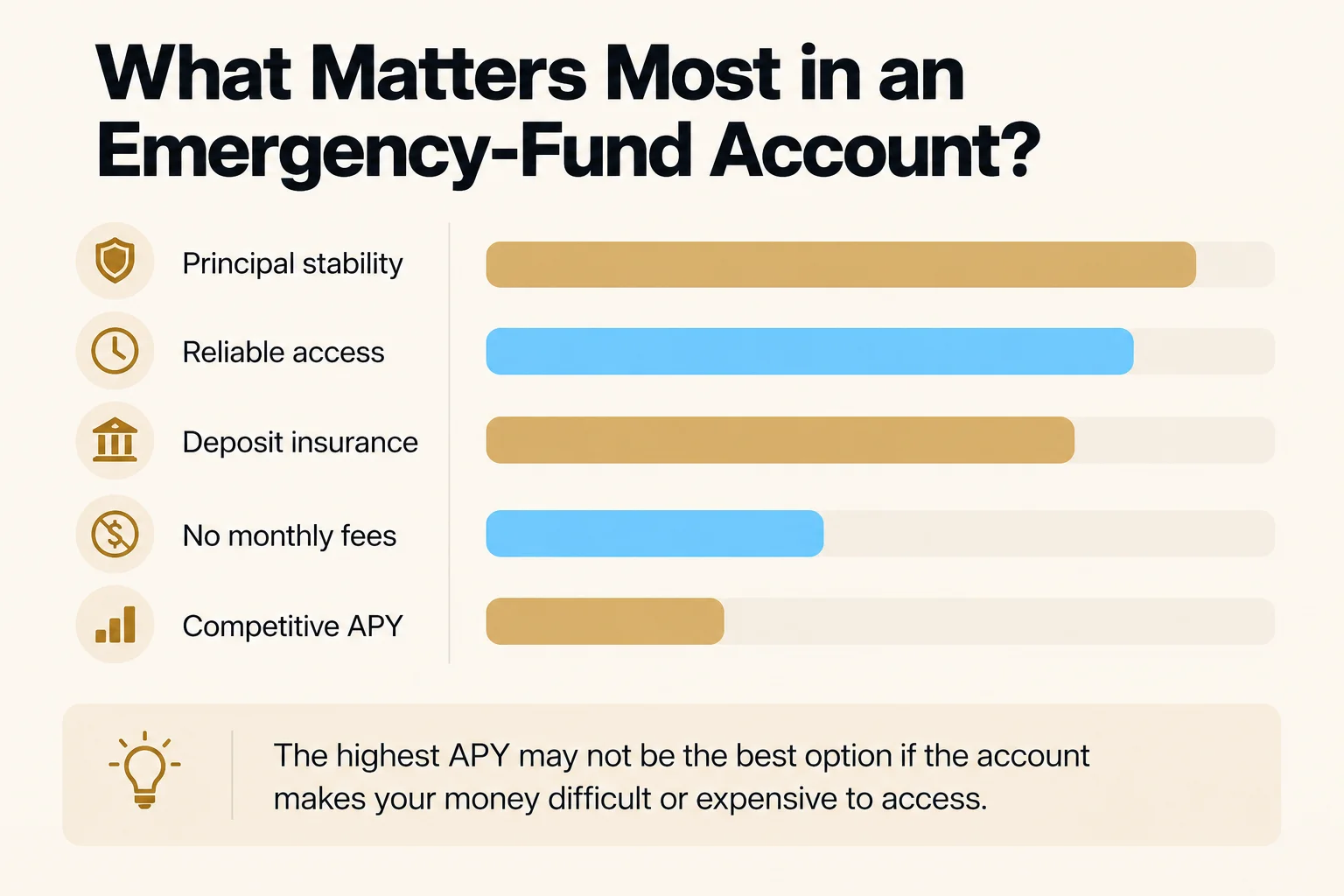
The best emergency account is not necessarily the account with the highest number in an advertisement. It is the account that lets you reach your money reliably without losing part of the balance to avoidable charges.
Look for the following features:
- No monthly maintenance fee
- No restrictive minimum-balance requirement
- A competitive APY on the amount you expect to keep
- FDIC or NCUA protection for eligible deposits
- Dependable transfers to your checking account
- Clear withdrawal limits and processing times
- Mobile and online account access
- Customer support available when access goes wrong
Some accounts advertise a strong APY but require qualifying deposits, a specific balance, or other monthly activity. Others apply the headline APY only to a limited part of the balance.
Read the account disclosures before depositing your emergency money. A digital savings platform should clearly show the APY, fees, balance requirements, withdrawal methods, and the bank or credit union holding the funds.
How Quickly Can You Access an Emergency Fund?
Most high-yield savings accounts are liquid, but liquid does not always mean instant.
Electronic transfers
Electronic transfers are the most common way to move money from an online savings account to checking. Processing may take one or more business days. Weekends and federal holidays can extend the wait.
New accounts or recently linked external accounts may also face temporary holds. A large or unusual transfer can require additional verification.
If your HYSA and checking account are offered by the same institution, internal transfers may be faster. Confirm the provider’s processing schedule instead of assuming every transfer will arrive on the same day.
ATM cards
Some providers include an ATM card with a savings account. This may allow direct cash withdrawals without moving money to checking first.
Not every HYSA has this feature. An ATM withdrawal may also be subject to daily limits, network restrictions, or operator fees.
Read Do High-Yield Savings Accounts Have Debit Cards? for a closer look at card access.
Direct bill payments
A savings account may accept certain electronic debits, but it is not designed to replace a checking account. Some providers do not offer bill pay or check writing from savings.
If an urgent invoice is due, you may need to transfer the money into checking before paying it. Our guide to paying bills from a high-yield savings account covers the available methods and their limits.
How Much Should an Emergency Fund Hold?
There is no single amount that works for every household. Your target should reflect your essential expenses and the risks you are preparing for.
Start by adding the monthly costs you would still need to pay during a loss of income. These may include:
- Housing
- Utilities
- Groceries
- Insurance
- Essential transport
- Minimum debt payments
- Necessary medical costs
- Childcare or dependant care
Someone with stable income, strong insurance, and another working adult in the household may be comfortable with a smaller reserve. A freelancer, sole-income household, or person with higher medical costs may need more.
A practical approach is to build the fund in stages. Start with enough to handle a smaller urgent bill. Then work toward one month of essential expenses. From there, increase the balance based on your income stability and responsibilities.
Regular transfers can make the target easier to manage. You could move a fixed amount into your HYSA on every payday rather than waiting to deposit whatever remains at the end of the month.
Our guide to how much to save each month in a HYSA can help you set a realistic contribution.
Where Should You Keep Your Emergency Money?
Keeping every dollar in one account is simple, but it may not provide the best access.
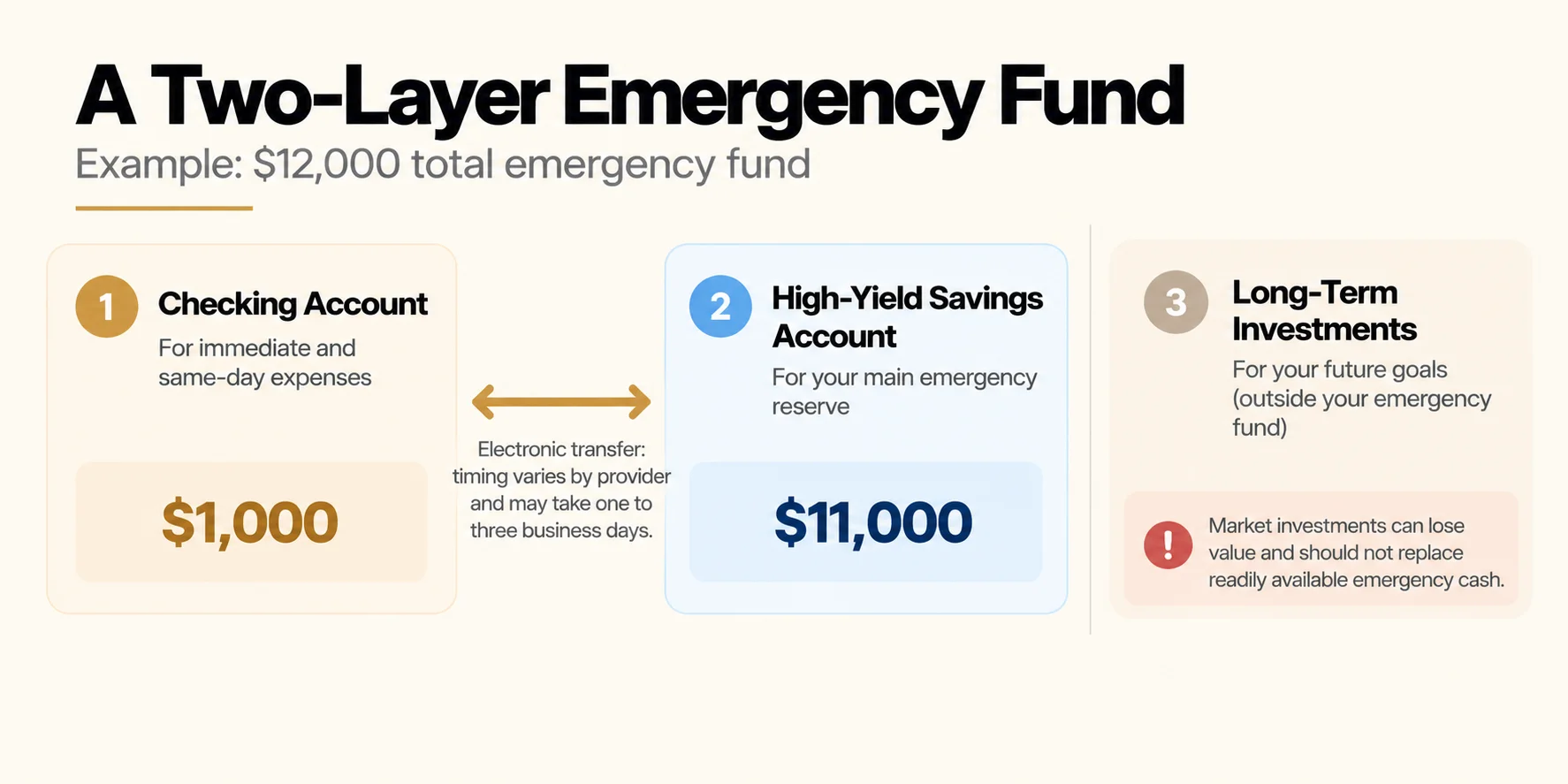
One option is to divide the fund into two layers. Keep a smaller buffer in checking for same-day expenses. Hold the rest in an insured high-yield savings account linked to that checking account.
For example, someone with a $12,000 emergency fund might keep $1,000 in checking and $11,000 in a HYSA. The checking buffer could cover an urgent payment while the larger balance continues earning.
The exact split depends on your normal bills and the time required to transfer money.
Keeping emergency savings separate from everyday spending can also reduce the temptation to use it for routine purchases. A high yield savings app or online savings app may allow you to name the account, track progress, and automate deposits.
Should Emergency Money Be Invested?
Money that may be needed at short notice should generally not depend on an asset sale. Investments can lose value, and selling during a downturn could turn a temporary expense into a permanent loss.
An insured savings balance does not have the same market-price risk. That is why it is commonly used for the core emergency reserve.
Once that reserve is fully funded, you may decide to place additional money into investments based on your goals, time frame, and willingness to accept losses. Those funds serve a different purpose from emergency cash.
Is a High-Yield Savings Account Good for an Emergency Fund?
Yes, a high-yield savings account can be a sensible place for an emergency fund. It can provide competitive earnings while keeping the balance separate from daily spending and available through withdrawals or transfers.
Look beyond the advertised APY. Check deposit insurance, fees, transfer times, withdrawal methods, minimum balances, and account conditions.
It can also help to keep a smaller amount in checking for immediate expenses. The main emergency balance can then remain in an insured HYSA until it is genuinely needed.
Put your dollars into something real
With PureFi, your projected earnings come from shares of real homes with tenants. Choose your properties from your phone, review the documents, and see every fee before you confirm.
Learn more about how PureFi can help you own real estate shares or download the app to get started today.
Up to 6% APY is projected, variable, and not guaranteed. Property shares can lose value. PureFi is not a bank, and its balances and real estate shares are not covered by FDIC insurance or another government deposit scheme.


