
How to Get the High-Yield Savings Bonus
A high-yield savings bonus can add a one-time payment to the earnings from a new account. Opening the account is usually only the first step. You may also need to use a promotional link, enter a code, deposit new money by a deadline, and maintain a qualifying balance for several weeks or months.
Each offer has its own rules. Missing one condition can cancel the bonus even if the account remains open. Before moving any money, read the full terms, save a copy, and record every deadline.
What Is a High-Yield Savings Account Bonus?
A high-yield savings account bonus is a promotional payment offered by a bank, credit union, or financial provider. It may be used to attract new customers or encourage people to deposit larger balances.
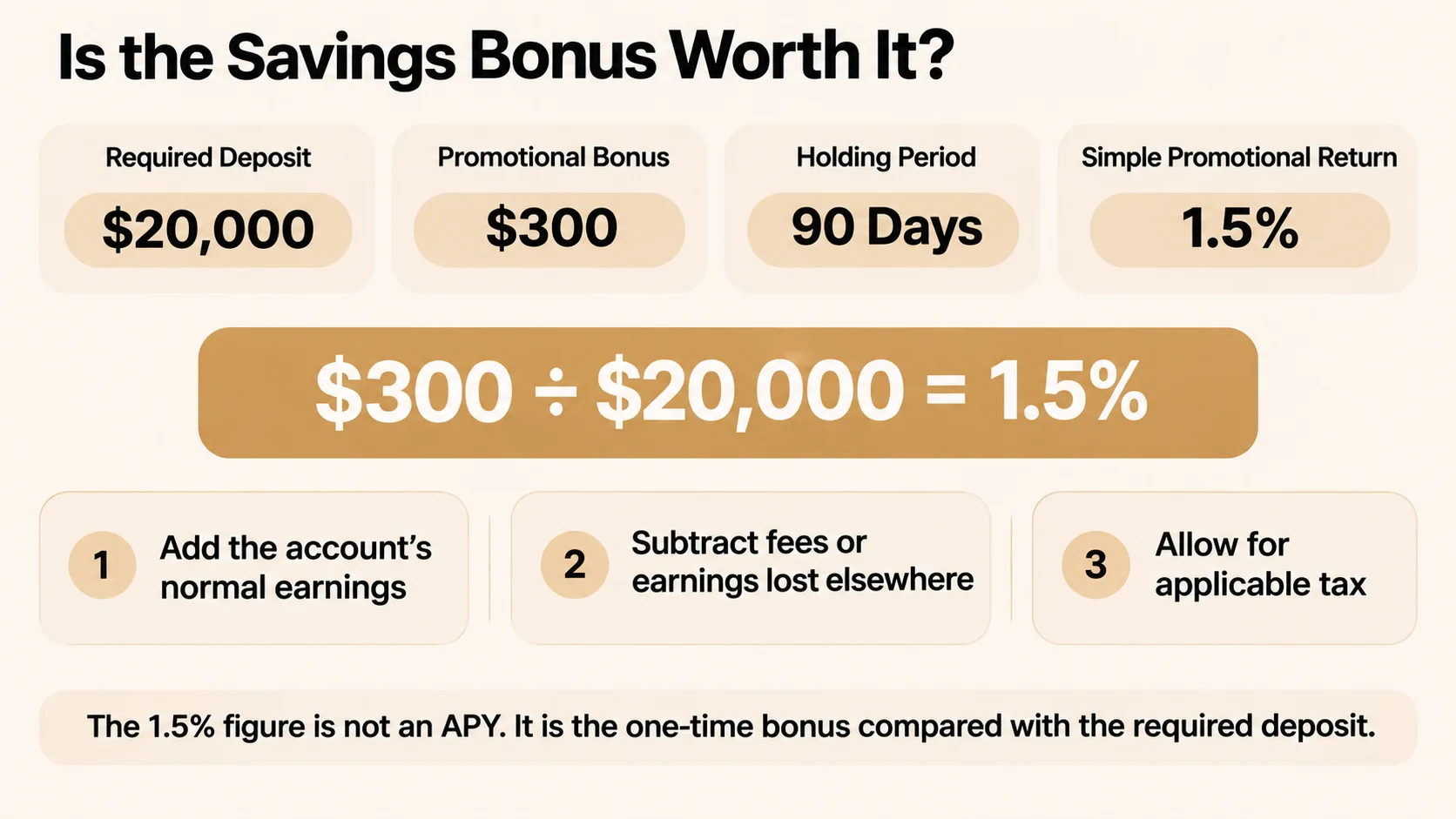
The bonus is separate from the account’s APY. A bonus is a one-time payment. You receive it after completing the promotion’s conditions. APY shows the effect of the account’s yield and compounding over one year.
For example, an account could offer a $300 opening bonus alongside a variable APY. You would receive the $300 once after qualifying. The balance would continue earning according to the account’s APY, although that APY could change.
A larger bonus does not automatically make an account better. The required deposit, holding period, monthly fees, standard APY, and withdrawal rules all affect the real value of an offer.
1. Find an Eligible Promotional Offer
Savings bonuses may appear on a provider’s website, in an email, through a referral link, or on a dedicated promotional page. Some offers are available to the public. Others are sent only to selected customers.
Start by finding the full terms. An advertisement may say that customers can earn “up to $500,” while the terms explain that the full amount requires a much larger deposit than the lower bonus tiers.
Check the following details before applying:
- The account-opening deadline
- The qualifying account
- The required deposit
- The funding deadline
- The balance-holding period
- The expected payment date
- Any location or customer restrictions
Confirm the offer through the provider’s official website. A third-party page may remain online after the promotion has ended.
Save a copy of the terms before opening the account. This gives you a record of the conditions in effect when you applied.
2. Read the New-Customer Rules
Many savings bonuses are reserved for new customers. However, each provider may define “new customer” differently.
You could be ineligible if you currently hold the same type of account, closed one recently, or received another opening bonus during a stated lookback period. The lookback period may cover several months or years.
Some promotions limit bonuses to one per person, household, address, or taxpayer identification number. Joint accounts can make these rules more complicated. If one owner held an account with the provider recently, the entire application may be excluded.
Opening another savings account with a bank you already use does not necessarily qualify you for a new-customer offer.
If the terms are unclear, ask the provider before applying. Keep a record of its response, especially when the promotion requires a large deposit.
3. Use the Correct Page or Promotional Code
Some promotions are attached automatically when you apply through a dedicated page. Others require a promotional code.
The code may need to be entered during the original application. Customer service might not be able to add it after the account has been opened.
Follow the application instructions exactly. If the promotion directs you to a specific link, do not leave that page and apply through the provider’s standard account-opening page instead.
Before submitting the application, look for the code or a message confirming that the offer has been attached.
Keep copies of the promotional terms, code, application confirmation, account-opening date, and funding instructions. These records can help if the bonus does not arrive and the provider asks for evidence.
Our guide to opening a high-yield savings account explains the standard application and identity-verification process.
4. Deposit the Required Amount on Time
Most savings bonuses require a minimum deposit. Some promotions use tiers, with larger bonuses available for higher qualifying balances.
An offer might provide $100 for one deposit range, $300 for another, and $500 for the highest tier. Check how much additional money is needed to reach each tier before deciding which bonus to pursue.
Does the money need to be new?
Many promotions require “new money.” This usually means funds transferred from outside the institution.
Moving money from an existing checking account to a new savings account at the same bank may not count. Internal transfers, returned deposits, account credits, and adjustments may also be excluded.
Read the promotion’s definition of new money rather than assuming every deposit will qualify.
When does the funding period begin?
The funding period may begin on the application date, approval date, or official account-opening date. The terms should identify which date starts the clock.
Do not wait until the final day to begin a transfer. ACH transfers can take several business days. Weekends, federal holidays, or account-verification checks may cause additional delays.
The provider may use the date the money reaches the account, not the date you requested the transfer.
Some accounts also accept payroll payments. However, a promotion may treat a direct deposit differently from a standard bank transfer. Our guide to direct deposits into a high-yield savings account explains the difference.
5. Maintain the Required Balance
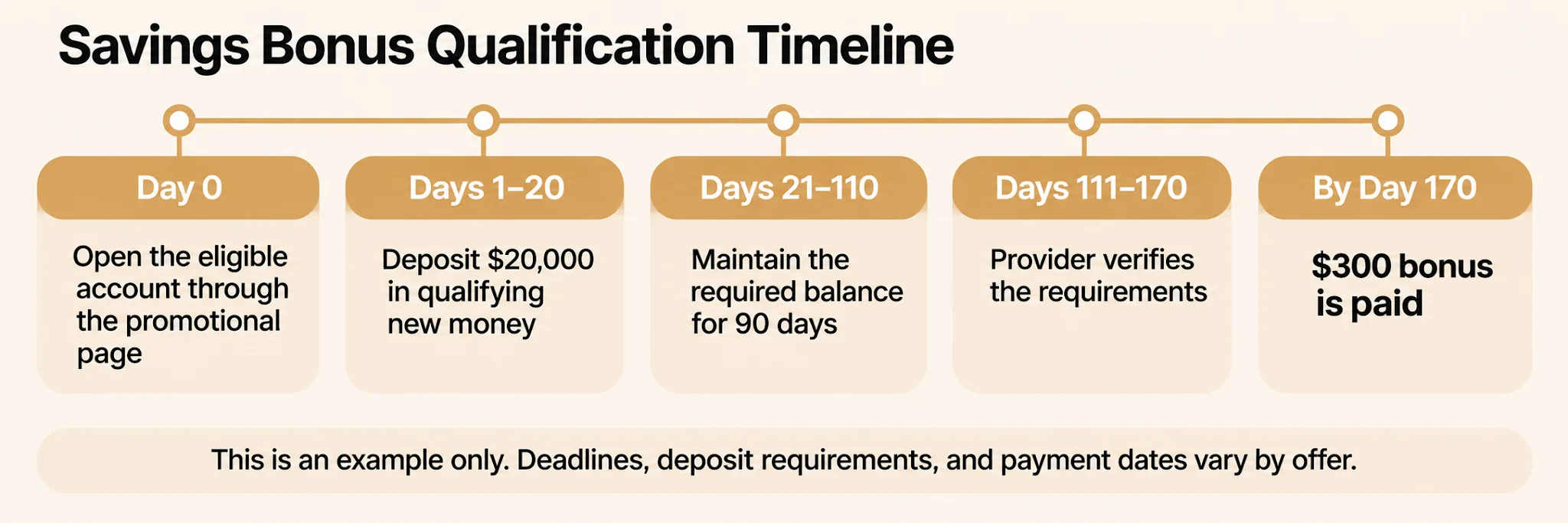
Reaching the deposit threshold may not be enough. You may have to maintain the qualifying balance for a set number of days or statement cycles.
The terms should explain whether the provider uses a minimum daily balance or an average daily balance.
A minimum daily balance means the account cannot fall below the required amount on any day during the qualification period. An average daily balance is calculated using the account’s balances across the entire measurement period.
Suppose an offer requires a minimum daily balance of $20,000 for 90 days. Withdrawing even a small amount could cause the balance to fall below the threshold and cancel the bonus.
Consider depositing slightly more than the minimum. A cushion can reduce the risk that a withdrawal, transfer, fee, or adjustment causes disqualification.
Do not assume you can remove the money as soon as the initial deposit appears. Confirm when the holding period begins and ends.
If you plan to keep building the balance, read our guide to making regular savings deposits.
6. Complete Any Additional Account Activity
Some offers require more than a deposit. You may need to receive direct deposits, create recurring transfers, or complete another qualifying action.
A provider may define a qualifying direct deposit as an electronic payment from an employer, payroll company, pension provider, or government agency. A transfer from another account you own may not carry the transaction coding needed to qualify.
Check the required amount, frequency, and completion period. An offer might require one payroll payment, several monthly deposits, or a minimum total deposited during the promotion.
Complete the requirement early when possible. If a payment is rejected or classified incorrectly, you will have more time to correct the issue before the deadline.
7. Keep the Account Open Until the Bonus Arrives
The bonus is rarely paid as soon as the last requirement is completed. The provider usually needs time to confirm the deposit, balance, and account activity.
Payment may take several weeks or statement cycles. If the terms say the bonus will arrive within 60 days, the provider may use the full period.
Closing the account before payment could cancel the bonus. Some institutions may also charge an early account-closing fee or recover the bonus if the account is closed soon after payment.
Keep enough money in the account to meet any minimum-balance or fee-waiver requirement while you wait.
Set reminders for the expected payment date and the earliest date the account can be closed without affecting the promotion. If the bonus does not arrive, contact the provider with your application confirmation and saved terms.
Are High-Yield Savings Bonuses Taxable?
Deposit-account bonuses are generally treated as taxable income in the United States. A provider may report the payment on Form 1099-INT or another applicable tax form.
The bonus may still be taxable even when you do not receive a form. The reporting method depends on the type of payment and how the provider classifies it.
Keep the payment confirmation with your tax records. The IRS guidance on taxable earnings provides general federal information. Speak with a qualified tax professional if you need advice for your own return.
How Do You Get a High-Yield Savings Bonus?
To qualify, open the correct account through the promotional offer, meet the customer rules, deposit enough eligible money, maintain the required balance, and keep the account open until payment.
Read the full terms before moving money. Save a copy of the offer and track every deadline. A bonus can provide useful additional value, but only when the deposit requirement, holding period, fees, and ongoing account terms make sense together.
Put your dollars into something real
With PureFi, your projected earnings come from shares of real homes with tenants. Choose your properties from your phone, review the documents, and see every fee before you confirm.
Learn more about how PureFi can help you own real estate shares or download the app to get started today.
Up to 6% APY is projected, variable, and not guaranteed. Property shares can lose value. PureFi is not a bank, and its balances and real estate shares are not covered by FDIC insurance or another government deposit scheme.


